





.svg)











Stay ahead with the International Thought Leadership insights: your source for industry-leading expertise and analysis
Blog
Oncology Innovation: 2026 and Beyond
Jul 17, 2026
Introduction
Oncology has long represented both a scientific frontier and a persistent public health challenge. Whilst recent decades have brought substantial advances in treatment, improving survival rates across many cancers, outcomes remain poor for some tumour types and patient populations. Cancer is still the second leading cause of death globally,1. and global incidence rates are forecast to rise significantly between now and 20502.
This unmet need continues to drive investment in scientific research: oncology accounts for a very large share of R&D activity, at 38% of all phase 1-3 clinical trial starts in 20253. However, the pace of innovation, alongside other factors such as health system capacity pressures and funding constraints, is leading to growing challenges for innovators as they look to launch new therapies.
Oncology continues to be the largest pharmaceutical market
The high volume of innovative launches over the last decade has driven rising expenditure on oncology medicines. Oncology remains the largest therapeutic area by global market size, at $291Bn at ex-manufacturer list prices in 2025, with strong historic growth4. While the forecast compound annual growth rate (CAGR) of 10% for 2026-2030 remains high relative to the overall pharmaceutical market, it does also represent a modest slowdown compared to the first half of the decade.
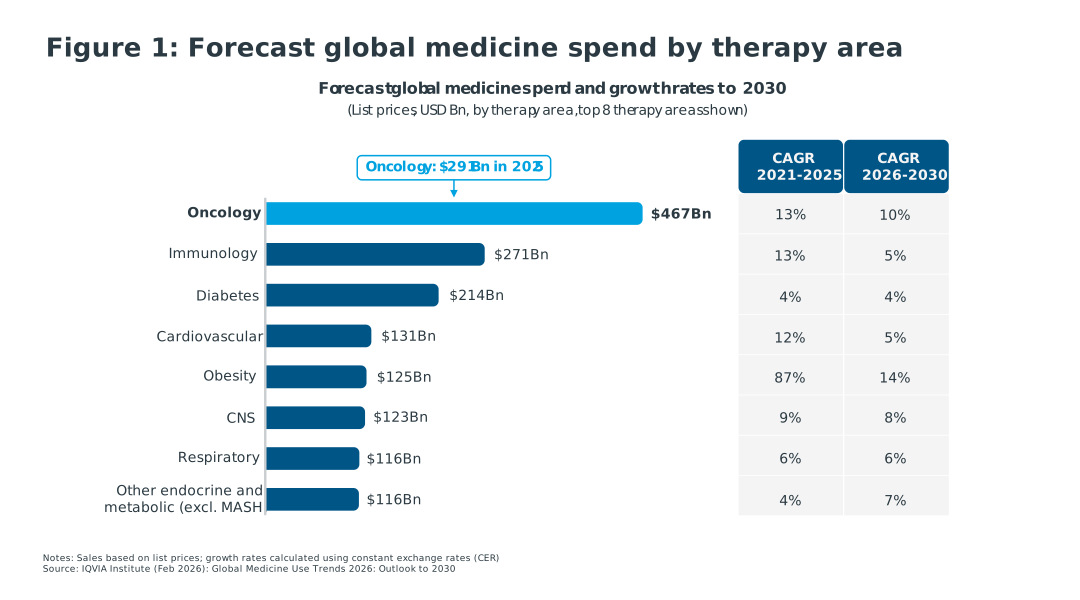
This forecast deceleration in growth is largely due to some major brands approaching loss of exclusivity (LoE). Notable examples include the immune checkpoint inhibitors Keytruda and Opdivo, which face patent expiry in 2028: the entry of biosimilars for these therapies may have implications not just for the two originators, but perhaps also for other checkpoint inhibitors where indications overlap.
In light of the many upcoming LoE events, pharmaceutical companies are now investing heavily in their pipelines. In the first half of 2026 alone, M&A deal value involving oncology targets surpassed $53Bn, equivalent to 41% of aggregate biopharma M&A deal value – more than any other therapy area. This included five blockbuster transactions valued at over $5Bn, such as the recently announced $10.6Bn acquisition of Nuvalent by GSK5.
The innovation landscape signals change ahead
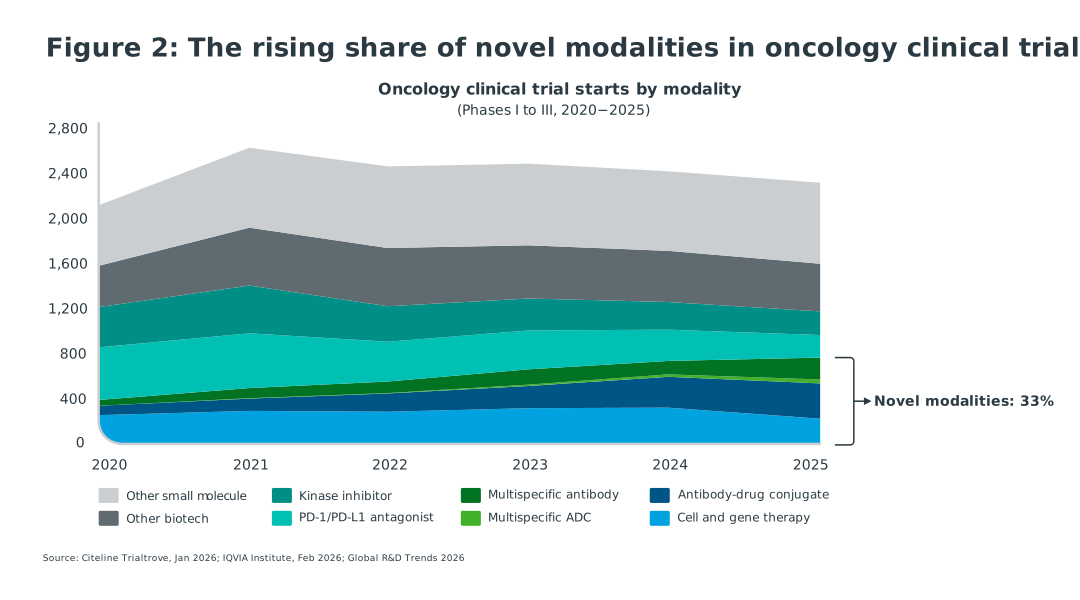
Future oncology launches will likely focus increasingly on highly innovative assets. The total number of clinical trial starts for novel modalities, defined here as cell and gene therapies, antibody-drug conjugates (ADCs) and multi-specific antibodies, has been rising steadily in recent years, and in 2025 they accounted for 33% of all clinical trial starts across oncology3. These novel modalities have the potential to transform cancer treatment through delivering deep and durable responses.
China-headquartered companies have emerged as a major contributor to this innovation: they are responsible for a growing share of oncology trial activity and licensing deal value, as well as some of the most advanced pipeline assets. For example, one of the only trispecific antibodies to have entered a phase 3 clinical trial is being developed by Innovent Biologics – a Chinese biopharma company6. A key unresolved question will be how many of these companies look to expand beyond China and establish a presence in the global oncology market.
Competition intensifies as system constraints grow
While oncology innovation continues to accelerate, the environment for bringing new therapies to market is increasingly challenging. Pipelines are becoming more crowded across tumour types, with growing numbers of assets competing within the same indications, targeting similar biological pathways and pursuing overlapping patient populations. Over two-thirds of top 10 pharma pipeline assets now focus on targets with at least five competing therapies in development, up from just 16% in 2000, making meaningful differentiation increasingly difficult to achieve.7
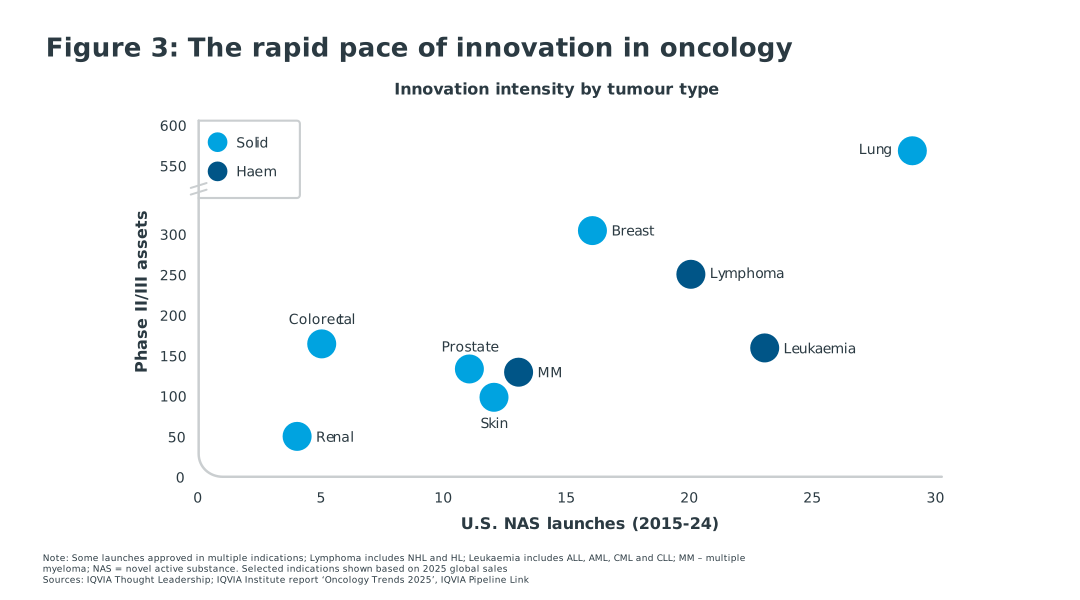
As competition further intensifies, this generates considerable challenges for launch:
- Healthcare systems are struggling to keep pace with innovation: A persistent gap exists between the pace of oncology innovation and healthcare systems’ ability to absorb and implement new therapies. Workforce shortages, diagnostic bottlenecks and funding constraints can delay patient access, even where there is high unmet need. The success of subcutaneous formulations such as Darzalex Faspro and Phesgo, which reduce administration times by several hours compared with equivalent IV infusions, demonstrates how addressing healthcare system constraints can support adoption, strengthen differentiation and contribute to launch success.8
- Rising evidence expectations are raising the bar for differentiation: Driven in part by increasing competition and pipeline complexity, demonstrating meaningful added benefit is becoming more difficult for innovative oncology medicines. IQVIA analysis of HTA assessments across Germany, France and Italy indicate that achieving major or incremental added benefit ratings has become increasingly challenging in recent years, placing greater emphasis on differentiation strategies supported by robust clinical and real-world evidence generation.9
- Engagement with healthcare professionals is being reshaped by AI: Generative AI is rapidly emerging as a source of scientific information for healthcare professionals. Adoption is already widespread, with 92% of oncologists reporting use of generative AI tools at work10. Increasingly, clinicians are using these platforms to obtain information that may previously have been sourced through medical science liaison (MSL) interactions or pharmaceutical sales representatives, highlighting a shift in how scientific information is accessed and consumed.11
Together, these trends are making oncology launches increasingly complex and raising the requirements for commercial success.
Conclusion: from innovation to impact
The evolving oncology landscape highlights that commercial success is determined by more than scientific innovation alone. As the number of innovative oncology launches grows and competition increasingly converges around the same targets, differentiation is becoming harder to achieve. At the same time, healthcare systems face mounting pressures, whilst AI is reshaping traditional engagement models with healthcare professionals.
In this environment, realising the full value of innovative therapies requires a broader approach to launch planning. Success increasingly depends on demonstrating clear value and differentiation, supporting implementation within healthcare systems, and engaging stakeholders in ways that reflect evolving behaviours and decision-making processes. Organisations that can align innovation with healthcare system needs and stakeholder expectations will be best positioned to maximise patient access and translate scientific advances into real-world impact.
For a deeper dive into these topics, watch our on-demand webinar here. Explore global oncology market dynamics, key areas of innovation and the evolving oncology launch environment to 2030.
FAQs
Oncology has long been the largest therapeutic area in the global pharmaceutical market, and reached $291Bn in 2025. Growth continues to be driven by a high volume of innovative medicine launches, significant unmet patient need and sustained investment in research and development, with oncology accounting for 38% of all phase 1-3 clinical trial starts in 2025.
Oncology innovation is increasingly being driven by novel modalities such as antibody-drug conjugates (ADCs), cell and gene therapies, and multi-specific antibodies. Together, these modalities accounted for 33% of all oncology phase 1-3 clinical trial starts in 2025, highlighting their growing importance within the future oncology pipeline.
The oncology pipeline is becoming increasingly crowded, with over two-thirds of top 10 pharma pipeline assets pursuing targets with at least five competing therapies in development, up from just 16% in 2000. As competition intensifies, healthcare systems, regulators and payers are placing greater emphasis on clinical differentiation and evidence generation, raising the bar for launch success.
Generative AI is rapidly changing how oncologists access and evaluate scientific information, with 92% of oncologists now using of generative AI tools at work. As AI adoption grows, pharmaceutical companies will need to adapt how they communicate evidence and engage healthcare professionals to remain visible, relevant and trusted sources of information.
References
1 Institute For Health Metrics and Evaluation (IHME) Global Burden of Disease (GBD), 2023: https://www.healthdata.org/research-analysis/library/global-regional-and-national-burden-cancer-1990-2023-forecasts-2050
2 WHO, Cancer Tomorrow, accessed June 2026: https://gco.iarc.who.int/tomorrow/en
3 Global R&D Trends 2026, IQVIA Institute report, February 2026: https://www.iqvia.com/insights/the-iqvia-institute/reports-and-publications/reports/global-r-and-d-trends-2026
4 Global Medicines Use Trends 2026, IQVIA Institute report, February 2026: https://www.iqvia.com/insights/the-iqvia-institute/reports-and-publications/reports/global-medicine-use-trends-2026
5 Biopharma M&A: Mid-year 2026 update, IQVIA Thought Leadership, July 2026: https://www.iqvia.com/locations/emea/blogs/2026/07/biopharma-ma-mid-year-2026-update
6 Company press release, Innovent Biologics, June 2026: https://en.innoventbio.com/InvestorsAndMedia/PressReleaseDetail?key=606
7 Fougner et al. Nature Reviews Drug Discovery, April 2023: https://www.nature.com/articles/d41573-023-00063-3
8 Achieving Oncology Launch Excellence, IQVIA Thought Leadership, July 2024: https://www.iqvia.com/library/white-papers/achieving-oncology-launch-excellence
9 Global Oncology Trends 2025, IQVIA Institute report, May 2025: https://www.iqvia.com/insights/the-iqvia-institute/reports-and-publications/reports/global-oncology-trends-2025
10 Clinical Decision-Making in the Era of Generative AI, IQVIA, April 2026: https://www.iqvia.com/library/white-papers/clinical-decision-making-in-the-era-of-generative-ai
11 The evolution of pharma engagement as AI becomes a front door to medical information, IQVIA Thought Leadership, March 2026: https://www.iqvia.com/locations/emea/blogs/2026/03/the-evolution-of-pharma-engagement-as-ai-becomes-a-front-door-to-medical-information