






.svg)











Stay ahead with the EMEA Thought Leadership insights: your source for industry-leading expertise and analysis
Blog
The evolution of pharma engagement as AI becomes a front door to medical information
Mar 31, 2026
For healthcare professionals (HCPs) under intense time pressure, AI tools are already delivering tangible time savings, from documentation support and clinical scribing to easing administrative workloads. Importantly for pharma companies, generative AI chatbots are also becoming a first stop for fast, on‑demand answers to clinical queries. Rather than replacing clinical judgement, these tools are becoming the front door to medical information: helping clinicians quickly orient themselves, surface relevant evidence, and compare options. In doing so, these tools increasingly influence how clinicians access, interpret, and prioritise medical evidence.
For pharmaceutical companies, this matters because AI is increasingly becoming the first port of call for information on products, guidelines and treatment pathways, often before traditional engagement occurs. By democratising access to guideline‑level, society‑vetted medical knowledge, these tools reduce dependence on proximity to academic centres or specialist networks, and enable more consistent application of evidence‑based care. While this shift is happening rapidly, pharmaceutical go‑to‑market models are, in many cases, evolving more slowly. Here, we explore the pace of adoption of AI tools in different markets, and what this means for the evolution of pharmaceutical go‑to‑market (GtM) models.
Adoption of generative AI tools for clinical decision-making is material, but uneven
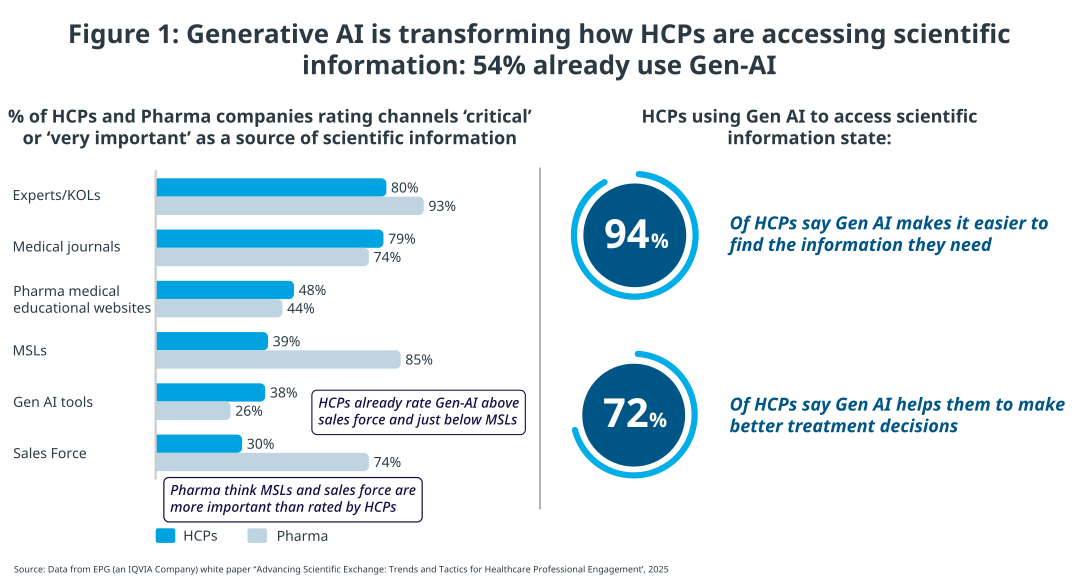
A survey conducted by EPG (an IQVIA company) in March-April 2025 found that 54% of HCPs were already using generative AI tools to access scientific information, with adoption sharply skewed by age (75% of HCPs born from 1990 onwards, versus 48% among those born before 1990).1 Figure 1 shows that 38% of HCPs already rate generative AI as “critical” or “very important” as a source of scientific information. In contrast, pharmaceutical executives vastly overestimate the importance of traditional engagements with sales reps and MSLs (compared to HCPs, as shown in figure 1). This large perception gap between pharmaceutical companies and HCPs implies a growing disconnect between how clinicians are accessing medical information, and the continued investment of pharma companies into traditional engagement models.
What’s especially notable is how clinicians describe the value of newfound AI tools: among HCPs who are using generative AI, 94% say it makes it easier to find the information they need, and 72% believe it helps them make better treatment decisions.1 The current role of AI is an accelerator for medical search and summarisation, rather than an unquestioned decision-maker.
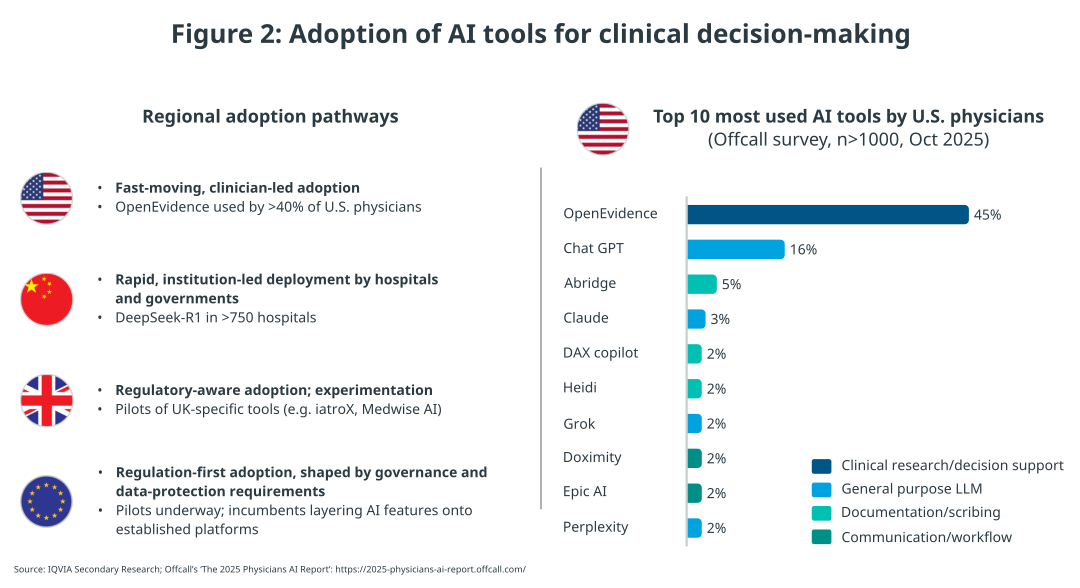
In practice, adoption of generative AI tools is uneven. While general-purpose large language models (LLMs) are broadly available, and some incumbent clinical decision platforms are rolling out AI-enhanced features (e.g. UpToDate Expert AI and EBSCO’s Dyna AI)2, differences in regulation and local innovation ecosystems drive markedly different adoption patterns across countries (figure 2). In some settings, AI tools are licensed and embedded at a system-level; in others, individual HCPs adopt them independently, outside formal institutional workflows and governance. For pharmaceutical companies, this underscores the importance of understanding how different AI tools are being adopted and used across the clinical workflow.
In the US, adoption of AI-powered clinical evidence tools has surged, driven by strong physician demand, a dynamic health-tech market and a comparatively permissive regulatory environment. A survey of more than a thousand US physicians in October 2025 found OpenEvidence to be the most broadly adopted AI-tool, used by 45% of respondents (figure 2).3 As OpenEvidence scales, from 2.6 million monthly queries in 2024 to 18 million in December 20254, visibility on the platform becomes important for pharmaceutical companies. However, competition is intensifying. Doximity, a leading professional network for US physicians, acquired Pathway Medical in mid-2025 to strengthen its generative AI assistant, DoxGPT, and subsequently published an analysis in which DoxGPT was rated as providing the best clinical answer in 61% of side-by-side evaluations, compared with 26% for OpenEvidence.5
China illustrates a contrasting adoption pathway to the US, where generative AI is scaling predominantly through institution‑led, system‑level deployment rather than through individual HCP uptake. According to an article in Nature Medicine, by May 2025 more than 750 healthcare institutions in China had deployed the DeepSeek‑R1 large language model, with over 500 implementing on‑premise deployments within hospital infrastructure, enabling rapid integration into clinical and operational workflows.6 This pace of system‑level deployment has raised concerns that adoption is outpacing formal regulatory oversight and clinical governance frameworks.7 For pharma, it represents a fundamentally different environment: one where AI-mediated evidence access may be embedded directly into hospital systems rather than chosen individually by HCPs.
In Europe, HCP interest is high and adoption of generative AI tools that support clinical decision‑making is progressing, but in a more cautious and controlled manner. In the UK, uptake is characterised by experimentation and pilots (including of UK‑specific tools such as iatroX and Medwise AI, which support rapid navigation of accepted local guidelines).8 In Europe, hospitals are piloting AI‑enhanced search capabilities embedded within incumbent clinical decision support platforms e.g. UpToDate Expert AI.9 However, scaling into routine practice has been slowed by evolving regulation, most notably the EU AI Act, and GDPR-driven data-governance requirements that raise the bar for using and sharing patient-level data at scale. Over time, the establishment of clear regulatory guardrails for high‑risk medical AI could increase institutional confidence and support more systematic deployment. In parallel, the rollout of European data‑sharing initiatives such as the European Health Data Space is expected to expand access to high‑quality, real‑world and locally relevant data. This will create new opportunities to generate evidence at scale, strengthening the data foundations that AI will increasingly draw on to support evidence-based care.
When AI replaces pharma as interlocutor: implications for pharma’s customer engagement model
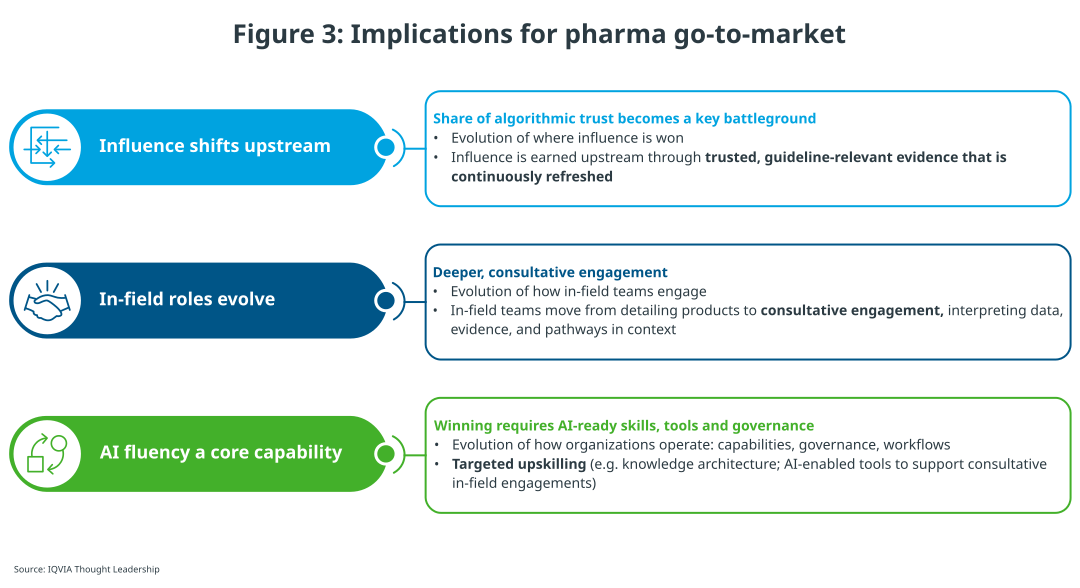
AI is increasingly mediating clinicians’ first encounter with medical information, shifting influence away from pharma-owned media towards earned, evidence‑based sources surfaced by AI tools. Generative AI tools are not simply additional channels to manage, because they reshape domains of influence, requirements on in-field interactive engagements and what capabilities matter (figure 3):
- Influence shifts upstream, share of algorithmic trust becomes a key battleground:
AI tools increasingly determine what HCPs see first by filtering, ranking and compressing medical information. As a result, influence is increasingly shaped by the credibility of the evidence that feeds these systems. Inclusion in national and medical society guidelines, publication in highly‑rated peer‑reviewed journals, and clear, clinically meaningful comparative positioning become critical signals of trust. Visibility and access isn’t secured once: it depends on continuous evidence generation and regularly refreshed, up-to-date guidelines. Where AI tools are the front door to national guidelines and pathways, local evidence may also be prioritised. The strategic battleground will shift from share of voice to share of algorithmic trust. - The roles of in-field teams don’t disappear, but they change:
Interactive engagements will increasingly transition from product detailing and medical or scientific education towards a more consultative model, centred on joint analysis of real‑world data, outcomes and clinical experience. In-field teams, particularly MSLs, will play a critical role in helping HCPs interpret evidence in context: exploring how it translates into real‑world practice, supporting HCPs to navigate clinical trade‑offs and specific practice challenges, and applying benchmarks to local pathways and population-level outcomes. The result is likely to be fewer interactions, but more meaningful ones, where depth of discussion, analytical capability and human judgement matter more. In addition, as AI tools become institutionally embedded, future-ready account management will increasingly rely on engaging with hospitals and health systems, focused on pathway performance, opportunities to reduce delays in diagnosis and treatment, and variation in outcomes across settings. - AI fluency becomes a core capability, critical for competitive advantage:
Competitive edge will increasingly depend on organisational AI-fluency across functions, requiring targeted upskilling. In the field, MSLs and reps will increasingly need access to AI-enabled tools that support consultative, data driven exchange with HCPs (e.g. tools that help profile likely responders, or benchmark local practice against best-practice care pathways). Medical, marketing and compliance teams must understand how AI tools source, interpret and present information to optimise the knowledge architecture of pharma-owned media to increase visibility within AI platforms. In addition, they must evolve from reviewers of static materials to partners in building guardrails for an AI-mediated environment, where information is dynamically generated and accountability is less clearly attributable. Therefore, legacy workflows and decision-making processes must be redesigned for a world moving at AI speed, which demands greater organisational agility in governance and execution.
Conclusion
AI is not replacing HCPs, but it is increasingly shaping how they encounter medical evidence. As generative AI becomes the front door to medical information, pharma engagement must evolve accordingly. Over time, we can expect a rebalancing of investment from volume-driven engagement towards evidence-generation and enablement of deeper consultative interactions. This also implies new measures of success, shifting from activity-based metrics (e.g. number of interactions or click-through rates) towards indicators of influence, such as visibility in AI-mediated searches, contribution to guideline-aligned pathways, and measurable improvements in care delivery at system-level.
Change will be compounded by parallel developments on the patient side. Already, hundreds of millions of health‑related questions are being asked through general‑purpose LLMs, and January 2026 marked a step change with the launch of healthcare‑specific generative AI offerings designed explicitly for public medical use.10 The convergence of AI‑shaped clinician and patient behaviour points to a profound shift in how healthcare decisions are initiated and informed.
The unanswered question is no longer whether AI will play a central role in healthcare decision-making, but how pharmaceutical go-to-market models will adapt as that role continues to evolve and expand. The companies that win will be those that understand how AI reshapes influence, and are able to translate that understanding into reshaping go-to-market models to be fit for an AI-mediated world.
References
1. EPG (an IQVIA Company) white paper, “Advancing Scientific Exchange: Trends and Tactics for Healthcare Professional Engagement”, 2025: Advancing Scientific Exchange: Trends and Tactics for Healthcare Professional Engagement | IQVIA
2. Wolters Kluwer press release, September 2025: https://www.wolterskluwer.com/en-in/news/uptodate-expert-ai-genai-clinical-decision-support; EBSCO press release, February 2026: https://about.ebsco.com/news-center/press-releases/ebsco-clinical-decisions-launches-dyna-ai-mode
3. Offcall, “The 2025 Physicians AI Report”, October 2025: https://2025-physicians-ai-report.offcall.com/
4. OpenEvidence presentation at the J.P. Morgan Healthcare Conference, January 2026
5. Doximity, “Physician Ratings of Clinical AI Tools”, 2026: https://press.doximity.com/reports/physicians-rating-ai-tools.pdf
6. Shen T, Li Y, Cao Y, Du X, Wang X, Zhang Y, et al. Rapid deployment of large language model DeepSeek in Chinese hospitals demands a regulatory response. Nat Med. 2025. doi:10.1038/s41591-025-03836-y (https://www.nature.com/articles/s41591-025-03836-y)
7. Zeng D, Qin Y, Sheng B, Wong TY. DeepSeek’s “low‑cost” adoption across China’s hospital systems: too fast, too soon? JAMA. 2025. doi:10.1001/jama.2025.6571 (https://jamanetwork.com/journals/jama/fullarticle/2833431)
8. iatroX article, February 2026: How to use iatroX as a “NICE/CKS front door” (and stop losing 15 minutes per query) | iatroX Clinical AI Insights; https://www.iatrox.com/blog/best-ai-apps-uk-gps-anps-pharmacists-iatrox-medwise-ai-openevidence-scribes-2025
9. Wolters Kluwer press release, June 2025: Wolters Kluwer launches AI-enhanced UpToDate Enterprise Edition in EMEA | Wolters Kluwer
10. Reuters article, January 2026: https://www.reuters.com/business/healthcare-pharmaceuticals/openai-launches-chatgpt-health-connect-medical-records-wellness-apps-2026-01-07/; Anthropic, January 2026: https://www.anthropic.com/news/healthcare-life-sciences