





.svg)











Stay ahead with the EMEA Thought Leadership insights: your source for industry-leading expertise and analysis
Blog
Biopharma M&A: Mid-year 2026 update
Dealmaking momentum accelerates in H1/2026, tracking towards a post-pandemic full-year high
Jul 08, 2026
In our second blog of 2026 on biopharma M&A, we take a mid-year snapshot of dealmaking activity and look at trends and highlights from the first two quarters.
Biopharma dealmaking momentum accelerates sharply
Following a decisive rebound in 2025, which saw aggregate M&A deal value jump by +133% vs. 2024 to $133Bn, the second highest level since 2021, dealmaking momentum not only carried over into 2026 but accelerated further.
After the first six months of 2026, aggregate M&A deal value has already reached $130Bn, almost matching the full-year total for 2025, with a year-to-date deal count of 42, or 84% of the 2025 total. This equates to an average deal size of $3.1Bn for H1/2026, the second highest since 2021 and an increase from $2.7Bn in 2025, implying that deals are getting bigger (see Figure 1).
Note, consistent with our previous analyses, we only included transactions involving a biopharma target, with an acquisition of a majority stake in the target entity, and a deal value equal to or exceeding $250Mn.
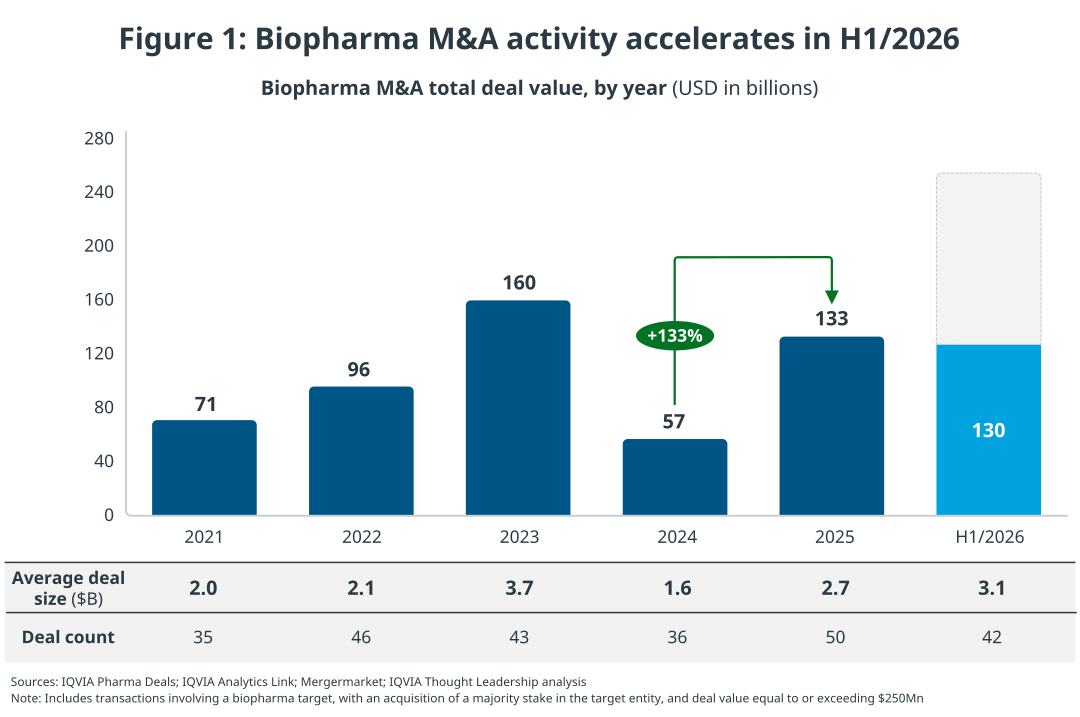
This deal flow trajectory is tracking well ahead of the prediction we made at the beginning of the year in our outlook for 2026, where we projected aggregate M&A deal value of $140-160Bn for the year ahead, with a potential incremental upside of $20-30Bn.
If the current M&A momentum holds, we will be heading towards a best-case scenario of $250Bn, with 2026 emerging as the strongest year since the pandemic.
Nevertheless, we did not see any mega-mergers in 2026 so far, defined as involving an acquisition target >$30Bn, which marks a continuation of their absence in 2024 and 2025.
Highlights for H1/2026 include 9 sizeable M&A transactions with values ≥$5Bn:
- Three deals with values >$10Bn: Sun Pharma/Organon ($11.8Bn), AbbVie/Apogee ($10.9Bn), GSK/Nuvalent ($10.6Bn),
- Six deals in the value bracket of ≥$5Bn to <$10Bn: Gilead/Arcellx ($7.8Bn), Eli Lilly/Centessa ($7.8Bn), Eli Lilly/Kelonia ($7Bn), Merck/Terns ($6.7Bn), Biogen/Apellis ($5.6Bn), and Gilead/Tubulis ($5Bn)
Halfway through 2026, the top 5 therapy areas in focus of M&A, by value share, include oncology (41%), immunology (19%), neurology (9%), women’s health (9%), and rare diseases (7%), with oncology reclaiming the top spot in line with the long-term pattern. Of note, the absence of CVRM (cardiovascular-renal-metabolic) among the top 5 TAs is in stark contrast to its #2 rank in 2025.
Lilly emerged as the most prolific deal maker of 2026, with 9 acquisitions >$250Mn each to date, deploying $26Bn of the company’s formidable firepower that is fuelled by its incretin mega-blockbuster cashflows.
Lilly’s acquisition of a trio of vaccine companies on 26 May 2026, for a combined value of $3.8Bn, is particularly noteworthy as a decisive bet on preventative medicines, a seemingly contrarian move in the context of recent political headwinds that vaccines have been facing.
In addition to M&A, Lilly signed 12 licensing deals in the past 6 months with a combined value of $28Bn, spanning a wide range of disease areas, including oncology, immunology and inflammation, metabolism and genetic diseases.
Collectively, these deals expand and deepen Lilly’s pipeline and include bets on novel innovation platforms, e.g., gene therapies, in vivo CAR-Ts, multi-specifics, T-cell engagers (TCE) and antibody drug conjugates (ADC).
Licensing: China’s relentless ascent fuels policymakers’ concerns
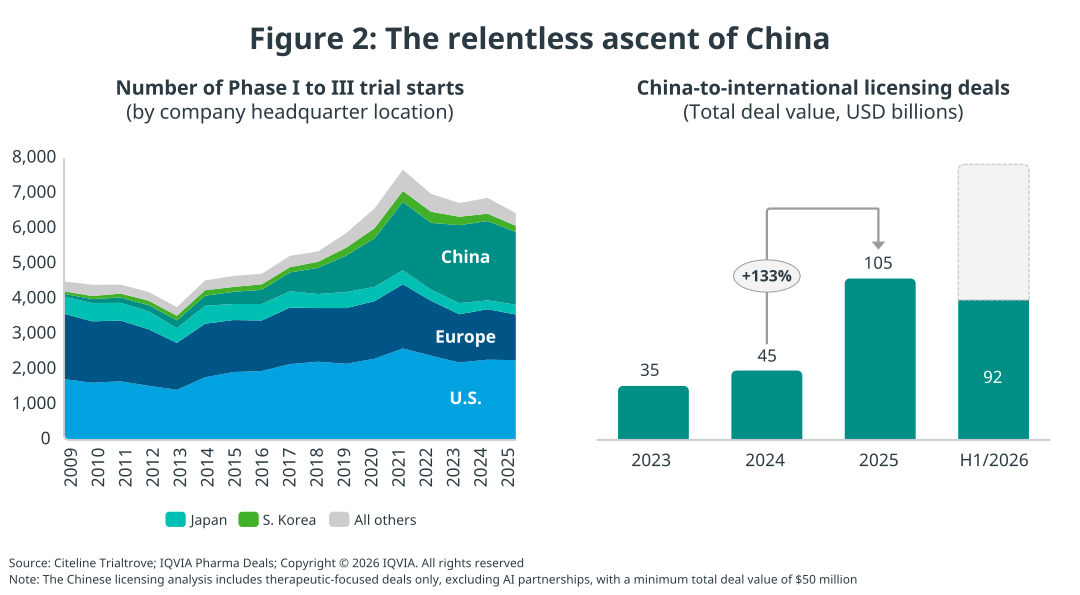
China has firmly put itself on the map as a biopharma innovation powerhouse, closing in on the US as a key location for running clinical trials, with Europe left trailing behind.
Speed, in particular in the early stages of drug development, has become a hallmark of biopharma innovation in China. A flexible, supportive policy environment has helped Chinese biotech innovators move fast into the clinic and rapidly generate proof-of-concept data to de-risk their assets.
Combined with low development cost, this has fuelled the rise of Chinese biotech companies as prime sources of high-quality, best-in-class/first-in-class assets that are much sought after by Western licensees and accounted for 40% of all assets in-licensed by big pharma in 2025.
In H1/2026, the aggregate total value of therapeutic in-licensing deals, excluding AI-focused partnerships, involving Chinese-originated assets already reached $92Bn, or 88% of the 2025 total.
This represents a continuation of a steep upward trend in China-to-international licensing which saw total deal value more than double between 2024 and 2025. It suggests 2026 is on track to become another record year, possibly with aggregate total deal value for Chinese out-licensing doubling again (see Figure 2).
Crucially, the scope of China-to-international licensing is also expanding beyond a single asset focus. Instead, such arrangements are becoming bigger, more comprehensive and more collaborative, including large-scale, multi-programme deals, for example:
- AZ’s $18.5Bn deal ($1.2Bn upfront) with CSPC, with focus on multiple next-generation therapies for obesity and T2D across eight programmes, including clinical-ready asset SYH2082, a once-monthly injectable, long-acting GLP1R/GIPR agonist.
- BMS’s $15.2Bn deal ($600M upfront) with Hengrui, spanning 13 early-stage programmes across oncology, haematology and immunology.
- Pfizer’s $10.5Bn deal ($650M upfront) with Innovent, spanning 12 oncology programmes including a diverse portfolio of antibody-drug conjugates and multi-specific antibodies.
- Lilly’s $8.8Bn deal ($350M upfront) with Innovent, covering an extensive oncology and immunology collaboration.
Furthermore, Chinese innovation is at the heart of the popular ‘NewCo model’ – the formation of new Western companies around assets licensed from Chinese biotechs.
The NewCo model keeps attracting major investments, e.g., Kailera ($400M Series A, 2024; $600M Series B, 2025; followed by a record $625M IPO in 2026) founded on an obesity-metabolic pipeline licensed from Hengrui; or Air Nexis ($200M Series A, 2026) formed around a COPD asset licensed from Haisco.
Policymakers are raising concerns about the surge in licensing deals involving Chinese-originated assets and its impact on the US biopharma ecosystem and US innovation leadership.
Aimed at safeguarding American competitiveness, draft legislation is being proposed that seeks to impose restrictions, specifically:
The Biotech Investment National Security Act (BINSA) proposes to amend the COINS Act of 2025 (Comprehensive Outbound Investment National Security Act) to include biotechnology in the sectors subject to outbound investment screening, with relevant licensing deals, joint ventures and equity investments subject to Treasury review.
The prospect of a protectionist policy response introduces significant uncertainty to the outlook for cross-border transactions involving Chinese biotech innovation, with potentially unintended consequences for the wider biopharma ecosystem.
Funding environment: Public market sentiment improves
Over the past 6-12 months, public market sentiment has undoubtedly turned a corner:
- The XBI biotech index rose by ~30% during the first half of 2026, and by ~84% over the past 12 months, thereby significantly outperforming the wider stock market.
- The IPO window has re-opened, albeit narrowly, as 13 biotech companies went public with listings at US exchanges during H1/2026. This number already exceeds the total of 11 IPOs for 2025 but is still a long way from the highs of 2020 and 2021, which saw 79 and 104 IPOs, respectively.
- Among those 13 biotech listings to date, 11 raised ≥$250M, the largest number since 2022, including two record-breaking IPOs. On 16 April 2026, obesity/metabolic-focused Kailera raised an upsized $625M in the largest-ever biotech IPO. That record was broken only 2 months later, on 10 June 2026, when oncology-focused Parabilis Medicines raised an extraordinary $670M and saw its shares surge by 58% to end the day with a market capitalisation of $3.7Bn.
These numbers signal a return of investor confidence; however, we should not assume that the rebound in market sentiment is broad-based. Investors today show greater capital discipline and invest very selectively, with focus on strong value stories, including differentiated, clinically validated best-in-class/first-in-class assets, with a clear regulatory path and credible, near-term post-IPO catalysts. For example, 12 of the 13 IPOs to date involved biotech companies with assets in phase 2 or later-stage testing.
Therefore, the exit route via IPO remains available only to a select few, high-quality biotech companies. Meanwhile, venture rounds are subdued as VCs continue to exercise caution, especially for early-stage funding. This leaves many private biotech companies exposed to increasing financing pressures that may drive them towards partnering or an exit via M&A, thus feeding the pipeline of potential targets for big pharma dealmaking.
Outlook for H2/2026
Dealmaking momentum was remarkably strong during the first six months of 2026. It also proved resilient to numerous headwinds, including geopolitics, disruptive policies, especially most favored nation (MFN) drug pricing, regulatory uncertainty from a less predictable FDA, and a deteriorating interest rate environment following recent inflationary pressures.
Looking ahead to the second half of 2026, we expect this strong deal flow momentum to continue, supported by favourable fundamentals that remain unchanged:
(i) The urgency for big pharma to replenish revenue ahead of a looming patent cliff; (ii) combined with significant deal capacity, with ample, yet to be spent dry powder; and (iii) a rich pipeline of unpartnered assets owned by biotech companies many of which continue to face funding pressures.
We are optimistic that 2026 is on track to end as the strongest year for M&A since the pandemic, with a finish exceeding our projected best-case scenario of $180-200Bn for aggregate deal value now eminently possible.
Key data and information sources
IQVIA Pharma Deals; IQVIA Forecast Link; IQVIA Pipeline Link; Mergermarket; Refinitiv Workspace; company financial reports; company press releases and deal announcements; IQVIA Thought Leadership desk research and analysis