
.svg)




Go beyond tracking procedures with MedTech Market Monitor
Enquire about IQVIA’s MedTech Market Monitor data solution today















In the aftermath of the COVID-19 pandemic, many MedTech leaders naturally assumed that countries with highly developed healthcare infrastructure, stronger economic positioning, and well-established public health systems would be the fastest to recover lost surgical procedure volumes. By this logic, mature European markets such as Italy would be expected to rebound more quickly than countries in Latin America, where healthcare systems are often perceived as less resourced and more fragmented.
However, procedure-level data tells a very different story.
Using IQVIA’s MedTech Market Monitor, this analysis compares cardiovascular surgical procedure recovery in Italy and Colombia — two countries with similar population sizes but fundamentally different healthcare system structures and market maturity. Contrary to expectations, the data shows that Colombia has returned to positive growth in cardiovascular surgical volumes, while Italy continues to lag behind its pre-pandemic trajectory.
This unexpected divergence highlights a critical lesson for MedTech manufacturers: healthcare sophistication and economic strength alone are poor predictors of post-pandemic recovery. True insight lies in understanding how demographics, capacity constraints, reimbursement models, technology adoption, and patient behaviour interact at a local level.
By examining why Italy and Colombia have followed such different recovery paths, this blog demonstrates the strategic value of granular, country-specific MedTech surgical data — and why tools like IQVIA’s MedTech Market Monitor are essential for informing market access, portfolio strategy, and long-term growth planning.
Using IQVIA MedTech Market Monitor data, we assessed cardiovascular surgical volumes before the pandemic, during COVID disruption, and in the post-COVID recovery phase.
These baseline differences are crucial: recovery dynamics cannot be interpreted without understanding where each market started.
During the pandemic, Italy experienced a dramatic decline in cardiovascular surgical procedures, with volume reductions approximately 4.5 times greater than those seen in Colombia.
This disproportionate impact reflects:
Colombia’s decline, while significant, was more moderate — setting the stage for a faster rebound.
One might expect a well-funded, highly developed healthcare system like Italy’s to rebound more quickly. However, MedTech Market Monitor data reveals the opposite:
This divergence highlights why headline economic strength alone is insufficient for MedTech market forecasting.
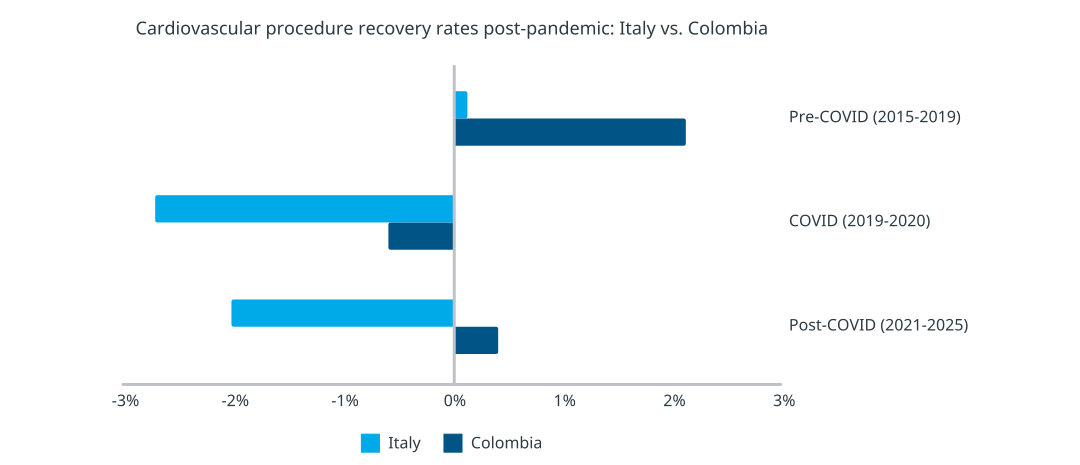
Source: IQVIA MedTech Market Monitor
1. Demographic and Epidemiologic Structure
Colombia’s younger population presents:
Despite similar population sizes, Italy’s over-65 population share is more than double Colombia’s — a critical factor shaping procedural recovery.
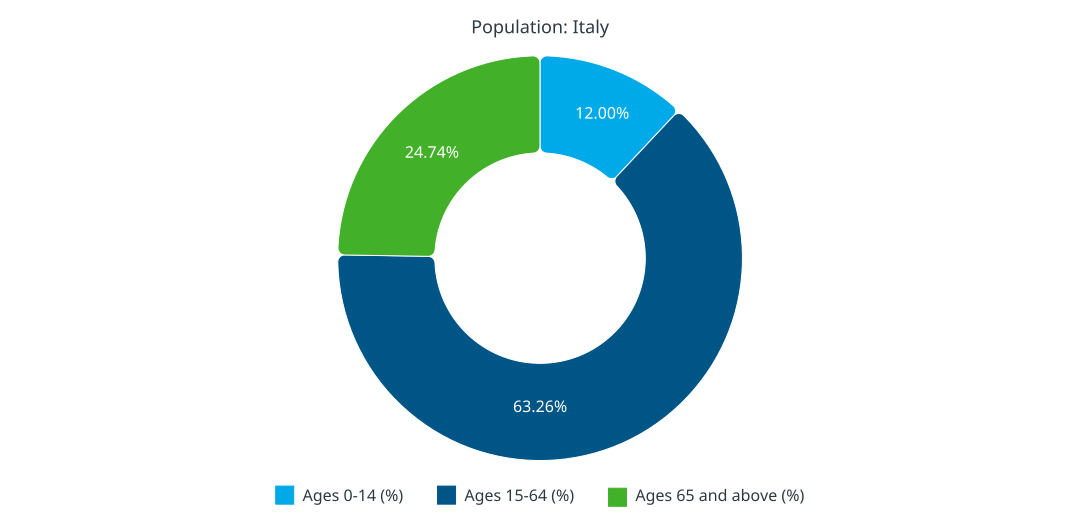
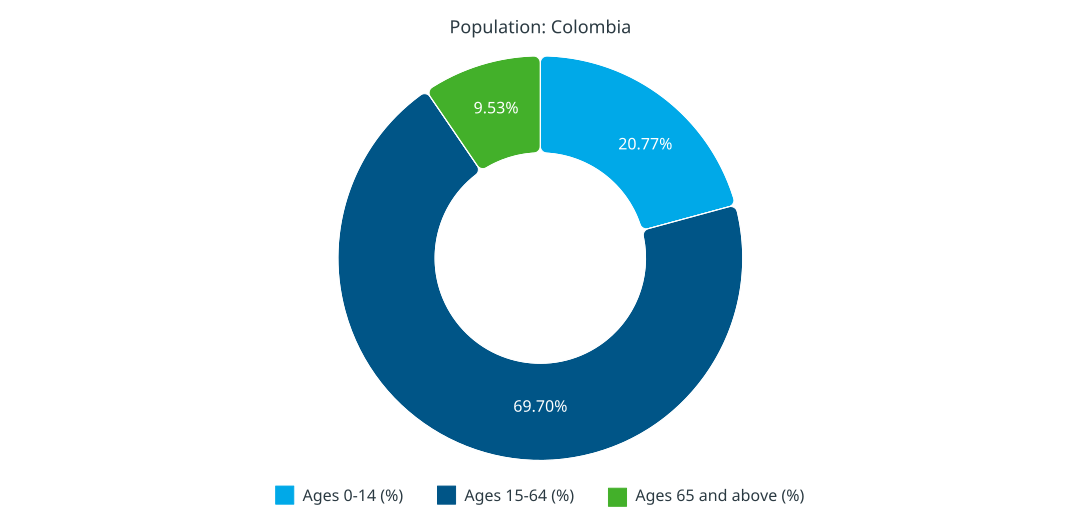
Source: IQVIA MedTech
2.Healthcare Capacity and System Recovery
Italy’s hospitals faced prolonged post-COVID strain:
Colombia’s healthcare system, while more fragmented, proved operationally agile:
3. Economic, Reimbursement, and Policy Effects
In Italy:
In Colombia:
4. Clinical and Technology Adoption Dynamics
Italy has accelerated adoption of minimally invasive cardiovascular technologies, such as catheter-based interventions, which may reduce open surgical volumes without reducing total treatment rates.
In Colombia, adoption of newer technologies has been slower, meaning:
5. Social Equity and Patient Behaviour
Post-COVID behavioural effects continue to shape recovery:
These findings underscore a critical reality for MedTech manufacturers: procedure recovery is not uniform, predictable, or purely economic. It is shaped by demographics, policy, capacity, technology, and patient behaviour — all of which vary dramatically by country.
Without granular, longitudinal surgical data, these insights remain invisible.
To navigate post-pandemic markets effectively, MedTech leaders should consider:
The contrasting recovery paths of Italy and Colombia illustrate why MedTech strategy cannot rely on assumptions or averages. Country-specific surgical data is essential for identifying true growth opportunities, anticipating risks, and aligning innovation with real-world clinical demand.
IQVIA’s MedTech Market Monitor provides the depth, consistency, and historical perspective needed to transform post-pandemic uncertainty into informed, confident decision-making — empowering MedTech manufacturers to shape strategy, optimise market access, and compete effectively in a rapidly evolving global landscape.
Click the CONTACT US button to find out more.

MMM helps MedTech companies realize that data isn’t just numbers—it’s insights that drives smarter decisions and better outcomes for patients. It’s exciting to be part of something that truly empowers innovation in healthcare.

MMM isn’t just about tracking procedures—it’s about unlocking the pulse of global healthcare. It empowers MedTech companies to act with precision, innovate with purpose, and lead with data.


The MedTech industries single source of truth for leaders seeking to understand and anticipate global surgical trends.
How Big Is the Opportunity? Navigate market sizing in devices and diagnostics.
Global surgical trends in cardiovascular care show uneven post-pandemic recovery patterns, with mature healthcare markets such as Italy experiencing slower rebounds in cardiovascular surgical volumes compared to emerging markets like Colombia. Growth is increasingly driven by minimally invasive and catheter-based interventions, structural heart procedures, and hybrid operating models, while demographic ageing, hospital capacity constraints, reimbursement systems, and patient behaviour continue to shape country-specific recovery trajectories across the global MedTech landscape.
The global MedTech industry is adapting to changing cardiovascular surgery volumes by reallocating investment toward higher-growth regions, expanding portfolios in minimally invasive and structural heart technologies, and using advanced procedure-level data analytics to refine forecasting and market access strategies. Companies are increasingly relying on longitudinal surgical intelligence platforms, including those developed by IQVIA MedTech, to understand local recovery dynamics, technology substitution effects, and evolving demand for cardiovascular medical devices.
Cardiovascular surgical recovery rates differ between countries because they are influenced by demographic structure, healthcare system design, reimbursement incentives, hospital capacity, and the pace of medical device adoption rather than overall economic strength alone. Countries with older populations and predominantly public healthcare funding models may face prolonged recovery due to higher COVID-related vulnerability and budget reallocation, while younger populations and more agile private-sector systems often experience faster restoration of elective and semi-elective cardiovascular procedures.