














Information Solutions
We empower life sciences with connected intelligence, transforming data into actionable insights for smarter decisions and better patient outcomes.
This blog is part of the ongoing series, A Brave New World: Modern Analytics and Next Gen Insights.
For decades, commercial analytics have helped life sciences organizations understand performance, evaluate strategy, and monitor market dynamics. Dashboards, reporting, and benchmarking provide valuable visibility into what has happened and why. These capabilities remain essential. However, visibility into past performance does not necessarily enable an organization to respond at the speed of market change.
Today, commercial teams have access to more information than ever before. Every prescription, customer engagement, payer decision, and patient interaction generates data that can be measured and analyzed. Yet despite unprecedented visibility into performance, many organizations continue to face a common challenge: the time required to move from signal to action remains surprisingly long. The constraint is not simply how quickly data can be collected or analyzed, but how quickly the organization can interpret a signal, determine what it means, align around a response, and act.
Markets do not wait for organizations to complete analyses, align stakeholders, revise plans, and execute responses. Competitive actions unfold continuously, access conditions evolve rapidly, and patient behavior shifts across increasingly complex care journeys. As market change accelerates, the speed of the commercial strategic cycle becomes a more important determinant of performance. The critical question is no longer only whether an organization can generate insight, but whether it can interpret and act on that insight while outcomes can still be influenced.
Commercial decision-making follows a structured and deliberate process. Teams identify signals, analyze implications, develop recommendations, align stakeholders, secure approvals, allocate resources, and execute a response. Each step plays an important role in reducing risk and improving decision quality.
Collectively, however, these activities create a lengthy path between observing change and responding to it. Many existing commercial decision processes were built for environments where markets evolved at a slower pace.
Today, meaningful shifts in market dynamics can occur while organizations are still evaluating what happened. As a result, opportunities and risks continue to develop throughout the decision-making process itself. By the time a response reaches the market, the original signal may have evolved, expanded, or been overtaken by new developments.
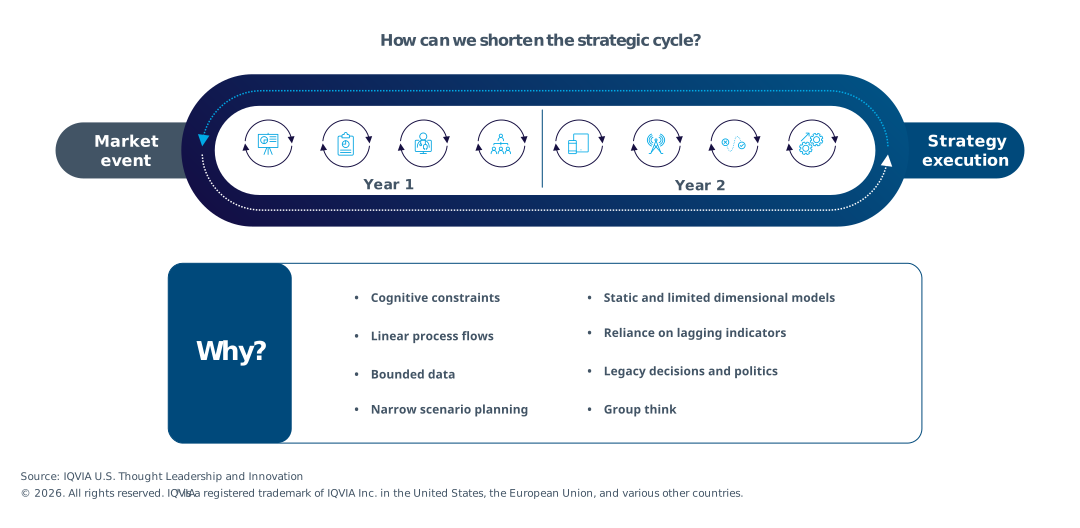
The length of the commercial strategic cycle does not stem from a single process or technology limitation. It reflects a combination of human, process, information, and planning constraints that influence how decisions are made. Individually, each serves an important purpose. Collectively, they increase the time required to move from observation to action.
Human Constraints: Cognitive Constraints and Groupthink
Commercial organizations operate in increasingly complex environments, yet decision-making ultimately depends on people interpreting information and determining a course of action. To make complexity manageable, teams often rely on established frameworks, familiar metrics, and proven assumptions that help create alignment across the organization.
These shared perspectives support efficient decision-making and organizational coordination, but they can also narrow the range of signals considered when evaluating an evolving market. As conditions change, new patterns may take time to gain recognition because they do not fit within existing mental models.
Process Constraints: Linear Process Flows and Legacy Decisions
Most commercial decisions are made through a structured sequence of activities. These linear process flows help organizations manage risk and coordinate across functions. That coordination takes time, lengthening the path between observation and action.
At the same time, legacy decisions, existing commitments, and organizational priorities influence how quickly a strategy can change course. As markets evolve, organizations often need to balance new information against previously established plans, creating additional friction between emerging opportunities and timely action.
Information Constraints: Bounded Data and Reliance on Lagging Indicators
Commercial organizations have access to enormous volumes of information, yet most datasets capture only part of the broader commercial environment. Individual datasets provide valuable perspectives on patients, providers, payers, and market performance, but each represents only a portion of the commercial ecosystem. Understanding how those signals connect across the market remains significantly more challenging.
Many commercial measures are also inherently retrospective. Organizations continue to rely heavily on lagging indicators such as prescribing performance, market share, and access metrics. These indicators reflect events that have already occurred. They remain essential for understanding performance, but they are less effective at identifying shifts while there is still an opportunity to influence the outcome.
Planning Constraints: Static Models and Narrow Scenario Planning
Commercial planning is designed to reduce uncertainty. Forecasts, strategic plans, and performance expectations help organizations allocate resources and establish priorities. Yet many planning processes continue to rely on static and limited-dimensional models that simplify complex market dynamics into a small set of assumptions.
Narrow scenario planning can create similar limitations. Organizations frequently evaluate a limited range of future outcomes while increasingly complex markets are shaped by many interacting variables. As policy, competition, access, and stakeholder behavior evolve simultaneously, understanding the full range of possible outcomes becomes significantly more difficult within traditional planning approaches.
Taken individually, each of these constraints is manageable. Together, they extend the time required to move from signal to decision to action. As markets become more interconnected and dynamic, the cumulative effect is a growing gap between the speed at which markets change and the speed at which organizations can respond.
The consequences of lengthy strategic cycles extend beyond operational efficiency. When organizations require months to move from signal to action, the value of information begins to erode. Organizations may find themselves responding to conditions that are no longer the primary drivers of performance as new developments continue to unfold. The result is a shrinking window to evaluate signals, align stakeholders, and act while outcomes are still being shaped.
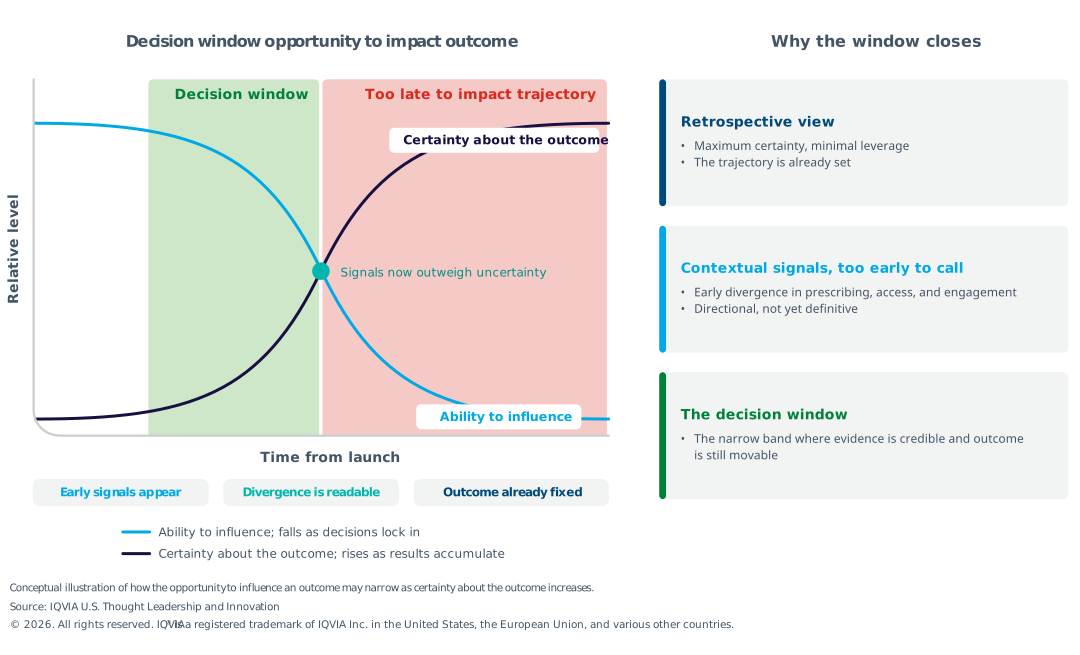
As decision latency grows, organizations become increasingly retrospective and reactive. Past performance remains important, but historical visibility alone provides limited ability to influence outcomes that are still unfolding. Commercial success increasingly depends on recognizing relevant signals early enough to take meaningful action while market conditions remain fluid.
The effects of decision latency become particularly visible during launches. Modern launches often require hundreds of millions of dollars in early commercial investment, making it especially important to recognize performance divergence while there is still an opportunity to intervene.
Consider two recent launches, one retail and one specialty. By year three, neither brand had generated sufficient revenue to recover its promotional investment. After adjusting for access costs, the retail brand spent roughly twice the revenue it generated, while the specialty brand spent nearly three times the revenue it generated. Promotional investment is often necessary to drive launch success, yet signs of divergence emerged well before these outcomes became visible through traditional performance measures. Prescribing trends, access dynamics, and stakeholder engagement patterns signaled growing divergence from expectations before traditional measures clearly reflected the underlying challenge.
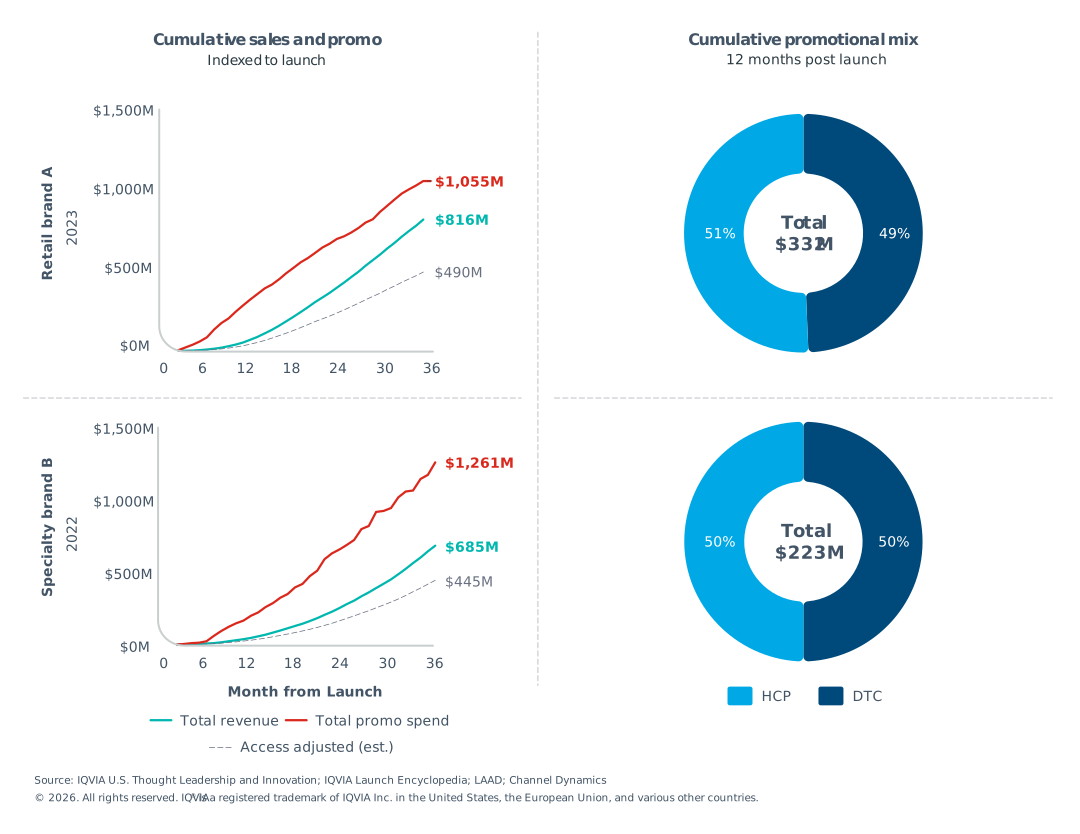
Launches provide a clear illustration of a broader challenge. The opportunity to influence commercial performance often comes before conventional outcome measures fully reveal what is happening.
The importance of timely decision-making continues to grow as life sciences markets become more interconnected. Commercial performance develops through a continuous network of interactions involving providers, patients, payers, health systems, regulators, and competitors. Signals emerge simultaneously across the ecosystem, creating new opportunities to identify changes earlier as they develop.
At the same time, many organizations face increasing pressure to generate value within compressed commercial windows. Policy evolution, reimbursement dynamics, launch investment requirements, and ongoing economic pressures place greater importance on early performance optimization. Delayed recognition of emerging issues can influence both near-term results and long-term asset value.
These dynamics extend well beyond launch environments. Fragmented patient journeys, expanding payer influence, growing provider networks, emerging healthcare provider behavior, and increasingly connected stakeholder ecosystems all create additional pathways through which performance can diverge from expectations. Understanding how those signals connect can help organizations recognize a developing market dynamic sooner.
As markets continue to evolve, organizations face a growing need to recognize change, evaluate uncertainty, and respond while outcomes are still developing. The value of analytics increasingly depends on the quality of the insight provided and how early it can inform a decision.
This raises an important question. If many of today's analytics systems were designed primarily to explain outcomes after they occur, what would analytics look like if they were designed to help organizations evaluate emerging signals, assess uncertainty, and act while outcomes are still taking shape? That question sits at the center of next-generation analytics. The next article explores how leading indicators, expected-value thinking, and new decision-making frameworks can help organizations move from understanding change to anticipating it.

Today’s brand leaders face faster-moving markets, growing complexity, and more variables than ever before. This blog explores how AI, predictive analytics, and connected data can accelerate decision-making, uncover emerging market dynamics, and help teams anticipate what comes next.
Related solutions
We empower life sciences with connected intelligence, transforming data into actionable insights for smarter decisions and better patient outcomes.