Many accounts characterized the global health upheaval of 2025 not only as a crisis but as a potential inflection point. Shrinking aid budgets, weakened global institutions, and a drift toward a post-multilateral order caused profound shocks. At the same time, this disruption created an opportunity to rethink how global health could be financed, governed, and delivered. The honest caveat was that it remained too early to know whether the sector would seize this opportunity or squander it, or whether the timelines required for such reform, however necessary, were simply too short. In that sense, 2026 would provide the evidence needed to assess the changes set in motion in 2025 and to establish a clearer direction of travel.
As the third quarter of the year is about to end, it is a natural moment to take stock. The seventy-ninth World Health Assembly (WHA79),1 held in Geneva in late May, offered a unique vantage point on where things stand. Conversations amongst the global health community provided substantial evidence that global health’s anticipated reinvention is underway. Encouragingly, the system is not in freefall but restructuring under severe pressure. Although the direction of change is becoming clearer, the road ahead remains long.
Member states extended negotiations on the Pathogen Access and Benefit-Sharing annex,2 the unfinished piece that holds up the Pandemic Agreement,3 with talks resuming in July and a resolution pushed toward a special session or WHA80 in 2027. The World Health Organization proposed hosting a member state-led joint process to reform the global health architecture itself, aligned with the wider UN80 initiative4 and aimed at reducing duplication and establishing a proper division of labor across key stakeholders. A draft Economics of Health for All strategy for the period 2026 to 20305 moved into formal consideration, reframing health not as a cost to be contained but as an investment to be defended before finance ministries.
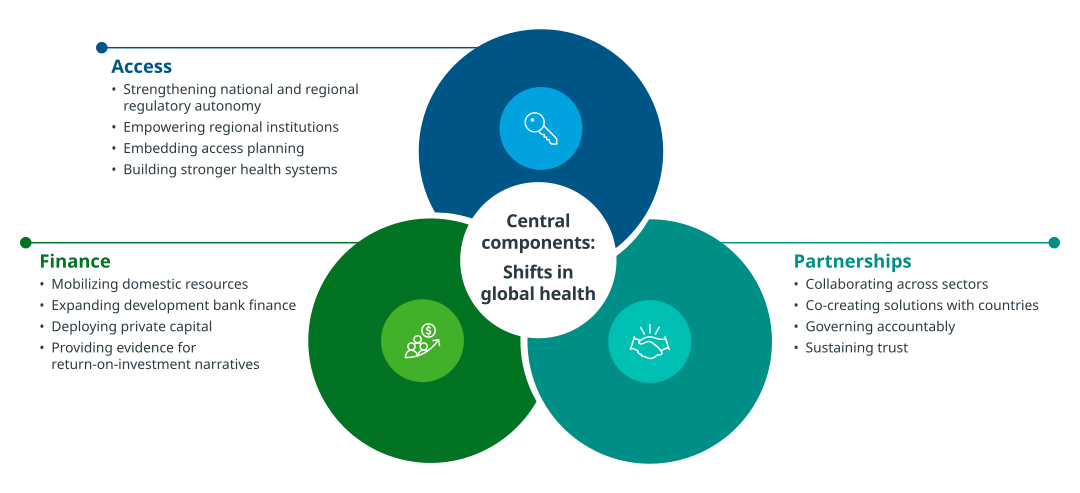
This reinvention converged on WHA79’s official outcomes and, more candidly, in the views of practitioners who gathered across many side events. Based on these discussions, three shifts will determine whether this crisis becomes an opportunity: first, the gradual rebuilding of equitable access from the bottom up; second, the increasing use of finance as the native language of health; and third, the emergence of partnerships as the connective tissue of a fragmenting system.
What does it take for this crisis to become an opportunity?
-
Rebuilding access from the bottom up
At the start of the year, IQVIA anticipated that country-centric priority-setting was the only path forward, and that governments facing shifting disease burdens and constrained budgets would be able to define their own priorities rather than follow those of donors6. WHA79 confirmed that this shift is already underway and increasingly tangible in practice.
The evidence lies in the behavior of governments themselves. National regulators are moving ahead of global processes rather than waiting for them. In Africa, some countries have taken regulatory steps independently, with examples such as lenacapavir in South Africa7 and the R21/Matrix-M malaria vaccine in Ghana, Nigeria, and Burkina Faso,8 in response to local priorities. Governments are also ensuring they are engaged in access planning for products still in development, such as an anticipated tuberculosis vaccine, rather than reacting once global guidance arrives and decisions are made without them. Regional institutions are maturing into genuine standard-setters, with the Africa CDC and the African Medicines Agency (AMA) harmonizing approaches while informal clusters tackle shared challenges like malaria resistance directly. Power is shifting toward the countries and regions where access ultimately succeeds or fails.
Yet regulatory maturity is only one dimension of this transition. Moving products through approval pathways more quickly is important, but lasting access is inextricably connected with the ability of health systems to deliver, finance, and sustain care once products reach the market. This matters because optimal access to care and medicines relies on robust health systems. Decades of desperately needed disease-specific, vertical programs generated progress against individual pathogens. Unintentionally though, underlying systems, patient care, funding streams, and capacity development for health workers were left fragmented. This is particularly evident in noncommunicable diseases, now the leading cause of death in many low- and middle-income countries (LMICs). Patients beyond primary care too often fall through gaps in referral pathways, with compounding follow-up costs that neither individuals nor health systems can afford. A vaccine or therapy that arrives without the right supporting workforce, cold chains, financing, and care pathways will remain inaccessible.
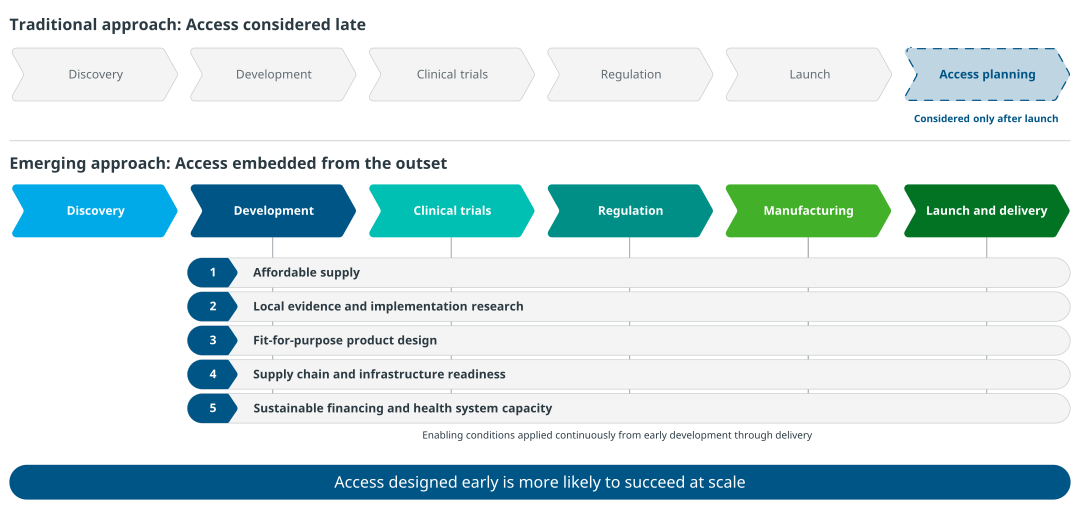
Access can no longer be designed at the end of the pipeline as an afterthought. While this has been a far more established practice in higher income countries, although not perfectly, it has lagged elsewhere. Sustainable and long-lasting access must be built in from the first day of innovation, considering critical components such as supply chains, refrigeration requirements, moisture-resistant packaging, and the ability of assets to withstand high temperatures. Ensuring access from the outset means embedding it into every stage of research and development (R&D). This includes designing flexible product profiles before late-stage lock-in occurs, generating implementation evidence that supports real-world uptake, partnering with LMICs from the proof-of-concept stage to ensure affordable supply at launch, and conducting clinical trials in low-resource settings under the leadership of local investigators. Access that is built in early, and delivered through local health systems rather than around them, is the form of access most likely to succeed.
Source: IQVIA Thought Leadership
-
Setting finance as the native language of health
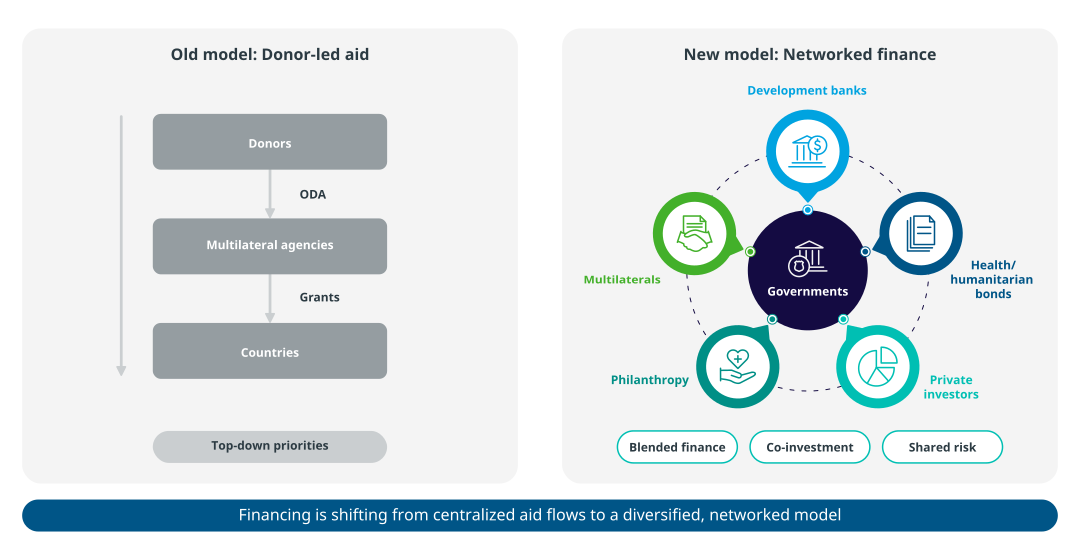
Official development assistance is declining sharply, and WHA79 suggested that much of the global health community is beginning to adapt to that reality rather than resist it. A recurring theme, echoed from the Economics of Health for All strategy to conversations throughout the Assembly, was that the moral case for health, while still essential, is no longer sufficient on its own. In an era of constrained public finances and rising debt, health is increasingly competing for resources on economic as well as ethical grounds. The strategy reframes health as a foundational investment in productivity, resilience and growth, and argues that the case for health must increasingly be made to finance ministries, treasury departments, and other economic decision-makers, not just health-related ones. From a financing perspective, this shift is already visible in the growing role of multilateral development banks, philanthropy, and private capital. Together, these sources are helping to shape a more diversified financing model for global health.
The new playbook is grounded on concrete interventions and efficiencies. In the context of a roundtable hosted by IQVIA during WHA79, participants highlighted how, for example, a cervical cancer program in Asia secured World Bank alignment not by restating the disease burden but by re-articulating its value around the jobs created through localized vaccine production. They also mentioned how an artificial intelligent (AI)-assisted diagnostic tool made its case by cutting clinician training from six months to two hours, a saving that lands immediately on health budgets. Simple, credible metrics travel furthest. The observation that, for instance, a dollar invested in vaccines can yield US$19 in benefits9 is compelling because it makes a strong case to a treasury official. Health security arguments, particularly around antimicrobial resistance, already sit on finance ministries’ radar and offer a powerful entry point.
This emphasizes the need to build robust investment cases, written for the stakeholders who hold the purse strings and that carry the equity argument inside them. The deeper task is developing credible and rigorous models that link health outcomes to economic output, so that arguments withstand a finance minister’s scrutiny. Governments, multilateral development banks, philanthropies, and private investors are increasingly asking the same questions: what works, for whom, at what cost, and with what measurable impact. That is where the reinvention still has furthest to travel.
Source: IQVIA Thought Leadership
-
Establishing partnerships as the connective tissue of a fragmenting system
The third shift is the one that makes the other two possible, and most closely echoes where the year began. IQVIA’s analysis anticipated that the private sector was becoming more relevant not as a philanthropic last-resort funder or a backer of narrowly targeted, disease-specific interventions, but as a catalyst of structural change. This shift reflects a move away from historically fragmented and supply-driven engagement toward more aligned partnerships with ministries of health, underscoring the value of “collaboraction”10 in translating intelligence into policy and then into concrete initiatives. WHA79 sharpened that idea into a working principle. As the coordinating multilateral layer thins, the risk is that norm-setting fractures and gaps open between institutions. Some connective tissue must remain, and partnerships themselves are playing this role.
The quality of partnerships rests on trust, treated not as soft value but as critical governance infrastructure. The move underway is from arm’s-length suspicion toward pre-competitive models grounded in shared responsibility, transparency, and explicit rules of engagement. Multi-stakeholder frameworks in many areas, as visited during IQVIA’s roundtable, especially in oncological care, show public, private, and civil society actors working together without compromise, precisely because the rules are clear, conflicts of interest are named, and the primacy of national health authorities is maintained. Industry earns more credibility when it engages in an advisory capacity, contributing expertise on market shaping, procurement, and health economics while decoupling that advice from product sales.
|
Indonesia's recently launched Breast Cancer National Action Plan demonstrates how effective partnerships can translate ambition into action. Developed under Ministry of Health leadership with support from IQVIA and sponsoring partners, this initiative aligns public priorities, technical expertise, and private sector resources behind a nationally owned agenda. Ultimately, success will depend less on identifying promising interventions than on creating the conditions for scale through early access planning, robust evidence, strong partnerships, and implementation-focused design.
|
Sources: IQVIA Thought Leadership and Indonesia’s Rencana Kanker Nasional11
Partnerships, however, must be landed in a genuine intent to engage and embrace the incentives and viewpoints of all parties and the leadership of governments. Organizations waving a collaboration flag inside their own silo are unlikely to achieve meaningful progress. Genuine resource-sharing and co-creation are factors that truly move the needle. The distinction between real and superficial collaboration, between co-investing and merely co-signing, is now the difference between equitable access to care and similar interventions that stall. This approach may require greater time and resources in the short term, but its medium- to long-term benefits are substantial. “Collaboraction” is only worth the name when the action is real.
In fact, partnerships at the global level—such as product development partnerships (PDPs) like Drugs for Neglected Diseases initiative (DNDi), the Global Antibiotic Research and Development Partnership (GARDP), and the Medicines for Malaria Venture (MMV)—are actively demonstrating why global coordination remains essential for driving true innovation and access, all while preserving country-level decision-making and prioritization. In June 2026, DNDi, GARDP, and MMV signed a strategic cooperation agreement to pool R&D resources, strengthen policy advocacy, and speak with a unified voice, maximizing impact despite shrinking aid and shifting global health architecture.12 Separately, DNDi and MMV launched a Joint Regulatory Platform to accelerate drug registration timelines and streamline clinical strategy through coordinated regulatory science efforts.13 These initiatives underline the real-world value of collaboration in translating intelligence into policy and concrete initiatives.
Source: IQVIA Thought Leadership
Five trends to follow closely for the rest of 2026
If the first half of 2026 set the direction of travel in global health, the second half will test it. Five developments deserve close attention:
-
The pandemic accord will most likely remain unfinished through 2026.
The July negotiating round is likely to produce partial convergence on governance and non-monetary benefit-sharing, while the hardest questions, covering areas such as digital sequence information and any mandatory set-aside of countermeasures, are pushed to a possible special session late in the year or to WHA80 in 2027. The agreement could stay unsigned for now.
-
Domestic resource mobilization becomes the central financing story, rather than a return to donor-led models.
As aid declines, focus shifts to health taxes, development bank lending, and blended finance, with donors playing a more selective role. Nevertheless, in a world shaped by conflict, climate change, and disasters, needs still outpace resources, making diversified mechanisms such as humanitarian and health bonds essential to closing the gap.
-
Architecture reform advances but slowly, and bilateralism runs alongside it.
The UN80-aligned reform process is gradually bringing greater clarity to an institutional landscape long characterized by overlapping mandates and fragmented responsibilities. At the same time, a growing number of bilateral health agreements are reshaping cooperation and financing, creating a second track that will coexist with, and at times complicate, multilateral reform efforts.
-
Regionalization accelerates.
The current landscape points to more national approvals ahead of global guidance, a stronger Africa CDC and AMA, and localized manufacturing pitched as an avenue for national progress and health sovereignty.
-
The metabolic and digital agendas expand, with data increasingly positioned as a financing tool.
Recognition of steatotic liver disease14 and growing debate over access to obesity medicines as public health interventions15 are elevating the metabolic agenda. At the same time, AI and data governance are moving from guidance to implementation, valued not only for their clinical potential but also for their contribution to efficiency and return on investment.
The verdict at the halfway mark
Six months ago, the question was whether the disruption of 2025 would become global health's greatest barrier or the catalyst for a more resilient model. The evidence from WHA79 offers an early and qualified answer. The reform aspiration reflected in initiatives such as the Lusaka Agenda16 and the Accra Reset17 is no longer theoretical. The contours of a system that is less donor-dependent, more country-led, and supported by a broader mix of financing and partnerships are gradually becoming clearer.
Momentum, nonetheless, should not be mistaken for success. The institutions that carried global health this far will not disappear, but their role is evolving from directing action to enabling it. The challenge now is translating ambition into implementation by embedding access earlier in innovation, building financing approaches that can withstand fiscal pressures, and creating partnerships capable of delivering measurable results at scale.
The next phase of global health will be shaped by how effectively innovation, financing, and delivery are aligned around country priorities and the needs of the people they serve. The choices made over the coming months will determine whether today's reinvention becomes tomorrow's lasting impact.
The authors acknowledge the valuable contributions of Natasha Pillai, Principal, Global Health, and Fridah Mwendia, Market Development Specialist, Sub-Saharan Africa, Clinical Operations, to the development of this piece.
References
1 World Health Organization (n.d.). Seventy-ninth World Health Assembly.
https://www.who.int/about/governance/world-health-assembly/seventy-ninth
2 World Health Organization (2026, July 20). WHO member states continue negotiations on the pathogen access and benefit-sharing annex. https://www.who.int/news/item/20-07-2026-who-member-states-continue-negotiations-on-the-pathogen-access-and-benefit-sharing-annex
3 World Health Organization (n.d.). WHO pandemic agreement. https://www.who.int/health-topics/who-pandemic-agreement
4 United Nations (n.d.). UN80 Initiative. https://www.un.org/un80-initiative/en
5 People's Health Movement (n.d.). WHO World Health Assembly 79: Adopt strategy on economics of health for all. https://phmovement.org/who-world-health-assembly-79-adopt-strategy-economics-health-all
6 Mora-Brito, D., Garg, G., and Harvie, J. (2026, March 12). A crisis turned into opportunity: What will global health look like in 2026? IQVIA. https://www.iqvia.com/locations/emea/blogs/2026/03/a-crisis-turned-into-opportunity
7 Gilead Sciences (n.d.). Access strategy for long-acting PrEP. https://www.gilead.com/responsibility/global-health-and-access/access-in-low--and-middle-income-countries/access-strategy-for-long-acting-prep
8 World Health Organization (2023, October 2). WHO recommends R21/Matrix-M vaccine for malaria prevention in updated advice on immunization. https://www.who.int/news/item/02-10-2023-who-recommends-r21-matrix-m-vaccine-for-malaria-prevention-in-updated-advice-on-immunization
9 Ozawa, S., Clark, S., Portnoy, A., et al. (2016). Return on investment from childhood immunization in low- and middle-income countries 2011-20. Health Affairs, 35(2), 199-207. https://doi.org/10.1377/hlthaff.2015.1086
10 See reference 6
11 Kementerian Kesehatan Republik Indonesia (n.d.). Indonesia NCCP. SLINK Kemkes. https://s.kemkes.go.id/IndonesiaNCCP
12 Global Antibiotic Research and Development Partnership (n.d.). DNDi, GARDP and MMV join forces to accelerate drug development for patients in greatest need. https://gardp.org/dndi-gardp-and-mmv-join-forces-to-accelerate-drug-development-for-patients-in-greatest-need/
13 Drugs for Neglected Diseases initiative (2026). DNDi and MMV pool regulatory expertise to accelerate access to lifesaving medicines. https://dndi.org/stories/2026/dndi-mmv-pool-regulatory-expertise-accelerate-access-lifesaving-medicines/
14 European Association for the Study of the Liver (n.d.). World Health Assembly side event. https://easl.eu/news/wha-side-event/
15 World Health Organization (2025, December 1). WHO issues global guideline on the use of GLP-1 medicines in treating obesity. https://www.who.int/news/item/01-12-2025-who-issues-global-guideline-on-the-use-of-glp-1-medicines-in-treating-obesity
16 Future of Global Health Initiatives (2023, December 12). The Lusaka Agenda: Conclusions of the Future of Global Health Initiatives process. Future of Global Health Initiatives. https://futureofghis.org/final-outputs/lusaka-agenda/ https://futureofghis.org/final-outputs/lusaka-agenda/
17 The Accra Reset (n.d.). The Accra Reset. https://accrareset.org/ https://accrareset.org/






.svg)