














Brand & Marketing
Grow your brand, now and through patent expiry
This blog is part of an ongoing series, A Brave New World: Finding Life Sciences Success in Modern Markets.
The introduction of new pharmaceutical products has always required substantial capital, but traditionally the investment was expected to yield multi-fold returns. In the current launch environment, however, the financial bar has risen while the payoff has become less certain. Policy reform, intensified pricing scrutiny, and increasingly sophisticated payers have compressed margins. At the same time, competitive noise and higher expectations from physicians and patients have driven companies to spend more simply to be heard. The average promotional spend per provider and patient for specialty products has risen by close to 60% over recent years.
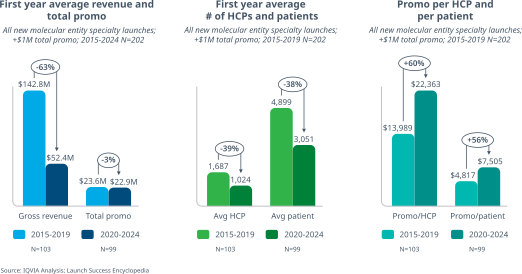
On the surface, gross sales figures suggest a thriving pharmaceutical industry. However, a closer look under the hood reveals a more nuanced picture when the true cost of those gains is included. After accounting for the cost to engage stakeholders with promotion and access, not to mention recouping research and development (R&D) expenditure, a growing share of brands fail to recover their launch investment.
Break-even investment provides a clear view into the true state of the industry, making it important to assess at multiple levels, including individual brands, organizations, therapeutic areas, and the industry as a whole. For many products, even robust clinical profiles are no longer enough to guarantee timely payback. This dynamic requires a reimagining of how success is measured beyond simple utilization metrics to include the return of invested dollars. Break-even analyses are now essential to govern how organizations deploy resources, manage access, and sequence their investments over several years, not just on how rapidly sales climb in the first few quarters.
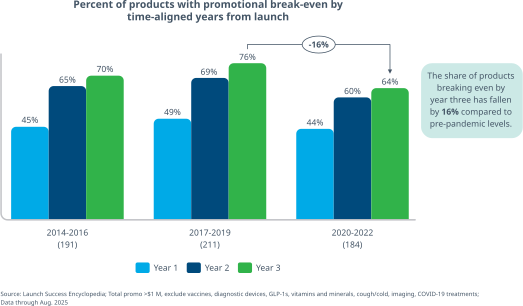
Break-even, in simple terms, is the point at which a product’s cumulative revenue begins to exceed its cumulative investments and can be calculated across numerous expenditure types. Take, for example, promotional break-even which compares the gross sales of a product to the cost of promoting the product excluding any access or other gross-to-net deductions. The share of new products that achieve promotional break-even by year three has fallen by about 16% in the post-pandemic period compared to pre-pandemic launches. For drugs launched between 2020–2022, 64% reach break-even by their third year on the market, versus 76% of those launched in the late 2010s. Over the past decade, less than 50% of products achieved promotional break-even in their first year, indicating that promotional costs often exceeded the gross revenue generated.
At the brand level, an analysis of top performing launches spanning diabetes, neurology, immunology, and dermatology illustrate the variation and rising challenge in time to promotional break-even over recent years. Despite each product becoming a high-performing brand, the average time for promotional break-even was 11 months, with some products not securing break-even until well into their second year.
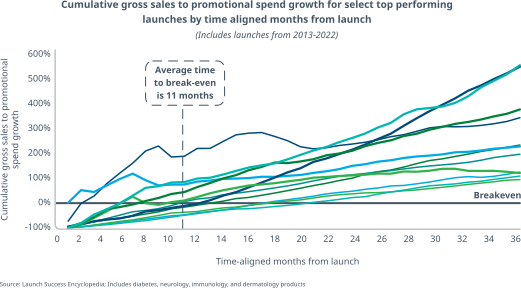
Several structural shifts sit behind this erosion. Beginning in the pandemic, companies accelerated promotional spending into the earliest months of launch. While this aggressive early investment is intended to jump-start uptake, its side effect is delaying break-even.
In parallel, modern launches have faced a difficult environment characterized by flattening uptake trajectories, rising payer control, and lifecycle compression due to policy changes such as the Inflation Reduction Act. Revenue that once ramped up quickly enough to offset launch costs now accumulates more gradually. For many products, the intersection between cumulative cost and cumulative profit occurs later, if at all.
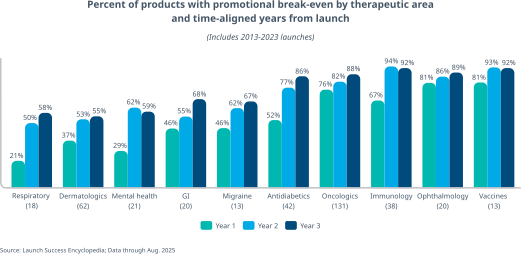
Unmet need, competitive intensity, and access complexity shape revenue trajectories in fundamentally different ways, influencing the timelines for different therapeutic areas to obtain promotional break-even. In immunology, a high-cost but high-demand area, nearly 68% of products break even in their first year, and over 92% achieve break-even by Year 3. These therapies (for conditions like rheumatoid arthritis or psoriasis) often benefit from strong demand, high per-patient values, and effective market access strategies, allowing faster payback.
In contrast, in dermatology, only about 37% of launches break-even at Year 1, and just 55% by Year 3, meaning almost half of dermatology products still do not recoup launch investments even three years in. Dermatology is a crowded market (e.g., many brands for acne, psoriasis, etc.). Patient behavior often leads to inconsistent and often low adherence, and achieving standout performance can require prolonged investment and time to capture market share.
Other areas fall in between these extremes: for example, oncology drugs show relatively faster break-even on average (driven by high prices, a high per patient value, a focused number of prescribers, and targeted patient populations); whereas respiratory and some mental health products demonstrate slower break-even trajectories.
These distinctions highlight a crucial point: a uniform launch budget template applied across all disease areas is almost guaranteed to misfire. If launching a new immunology biologic, historical data suggests break-even could be reached relatively sooner with the right strategy. However, if the launch is for a dermatology or primary care product, a longer path to recover costs should be expected and investment should be paced with that timeline in mind. Launch planners who do not consider these nuances risk either under-investing in high-potential assets or over-investing in categories where structural headwinds make rapid payback unlikely.
While promotional break-even is important and happens first, commercial and asset break-even should not be overlooked. Taken together, each captures a different slice of investment that should be monitored to guide different decisions during launch.
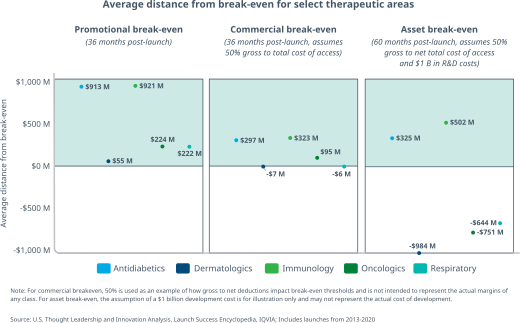
Evaluating each type of break-even for diabetes, dermatology, immunology, oncology, and respiratory launches from previous years reveals the rising challenge of achieving full product break-even. Three years from launch, the average product in each of these therapeutic areas achieves promotional break-even, though dermatology brands barely cross the threshold, earning just $55 million in net profit.
For commercial break-even, once a 50% gross-to-net total cost of access is applied in addition to promotional costs, the number of products reaching break-even drastically tightens. While 50% is an assumption that does not hold true across all products, it shows the difficulty in achieving break-even when commercial costs are considered. The average immunology and diabetes brands performed the best three years post-launch, though neither is able to break $500 million in net profit. Respiratory and dermatology products, on average, fail to achieve break-even at this point.
Amidst rising compression, an effective strategy is key to achieving commercial break-even. Selecting a well-differentiated product and deploying operational expenses effectively are central to achieving success, especially for emerging biopharma companies which are often resource constrained. During launch, it is important to track year-over-year profitability, the cumulative break-even ratio, and the time required to reach break-even to understand the brand’s trajectory and adjust strategy as needed1.
Going a step further and estimating asset break-even at five years from launch by assuming an additional $1 billion in R&D spend, which itself is a conservative number, reveals only immunology and diabetes products fully recouped the total investment in their development and commercialization. Oncology, despite being a leading growth driver for the industry, delivers an average net loss of approximately $750 million, while dermatology products average nearly a $1 billion net deficit once promotional spend, a 50% gross-to-net adjustment, and $1 billion in R&D costs are deducted from gross sales. The underlying causes are multifaceted and range from heightened payer control to intense competitive pressure that demands significant promotional investment. These forces, combined with rapid generic encroachment, constrain revenue potential to the point that many products struggle to recover their full costs. Even among those that break-even, the margins can be small. The difference from asset break-even for the average diabetes and immunology product is $325M and $500M, respectively.
Rising launch complexity and intensifying access costs have significantly changed the calculation on the profitability potential of molecules at various stages of development. Assumptions embedded in earlier net present value models may no longer hold. For near-launch assets, revisiting these projections is no longer optional; it has become central to responsible capital allocation. When a product is deemed financially viable for launch, forecasting should include both the revenue and the reasonable investment needed to achieve that revenue to avoid net negative spend five years down the line2.
Given the tougher climb to profitability, what separates those launches that do break-even in a timely manner from those that lag? Key drivers and inhibitors of break-even timing include:
In today’s constrained and scrutinized marketplace, launch excellence cannot be equated with a short-lived surge in prescription volume. The more meaningful measure is the speed and reliability with which an asset progresses from heavy investment to sustainable profitability, given the realities of its therapeutic area, competitive context, and rising gross-to-net squeeze.
In the coming generation of products, successful organizations that internalize these definitions design launches that are both financially and clinically robust. They treat break-even as a central strategic milestone rather than a back-office accounting concept. They sequence investment deliberately, tune their promotional mix based on real data, and embed access strategy at the core of launch planning.
For those companies, the three-year journey from approval to stable profitability becomes not just a hurdle but an opportunity to sharpen commercial capabilities, deepen relationships with stakeholders, and set a higher standard for how innovation reaches patients. In an era where capital is finite and scrutiny is intense, mastering that journey will distinguish the leaders of the next decade in biopharmaceuticals.
References:

Related solutions
Grow your brand, now and through patent expiry
Data, AI, and expertise empower Commercial Solutions to optimize strategy, accelerate market access, and maximize brand performance.