














Brand & Marketing
Grow your brand, now and through patent expiry
This blog is part of an ongoing series, A Brave New World: Finding life sciences success in modern markets.
The cost of launching a product in the life sciences sector has risen sharply in recent years, driven in part by increased investment in direct-to-consumer (DTC) advertising aimed at boosting consumer awareness. In today’s challenging launch environment, companies are continually exploring new ways to optimize DTC channels, both legacy and emerging, to reach and engage their audiences. While this is a worthwhile objective, it raises an important question: Is higher spend on DTC advertising actually delivering better results for brands? As with many complex issues, the answer is nuanced.
While the level of DTC investments has surged, the efficiency of these expenditures has declined overall, with saturated airwaves weakening returns on investment and a dramatic escalation in the cost to acquire each new patient. To add to the complexity, rising media costs, shifting consumer behaviors, and the potential for volatility in the regulatory environment are all upending the status quo. This moment calls for a clear understanding of the current landscape and the strategic actions needed to bring new products to the patients who need them most. Successful brands are evolving beyond spend and channel-mix optimization. They must now apply the same agility and responsiveness to their entire go-to-market strategy to accelerate decision-making, adapt to regulatory shifts, and drive meaningful impact.
DTC spend in support of new product launches has grown markedly in recent years. The average cumulative DTC spend during the first 36 months post-launch was around 21% higher for products launched between 2019–2022 than those introduced in 2015–2018. On average, companies now allocate approximately $169 million to DTC media campaigns over the first three years for a typical launch, up from about $140 million a few years prior. This increase signals the growing emphasis on driving rapid consumer awareness as an accelerant to demand generation.

Source: Launch Success Encyclopedia, Excludes diagnostic equipment.
In terms of promotional mix, DTC remains a smaller portion of the overall launch budget compared to healthcare provider (HCP) focused promotion (when factoring in both working media spend and investment in in-person engagements), yet it remains a critical element. Roughly one-third of first year promotional dollars for specialty launches are allocated to DTC efforts, with the remainder directed toward HCP promotion. For many specialty drugs, two-thirds of first year promotional spend focused on HCPs, underscoring the continuing importance of sales reps, medical outreach, and other professional channels. Still, the share attributed to DTC has gradually increased with the expansion of digital media and new consumer engagement tactics.
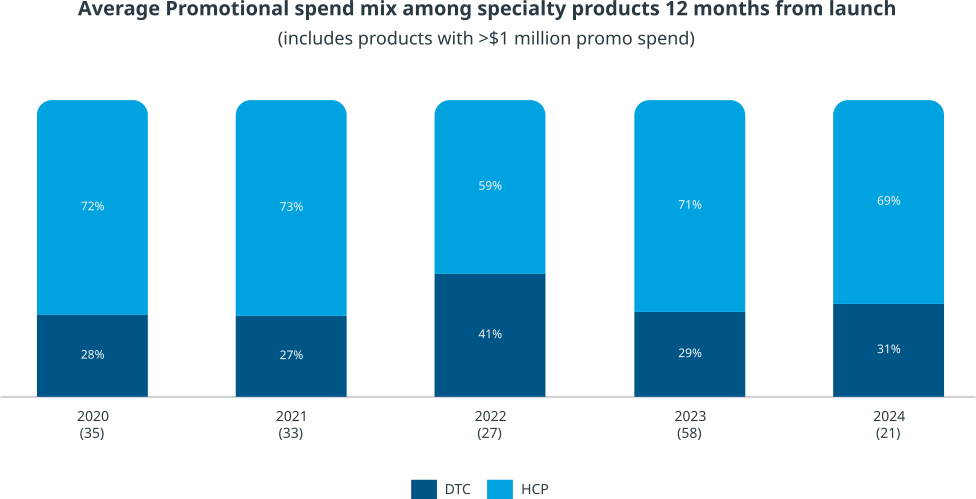
Source: Launch Success Encyclopedia.
While DTC represents a smaller portion of the overall launch promotional mix, it generally serves as a reliable bellwether for success. High performing product launches tend to invest far more in DTC advertising than lower performing launches. Across launch cohorts, products that achieve over $100 million in first year sales spend more on DTC than their counterparts. Between 2022 and 2024, top launches spent an average of $28 million on DTC in the first year, compared to just $13 million for launches generating less than $100 million in sales. This translates to a 91% higher DTC budget for the top-performing cohort. While causation is complex, exceptional products may attract both high sales and large ad budgets, the association is clear: substantial early DTC investment is a common trait among successful launches. In today's competitive market, making an impact often requires robust consumer outreach to drive awareness and uptake.
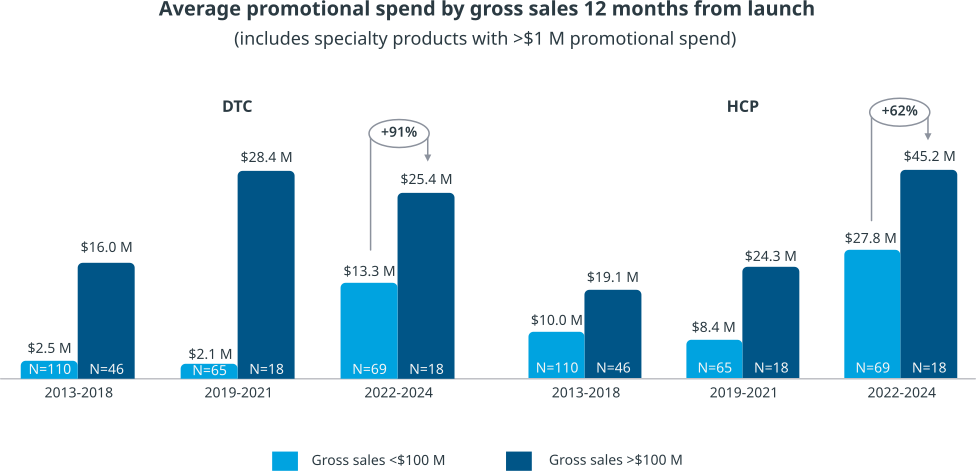
Source: Launch Success Encyclopedia.
The impact of DTC advertising on consumer awareness remains a vital element in generating consumer demand and guiding patients through the treatment funnel. Among specialty drug launches between 2013–2023, those investing at least $1 million in DTC saw nearly double the number of patients per treating provider in Year 1 compared to launches with minimal DTC. This enhanced HCP productivity ratio persisted into Year 5, with about a 45% higher rate than products with little or no DTC spend. A well-executed DTC campaign can significantly increase the number of patients discussing new therapies with their physicians, boosting each provider’s contribution to brand uptake.
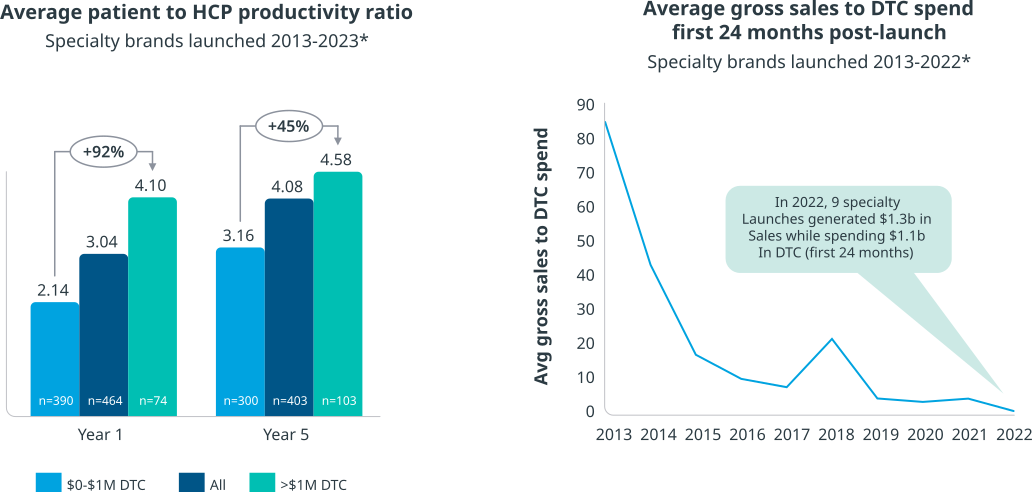
Source: IQVIA US Market Access Strategy Consulting analysis; Pharmacy Channel Launches Only.
However, the story isn’t all positive. In recent years, the return on investment for DTC has declined sharply. A decade ago, new product launches delivered outstanding sales relative to DTC investment. For specialty products launched in 2013, the gross sales to DTC spend ratio during the first two years was about 85:1, an exceptionally high return on investment (ROI). Fast forward nine years to 2022 launches, and this ratio plummeted to nearly 1:1, signaling a fundamental shift. In one notable example, nine specialty launches in 2022 generated $1.3 billion in combined sales while spending $1.1 billion on DTC advertising in the first 24 months on market, leaving little margin for other launch expenses. After factoring in costs for sales force, physician outreach, payer rebates, and clinical evidence generation, the ratio suggests brands struggle to recoup their overall investment in the short term. Many of these recent launches are effectively underwater on ROI when DTC spend is included.
Several factors explain this dramatic decline in DTC efficiency:
These factors combine to make DTC launch spend an unreliable predictor of elevated ROI. Launch teams must recalibrate expectations and strategies, recognizing that indiscriminate spending on consumer ads may be inefficient or even counterproductive.
One of the clearest markers of declining DTC efficiency is the soaring cost to acquire each patient. Among 2022 launches, the average DTC spend per patient start was $13,000 within the first 24 months, an enormous jump from the $2,700 per patient seen for 2018 launches. This 375 percent increase highlights how much less efficient consumer outreach has become.
The variation in patient acquisition cost across products is striking. Some brands managed to keep DTC cost per patient under a few hundred dollars, while others spent more than $80,000 per patient acquired. This disparity suggests that some teams are far more effective at translating ad dollars into patient uptake, often due to superior audience identification strategies or more compelling products. Others rely on mass-market saturation, burning through budgets for relatively little return.

Source: Launch Success Encyclopedia, excludes vaccines.
Understanding patient value and healthcare provider productivity are key metrics that can be used to justify the cost of DTC advertising. For brands that have high patient value, or those with high physician productivity as measured by the number of their patients, the value may justify the cost of acquisition and continued investment.
However, high acquisition costs are often the flip side of low ROI, indicating resources may be misallocated. When tens of thousands of dollars in advertising are required to acquire a single patient, it’s worth questioning whether these funds could be better spent elsewhere or if such high DTC spend is sustainable. Tailoring messaging to the right consumer population can dramatically improve efficiency, whereas broad, unfocused campaigns can waste resources.
Given these trends, pharmaceutical companies must adopt a more strategic, data-driven approach to DTC advertising. Four key strategies can drive a more effective return on marketing investment:
Together, these strategies form a playbook for smarter DTC spend. The overarching message is to focus on product strengths, optimize promotional mix, and apply data-driven insights to continuously improve the brand’s ability to reach and resonate with the intended audience. By embracing these principles, pharmaceutical companies avoid the trap of simply spending more, and instead spend wisely, achieving better results even as ROI challenges persist.
DTC advertising in pharmaceutical launches stands at a crossroads. Budgets are at record highs, but returns have hit historic lows. The data is clear: higher spending alone no longer guarantees success. To navigate this environment, launch teams must blend analytic rigor with marketing ingenuity, focusing on smart spending that identifies the right audiences, delivers compelling and differentiated messages, and continually optimizes based on evidence.
Despite the challenges, DTC advertising remains a powerful tool when executed thoughtfully. It can build awareness and accelerate adoption at a scale unmatched by other tactics, particularly for new therapies aiming to transform standards of care. The fundamental opportunity to engage patients in their health decisions and drive them toward life-changing treatments remains intact. By refining approaches and applying lessons from recent years, pharmaceutical companies can ensure that increased spending translates into higher returns for future launches. Please contact your IQVIA representative for more information.

This blog is part of a series exploring the evolving dynamics of pharmaceutical brand commercialization. Upcoming posts will delve into critical themes such as patient engagement, resource-constrained uptake, HCP adoption, investment analysis, payer control, strategic promotion, and the shifting provider landscape. You can find all of our Brave New World content in the U.S. Insights Library.
Grow your brand, now and through patent expiry
Data, AI, and expertise empower Commercial Solutions to optimize strategy, accelerate market access, and maximize brand performance.
Gain high value access and increase the profitability of your brands
We empower life sciences with connected intelligence, transforming data into actionable insights for smarter decisions and better patient outcomes.