














Market Access
Gain high value access and increase the profitability of your brands
This blog is part of an ongoing series, A Brave New World: Therapeutic Area Deep Dives.
The commercialization of the obesity treatment market has grown rapidly, despite a persistent lack of insurance coverage. With many payers still excluding obesity medications or imposing restrictive prior authorization requirements, manufacturers have turned to direct-to-patient (DTP) programs as a workaround—offering cash-pay access at flat monthly rates, streamlined fulfillment, and starter dose discounts. Importantly, the rise of DTP models in obesity care carries implications for the broader biopharma market.
Both Novo Nordisk and Eli Lilly now use their platforms to offer more than just their obesity medicines, signaling that these programs are evolving into an enduring channel rather than a product-specific workaround. The scope and sustained investment in these platforms point to a scalable, manufacturer led access channel that operates independently of short term supply or payer dynamics while expanding patient reach and preserving control over pricing, distribution, and engagement. These programs have not only opened new revenue channels but also reshaped the patient experience, making GLP-1s more accessible to those willing to pay out-of-pocket. In late 2025, the federal government entered the fray with Most Favored Nation (MFN) pricing agreements, introducing standardized costs and enabling broader Medicare coverage for obesity drugs. Together, DTP and MFN initiatives reflect a broader shift toward consumer-driven access and pricing transparency, signaling a new phase in the commercial evolution of obesity care.
The surge in demand for obesity therapies has created fertile ground for DTP programs, especially as traditional payer channels struggle to keep pace. These programs offer a compelling value proposition: they bypass insurance barriers, provide faster access, and appeal to patients who are either uninsured, underinsured, or simply unwilling to wait for coverage decisions. In a market where patients are willing to spend hundreds of dollars out of pocket each month, DTP models are thriving.
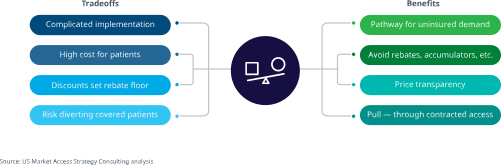
While DTP models offer clear benefits such as price transparency and access for populations without insurance access, they also come with trade-offs. Some commercial plans are beginning to avoid covering GLP-1 medicines altogether and are instead directing patients to purchase the products out of pocket through DTP platforms, as HCA Healthcare recently did. At the same time, several state Medicaid programs are moving to limit or halt coverage, which pushes more patients into cash-pay channels. These shifts risk diverting individuals who otherwise could have received insurance coverage. They may also shape broader pricing dynamics, since discounts offered in cash-pay programs can influence rebate floors across the market. Patients continue to face substantial financial burdens, and manufacturers must coordinate across pharmacies, digital platforms, and service providers to operate these programs effectively.
Over the past two years, DTP programs have dramatically lowered the list cost of GLP-1 therapies like Wegovy and Zepbound. Originally priced at over $1,000 per month, these medications are available for as little as $299–$499 through manufacturer-run platforms such as Novo Nordisk’s NovoCare® and Eli Lilly’s LillyDirect®. These programs offer flat-rate pricing, starter dose discounts, and home delivery, making treatment more accessible for uninsured and underinsured patients. As of January 2026, Wegovy's introductory offer includes two months at $199 with subsequent doses down to $349 per month. Zepbound vials, available exclusively through LillyDirect, launched with starter doses at $349 and subsequent doses capped at $499 or less.
In November 2025, the Trump Administration announced MFN pricing agreements with Novo Nordisk and Eli Lilly, further reducing GLP-1 costs and enabling broader access. These negotiations—completed before the launch of Novo Nordisk’s oral formulation—set lower prices for government purchases, introduced Medicare coverage for obesity drugs, and established discounted pricing on the government’s new direct-to-consumer platform, TrumpRx, launching in 2026. Under this program, Wegovy and Zepbound will be offered at standardized prices of $349 and $346 respectively, with Medicare covering these drugs for the first time at just $245 per month. Following the MFN announcement, Eli Lilly further reduced Zepbound vial prices through LillyDirect, lowering starter doses to $299 and offering maintenance doses for as little as $449.
The MFN framework also included provisions for forthcoming oral GLP-1 therapies, which were anticipated to enter the market at substantially lower price points. MFN negotiations established pricing parameters ahead of the launches of Novo Nordisk’s oral semaglutide and Eli Lilly’s orforglipron, setting initial pricing at approximately $150 per month, with ongoing treatment aligning to the $346 MFN benchmark. The transition to pill-based therapies was anticipated to broaden access by removing barriers associated with injectable medications, offering a more convenient and scalable option for patients and providers.
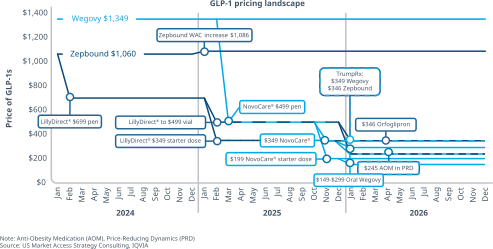
Following MFN negotiations, the FDA approved Novo Nordisk’s oral Wegovy in December 2025 making it the first oral GLP-1 therapy for chronic weight management. Novo Nordisk’s oral Wegovy is now available at a starting price of $149 per month for the 1.5 mg and 4 mg doses (with the 4 mg dose increasing to $199 after April 2026) and $299 per month for higher doses (9 mg and 25 mg). Eli Lilly, however, is still awaiting FDA approval for its oral GLP-1 candidate. NovoCare and LillyDirect continue to support oral formulations with similar pricing models, leveraging their existing infrastructure.
The public release of MFN pricing has triggered competitive and policy pressures across the obesity treatment landscape. Commercial payers are likely to demand rebates or pricing parity with TrumpRx, while pharmaceutical competitors will need to align with MFN benchmarks to maintain access to government-backed channels.
As GLP-1 therapies become more affordable through DTP programs, early evidence suggests these channels are also improving treatment adherence—a critical factor for achieving meaningful weight-loss outcomes. Historically, traditional retail pharmacy fills, especially for cash-paying patients, have been linked to lower adherence rates. Barriers such as fluctuating costs, logistical challenges, and limited support services often led to early discontinuation.
In contrast, DTP programs like LillyDirect and NovoCare provide streamlined access, predictable pricing, and home delivery, reducing friction throughout the patient journey. These platforms often include additional support features such as onboarding assistance and educational resources, which help patients navigate complex titration schedules and side-effect management.
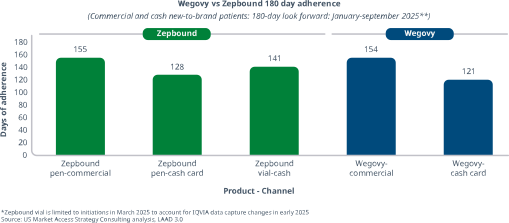
A recent analysis of 180-day adherence data for Wegovy and Zepbound indicates that patients using DTP vial channels maintain adherence levels comparable to those with commercial insurance. Commercial patients average 155 days for Zepbound (Pen) and 154 days for Wegovy, while those using Zepbound (vial) DTP channels remain comparably persistent (141 days). Cash-pay cohorts lag behind slightly at 128 days for Zepbound Pen Cash Card; 121 days for Wegovy Cash Card, suggesting that out-of-pocket costs may undermine adherence despite enhanced support. Sustained use of GLP-1 therapies is critical for clinically meaningful outcomes, and direct-to-patient programs help preserve engagement.
Looking ahead, manufacturers are enhancing DTP strategies with refill automation, digital coaching, and integrated telehealth support, creating a more holistic care model. These innovations aim to address common drop-off points in therapy, such as dose escalation and side-effect management, while fostering patient confidence and continuity of care. For individuals managing chronic conditions like obesity, these programs offer more than affordability—they deliver a structured, supportive experience that aligns with real-world needs and improves health outcomes.
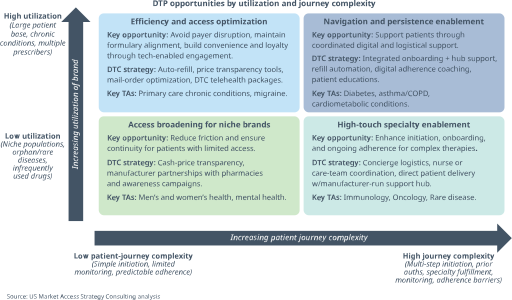
As DTP programs mature, it is clear that a one-size-fits-all approach cannot address the diverse needs of patients across therapeutic areas. Each therapy category has unique dynamics: how patients initiate treatment, manage side effects, adhere to therapy, and engage with support services. These factors should influence how DTP strategies are designed and deployed.
In obesity care, the patient journey is particularly complex, placing it firmly within the Navigation & Persistence Enablement category of the DTP framework. Treatment often involves multi-step initiation, ongoing lifestyle changes, and management of comorbid conditions such as diabetes and cardiovascular disease. Patients need more than access. They require structured onboarding, refill automation, digital coaching, and educational support to remain engaged. Here, DTP programs can excel by integrating hub services, telehealth, and behavioral tools to guide patients through the journey and sustain adherence over time.
What makes the obesity market unique is strong patient demand combined with a growing normalization of out-of-pocket spending driven by high deductible health plans. Many patients increasingly experience healthcare as a direct financial transaction, often paying meaningful costs before insurance applies and still facing coverage uncertainty, which reduces the perceived distinction between insured and uninsured care. Against this backdrop, GLP1 therapies are widely viewed as lifechanging, and patients are motivated to invest in treatment even without full insurance coverage. This combination of high consumer interest, perceived value, and a desire for simpler, more predictable access creates an environment where DTP programs can thrive. In contrast, other therapeutic areas, such as oncology or rare diseases, typically rely on payer-driven access models, intensive clinical oversight, and less discretionary patient spending, limiting the applicability of DTP. Additionally, manufacturers’ willingness to offer specialty medications at prices acceptable to consumer-level interest narrows the situational alignment where these programs could work.
The success of DTP in obesity hinges on convenience and continuity. Patients paying out of pocket make a significant financial commitment, but without robust support, persistence declines quickly. By tailoring DTP programs to the behavioral and logistical needs of obesity patients, manufacturers can build loyalty, improve outcomes, and differentiate their offerings in a crowded market. For other therapy areas, DTP strategies must be adapted thoughtfully, ensuring they complement clinical realities and patient expectations rather than forcing a uniform model.
DTP programs are emerging as a powerful, though imperfect, channel for access. While they offer speed, transparency, and autonomy, they also face challenges around affordability, and integration with traditional care. To capitalize on the opportunity while minimizing risk, organizations should:
Direct-to-patient programs are reshaping access in the obesity market. While they will not replace traditional insured channels, they are proving essential for reaching patients underserved by the current system. Reach out to IQVIA to learn more about how DTP strategies can evolve to meet patient needs and drive sustainable engagement.

This blog is part of a series exploring a range of topics in the obesity market, including: market size and scope, impact of payer controls, activity in non-traditional channels, patient behavior, GLP-1 impact, HCP responses, the policy landscape, pharmacy economics, and the outlook for the future of GLP-1. You can find all of our Brave New World content in the U.S. Insights Library.
Related solutions
Gain high value access and increase the profitability of your brands
Data, AI, and expertise empower Commercial Solutions to optimize strategy, accelerate market access, and maximize brand performance.