













Stay ahead with the International Thought Leadership insights: your source for industry-leading expertise and analysis
Blog
Beyond the front door: evolving implications of AI as a gateway to medical information
Nov 10, 2026
In March, we reflected on how pharmaceutical engagement will need to evolve as generative AI rapidly becomes a front door for healthcare professionals (HCPs) to access medical information1. Six months on, new survey results from more than 23,000 HCPs across 34 countries show that AI use is already mainstream and routine. The landscape is moving quickly: as of June 2026, 80% reported using AI tools, and around half use them daily or several times a week. Analysis of real-world prompts adds new insight into what HCPs ask AI when no one from pharma is in the room. It shows where information gaps and clinical uncertainty remain, often as HCPs work out how evidence applies to the patient in front of them. In this article, we explore how the landscape is evolving, what HCPs are asking AI, and how the new data refines the three implications we set out previously: the battle for algorithmic trust, the changing role of in-field teams, and AI fluency as a core launch capability.
National ecosystems continue to evolve
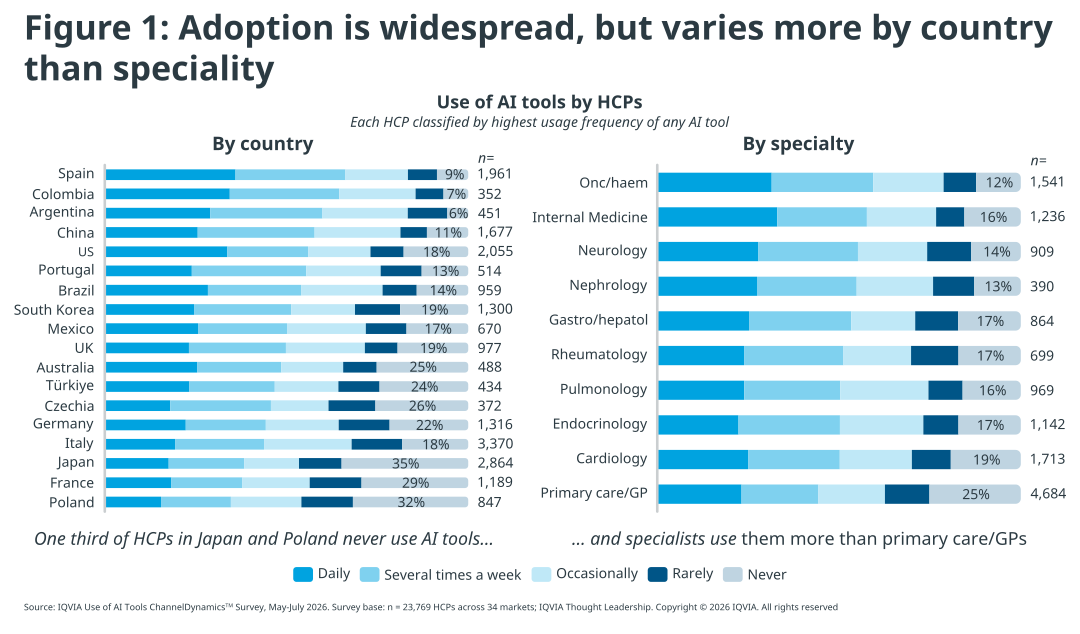
Figure 1 shows that AI adoption is widespread, but it varies more by country than by specialty. In Spain, Colombia and Argentina, fewer than 10% of HCPs have never used AI tools in their practice. In Japan and Poland, roughly a third say they never use them. Differences between specialties are modest, although oncologists use AI tools the most, possibly reflecting the volume and complexity of new evidence in oncology which makes it especially hard to stay current. Local conditions appear to shape adoption more than clinical need, likely due to variation in the availability of specialist medical tools, culture, language and local regulation.
Generalist tools such as ChatGPT are the most widely used because they are available almost everywhere, but our survey shows distinct national ecosystems emerging (Figure 2). In France and Germany, general-purpose tools dominate, and specialist medical tools are used less, for needs ranging from differential diagnosis to point-of-care reference. In the US, the landscape is more fragmented: healthcare-specific tools such as OpenEvidence, UpToDate AI and Doximity's AI are used about as much as many general-purpose models, and HCPs report higher organisational endorsement of AI than in Europe. In the UK, HCPs widely use ChatGPT informally, while the NHS is rolling out Copilot to around half a million staff 2. China stands apart with a separate domestic ecosystem of AI tools, with Alibaba's AI assistant reported as the most widely used generalist tool. China has gone furthest in purposefully embedding AI within institutions: 69% of HCPs there report AI built into their medical software, compared with around 30% on average across the other 33 markets.
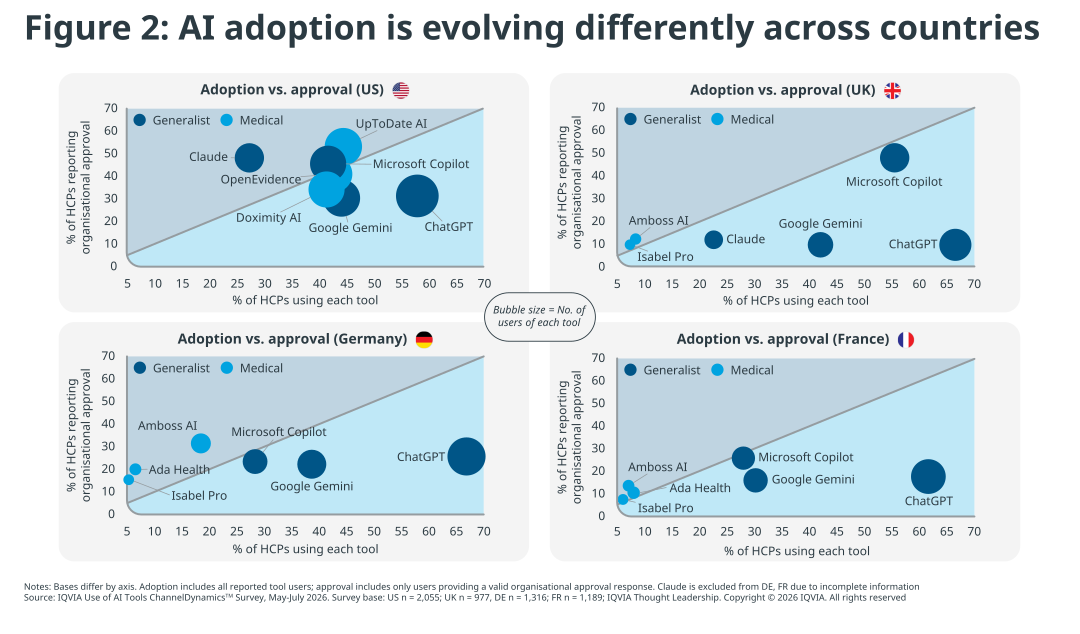
Our survey points to two routes to adoption. In one, HCPs choose their own tools. In the other, health systems purposefully embed AI into clinical workflows. Outside China, the first route still dominates. This matters because it shapes which layers of information HCPs draw on. The tools HCPs choose themselves, such as ChatGPT and OpenEvidence, largely draw on global evidence, such as published literature and major society guidelines. Beyond what our survey measured, further layers are emerging: some tools add national guidance, while others deployed within hospitals answer according to local protocol. In some NHS trusts, for example, Eolas Medical offers the promise of an "institutional brain." As institutional deployment grows, these national and local layers will carry more weight, and that is increasingly where a company's evidence will be interpreted.
AI is moving beyond information retrieval into the space before decisions
The more strategically relevant question is what HCPs are using AI for. Figure 3 shows our analysis of more than 2,000 anonymised prompts from over 100 HCPs in the UK, France and Germany. Guidelines were the single largest topic, but HCPs are most often trying to apply them rather than simply look them up. Almost a third of prompts had a patient-specific dimension, such as treatment selection, diagnosis or test interpretation, and a further quarter concerned optimising treatment, including dosing, efficacy and adverse event management.
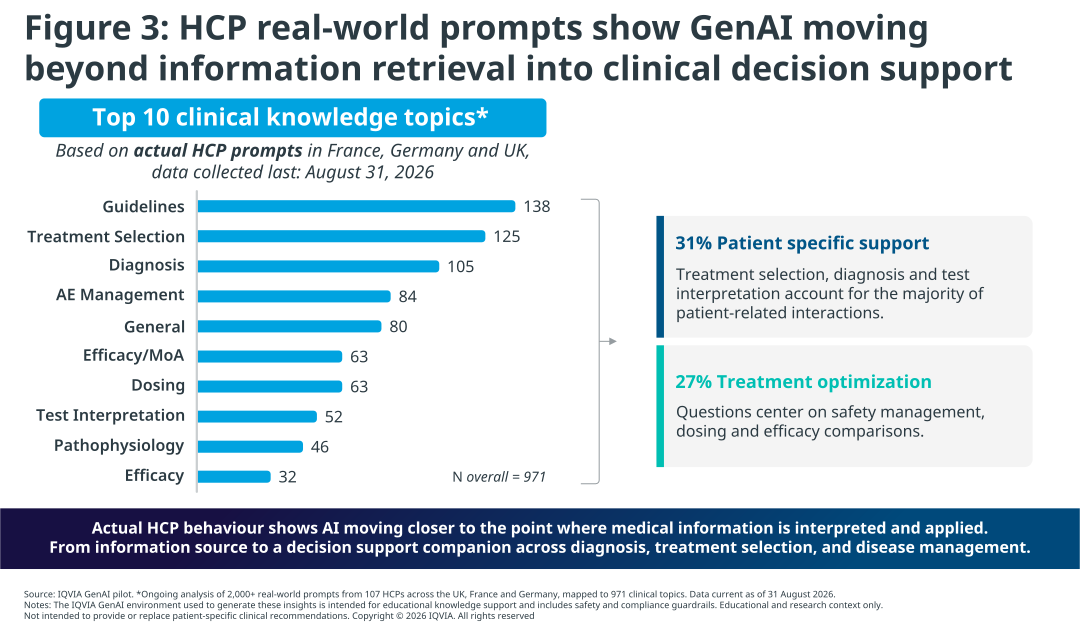
Together, these findings show HCPs using AI to fit the evidence to the patient and clinical situation in front of them. This is often where uncertainty and hesitancy remain: in the translation step that connects evidence to a specific patient, such as their age, lab values, treatment history or contraindications.
Across diseases, specialties and products, the prompts cluster around five recurring questions: which treatment, for which patient, what is the risk, at what point, and based on what evidence? For example, HCPs asked whether a PD-L1 score supports immunotherapy, or whether a treatment should be used alone or with chemotherapy. They were asking how to apply the evidence, not just for a summary of it. Around two-thirds of prompts that named a prescription medicine came up in the context of a specific clinical decision, such as treatment selection or comparison with alternatives, rather than as simple awareness questions.
Revisiting our three implications
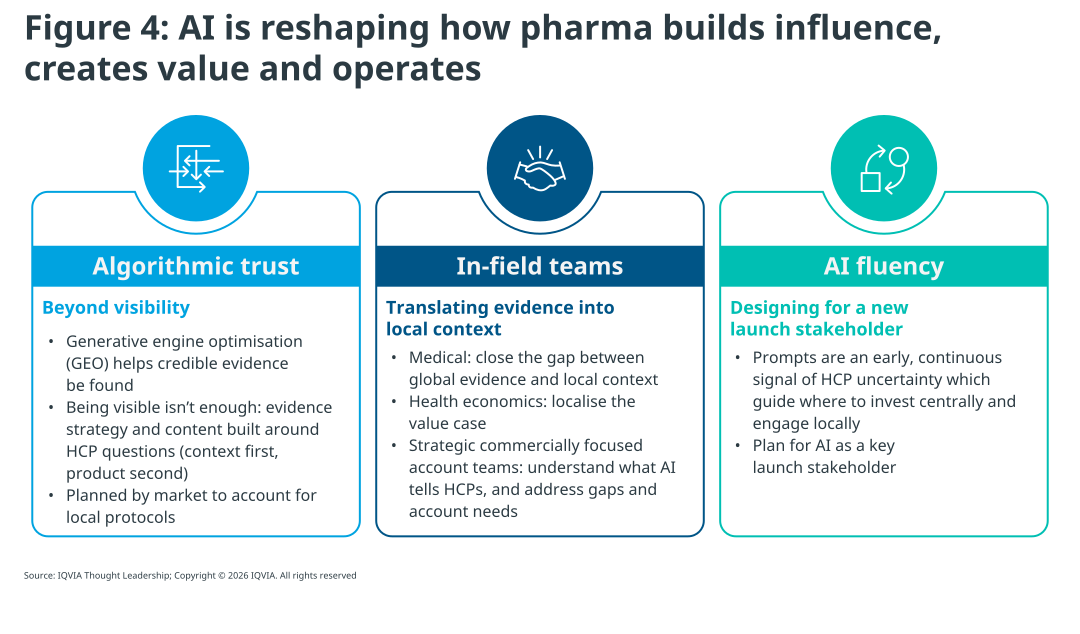
In our previous article, we set out three implications of AI becoming a front door to medical information. All three still hold, but evolving insights on how HCPs use AI, and what they ask of it prompt us to continuously refine our conclusions (figure 4).
1. Algorithmic trust: beyond visibility
Industry attention has rightly turned to generative engine optimisation (GEO): making sure AI tools can find, interpret and accurately surface balanced, authoritative evidence. GEO can help a company's evidence be found, but visibility alone is not an evidence strategy. The evidence itself must also be planned, generated and communicated around the questions HCPs actually ask of it, in the local care setting.
The prompt data indicates HCPs rarely start with a product: they start with a patient, a diagnosis or a treatment decision. Even when products are named, it is in the context of how those products compare, who they suit and how to use them safely. Evidence needs to be planned and generated around these questions: context first, product second. That means starting from the disease area, including its unmet needs, patient profiles and the decisions HCPs face, so that product evidence links clearly to the questions that come before it. It is also an argument for investing in unbranded disease, diagnosis and pathway content, where many questions begin. Finally, credibility remains the lasting advantage. It comes from guideline inclusion, publication in highly rated peer-reviewed journals, clear comparative positioning and the support of credible third parties, such as patient organisations and diagnostic providers.
Visibility has to be planned market by market, not solved once globally. Evidence planning also needs to account for the layer where health systems turn guidelines into local protocols, so that each system's interpretation of a company's evidence reflects its full value. Strong global visibility will not help if the local protocol says otherwise. Pharma needs to be credible and relevant at every layer.
2. In-field teams: translating the evidence into local context
We previously argued that in-field roles need to become deeper and more consultative. The new insight sharpens where they add most value: the richest opportunity lies in the translation of evidence into the local context. AI can increasingly tell a HCP what the evidence says, and even what the protocol says. It cannot uncover how a specific hospital or care network actually works: its pressure points, how it measures cost and quality, and which objectives it is held to. Even within one country, regions can apply the same guidelines very differently.
The question is therefore less whether field roles will survive and more which jobs need doing. Three stand out:
- Medical teams are best placed to close the translation gap. They set out the evidence and how it applies locally, and handle the complex scientific questions AI cannot settle, such as applying evidence to patients outside the trial population, weighing competing risks or reconciling a guideline with a complex case.
- Health economics teams, usually behind the scenes, adapt global value models with local data, such as patient numbers, length of stay and readmissions, to build a case that reflects how the local system measures success.
- Strategic commercially focused account teams start by understanding what AI tools are telling HCPs in each market. They then focus on what AI cannot resolve: reinforcing differentiation, addressing gaps within the label, helping settle comparisons HCPs are still weighing, and giving practical support on access, referral routes and support services. Increasingly, they also learn how individual accounts work, where pathways fall short and which patients they miss, helping systems meet their objectives.
How companies organise these roles is likely to vary. Some may keep a traditional field structure; others might look to models from rare disease, where account teams work closely with medical and health economics experts around each account's needs.
3. AI fluency: designing for a new launch stakeholder
In March, we argued that AI fluency would become a core launch capability. Here, we focus on two areas that follow directly from our newfound insights.
First, what HCPs ask AI is an early and continuous signal. Prompts show what HCPs ask when making decisions. That offers a unique and unfiltered window into customer needs, uncertainties and evidence gaps in real-world practice, revealing where evidence might be unclear, missing or not yet trusted. Because the signal is captured real-time, it also shows how questions shift as new data is published, guidelines change or the competitive landscape evolves.
As such, well before launch, AI tools offer a window into the market. Asking them the questions HCPs ask, across patient profiles and launch markets, shows how existing evidence and treatments are positioned and to what extent that positioning reflects a company's own scientific narrative. Used this way, the signal guides both where to invest centrally, through new evidence and content, and where to engage locally, on unresolved comparisons, patient fit or pathway questions.
Second, this changes launch planning itself. AI tools interpret evidence and pass it on to HCPs at scale, so they need to be planned for as a distinct stakeholder, alongside external experts, HCPs, patients and payers. Treating this as a GEO task close to launch is too late. What these tools surface in a disease area needs to shape early launch strategy, both centrally and locally.
Conclusion
For many HCPs, AI is already part of everyday practice, often adopted on their own initiative before, or in parallel with, seminal institutional deployments. Individual HCPs are moving faster than the health systems and pharmaceutical companies around them.
The tools are evolving quickly too. In July 2026, OpenEvidence introduced EvidenceGradeTM, which provides a real-time assessment of the strength of evidence underpinning its answers3. As this capability spreads, weak or undifferentiated evidence will be easier to expose, and the quality and differentiation of a company's evidence will matter more. Medical AI tools are also being integrated into electronic health records (EHRs)4. As these tools become embedded within clinical workflows, they move towards accounting for the patient's history, medications, lab values and comorbidities to support exactly the translation step where HCP uncertainty remains.
Change within health systems will be slower and more uneven, but increasingly health systems will institutionalise the use of AI as a means to increase protocol usage and reduce time-to-guidance at point of care. AI is also starting to act as well as answer: it can flag patients for referral, find patients with commonly missed conditions and support care continuity by directing patients to services, as in the UK’s NHS App. While some may see risks inherent in institutional uptake of AI, it does not by default remove the HCPs own judgement. Its suggestions can be accepted or declined by HCPs, in the best of cases instilling a continuous learning loop. Even so, AI will increasingly shape treatment patterns. That is why pharma is likely to increase its focus on disease-relevant health system partnerships, as healthcare networks decide how AI fits into care, for example in areas such as risk profiling, diagnosis, pathway optimisation and care continuity.
HCPs use AI because it gives them fast, relevant answers at the point where evidence meets the patient. For pharma, that brings both risk and opportunity. The risk is losing influence as AI tools, and the guidance and protocols built into them, increasingly shape what HCPs see. The opportunity is that what HCPs ask AI shows exactly where uncertainty remains before treatment decisions are made. Acting on it represents an opportunity to truly design for, and engage on, the questions and knowledge gaps that exist in the local healthcare setting. It means an opportunity to equip field and expert teams to close the gap in translating evidence to the local context. And, finally, it means factoring AI into early launch planning, both as a critical source of insight and as a key partner in the evolving dialogue around scientific narratives and interpretation of evidence.
HCPs have already walked through the front door, and health systems are starting to follow. Pharma will need to leapfrog to adapt.
Acknowledgements
The authors would like to thank Clemens Boehler and Markus Gores for their support in developing this blog.
References
1. IQVIA blog, March 2026: https://www.iqvia.com/locations/emea/blogs/2026/03/the-evolution-of-pharma-engagement-as-ai-becomes-a-front-door-to-medical-information
2. NHS England press release, June 2026: https://www.england.nhs.uk/2026/06/500000-nhs-staff-to-get-new-artificial-intelligence-tools-to-help-free-up-more-time-for-patients/
3. OpenEvidence press release, July 2026: https://www.openevidence.com/evidence-grade
4. OpenEvidence multiple press releases, 2026: e.g. https://www.openevidence.com/announcements/openevidence-and-northwestern-medicine-launch-collaboration-to-integrate-clinical-evidence-into-the-ehr; https://www.openevidence.com/announcements/mount-sinai-health-system-collaborates-with-openevidence-to-provide-evidence-based-knowledge-within-electronic-medical-record