
.svg)




Product and Claim Development
Compelling claims to capture the minds of consumers













Rx‑to‑OTC switch in Europe has long been treated as a scientific classification exercise. If the molecule was well understood, the safety profile robust, and the indication self‑limiting, the logic followed that wider access should be possible. That framing still shapes many internal switch strategies today. But it no longer reflects how decisions are actually being made.
Across Europe, pharmacy is being repositioned as a frontline healthcare provider, and regulators increasingly consider access models alongside the molecule itself. At the same time, as governments struggle with ageing populations, medical staff shortages, and rising healthcare costs, interest in Rx-to-OTC switch is growing.
Speaking during the Flipping the Switch: Entering a new Rx-to-OTC switch era in Europe and the UK webinar, Dr Volker Spitzer, Vice-President, Global R&D/RWE Services at IQVIA Consumer Health, pointed out that industry was now seeing a shift in “the context around switch — not its core requirements”.
This shift matters because it exposes a persistent misunderstanding. Success in European switch is not determined by whether a product can be used safely without prescription control. It is determined by whether regulators believe the proposed self‑care pathway will work reliably, repeatedly, and at scale.
Across Europe, and most visibly in the UK, switch is now being discussed less as a consumer convenience and more as a response to structural pressure. Ageing populations, workforce shortages and rising demand have made it increasingly difficult to sustain a doctor‑centric access model for conditions that are often manageable elsewhere in the system.
As Christelle Anquez-Traxler, Senior Regulatory Science and Strategy Lead at AESGP, noted during the webinar, that “each year across Europe, 1.2 billion cases of minor ailments are self-managed by the uptake of non-prescription medicines. This practice avoids considerable expenditure (€ 36.72 billion). The socio-economic benefits of selfcare and NPM are starting to be recognized as a sustainability lever for healthcare systems and national health funds. The switches initiatives that recently started in France and Greece are illustrative of this.”
Switch was “no longer just a classification decision”, Spitzer, pointed out, “but a practical way to support safe self‑care and relieve pressure on the health system”.
The commercial case for switch has also not disappeared, with many of Europe’s most valuable OTC brands tracing their origins to reclassification (see Figure 1). But commercial upside is no longer sufficient on its own. Switch proposals now need to align with explicit health‑system objectives, not just product opportunity.
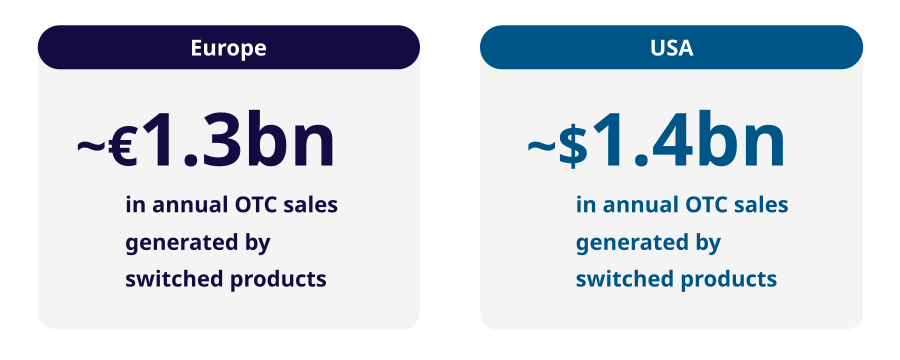
Figure 1 – OTC sales generated by switched products in Europe and the US (Note: Brands total sales defined by IQVIA International Product name and may be known by different local names in countries; Source: IQVIA Global Analysis, OTC CH Quarterly Insights MAT Q4 2025 Europe includes EU +UK/CH countries covered by IQVIA database)
European switch discussions often begin with the observation that classification criteria are harmonized at EU level. That is true, but it can be misleading. Shared legal definitions create a common starting point, not a shared route to market.
In practice, EU Member States differ sharply in how risk is controlled at the point of supply, how much responsibility is placed on pharmacists, and how comfortable regulators are with consumer‑led decision‑making. “EU rules give you a common baseline,” Spitzer observed, “but not a common access model, leading to a situation where the same scientific file can result in very different outcomes depending on the national pathway it encounters.”
This is why pan‑European switch strategies so often stall. They assume convergence where none exists. Anquez‑Traxler was explicit that this fragmentation was structural, not accidental, pointing out that “Europe may share harmonized definitions for non‑prescription medicines, but access decisions ultimately sit at national level.” She added that the “centralized procedure is not easy, but with the right candidates, evidence package, and long-term preparation, it can be worth the effort because it is the only pathway that can materially reduce unequal access across the EU.”
Cultural attitudes to self‑care,” she continued, “healthcare system design, pharmacy roles and political context all shape whether a switch is considered viable in practice.”
The reality is that Europe operates as a set of access archetypes rather than a single market. Effective strategies begin with an honest assessment of how risk is expected to be managed locally, and then to build evidence and execution around that assessment.
The switch of erectile dysfunction drugs in Europe over the past few years clearly stripped away any illusion that pharmacology alone dictates switch outcomes. Across Europe, the same molecules have been assessed repeatedly, yet results diverge sharply.
Where pharmacy‑mediated access has been designed as a credible, repeatable process — with clear eligibility checks and discreet workflows — regulators have been willing to accept switch. Where concerns persist around self‑diagnosis, misuse or behavioral risk, proposals have stalled despite comparable safety data. As Spitzer noted, “for sensitive categories, regulators judge the access model as closely as the molecule.”
The implication is uncomfortable but clear. For complex or sensitive indications, switch succeeds only where the surrounding system earns trust.
This is where real‑world evidence (RWE) has become more prominent — and more misunderstood. RWE is often treated as a generic confidence booster, added broadly in the hope that more data will compensate for residual concern. That approach rarely works.
“In switch, the key question is not just whether the molecule is safe,” explained Dr Inês Rocha, Associate Director, Global R&D/RWE Services, IQVIA Consumer Health, “it’s whether the self‑care model will work reliably in real consumer hands.”
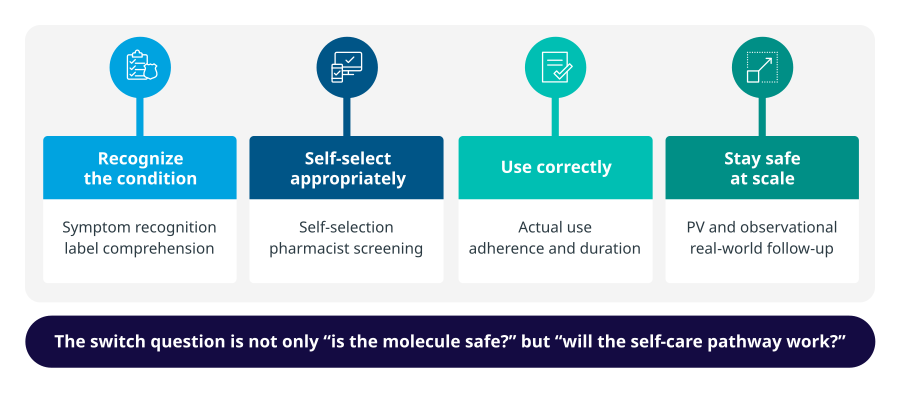
Figure 2: Appropriate questions that need answering to evaluate suitability of a potential rx-to-OTC switch (Source: IQVIA Consumer Health)
Regulators are asking whether consumers recognize symptoms correctly, select appropriately, use the product as intended, and remain safe when access widens (see Figure 2). These are behavioral questions, not pharmacological ones.
RWE matters when it is explicitly designed to test those behaviors within the proposed access model. Used selectively, such evidence can remove very specific uncertainties around self‑selection, actual use or pharmacist intervention. Used indiscriminately, it adds volume but little clarity. The strongest switch packages still respect evidence hierarchy: clinical data establish safety and efficacy; behaviour‑focused RWE reduces the remaining doubt around self‑care.
From AESGP’s perspective, RWE strengthens the Brass model, Anquez Traxler pointed out, as it helps evaluate switch against the right comparator—not a theoretical and idealistic prescription setting where clinical trials is the baseline but a realistic, real world prescription in a healthcare system reflecting uncertainties and variabilities. Hence (Rx) drug use studies may prove very useful in a switch.
As switch moves into more complex and recurring conditions, a deeper tension is emerging. Traditional benefit–risk frameworks remain heavily weighted toward visible risks, while many of the benefits of OTC access — timely treatment, reduced system burden, avoidance of prescription‑related harms — remain under‑accounted.
Dr Sachin Silva, Principal, Strategy/Life Sciences at IQVIA, argued that this imbalance now mattered materially. Regulators were being asked to make decisions with significant public‑health implications, yet “the tools used to assess those decisions haven’t kept pace with the data now available”, he added. Advances in analytics and population‑level data make it possible to understand risk and benefit far more precisely than before, but those insights are not yet consistently reflected in switch decision‑making.
Echoing Silva’s point, Anquez‑Traxler stated that “only the incremental risks and benefits of non‑prescription availability should be assessed against prescription use as the true comparator. Real‑world data is essential here, because it captures how medicines are used in practice — not under idealized trial conditions.”
Modernizing benefit–risk frameworks is not about lowering the bar for switch, Silva pointed out, but about making that bar more explicit, more consistent, and better aligned with today’s access realities.
The emerging picture for Rx-to-OTC switch in the UK and Europe is not one of deregulation or accelerated liberalization, but more one of a need for demanding, more design‑intensive switch strategies. The strongest proposals treat switch as an operating model rather than a regulatory event.
They start with the access environment, not the molecule. They design pharmacy workflows as carefully as labels. They deploy evidence to answer specific trust questions rather than to decorate dossiers. And they engage seriously with the broader public‑health consequences of access decisions.
Switch has not become easier in Europe. But it has become clearer. For organizations willing to rethink how access, evidence and trust fit together, the next phase of Rx‑to‑OTC is less uncertain than it first appears.
At IQVIA Consumer Health we offer unparalleled expertise and innovative approaches to support your switch activities—from concept to approval.
|
|
Compelling claims to capture the minds of consumers