Blog
Rx to OTC switch in the US has changed. Most strategies haven’t.
Matt Stewart, Associate Director, Global Marketing, IQVIA Consumer Health
Apr 24, 2026

The US Food and Drug Administration’s (FDA’s) standards for Rx to OTC switch remain intact, but the pathway to meeting them is being fundamentally re engineered. With the introduction of Additional Conditions for Nonprescription Use (ACNU), success is no longer about labeling alone—it is about designing systems that manage real consumer behaviour at scale.

For decades, Rx to OTC switch has been framed as a question of access versus risk. Could well-understood medicine be used safely without the guidance of a healthcare professional (HCP)? Could labeling carry enough of the burden? Could consumers be trusted to make the right call on their own? Those questions still matter, but they are no longer the only questions. What is changing in the US is not the regulatory bar for switch, but the logic of how that bar can be met.

Speaking during IQVIA Consumer Health’s recent webinar Flipping the Switch: Entering a new Rx-to-OTC switch era in the United States, Tammy Clemmer, Senior Director and General Manager at Concentrics Research, an IQVIA business, pointed out that while “Rx to OTC switch remains one of the most durable and strategically important tools in pharma lifecycle management, it’s playing a different role today than it did a decade ago”.

That shift is subtle but consequential. Switch is no longer a late stage convenience play, it has become a structural strategy for preserving brand value, expanding access, and responding to systemic pressure across healthcare.


The standard has not changed. The pathway has.

The FDA’s fundamental expectation for switch candidates has not softened over the years, with the agency still requiring compelling evidence that consumers can select and use a product safely without professional supervision. What has now changed is how that evidence can be generated and operationalized.

Recent US switches such as naloxone nasal spray and the first daily oral contraceptive approved for OTC use signaled something important. In both cases, regulators were willing to reconsider long standing assumptions about prescription status when consumer evidence was strong enough to support it. As Clemmer noted, these decisions did not reflect a relaxed standard, but a willingness to reframe access when public health benefit and real world behaviour aligned.

That reframing becomes explicit with the introduction of ACNU. Historically, if labeling alone could not support safe OTC use, the switch effectively stopped. ACNU has introduced a different proposition: that additional conditions, including digital tools or structured decision aids, may bridge the gap when labeling alone is insufficient.

webinar
Flipping the switch: Entering a new Rx-to-OTC switch era in the United States
Join IQVIA Consumer Health and Idea Evolver for a live expert discussion on how these regulatory developments are influencing decision-making, expanding innovation potential, and shaping the next phase of OTC growth in the United States.
Consumer health_Young women pharmacy vitamins

The biggest misunderstanding about ACNU

ACNU is often described as a regulatory innovation, yet in practice, it is better understood as a behavioral one, according to Sara Travis, Director of Operations at Concentrics Research. “ACNU doesn’t lower the safety bar—it adds tools to meet it,” Travis noted, instead of asking whether a product is safe with labeling alone, the question becomes whether the remaining risk can be responsibly managed through an additional condition.

That shift moves the burden of proof from comprehension to execution. Under ACNU, behaviour becomes the product, with regulators focusing not only on whether consumers understand the label, but whether they can consistently make the right decision, use the product correctly over time, and respond appropriately when something goes wrong.

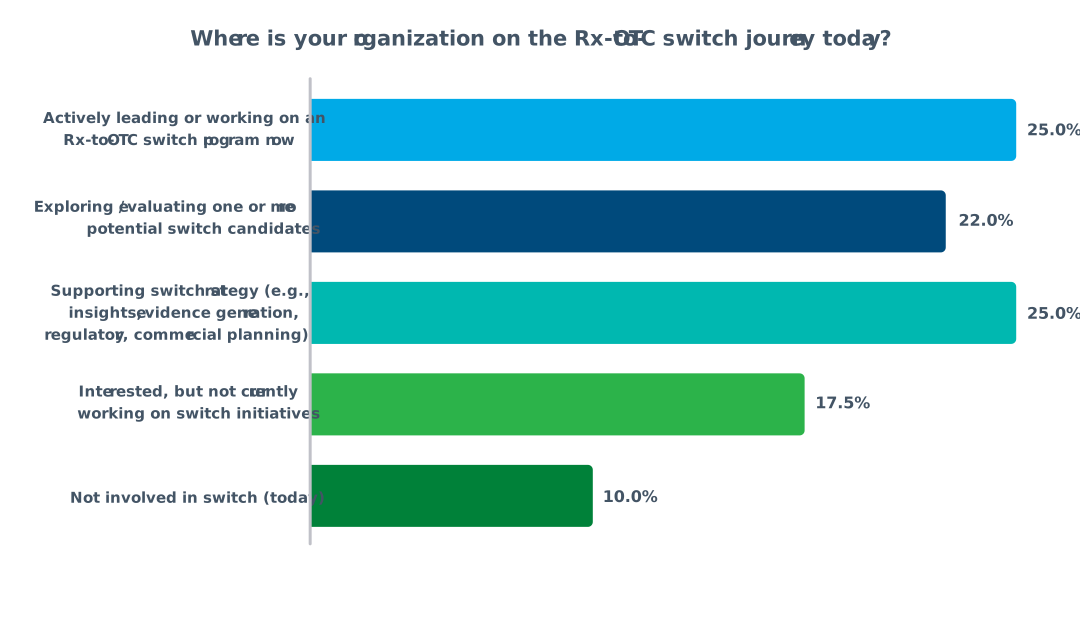
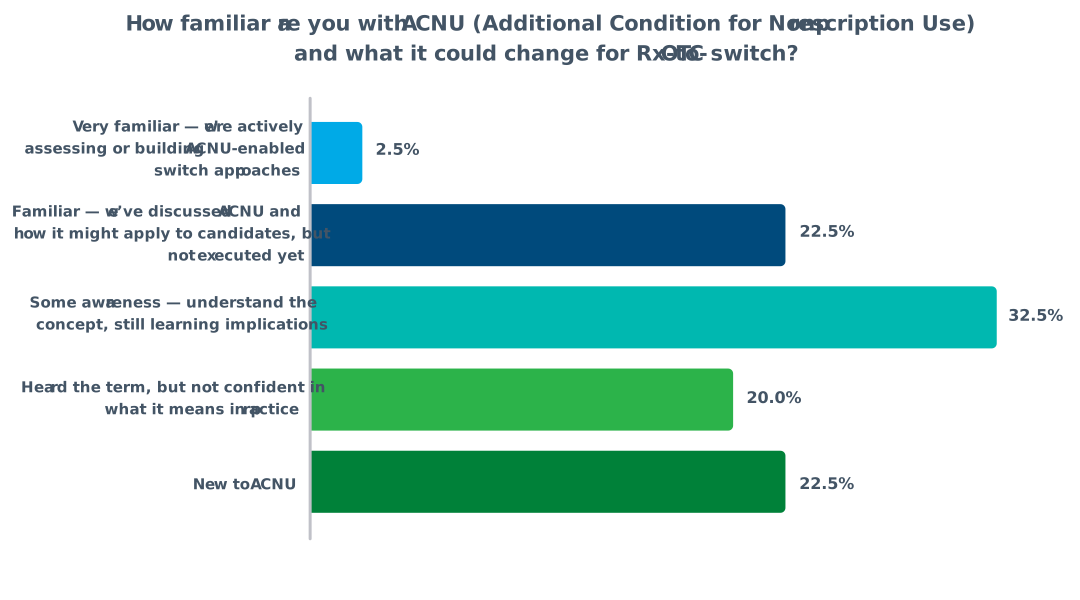
Many sponsors underestimate what that entails, Travis stated, a point reflected in a poll of the webinar audience, which showed that while three-quarters of respondents were actively engaged in switch activity, only 25% were familiar/very familiar with ACNU (see Figure 1).

What was important to understand, Travis pointed out, was that ACNU does not simplify switch, it makes it more demanding by expanding the scope of what must be designed, evaluated, and maintained in the real world.

Figure 1: Results from the audience poll questions on the Flipping the Switch: Entering a new Rx-to-OTC switch era in the United States webinar – 24 March 2026 – 40 respondents to each poll question. Respondents might not be the same for each question.


Software is no longer a support tool

Nowhere is this evolution more visible than in ACNU programs. When additional conditions are implemented digitally, those systems are no longer peripheral. They become a central to how safe use is achieved. Lauren Cleary, Chief Client Officer at Idea Evolver, pointed out that “from the consumer perspective, the interaction should feel simple, but behind the scenes these systems are much more structured than a typical questionnaire”. They must be designed to behave consistently, produce traceable outcomes, and operate reliably in highly visible, consumer-facing environments.

This is where many organizations could stumble, Cleary noted. They design consumer friendly experiences without fully recognizing that regulators will scrutinize the system beneath. This means these systems need to address both clinical and non clinical risks across the lifecycle, starting with the initial design.

These platforms must perform successfully not just under expected conditions, Cleary stated, but also across the variability in how users interact with the system in real-world use. This often leads sponsors to adopt enterprise grade architecture, disciplined change control, and continuous monitoring, she added, with software not an enabler of access, but the mechanism by which access is made safe.


Why late stage thinking fails

What ACNU was not, Travis pointed out, was a rescue strategy for switch applications. “The biggest mistake sponsors make is treating ACNU as a late stage solution,” she observed. If labeling alone can work, regulators will not impose additional conditions. If it cannot, an ACNU must be built into the development strategy from the beginning.

This demands a different kind of planning. Evidence generation, behavioral research, technology design, and regulatory strategy can no longer sit in sequence. They must be developed in parallel, informed by a shared understanding of the behavioral problem being solved.

The most effective sponsors are not asking whether they can use ACNU. They are asking what specific risk or behavioral constraint ACNU is meant to address, and whether it is the least restrictive way to do so.


Reframing success in the next switch era

The next generation of Rx to OTC switch in the United States will not be defined by the number of products move across the counter. Switches will be defined by how responsibly access is expanded, and how well real world consumer behaviour is anticipated, supported, and governed.

Switch is no longer a regulatory event. It is an operating model. One that spans clinical evidence, behavioral science, digital infrastructure, and long term brand stewardship. Organizations that continue to approach it as a packaging or labeling exercise will struggle to scale. Those that treat it as a system, designed around how people behave, will be better positioned to navigate what comes next.

Related solutions

Contact Us