














Thought Leadership & Innovation
Leapfrog the competition by proving the value of your products
This blog is part of an ongoing series, A Brave New World: Modern Analytics and Next Gen Insights.
The previous blog in this series, The Life Sciences strategic cycle is too long, examined how decision latency can limit an organization’s ability to respond as markets evolve. Addressing that challenge requires analytics that support earlier interpretation, faster evaluation, and more continuous decision-making.
Commercial leaders routinely make consequential decisions before performance is fully visible. They refine launch strategies as adoption patterns emerge, allocate resources as demand takes shape, and adjust investments as access conditions, stakeholder behaviors, and competitive dynamics evolve. Early indications of future performance often emerge through the interaction of these factors. Connecting them can reveal meaningful patterns and provide an earlier view of where a market may be heading.
Next-generation analytics expands this signal-detection window, helping organizations connect broader evidence, recognize leading indicators sooner, and evaluate a wider range of potential outcomes. Commercial teams can then reassess assumptions, investments, and priorities as new information emerges, before the next resource commitment narrows their available choices.
Much of the analytical foundation is well established. Leading indicators, predictive analytics, scenario planning, and multivariable analysis have long supported commercial decision making. The current evolution expands the breadth of evidence that can be connected, accelerates the speed of insight generation, and strengthens the confidence with which future outcomes and their underlying assumptions can be evaluated more continuously.
Three interconnected advances are enabling this shift:
Together, these advances create a more responsive commercial environment. Organizations can identify important patterns earlier, assess their commercial implications, evaluate probable outcomes, and direct attention and resources to the conditions most likely to shape future performance.
Life sciences markets generate a continuous stream of information. Patients move through treatment pathways, providers adopt new therapies, payers shape access conditions, and competitors influence market development. Each source, however, provides only a partial view of how opportunity and performance are evolving.
The commercial value emerges when these perspectives are interpreted together. A change in prescribing behavior carries different implications depending on access, patient persistence, competitive activity, and promotional engagement. Connected evidence gives leaders the context to determine which patterns matter, what may be driving them, and where commercial action could improve the trajectory.
Broader data ecosystems make this interpretation possible by linking patient, provider, access, engagement, and market information. Equally important, they expand the frame of reference available to commercial teams. For example, instead of evaluating a launch solely within the context of its own market, organizations can draw insight from a broader universe of therapeutic areas, product launches, provider segments, and market environments.
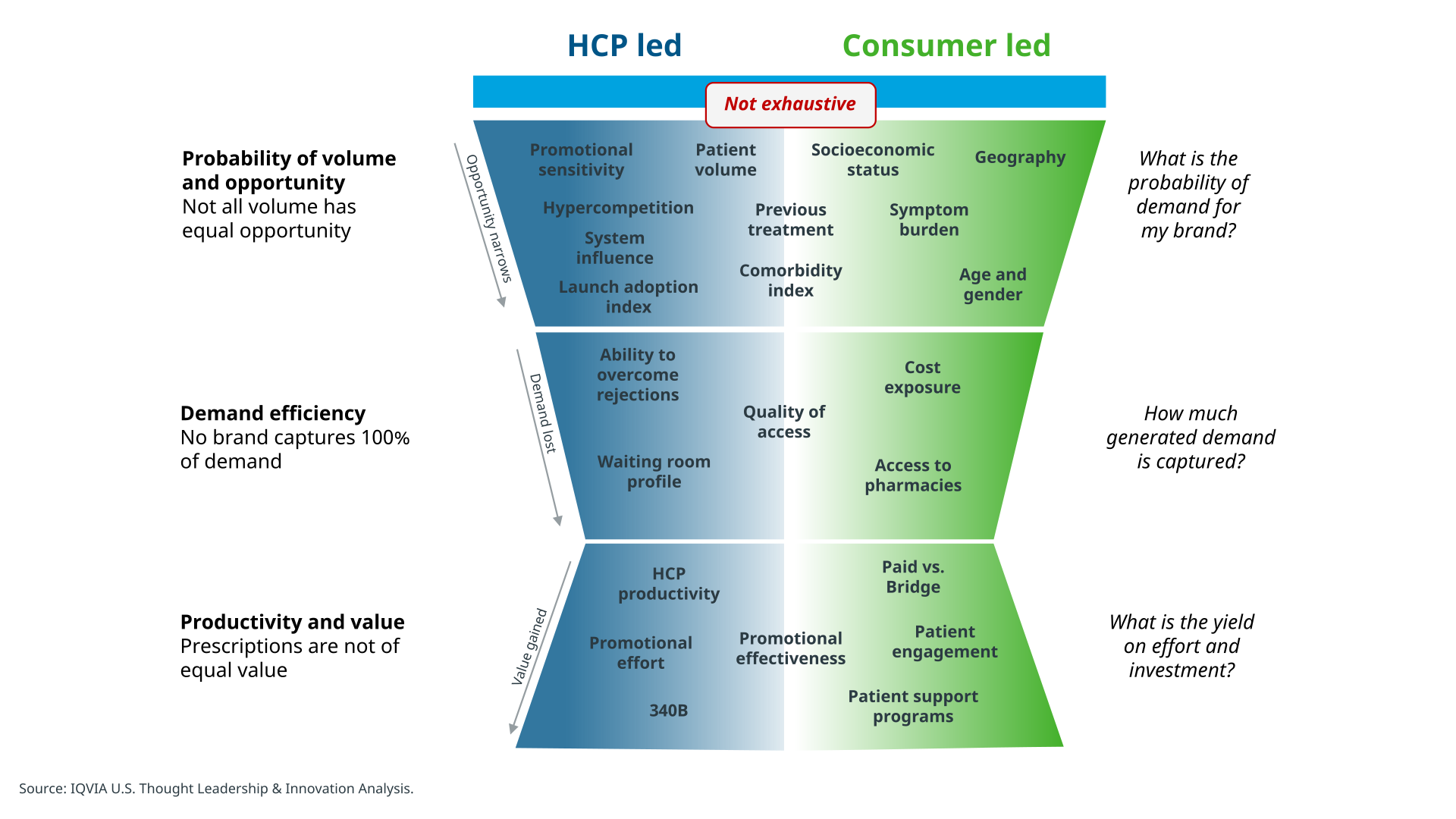
This connected view can be organized around three commercial questions:
Evaluating these dimensions together creates a more complete picture of commercial opportunity. Rather than viewing performance through a single lens, leaders can understand how demand is forming, which factors are influencing conversion, and where future value is most likely to be created. This richer view supports earlier, more targeted decisions while opportunities remain open to influence.
I think the intent here is to introduce the combination, but at a landscape level rather than fully explain either capability here. Blog 1 established why the traditional strategic cycle is too slow; this piece should define the broader shift toward earlier signals, probabilistic thinking, and a more continuous connection between evidence and action. Life Sciences Models and agentic AI are different but complementary enablers of that shift: one expands the ability to model multiple variables, scenarios, and possible outcomes, while the other makes it possible to connect broader inputs and refresh the analysis much faster. The deeper “how” should come through the subsequent articles, but we need to make that distinction and the series roadmap much clearer in this piece. We’ll sharpen the thesis accordingly so we are not implying that scenario modeling or multivariable analysis is itself new.
Provider behavior illustrates how broader evidence can sharpen the assessment of emerging opportunity. Adoption patterns are informative on their own, but they become significantly more valuable when evaluated alongside measures of patient complexity, provider influence, and other market dynamics. Looking across these dimensions together provides greater context for understanding how opportunity develops and which segments are most likely to shape future performance.
This perspective becomes particularly valuable when indicators begin to reinforce one another. Within cardiology, providers characterized by both faster adoption behavior and higher patient complexity averaged 922 patient referrals, compared with 882 referrals among providers treating similarly complex patients but demonstrating slower adoption behavior. Referral activity declined substantially among lower-complexity patient populations, reaching 654 referrals among slower adopters and 622 among faster adopters. Viewed together, these patterns suggest that provider networks, patient complexity, and adoption behavior do not develop independently. Instead, their interaction can reveal segments that combine higher adoption propensity, disease complexity, greater patient need, and broader local influence across the care ecosystem.
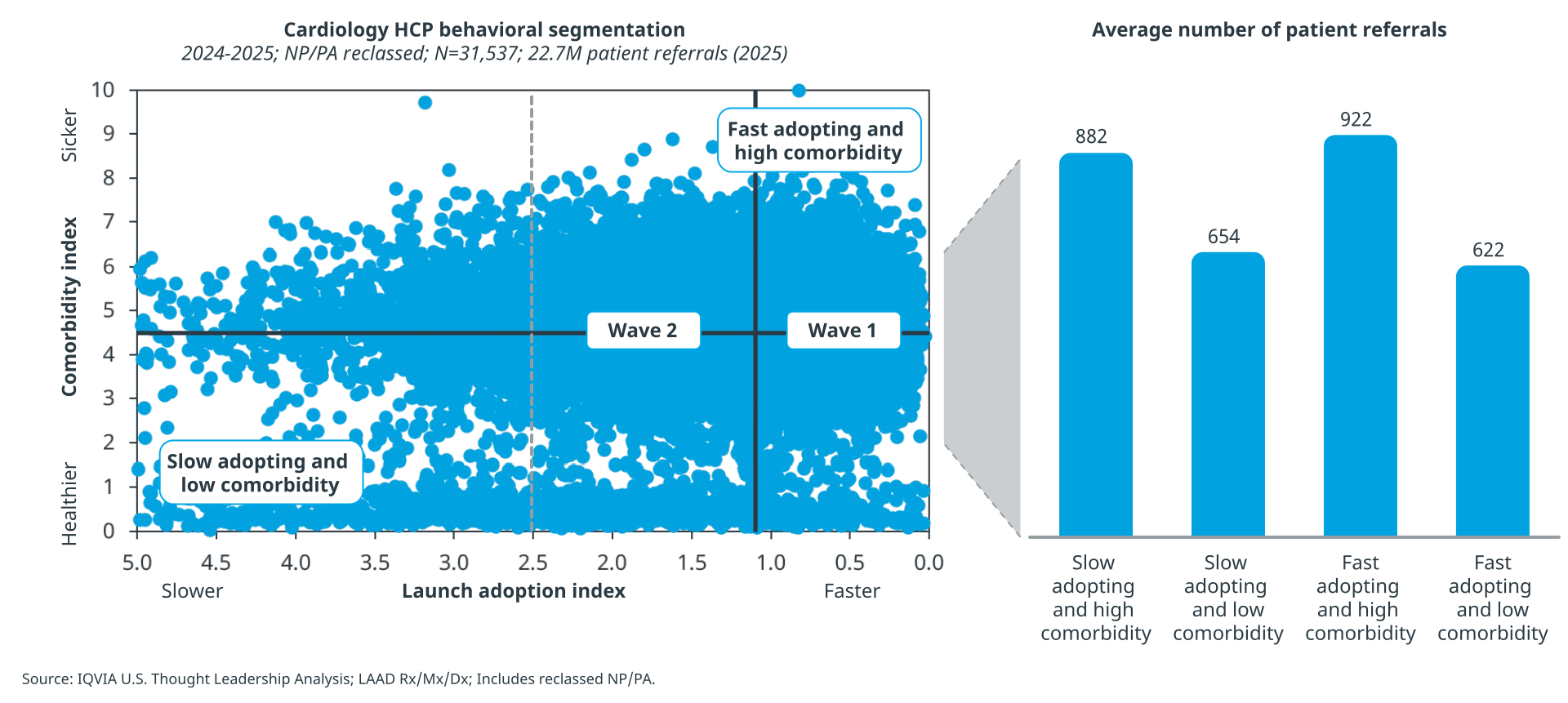
The commercial value comes from understanding how these factors interact. Rather than evaluating these metrics as separate observations, organizations can identify where multiple indicators converge to inform segmentation, engagement strategies, resource allocation, and ongoing market monitoring.
The significance lies in the intersection of behaviors. Adoption patterns, patient complexity, referral activity, access conditions, and engagement each provide valuable information on their own, but their collective value is often greater than the sum of their parts. Evaluated together, these behaviors can reveal how opportunity is developing, how influence moves through the market, and which conditions are most likely to shape future performance.
As organizations incorporate broader evidence into decision-making, data quality, consistency, and interoperability become increasingly important. Shared definitions, common business rules, and connected data foundations help ensure that diverse sources can be interpreted together and translated into decision-ready insight.
By bringing these perspectives together, organizations gain earlier visibility into emerging market conditions and a stronger foundation for anticipating change. The challenge then becomes evaluating that growing volume of connected evidence quickly enough to support timely action.
AI and agentic workflows can accelerate how connected evidence is evaluated, shared, and translated into commercial action.
Commercial teams regularly need to evaluate changing market conditions, reassess forecasts, refine launch strategies, update segmentation approaches, and understand the potential implications of new developments. These activities require significant coordination across teams, analyses, and planning processes, extending the path from insight to action.
Agentic workflows can help automate repeatable analytical tasks, connect formerly separate processes, and support a more continuous evaluation of market conditions. Forecasts, patient journey analyses, and market assessments can be refreshed more frequently as new evidence becomes available, helping organizations maintain a more current view of market conditions, act sooner, and reduce the operational effort required for each update.
Large language models extend these capabilities by synthesizing information across structured and unstructured sources. Market updates, field intelligence, stakeholder feedback, research findings, access developments, and performance measures can be assessed together to create a more cohesive view of changing conditions. Models can surface relevant patterns, flag areas for deeper investigation, and frame potential actions for commercial teams to evaluate.
The commercial benefit extends beyond efficiency. Faster insight cycles give leaders more opportunities to test assumptions, examine the factors associated with change, and adjust decisions while the trajectory remains responsive. A launch team could, for example, connect emerging provider adoption with underlying behaviors as those above in cardiology, patient initiation, access progression, and field feedback to identify the potential drivers of a performance gap and help direct action toward the conditions shaping it.
This creates a more continuous relationship between market evidence and commercial choice. Richer inputs improve the analytical view, while AI-enabled workflows help teams update and distribute that view before the next decision point. Human judgment remains central to interpreting context, challenging assumptions, and selecting the action that best fits the organization’s objectives.
Predictive analytics, machine learning, and scenario planning remain fundamental to commercial decision-making. The opportunity today lies in expanding what these methodologies can evaluate and increasing the confidence with which organizations can interpret their results.
Domain-specific AI models are an important part of this evolution. Unlike general-purpose models, domain-specific models are informed by terminology, relationships, market dynamics, and decision environments unique to life sciences. This specialized capability enables organizations to evaluate commercial questions with greater depth, precision, and domain context while incorporating a broader range of variables and market influences into the analytical process. Its usefulness still depends on the quality, representativeness, and validation of the underlying data and methods.
As these methodologies continue to advance, organizations can assess more complex relationships across patients, providers, access conditions, competitive dynamics, and commercial investments. Teams can explore a wider range of assumptions and possible outcomes, developing a more nuanced understanding of how different market conditions may shape future performance.
This expanded analytical capability is particularly valuable when evaluating future performance and investment decisions at launch. Leaders need to understand how likely an outcome may be, which factors are most attributable for moving performance toward that outcome, and which actions have the merit evaluation under each scenario. Probability-informed scenarios provide a practical way to align ambition, resources, and evidence.
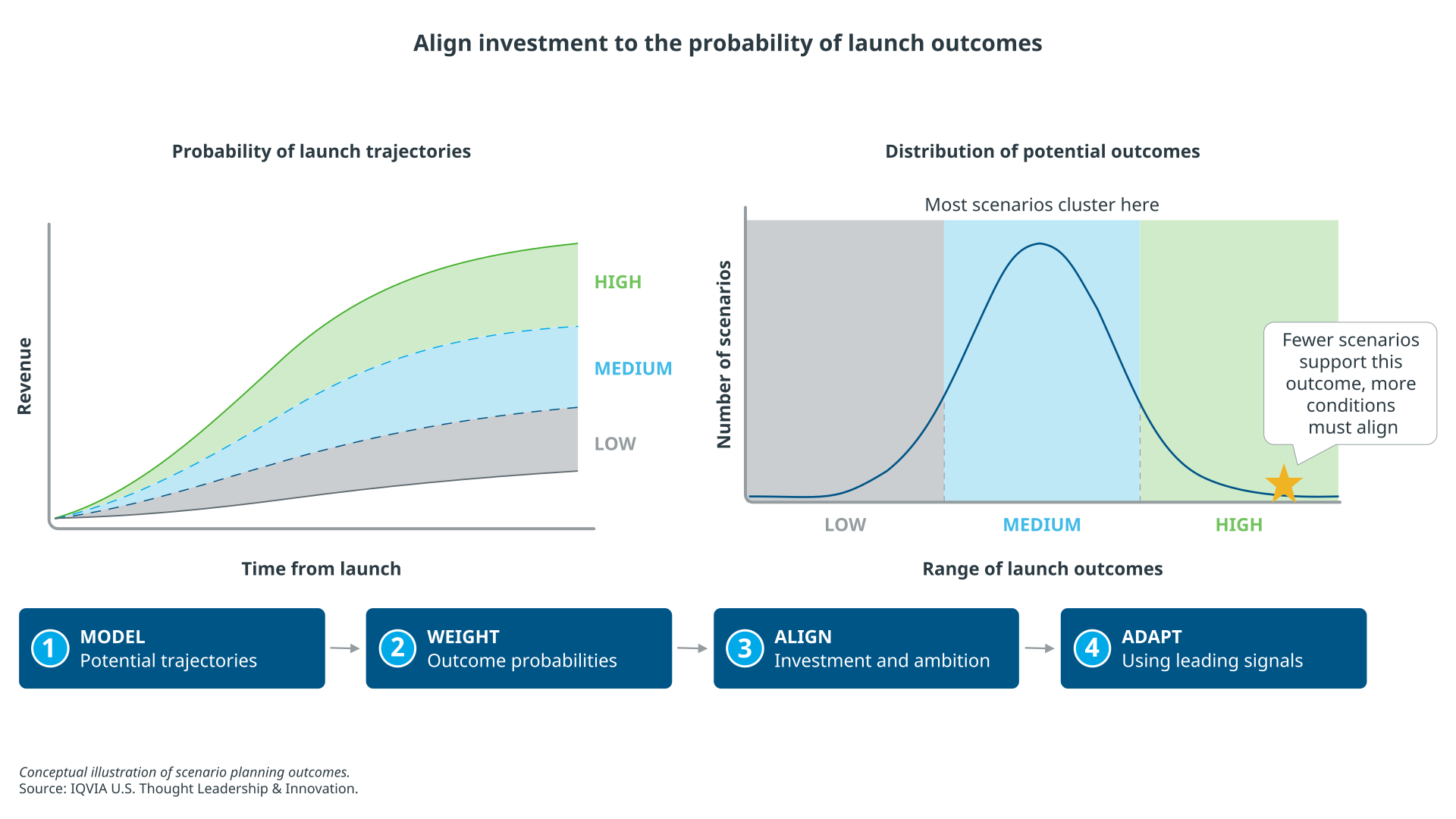
As new evidence becomes available, organizations can update the probability assigned to each trajectory. The resulting distribution clarifies where performance may land, how uncertainty is changing, and which outcomes are gaining or losing support. Leaders can align investment to the most credible trajectory, identify the conditions that could improve it, and revise plans as the evidence develops.
Each advancement creates value on its own. Applied together, they expand the window in which commercial leaders can understand developing conditions and influence performance.
Broader evidence reveals important patterns and behaviors earlier. AI and agentic workflows accelerate how that evidence is evaluated and moved through the organization. Advanced, domain-specific methodologies strengthen the assessment of probable outcomes and the actions most closely associated with them. Together, these capabilities create a continuous decision process that can be revisited as market evidence changes.
The implication extends across launches, brands, operations, and planning cycles. Commercial organizations gain a clearer view of how opportunity is forming, how effectively it is being captured, and where resources can influence future value. Decisions become more timely, commercially specific, and grounded in the conditions shaping performance.
The practical value of next-generation analytics: a wider and earlier decision window and a stronger ability to act within it. Organizations can recognize emerging opportunities, evaluate them with greater context and therefore confidence, and direct action while outcomes remain open to influence. The defining shift comes from connecting information, analytical intelligence, and human judgment early enough to change a decision, redirect an investment, or revise and expectation.

Related solutions
Leapfrog the competition by proving the value of your products