














Thought Leadership & Innovation
Leapfrog the competition by proving the value of your products
This blog is part of the ongoing series, A Brave New World: Finding Life Sciences Success in Modern Markets.
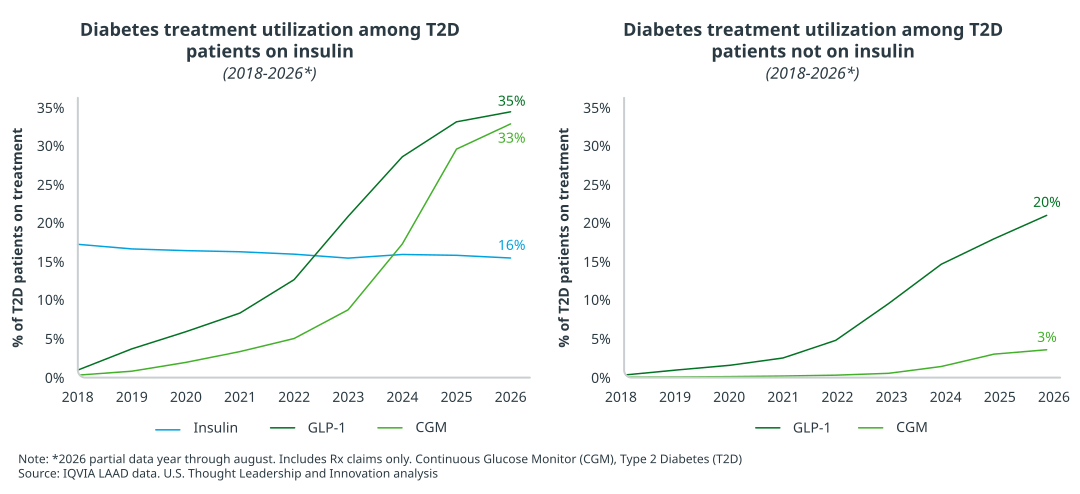
A major evolution in the diabetes market is unfolding as the introduction of GLP-1s reshapes the patient journey. In addition to a rapid evolution in drug treatment, diabetes has become one of the most complex and rapidly evolving areas in MedTech. While GLP-1s are part of that discourse, advances in continuous glucose monitoring (CGM), growing connectivity between monitoring and insulin delivery, and the ease that patients and families now follow glucose data on a mobile device have been reshaping diabetes care in parallel. That means the market is absorbing two major shifts at once (Figure 1).
Those dynamics do not move every diabetes product or technology in the same direction. The attention GLP-1s attract are bringing more people into care, widening the pool of potential CGM and connected-device users. At the same time, new therapies may delay appropriate insulin initiation for people with Type 2 Diabetes, slowing demand for insulin delivery devices. For MedTech manufacturers, the key question is how these market dynamics converge to influence the overall market. Understanding how these trends play out across people using GLP-1 therapy, insulin, CGMs, and insulin pumps can show manufacturers where to focus evidence, build partnerships, and invest for growth.
Figure 1: GLP-1 and CGM utilization among T2D patients, by insulin use
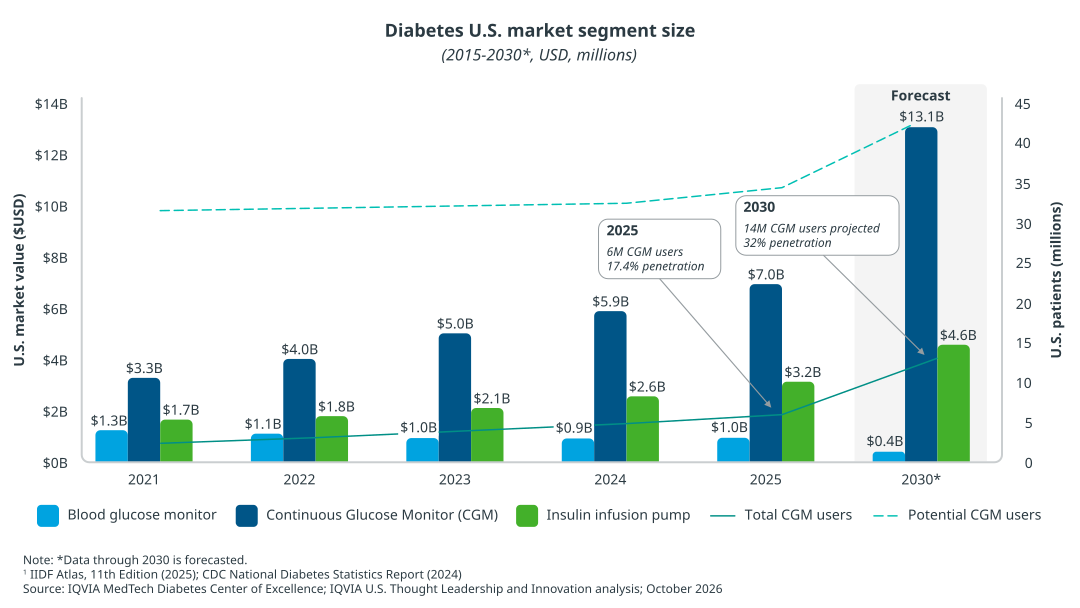
The first dynamic is the accelerated growth of CGM adoption in the U.S. market. CGMs now provide a continuous view of glucose levels for millions of patients. Expected to reach $13B in market value with 14 million users by 2030, utilization of CGMs is expected to increase to nearly double from 2025 revenue and patient bases (Figure 2). One important result has been an increase in supporting evidenceon the expansion of CGM use to people with type 2 diabetes who are not on insulin. That is driving increased adoption amongst the eligible patient population which is forecasted to reach 1 out of 3 potential CGM patients by the end of the decade leaving more room for growth beyond.
Often described as an artificial pancreas, the link between monitors and insulin pumps is moving toward automated insulin delivery systems. Integrated devices now adjust dosing from incoming glucose data with little or no manual input. Smart insulin pens automatically record doses, bringing dosing information more seamlessly into daily management, while glucose readings can be shared in real time with the family members and caregivers who help manage the condition. Together, these advances have made managing diabetes more visible in daily life, making it simpler to control glucose levels in real time. The results are easier, more convenient treatments and patients who are more informed on how to manage their disease.
Figure 2: U.S. diabetes technology market growth and remaining CGM opportunity
Growing reliance on connected devices also brings practical concerns into view. From what happens when an alert fails or a connection drops to how secure the devices are emerging challenges stakeholders face. That reliance raises a question of pace as well, since part of what appears to be rapid innovation may reflect faster uptake driven by awareness. Manufacturers watching for what comes next will want to know whether the next advance lies in broader connectivity, more dependable alerts, or closer links between monitoring and the therapies intended to prevent disease.
The second market dynamic is the growing number of treatment choices. Recent medicine advances had already reduced the need for insulin injections for many people with type 2 diabetes. GLP-1-based therapies, including GLP-1 receptor agonists and dual GIP/GLP-1 receptor agonists act at multiple points of the patient journey, treating established disease while also reaching people at risk without a recorded diabetes diagnosis (Figure 1). That dual effect can narrow the flow of patients toward insulin while widening the flow of people who enter care and want to know whether their glucose is improving.
Diabetes care once followed a familiar route from diagnosis in primary care to management by an endocrinologist to the start of a device. Today that single route no longer describes how many patients arrive at treatment (Figure 3). Beyond primary care, patients now enter through diverse starting points including weight management clinics, direct-to-consumer GLP-1 channels, and sleep diagnostics, and wearables with consumer-driven monitoring. The results are a population that needs attention wider than any one specialty can see.
Each entry point may shape what happens next. A person who starts a GLP-1 therapy through weight management, with or without a diabetes diagnosis, may approach a CGM differently than a person beginning insulin, and that difference carries through to the clinician who recommends the device, the evidence needed to support it, and how its value is assessed.
Figure 3: PCPs are prescribing more CGMs as GLP-1s aid in lessening the severity of disease
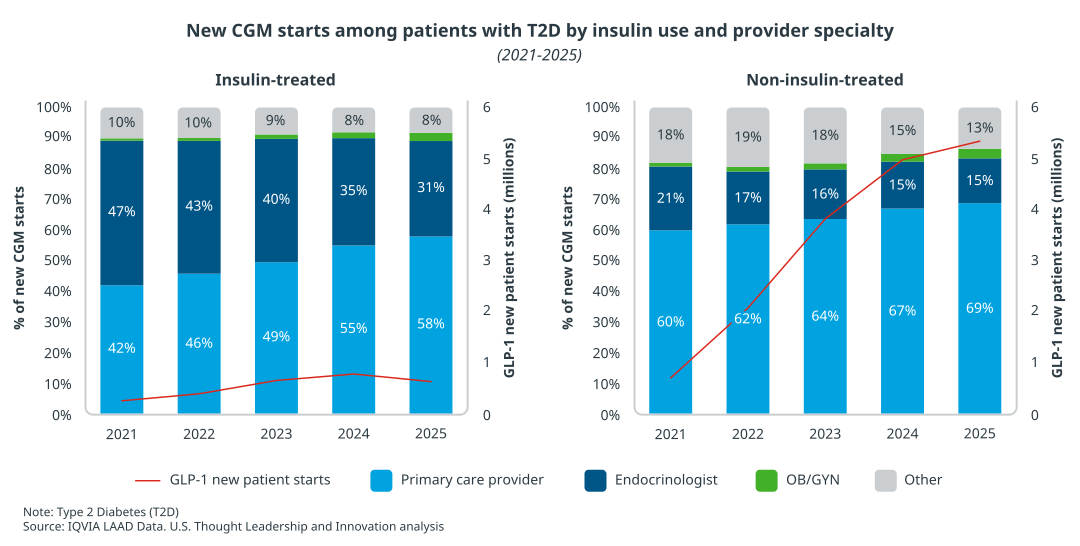
Awareness also reshape patient journeys. In modern markets, many patients arrive having already researched their options or tracked their own glucose. Subsequently, clinicians, who are consumers of information in their own right, bring their own views about which therapies and devices to recommend, so the decision to adopt a device is shaped by informed preference on both sides of the conversation as well as by clinical protocol. How patients and clinicians form those preferences therefore is foundational to understanding demand, alongside where patients enter care.
Understanding how the patient journey is shifting is foundational to building next generation strategies that tap into consumer driven demand. Because people with diabetes may also have chronic kidney disease, osteoarthritis, sleep apnea, and other weight-related conditions, changes in how diabetes is treated may eventually be associated with changes in when and how patients reach renal, sleep, orthopedic care, and other specialty treatment. This opens many downstream impacts that will need to be watched closely through patient-level data.
Demand for needles, syringes, and conventional insulin pens is closely tied to how patients begin insulin, when they begin it, and how intensively they use it. As such, these products are the most likely to feel pressure if GLP-1 therapies delay insulin for some people with type 2 diabetes. That pressure will not be uniform, because people with type 1 diabetes continue to rely on insulin and patients already using it have different needs from those earlier in the disease.
Smart pens, insulin pumps, and automated insulin delivery systems depend on insulin use as well, yet their value extends to making glucose and dosing information easier to act on in everyday care, which can strengthen their role among the patients who need them most. Their position also hinges on connectivity, as some manufacturers pursue open platforms that work with many partners while others build tightly integrated systems.
Monitoring follows a different pattern. CGMs may become relevant to a broader range of people with type 2 diabetes and to people at metabolic risk, while blood glucose meters (BGMs) and test strips remain a meaningful option where CGMs are too costly or unavailable. Diagnostics for kidney, cardiovascular, liver, and broader metabolic health sit farther from insulin delivery, yet they may gain importance as care becomes more proactive, provided a clear clinical purpose and a route to reimbursement to support their use. As more patients act as consumers, patient driven demand for these devices and services will increase over time.
Even in a growing market, as more companies pursue the same patients at the same time, each must establish a clear value proposition. That collective push is raising the evidence threshold, both for the consumer and the healthcare provider, above today’s standards. The same pressure applies to uses that sit outside today’s coverage norms. A company whose evidence outpaces its competitors may also be better positioned for reimbursement. For example, Medicare currently covers CGMs only for people with diabetes who take insulin or have a history of problematic low blood sugar. That leaves monitoring for many patients who could benefit, including those taking a GLP-1 therapy without a recorded diabetes diagnosis, outside of current coverage.
Use cases like this could become the norm in the future if data supports broader payer coverage. However, meeting higher evidence threshold depends on the quality and breadth of the underlying data. Manufacturers are investing in data and artificial intelligence (AI) to find patients and compete for share, yet even the most sophisticated tools are only as reliable as their inputs. The information that matters in diabetes, from demographics and treatment options to comorbidities and prior care, often sits in separate places. Data access is also bounded, meaning organizations see only what they buy, so a product team may understand its own utilization while missing the diagnoses, treatments, and devices that shape upstream demand or a patient’s next step.
A patient-level view that connects those sources can reveal where drugs, devices, and diagnostics intersect how CGM use changes alongside GLP-1 therapy. As reported in the Journal of Diabetes Science and Technology, these shifts reflect established patterns rather than early signals. That distinction matters when manufacturers decide whether to respond to an early signal or invest behind an established change in care.
A connected, patient-level view can help manufacturers move from observing these shifts to deciding where to compete, what evidence to build, and which capabilities to develop or access through partnership. The changing landscape does not point to a single answer, but it does raise four practical questions:
Diabetes MedTech is rapidly evolving as new treatments enter the market and alter the patient journey. The direction of change for the manufacturer depends on the product, the patients it serves, where those patients enter care, and whether the evidence supports wider adoption. Reading those signals calls for insight that reaches beyond any single product or data source and requires connecting treatment, diagnostic, device, and outcomes at the patient level. Leaders must trace how journeys are changing and sharpen decisions about where to focus evidence, partnerships, and growth.
Manufacturers that build this connected view will be better positioned to distinguish an early signal from an established change in care. Upcoming articles in this series will examine these dynamics in greater depth, including how GLP-1 therapies and consumer-driven healthcare are changing where patients enter care, how they use monitoring and connected devices, and how shifts in diabetes treatment may reach adjacent areas such as sleep, orthopedic, bariatric, and cardiovascular care. To explore what these changing patient journeys mean for portfolio, evidence, and growth priorities, contact an IQVIA representative.
Related solutions
Leapfrog the competition by proving the value of your products
Leapfrog the competition by proving the value of your products