














Market Access
Gain high value access and increase the profitability of your brands
This blog is part of an ongoing series, A Brave New World: Finding life science success in modern markets.
Optichannel is gaining momentum across biopharma as the heir apparent to omnichannel engagement, promising greater precision in how companies engage healthcare professionals. Yet, before embracing another new concept, it is worth confronting an uncomfortable reality: after a decade of investment, omnichannel has coordinated activity but has not consistently translated that activity into meaningful gains in engagement, with outcomes varying significantly based on execution maturity and sophistication. The issue is not omnichannel as a strategy, but the way it is implemented. What is needed now is not a new label, but stronger execution of the omnichannel promise.
Over the years, digital channels have multiplied, messaging has become more personalized, and commercial teams have expanded their reach. Still, to many, the expected improvements in healthcare professional engagement and an associated business impact can be uneven across organizations.
The appeal is understandable. Optichannel promises precision, and it signals that commercial teams can identify the optimal channel, content, and cadence for each customer interaction, rather than trying to be everywhere for everyone, all at once. In practice, some organizations have used a broad channel mix to enable timely, relevant engagement when opportunities arise, while others have expanded activity without the same level of coordination. Optichannel feels sharper, more disciplined, and better suited to an era of tighter budgets, higher access barriers, and rising expectations from healthcare professionals and patients. For executives under pressure to deliver more with less, the language is attractive, but adopting new language does not resolve the underlying execution challenge. The danger is mistaking a new label for a new capability.
The industry has been here before. Face-to-face engagement gave way to digital substitution, which evolved into multichannel marketing and later omnichannel engagement. Each shift carried a clear strategic intent: better alignment with customer needs. Yet, each also layered new terminology on top of legacy operating models that often struggled to support that ambition.
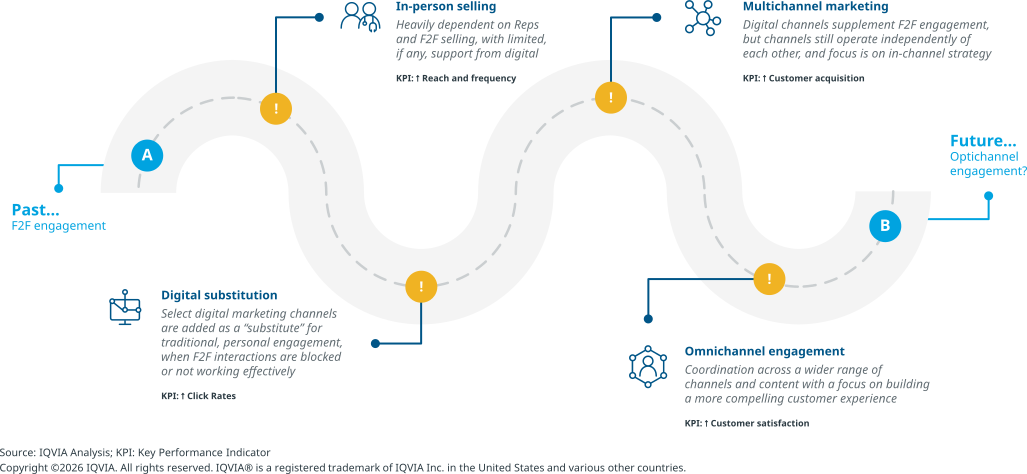
The current shift toward optichannel risks repeating the same pattern: If optichannel is used to sidestep why omnichannel has not consistently scaled, the industry may end up simply renaming the problem rather than addressing the underlying gap.
One of the most common misapplications in practice is interpreting omnichannel as being everywhere. Many organizations have therefore expanded channels more quickly than they have improved relevance, resulting in more email, portals, webinars, paid media, triggers, content journeys, and automation. When coordination lags, more activity does not translate to better engagement. Spamming channels is rarely the answer, as it often happens at the same time that other manufacturers are doing the same.
The original intent of omnichannel was orchestration. The aim was to serve the right customer, through the right channel, with the right content, on the right cadence. That requires a clear understanding of customer needs, decision moments, barriers to behavior change, and the specific touchpoints that influence clinical and prescribing decisions. In other words, omnichannel was always supposed to be selective. It was meant to identify the few moments that matter and make those moments more useful, seamless, and relevant.
This distinction is important, as many businesses have focused too much on the channel aspect and have not sufficiently invested in the operational framework needed to ensure that engagement is truly effective. The result is visible across the industry: significant activity, limited differentiation, and an uneven customer experience.
The industry has not lacked ambition or investment. Over the past five to ten years, and especially during the pandemic, pharmaceutical companies invested heavily in digital marketing automation, new channels, and technology platforms. These investments made it easier to distribute content at scale, but did not consistently translate into more valuable engagement.
Many omnichannel strategies assumed that the digital infrastructure would drive adoption, but in practice, that assumption has not consistently held. With technology at the center of transformation, necessary investments in people, process, governance, and data integration often lagged behind. The experiences around these digital investments did not meet the consumer-grade expectations that healthcare professionals increasingly expect. Healthcare providers (HCPs) have continued to place greater trust in peers, professional networks, clinical communities, and independent platforms than in branded pharma destinations.
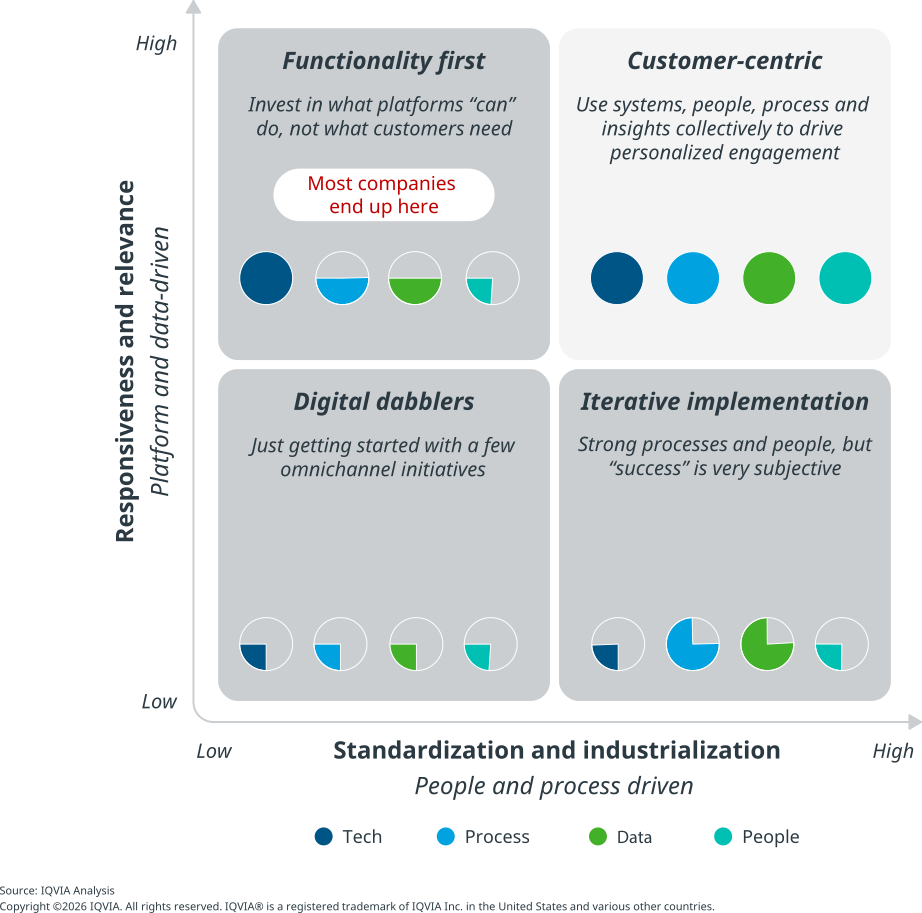
The consequences of the misalignment are now becoming more visible. Even as spending increases, meaningful campaign performance can remain difficult to achieve when engagement is fragmented or inconsistent. Customers are becoming less tolerant of irrelevant, fragmented, or repetitive experiences. When one channel becomes overloaded or irrelevant, disengagement can extend across the broader relationship, reducing performance and eroding trust over time.
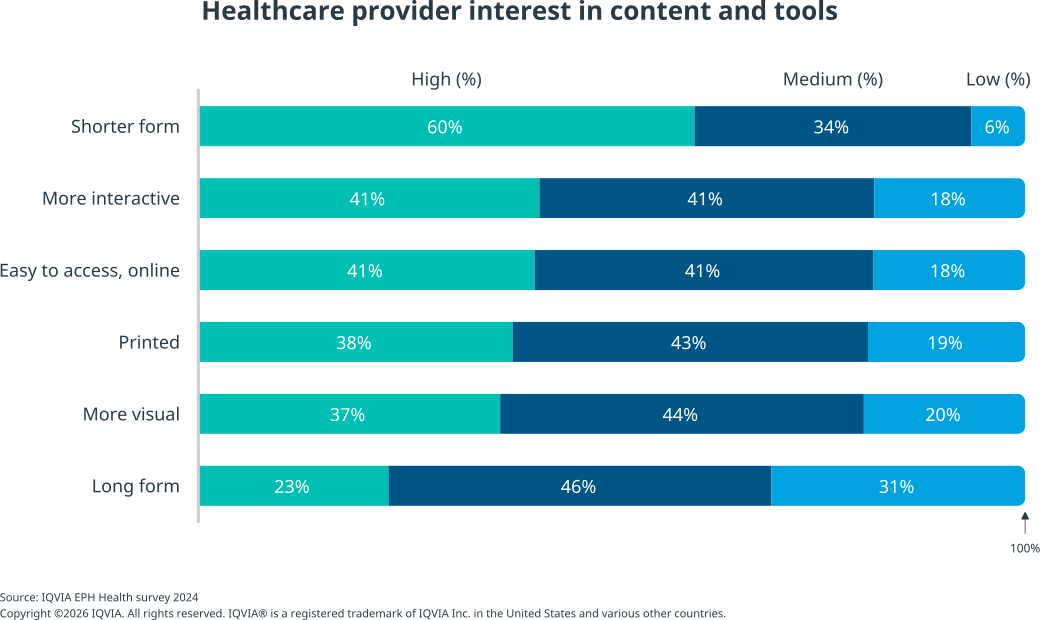
While internal fatigue with omnichannel is real, external forces are moving in the opposite direction. The need for integrated, seamless engagement is not diminishing, it is intensifying. Healthcare professionals are becoming more digitally native. Expectations for short-form, on-demand, interactive experiences continue to rise. Just like consumers everywhere, 60% of HCPs report high interest in short-form information compared to 23% for long-form. Easily accessed online content likewise outranks printed material. Digital behaviors shaped by consumer platforms are entering the professional setting, increasing the expectation that information be accessible, timely, and relevant in the moment.
At the same time, the information landscape is being reshaped by artificial intelligence. Generative and agentic AI tools are changing how medical and scientific information is discovered, summarized, and trusted.
This shift has major implications for pharma. In an AI-enabled information environment, influence depends less on driving traffic to owned channels and more on ensuring content is trusted, structured, discoverable, and useful within the systems healthcare professionals already use. This expands the challenge beyond channel selection to building trust and relevance within those environments. If omnichannel struggled to deliver consistently in a simpler environment, unstructured execution will perform even worse in an AI-mediated one.
A similar shift is occurring among patients acting as consumers. They are more informed, more connected, and more active in shaping conversations about diagnosis, treatment options, adherence, affordability, and support. The HCP journey and patient journey are distinct, but they intersect at critical moments. Patient expectations can influence clinical conversations, and HCP experiences can influence confidence in prescribing.
Commercial engagement can no longer be designed solely around product messages. Brand experience, company experience, HCP experience, and patient experience increasingly reinforce or undermine one another.
The underlying aspiration behind optichannel is sound, but the constraint is execution discipline. Engagement improves when decisions about channel, content, timing, and investment move together and shape what happens next. When they do not, activity increases without changing outcomes.
The risk arises when optichannel is positioned as something fundamentally new rather than as a disciplined expression of what omnichannel was always intended to achieve. Instead of debating omnichannel vs. optichannel, executives should ask why their omnichannel strategies have not consistently scaled to meet customer needs. This question sets a more actionable agenda:
Poorly executed engagement not only fails to meet expectations, but it can also damage trust and limit future prospects. Healthcare professionals have limited time and increasing control over what information reaches them. Irrelevant or excessive outreach can cause disengagement that extends beyond a single channel. Once confidence declines, recovery becomes difficult, and the broader relationship becomes less receptive.
The commercial risk is significant. As therapeutic areas become more competitive, experience can become a critical differentiator. Not every product can be first to market, or have a superior label or an obvious clinical advantage. In those cases, the surrounding experience matters. A company that provides useful information, coordinated support, intuitive access, responsive field engagement, and trustworthy resources can create meaningful differentiation. A company that floods customers with disconnected activity may become increasingly transactional. The bar is being raised as competitive intensity ramps up.
The same principle applies at the enterprise level. Many HCPs and patients have limited awareness of which company makes which product. Yet, enterprise trust can matter, especially as organizations expand patient services, digital health resources, affordability support, and direct-to-consumer engagement. Fragmented brand-level activity can dilute that trust. Coordinated enterprise-level experience can strengthen it.
Properly defined, omnichannel engagement is a customer-centric approach grounded in connected data and orchestrated experiences. It places healthcare professionals and patients at the center of engagement strategy rather than products or channels. It aligns activity across sales, marketing, and medical. It reduces friction. It respects context. It builds trust over time.
This vision is not new; it has been articulated for years. What has been missing is consistent execution. If those gaps remain unresolved, optichannel risks repeating the same pattern, because new terminology does not compensate for fragmented data, misaligned incentives, or insufficient change management.
The path forward is less about reinvention through renaming and more about recommitting to effective execution. The coming era for pharmaceutical leaders will be shaped not by new terminology, but by the ability to address persistent challenges with greater discipline.

This blog is part of a series exploring the evolving dynamics of pharmaceutical brand commercialization. Posts delve into critical themes such as patient engagement, resource-constrained uptake, HCP adoption, investment analysis, payer control, strategic promotion, and the shifting provider landscape. You can find all of our Brave New World content in the U.S. Insights Library.
Gain high value access and increase the profitability of your brands