














Brand & Marketing
Grow your brand, now and through patent expiry
This blog is part of the series, A Brave New World: State of the Industry, on modern market dynamics influencing the life sciences industry.
Over the past decade, the U.S. healthcare provider landscape has been quietly, but profoundly, rewritten. Licensed physicians remain central to care delivery, but they are no longer the sole drivers of patient management. Nurse Practitioners (NPs) and Physician Associates (PAs) have rapidly expanded their reach, now shaping treatment decisions, guiding disease management, and influencing patient journeys across a wide range of therapy areas. What was once considered a supplementary role has become a cornerstone of modern care.
For pharma, this shift should not be perceived as a peripheral workforce trend. Instead, it should inform strategies for prescriber engagement, patient journeys, access, and commercial execution. Companies that continue to rely on physician-centric engagement models risk missing a growing share of clinical decision-makers who increasingly guide therapy selection. NP/PAs are reshaping care delivery models with their rising influence within clinical teams. Understanding how and where NPs and PAs are driving patient care is now a strategic imperative for life sciences leaders.
The numbers tell the story. While the physician workforce, defined as MDs and DOs, grew by approximately 23 percent between 2010 and 2022, increasing from roughly 850,000 to 1.05 million, NP/PA growth has exploded. The NP ranks have surged nearly 400 percent since 2010, and PAs have expanded by roughly 76 percent between 2013 and 20221–4.
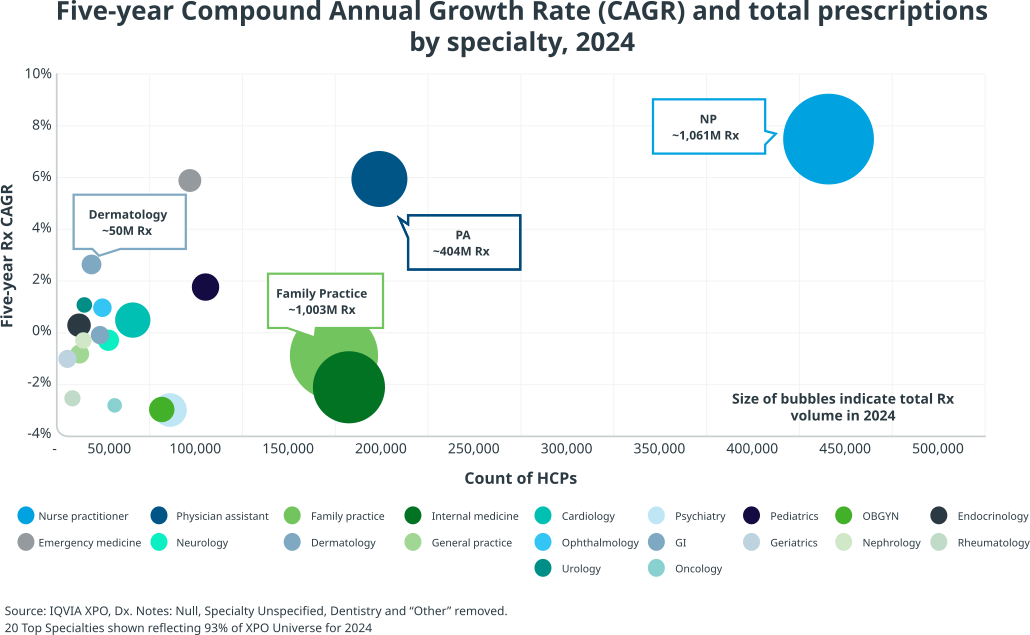
An IQVIA analysis found nearly 600,000 NP/PA providers practicing in the United States in calendar year 2024, and growth shows no sign of slowing. Across the top prescribing specialties, NPs and PAs are posting the fastest prescription growth rates of any provider group over the past five years. NPs have experienced approximately 7% compound annual growth rate (CAGR) in prescription volume, while PAs have grown at roughly 6%. Physician specialties displayed less growth than NP/PAs with variations by field. Dermatology and ophthalmology show minimal growth of 3% and 1%, respectively, while internal medicine experienced a 2% decline.
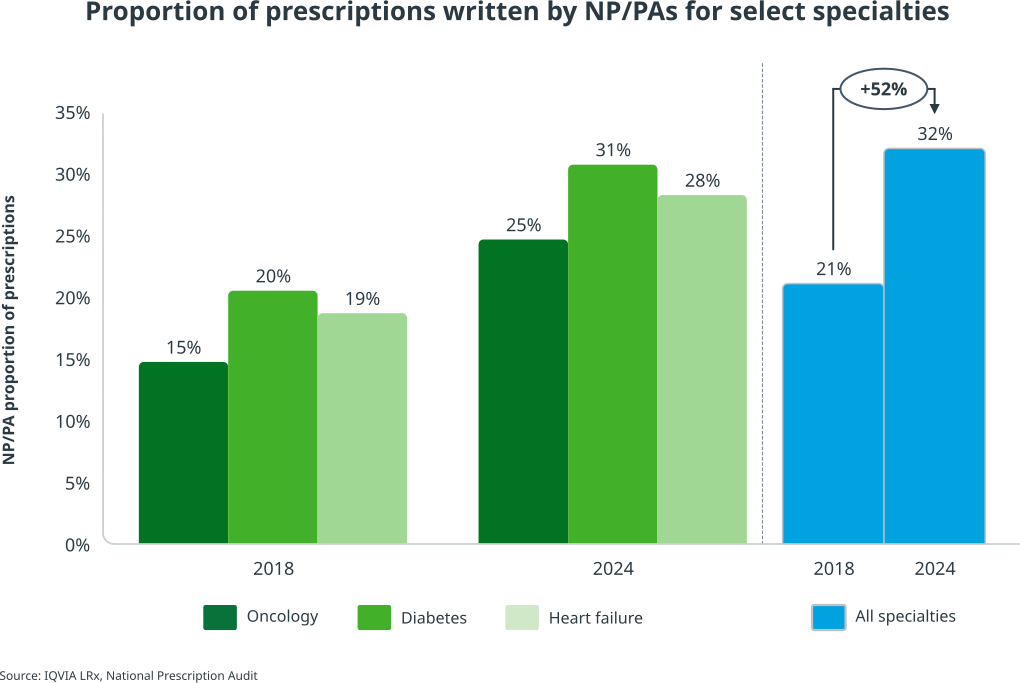
That NP/PAs are just filling gaps in primary care is a misnomer. They are now driving care across nearly every major specialty. Their rapid expansion is reshaping who makes frontline decisions, manages ongoing conditions, and guides patients through their treatment journeys. And the impact is big: their share of total prescription volume has jumped from about 21 percent in 2018 to 32 percent in 2024— a 52% surge that signals a fundamental shift in how U.S. healthcare is delivered.
In oncology, NP/PA prescribing has grown significantly, from roughly 15 percent in 2018 to 25 percent in 2024. Diabetes shows an even bigger shift, with their share of prescribing jumping from about 20% to 31% from 2018 to 2024, largely driven by a corresponding decline in internal medicine and family practice. Heart failure tells the same story: NP/PA’s have climbed from around 19 percent in 2018 to 28 percent in 2024. Licensed physicians are increasingly collaborating with NP/PAs in a consultative or supervisory role for complex cases, while leaving the day-to-day patient management and point of care treatment decisions to the NP/PAs.
To fully understand this shift, it’s important to look beyond the data and examine the day‑to‑day roles NP/PAs play in clinical practice and how they spend their time in real‑world settings. Across primary care and several major specialties, NPs and PAs have moved from supporting roles to being central providers of care. Nowhere is this more evident than in primary care, where visits to NPs and PAs increased by nearly 98 percent between 2010 and 2021, while visits to primary care physicians declined by roughly 43 percent5. Today, these providers routinely manage acute complaints, chronic disease follow-up, preventive care, and routine check-ups, often serving as the first and most frequent point of contact for patients. Similar team-based models are now common in endocrinology, where NPs and PAs manage much of routine diabetes care, including diagnosis, education, medication selection, titration, and prescribing.
In specialty care, NPs and PAs are deeply embedded across cardiology, oncology, dermatology, orthopedics, and surgery. In cardiology, they manage follow-up visits, heart failure and hypertension patients, care coordination, and cardiac rehabilitation, while PAs play key roles on cardiothoracic surgical teams. In oncology, NPs monitor chemotherapy patients, manage toxicities, and lead survivorship clinics, placing them at the center of the patient experience. Dermatology practices increasingly rely on NPs and PAs to manage routine cases and procedures, with many practices now seeing the majority of visits handled by these providers.
The influence of NPs and PAs continues to expand in orthopedics, mental health, and acute care settings. PAs commonly manage pre- and post-operative care, assist in surgery, and treat routine injuries, while NPs oversee inpatient post-surgical management, often providing the most consistent patient touchpoint. In mental health, psychiatric NPs diagnose conditions, prescribe medications, and manage long-term treatment plans, helping address persistent psychiatrist shortages. Emergency departments and urgent care centers also rely heavily on NPs and PAs to triage patients, manage minor injuries and infections, and participate directly in treatment teams, enabling health systems to maintain access, efficiency, and quality of care.
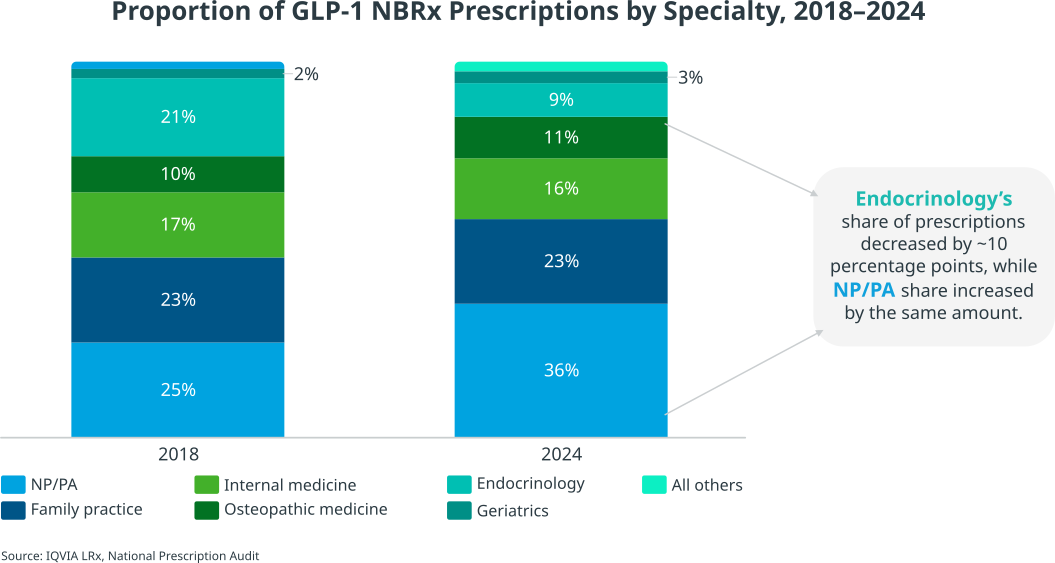
NP/PAs are increasingly acting as critical enablers of innovation, helping new therapies reach a broader and more diverse patient population. For example, NP/PAs have emerged as the fastest-growing prescriber segment in the GLP-1 market, and have directly contributed to their unparalleled success. When examining new-to-brand prescriptions (NBRx) for GLP-1 therapies, NP/PA providers have consistently held substantial share, increasing from approximately 25 percent to 36 percent between 2018 and 2024.
As NP/PAs gained roughly 10 percentage points of prescription share within the category, endocrinology declined by a similar amount. This growth reflects how these providers accelerate diffusion beyond specialty care, particularly in primary and community-based settings where many patients first enter the healthcare system. As NP/PAs adopt these therapies at scale, they amplify the real-world impact of innovation by improving access, reducing bottlenecks in specialty care, and supporting earlier intervention across cardiometabolic disease pathways.
For manufacturers, this shift reinforces the importance of engaging NP/PAs early and intentionally during new product launches. The data demonstrate that NP/PAs are not only fast adopters but are also capable of sustaining growth once momentum is established. Launch strategies that prioritize education, support, and tailored engagement for NP/PAs can meaningfully influence uptake trajectories, ensuring innovations are deployed efficiently. As their prescribing influence continues to expand, NP/PAs will be central to translating therapeutic advances into population-level outcomes.
Several structural forces are converging to elevate the role of NPs and PAs across the healthcare system.
With their momentum continuing to accelerate, NPs and PAs are on track to make up an even larger share of the provider workforce in the years ahead, potentially surpassing primary care physicians. Legislative shifts are further fueling this rise, expanding scope of practice and enabling greater autonomy. At the same time, specialization within NP/PA roles is deepening, with oncology, acute care, neonatal, and subspecialty positions becoming increasingly common. As these providers advance, care teams are becoming more integrated and collaborative, with less hierarchy and more coordinated decision-making. Education and training models are evolving as well, with interprofessional learning preparing future clinicians to operate as true team-based partners, rather than siloed provider types.
These trends necessitate a fundamental recalibration of commercial strategy. NP/PAs can no longer be treated as secondary audiences or peripheral influencers. In many therapy areas, they are first-line decision-makers and ongoing stewards of patient care. To engage them effectively, organizations should adopt best practices that ensure accurate clinician identification that corrects NP/PA misattribution, applies specialty-level segmentation, and incorporates attitudinal insights reflecting NP/PA learning preferences. Approaches to navigate the evolving care landscape include:
NPs and PAs should no longer be seen as emerging stakeholders in healthcare delivery. They are central actors shaping prescribing patterns, patient experiences, and therapy outcomes across multiple specialties. Pharmaceutical companies that adapt quickly can unlock meaningful competitive advantage. In the near term, this means expanding inclusion in campaigns, tailoring content, increasing presence at NP/PA conferences, developing specialized field roles, understanding the role and influence of AI, and tracking engagement separately. Over the long term, it requires dedicated NP/PA marketing teams, targeted product positioning, evolved omnichannel models, and deeper partnerships that reflect the realities of modern care delivery. The provider landscape is changing rapidly. Organizations that recognize and act on the growing influence of NPs and PAs will be better positioned to succeed in an increasingly complex and team-based healthcare environment.
Please contact your IQVIA representative for more information.
References:

Related solutions
Grow your brand, now and through patent expiry
Data, AI, and expertise empower Commercial Solutions to optimize strategy, accelerate market access, and maximize brand performance.
We empower Medical Affairs with end-to-end capabilities, leveraging data, technology, and expertise to generate and disseminate evidence for improved patient outcomes.