







.svg)











Stay ahead with the EMEA Thought Leadership insights: your source for industry-leading expertise and analysis
Blog
Beyond the molecule: Drug delivery innovation as a competitive differentiator
Sep 08, 2026
The pharmaceutical industry is entering a new phase of innovation, where successful therapies will increasingly be defined not only by the molecule itself, but by the way it is delivered. As innovative medicines reshape major therapy areas and healthcare systems seek more efficient models of care, drug delivery is becoming an important source of differentiation. What was once a technical consideration is increasingly influencing patient experience, healthcare efficiency and commercial success.
This trend is particularly evident in parenteral medicines, which are administered by injection or infusion. Parenteral therapies now sit at the centre of many of the industry's highest-value and fastest-growing markets, creating new opportunities to differentiate through convenience, dosing duration, administration setting and enhanced patient experience.1
The rise of parenterals as a key driver of pharmaceutical value
Many of today’s most commercially valuable medicines rely on parenteral delivery. By 2025, parenterals represented 49% of global prescription medicine value at list prices, up from 44% in 2020, making them the largest formulation segment. They also delivered the strongest growth of any major formulation category over the same period, with a CAGR of 13%.
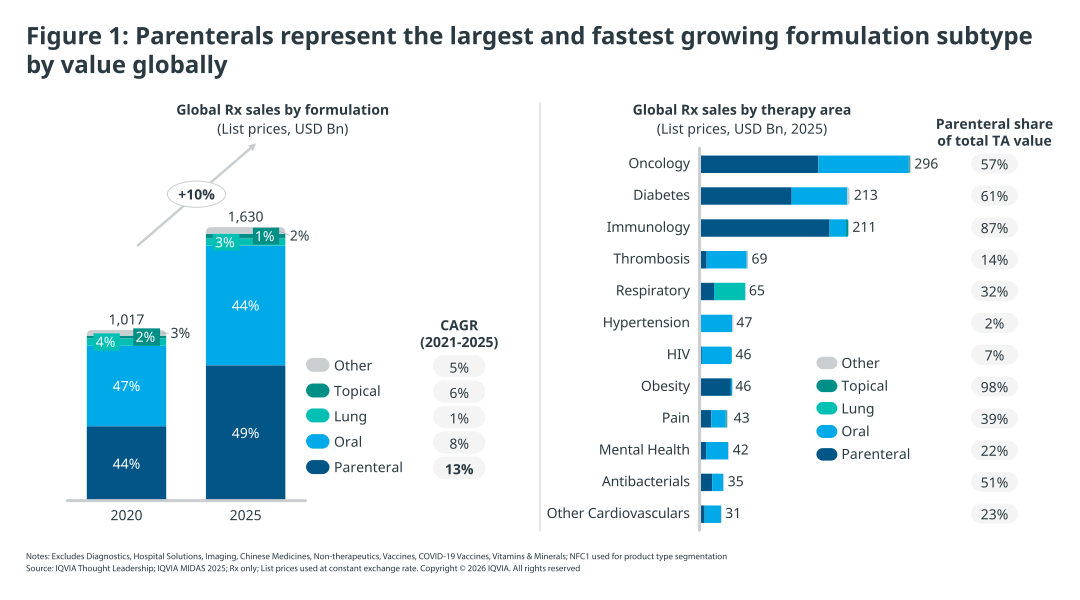
Parenteral medicines also dominate the pharmaceutical industry’s highest value therapy areas. Oncology derives 57% of its value from parenteral medicines, including leading brands such as Keytruda and Opdivo. In immunology, injectable therapies account for 87% of market value, while obesity is also heavily dependent on parenteral delivery, with Wegovy and Mounjaro driving a 98% share.
However, these dynamics are set to shift as oral treatments reshape major therapy areas. Following the launches of Wegovy Pill and Foundayo, the obesity market will become a mix of oral and injectable therapies, driven not only by patient preference, but also possibly by cost, off patent availability, and even sustainability.2 A similar shift is underway in immunology, where the recent launch of the oral IL-23 therapy Icotyde, alongside a growing oral pipeline, points to rising interest in oral treatment options.3
Nevertheless, parenteral medicines remain well positioned for sustained growth, supported by a convergence of powerful market drivers:
- Biologics remain the largest contributor to pharmaceutical market growth, accounting for 64% of overall value growth between 2024 and 2025. Combined with a robust pipeline, they continue to underpin the long-term growth of parenteral medicines.
- Many advanced therapies, including antibody-drug conjugates (ADCs), RNA therapeutics and cell and gene therapies, rely predominantly on parenteral administration and are set to be key drivers of value growth in coming years. ADCs alone are forecast to generate nearly $36 billion in oncology sales in 2030.4
- Accelerating biosimilar competition is shifting differentiation beyond clinical efficacy alone, creating new opportunities to compete through delivery innovation, patient experience and lifecycle management.
The shift from IV to subcutaneous delivery is redefining treatment paradigms
One of the most significant developments in recent years has been the expansion of subcutaneous formulations for medicines historically administered intravenously. With the potential to reduce treatment burden for both patients and healthcare systems, subcutaneous delivery is becoming an increasingly important source of differentiation and launch success.5
Recent subcutaneous launches such as Darzalex Faspro, Phesgo, Opdivo Qvantig and Keytruda Qlex have demonstrated strong uptake following launch, with adoption in some markets extending beyond market expansion to active switching from IV alternatives. Darzalex Faspro exemplifies this trend, accounting for 93% of global brand sales in 2025 while driving significant overall brand growth. In the US and Japan, uptake is even more pronounced, with Darzalex Faspro representing 96% and 99% of brand sales respectively in 2025, illustrating the scale of the shift away from its infusion-based alternative. However, it is important to note that these are standout cases, and subcutaneous therapies with more limited added benefits and efficiency gains may not achieve similar uptake and adoption.
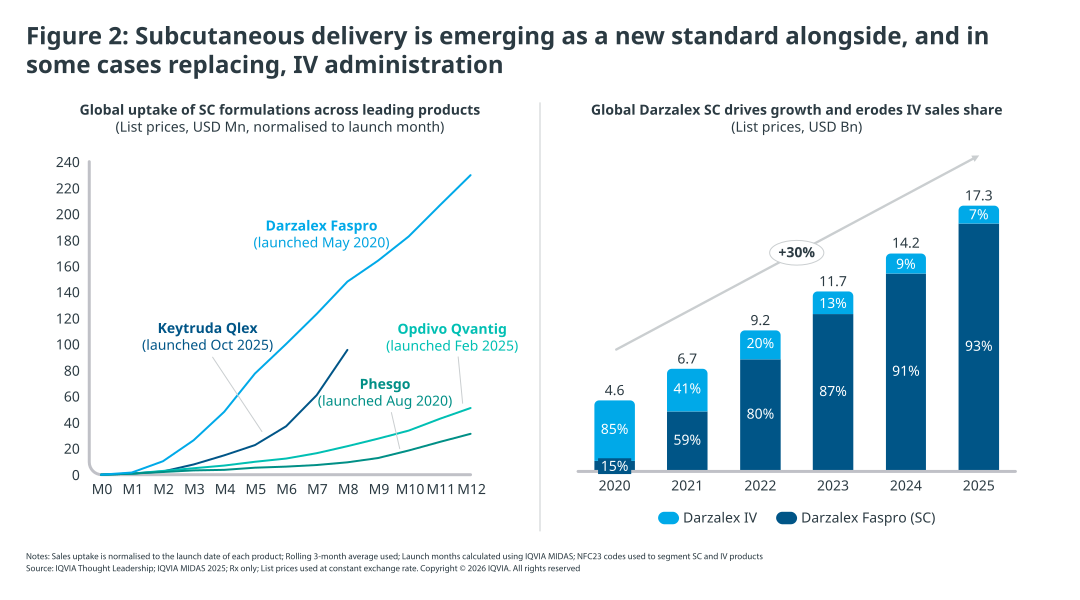
Crucially, the shift from IV to subcutaneous administration aligns closely with broader healthcare priorities. Phesgo can reduce administration time by 1-2.5 hours compared with IV therapy, while Darzalex Faspro can save 3-5 hours per treatment. By reducing pressure on healthcare infrastructure and improving patient and HCP convenience, these innovations create substantial value across the healthcare ecosystem. Their commercial success subsequently demonstrates the benefits of delivery innovation that addresses system-level challenges.
Additionally, this shift demonstrates that innovation increasingly extends beyond the molecule itself. Technologies such as hyaluronidase are enabling larger-volume biologics such as these to be administered subcutaneously, expanding the range of therapies that can move beyond infusion-based care. The value of these platforms is reflected in ongoing intellectual property disputes between Halozyme and Alteogen,6 whose technologies underpin several high-value products, including Keytruda Qlex, the subcutaneous version of one of the world's best-selling medicines.
As highlighted by Keytruda Qlex, delivery innovation is also becoming an important lifecycle management tool. New formulations and administration platforms can create additional intellectual property, differentiate established brands and help sustain value as loss of exclusivity approaches. Humira illustrated this well, with its citrate-free reformulation improving the injection experience for patients while strengthening differentiation ahead of biosimilar competition back in 2023.7 Consequently, as pharma pursues greater convenience, lifecycle extension and more flexible treatment settings, delivery technologies are emerging as strategic assets in their own right.
Self-administration and the extraordinary rise of GLP-1 medicines
Another defining trend in drug delivery innovation is the rise of self-administration, enabling treatment to move beyond hospitals and specialist clinics and into patients' homes. By 2025, medicines capable of self-administration accounted for more than 60% of global parenteral sales at list prices, reflecting growing demand for convenience, flexibility and reduced reliance on healthcare infrastructure.
Self-administration is already central to major therapy areas such as immunology and diabetes, but few therapies have reshaped the drug delivery landscape in recent years as profoundly as GLP-1 medicines. Unlike many other high-value injectables, GLP-1s serve large chronic patient populations, bringing injectable delivery into the pharmaceutical mainstream at unprecedented scale. While much attention has focused on their clinical benefits and commercial success, their impact on devices, manufacturing capacity and the broader injectable ecosystem prove equally significant.
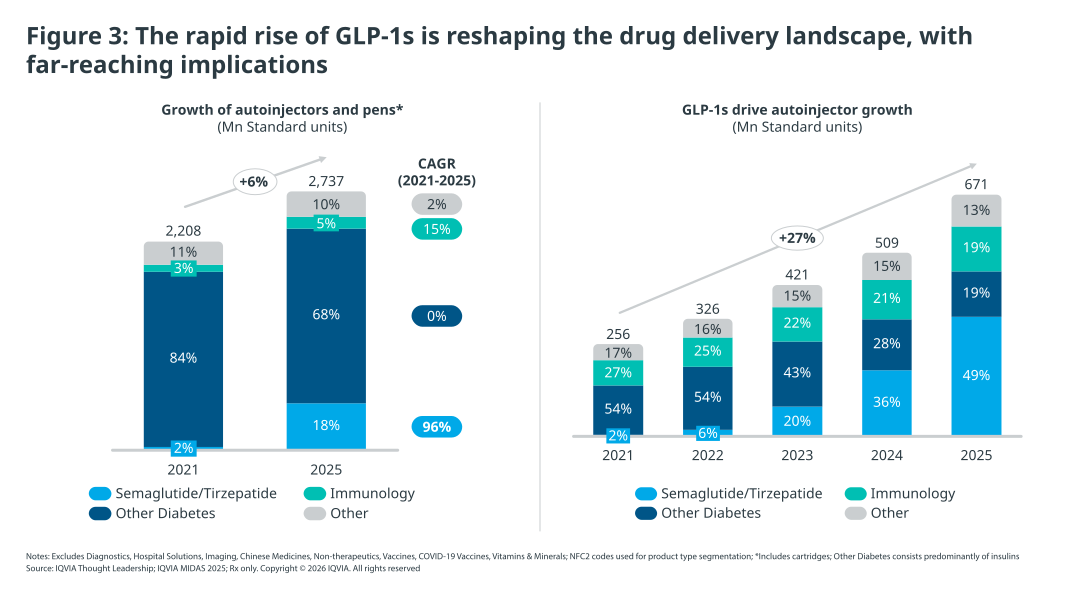
Their influence is evident in overall device demand. Historically, pens, cartridges and autoinjectors were largely driven by established therapies such as insulin. However, since 2021, semaglutide and tirzepatide have transformed this landscape, increasing their share of volume across these devices from 2% to 18%, while diabetes and insulin pens have remained flat over the same period.
This trend is even more profound when examining autoinjector devices alone. By 2025, semaglutide and tirzepatide accounted for almost half of global autoinjector volume, up from just 2% in 2021. In only a few years, GLP-1 medicines have become the largest segment within the category, fundamentally altering volume dynamics across the device market.
The subsequent implications of these seismic shifts are far-reaching:
- Accelerating the shift towards self-administration: GLP-1s have reinforced demand for patient-friendly delivery systems that reduce reliance on healthcare facilities and professionals, highlighting the growing importance of patient convenience.
- Increasing pressure on manufacturing capacity: The scale of demand is turning autoinjectors, pens and associated components into strategic assets, while access to manufacturing capacity and supply security is becoming an increasingly important competitive differentiator.
- Off-patent therapies are set to create a new wave of device demand: Future loss-of-exclusivity events are set to expand patient access further, driving additional demand for injectable delivery devices and increasing the importance of manufacturing scale and supply resilience.8 This dynamic is already evident in India, where generic semaglutide is available in multiple formats, including vials, reusable pens and cartridge-based devices.
- Bringing digital patient support into focus: As more therapies become self-administered, patient support programmes and digital companion applications will play a growing role in supporting adherence and treatment persistence.
- Increasing scrutiny of sustainability: The rapid growth of single-use devices is increasing scrutiny around material waste, recyclability and lifecycle impact, highlighting the need to balance convenience with environmental responsibility. Oral obesity agents may hold an advantage in this regard by eliminating injectable-related waste and sharps disposal challenges.
Looking ahead: The evolving role of drug delivery
As parenteral medicines continue to account for a growing share of pharmaceutical value, attention is increasingly shifting beyond therapeutic efficacy alone. Advances in formulations, delivery devices and administration routes are reshaping how medicines are experienced by patients, delivered through healthcare systems and differentiated in the market.
The rapid growth of subcutaneous delivery and self-administered injectables is accelerating this shift, demonstrating how delivery innovation can improve convenience, expand access and reshape treatment pathways. At the same time, emerging innovations, including ultra-long-acting injectables,1 novel devices and new administration models, are creating opportunities for lifecycle management and differentiation in increasingly competitive markets. As the industry continues to expand the use of biologics and other advanced modalities, success will increasingly depend on the ability to combine therapeutic innovation with delivery solutions that are patient-centred, operationally scalable and sustainable for healthcare systems.
References
1 Playing the long game: The promise of ultra long-acting injectables, IQVIA Thought Leadership, August 2025: https://www.iqvia.com/locations/emea/blogs/2025/08/playing-the-long-game
2 Outlook for Obesity in 2026: From Consolidation to Acceleration, IQVIA Thought Leadership, January 2026: https://www.iqvia.com/locations/emea/blogs/2026/01/outlook-for-obesity-in-2026
3 Nine for 2026: Part 2, IQVIA Thought Leadership, January 2026: https://www.iqvia.com/locations/emea/blogs/2026/01/nine-for-2026-part-2
4 IQVIA Early Bird: 2025 Revealed - The Trends Shaping Pharma's Future, IQVIA Thought Leadership, March 2026: https://www.iqvia.com/blogs/2026/03/iqvia-early-bird-2025-revealed
5 Achieving Oncology Launch Excellence, IQVIA Thought Leadership, July 2024: https://www.iqvia.com/library/white-papers/achieving-oncology-launch-excellence
6 Alteogen defends its technology as Halozyme sues MSD over Keytruda injectable, Korea Biomedical Review, March 2025: https://www.koreabiomed.com/news/articleView.html?idxno=27395
7 Generic and Biosimilar Economics in a Payer-Engineered Market, IQVIA U.S. Thought Leadership, June 2026: https://www.iqvia.com/locations/united-states/blogs/2026/05/generic-and-biosimilar-economics-in-a-payer-engineered-market
8 Your Questions Answered: Off-patent Semaglutide in 2026, IQVIA Thought Leadership, April 2026: https://www.iqvia.com/locations/emea/blogs/2026/04/your-questions-answered-off-patent-semaglutide-in-2026