
.svg)




Analytics Link Ecosystem
IQVIA Analytics Link Ecosystem establishes deep connections across our key data assets.












Throughout 2025, policy shifts, breakthrough innovation and renewed business momentum reshaped the global healthcare and pharmaceutical sectors. These developments unfolded within an increasingly complex launch environment, characterized by growing healthcare system capacity challenges, the expansion of the private market, and an evolving stakeholder engagement landscape. Against this backdrop, IQVIA’s “Early Bird” provides a first look at the defining pharmaceutical trends and metrics of 2025, shedding light on how key therapy areas evolved in response to these dynamics.
Beyond these macroenvironmental shifts shaping the industry, the global prescription medicine market delivered strong underlying performance in 2025. At list prices, the market reached ~$1.7 trillion, reflecting 10% year-on-year growth (Figure 1). This expansion was driven primarily by established medicines but also complemented by a continued flow of innovation. An estimated 73 novel active substances were launched globally during the year, exceeding the average of the past decade. Looking further ahead to 2030, however, loss of exclusivity is expected to be the single largest contributor to slower global growth, reinforcing the importance of sustained innovation to compensate for this value erosion.1
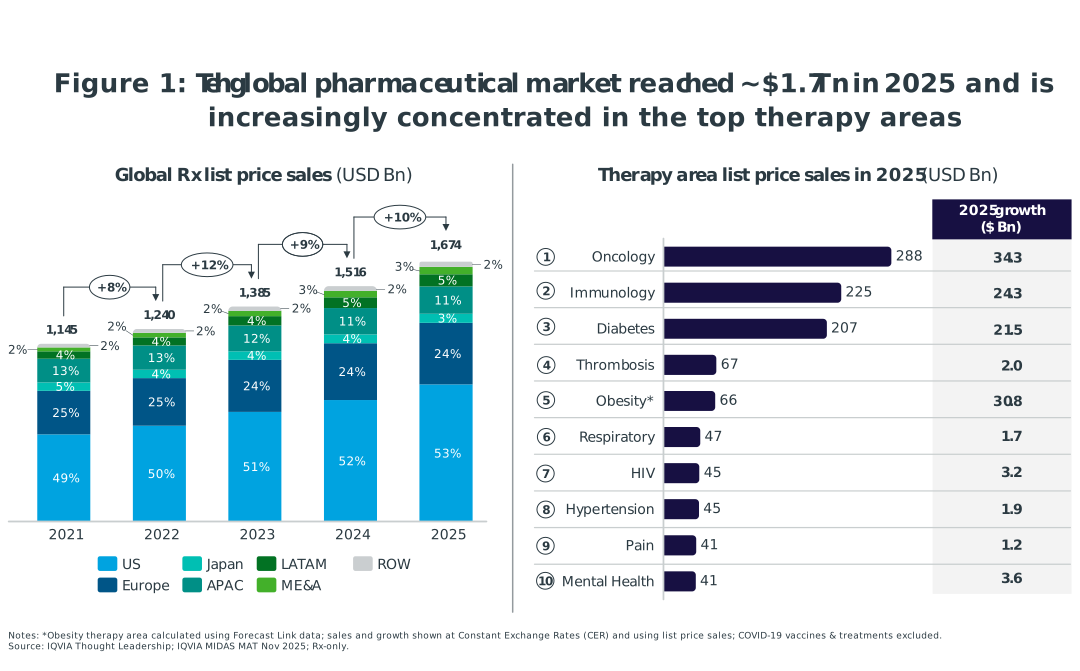
Globally, the pharmaceutical market remains highly concentrated, with the US now representing 53% of the market, up from 49% in 2021. Europe has maintained a share of 24% over recent years, led by Germany and France, and APAC's share of sales has contracted to 11%, despite China remaining the world’s second‑largest pharmaceutical market. In contrast, the greatest expansion occurred in Middle East and Africa (ME&A), where countries such as Saudi Arabia helped drive 18% year‑on‑year growth across the region, reflecting improved access and policy reforms alongside rising demand.
A similar pattern of concentration is evident at the therapy area level. In 2025, oncology, immunology, and diabetes together accounted for 43% of global pharmaceutical value, up 11% since 2019, underscoring how growth is increasingly anchored in a small number of high impact therapy areas. Most striking, however, is the rapid ascent of obesity, which has now entered the top five therapy areas globally. With almost $31 billion in absolute growth year-on-year, obesity surpassed immunology and emerged as the second largest contributor to growth. Taken together, oncology, immunology, diabetes, and obesity generated approximately $111 billion in growth over the past year - representing 89% of the growth generated from the top ten therapy areas.
As 2025 unfolded, oncology continued to lead the global prescription medicine market, with sales reaching approximately $288 billion. The majority of this value was concentrated in solid tumours, which accounted for $194 billion, led by breast cancer, non-small cell lung cancer and prostate cancer. In contrast, hematological tumors accounted for $75 billion, with multiple myeloma, chronic lymphocytic leukemia, and non-Hodgkin’s lymphoma representing the leading indications.
However, growth dynamics across these segments diverged. Whilst solid tumors maintained steady growth of around 13%, hematological tumors slowed to 8%, reflecting greater volatility driven by losses of exclusivity. This impact was particularly evident in multiple myeloma, in part driven by lenalidomide going off patent. Although patent protection lapsed in 2019, various settlement agreements continued to moderate generic impact, with increased generic volumes in 2025 contributing to a sharper slowdown in growth prior to unrestricted competition in 2026.
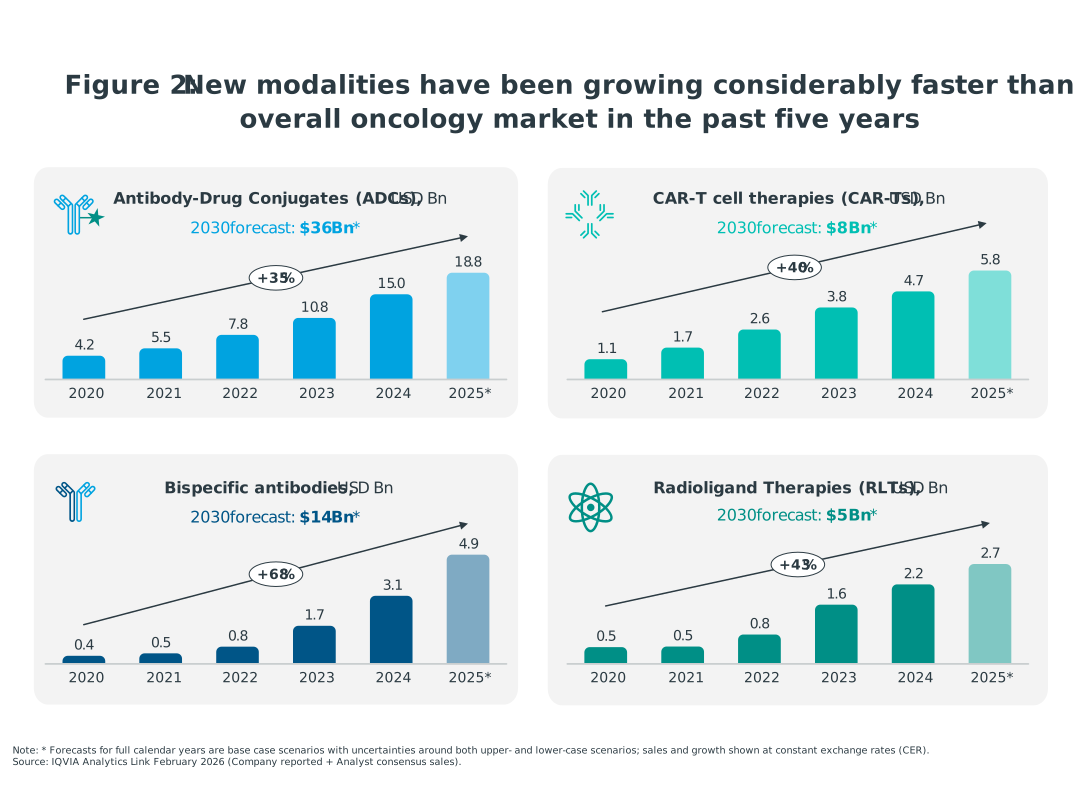
Looking ahead, similar dynamics are expected across the wider oncology market, as several blockbuster products approach losses of exclusivity towards the end of the decade, such as pembrolizumab and nivolumab. Nonetheless, novel modalities could help to compensate for value erosion ahead of these looming patent cliffs.2 Over recent years, many of these platforms have outpaced overall oncology market growth, underscoring their potential role in sustaining momentum (Figure 2).
As we moved through 2025, the global obesity market reached a watershed moment, with sales reaching nearly $66 billion at list prices (Figure 3). Resolution of operational challenges, most notably the alleviation of US supply constraints, stabilized product availability, further paving the way for accelerated market growth and greater patient access.3
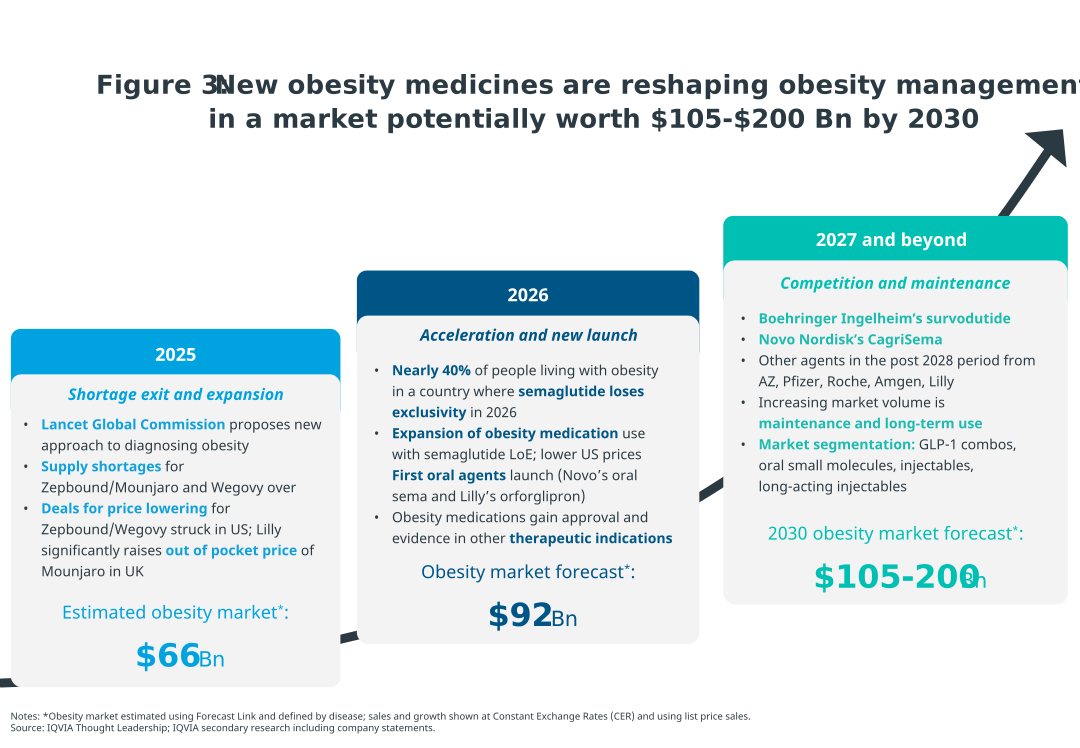
With 2026 now well underway, the obesity market is set to accelerate further, supported by the launch of the first oral agents (Novo Nordisk’s oral semaglutide and Lilly’s orforglipron). These advances are projected to help drive the global obesity market to an estimated $92 billion in 2026, reinforcing its position as one of the fastest-growing therapy areas. At the same time, 2026 represents a critical inflection point as semaglutide goes off patent across major markets including China, India, Mexico, Canada, and others. Collectively, these countries account for nearly 40% of adults living with obesity worldwide, so this marks a significant shift in global affordability and uptake. As lower priced off patent entrants emerge, private market expansion is likely to accelerate, particularly in price sensitive markets such as India and China, with the potential to unlock access for millions of patients previously priced-out of treatment. Lower pricing across these markets could also act as a catalyst for wider reimbursement, with Canada emerging as a potential early mover towards broad GLP 1 coverage.
Distinct country-level dynamics are also beginning to emerge, for example in India, where off-patent semaglutide is expected to enter the market within a year of the launches of Lilly’s Mounjaro in March 2025 and Novo Nordisk’s Wegovy in June 2025. This compressed timeline has created a narrow window for originators to establish patient share before generic competition intensifies. In parallel, Indian manufacturers are positioning for a broader global role, with companies such as Biocon partnering with Biomm to support the filing and commercialization of off-patent semaglutide in Brazil.4
Looking to 2027 and beyond, the obesity market is poised to become even more competitive and segmented. The anticipated introduction of novel agents, including Boehringer Ingelheim’s survodutide and Novo’s CagriSema, will further broaden treatment choice as additional assets progress through the pipeline. In this increasingly crowded environment, commercial focus will continue to shift from initial patient acquisition towards achieving long-term adherence, differentiation, and brand loyalty. Additionally, an expanding clinical pipeline spanning multiple mechanisms of action and routes of administration will continue to support market growth. Together, these dynamics point to a future obesity market that is not only significantly larger, but also increasingly crowded and segmented.
For a deeper dive into these topics, watch our on-demand webinar here. Explore global market trends, the evolving launch environment, and therapy area deep dives in oncology, immunology, and obesity markets. Don't miss out—watch the webinar now to stay ahead in the industry!
1Global Medicine Use Trends 2026; IQVIA Institute white paper, February 2026: https://www.iqvia.com/insights/the-iqvia-institute/reports-and-publications/reports/global-medicine-use-trends-2026
2Breaking New Ground: Advancing Cancer Care with Novel Therapeutic Modalities; IQVIA white paper, September 2024: https://www.iqvia.com/library/white-papers/breaking-new-ground-advancing-cancer-care-with-novel-therapeutic-modalities
3Outlook for Obesity in 2026: From Consolidation to Acceleration; IQVIA blog, January 2026: https://www.iqvia.com/locations/emea/blogs/2026/01/outlook-for-obesity-in-2026
4Off-patent semaglutide in 2026: the next revolution in anti-obesity medications; IQVIA blog, August 2025: https://www.iqvia.com/locations/emea/blogs/2025/07/off-patent-semaglutide

Join this on demand webinar to explore 2025 pharma market trends, understand their implications for the year ahead, and gain actionable insights to support strategic planning and decision making.
Related solutions
IQVIA Analytics Link Ecosystem establishes deep connections across our key data assets.
Analyze industry leading sales and medical data in a standardized and comparable way, including cross-country analysis of performance and additional insights into global and regional markets.
Measure the performance of your sales force and marketing channels, adapt your commercial strategy and gain real world competitive insights.