














Real World Evidence
Our Real-World Evidence offerings turn diverse healthcare data into actionable insights, empowering confident decisions and better patient outcomes.
This blog is part of an ongoing series, A Brave New World: State of the Industry, on modern market dynamics influencing the life sciences industry.
For decades, generics were expected to follow a predictable pattern, and biosimilars were expected to mirror this. Loss of exclusivity (LoE) was assumed to trigger rapid substitution, broad competition, and steady price erosion as lower-cost alternatives entered the market. That framework shaped how manufacturers anticipated lifecycle risk and how payers approached access. Today, however, post-exclusivity dynamics are no longer easy to predict. Traditional small-molecule generics are achieving slower and less consistent uptake than in prior eras, while uptake of biosimilars varies by product and market. Outcomes increasingly depend on market structure, economics, and access design rather than on prescriber or patient choice alone.
Biosimilars sit at the center of this shift and illustrate how the market has learned to manage post‑exclusivity transitions. Early examples suggested that biosimilar uptake would be gradual and fragmented, reinforcing perceptions of market inertia. What subsequent launches have revealed is that inertia persists only until certain economic and access thresholds are crossed. Once payer incentives align and switching mechanisms activate, utilization can move rapidly and at scale, often within compressed timeframes that resemble traditional generic erosion. The implication is clear. LoE is no longer a passive or predictable event. It is a payer‑engineered inflection point where timing, access strategy, and concentration determine how quickly value moves, how many winners emerge, and how much risk manufacturers ultimately face.
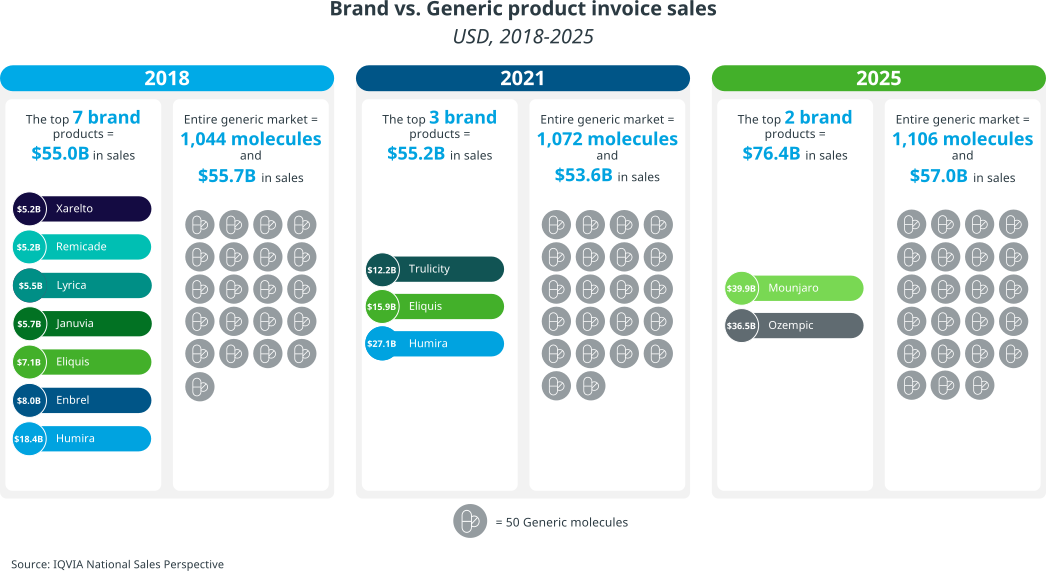
The gap between branded and generic value has widened significantly over the past decade. While generics continue to represent the vast majority of prescription volume, the overall size of the generic market has remained relatively flat at approximately $57 billion. At the same time, branded value has become increasingly concentrated. In 2018, it took seven branded products to equal the entire generic market. By 2025, just two GLP-1 products greatly exceeded total generic invoice sales, underscoring how much economic weight is now carried by a small number of blockbuster brands.
In addition to generating more concentrated branded revenue, generic molecule uptake slowed over time. For small molecules, between 2009 and 2013, generics on average reached 57% of peak uptake within 1 month of launch, while in the last five years, generics have taken 6 months on average to achieve this same level of uptake.
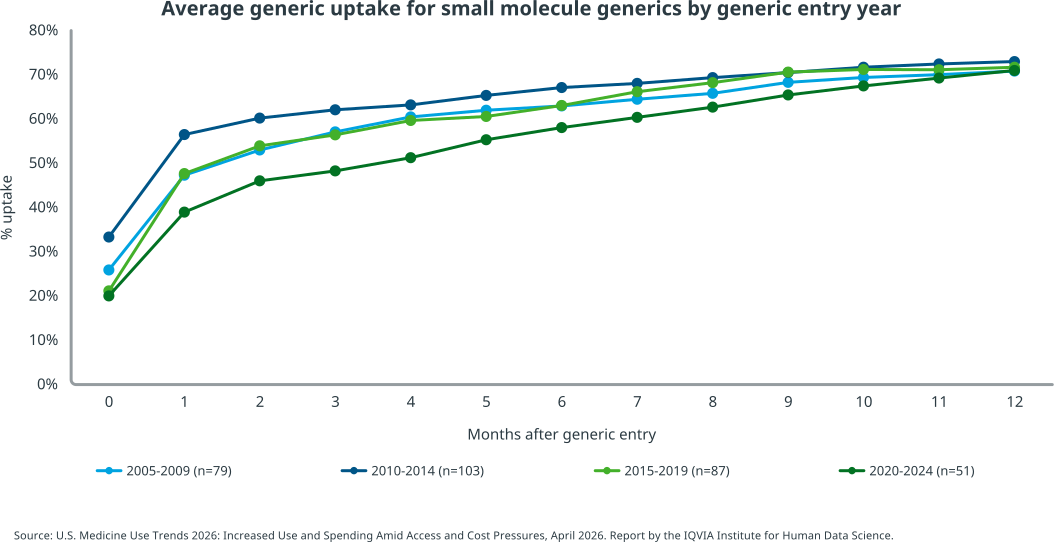
However, slower generic uptake may not signal reduced competitive risk at LoE; rather, it may indicate changes in who controls the generic market.
As payer utilization management, formulary design, and access controls have expanded, erosion has shifted from a gradual, economic-led process to one defined by discrete access decisions. In this environment, competition will not always steadily erode share from the moment alternatives launch. Instead, branded value remains anchored until payer economics and operational levers activate, at which point, demand can be rapidly and decisively reallocated.
The biosimilar launches of Humira and Stelara highlight how payer control and vertical integration, rather than product availability alone, determines the pace and shape of post‑exclusivity erosion. Both products ultimately experienced rapid biosimilar uptake; however, their paths diverged meaningfully in the time it took for market share to shift. Following LoE, Humira retained substantial share for more than a year as switching incentives remained weak and market inertia remained high. Stable access conditions, reinforced by copay support and rebates, limited economic pressure to move. At the same time, Humira’s multiple extended formulations, including widely adopted citrate‑free options with improved tolerability, raised the bar for biosimilar substitution. In this environment, the presence of multiple biosimilars was insufficient on its own to move utilization at scale which aided in preserving Humira’s market inertia.
For Humira, clear inflection points emerged only after payer intervention altered access economics. When two major PBMs implemented formulary restrictions and coordinated switching protocols, utilization shifted abruptly away from the reference product. The timing and magnitude of this change underscore a critical insight. Biosimilar adoption is constrained by inertia until payer economics, formulary position, and operational levers actively force a reallocation of demand. Discounts alone did not trigger switching in a market already optimized around patient affordability and brand familiarity. Erosion accelerated only after access conditions made biosimilar use the default option rather than a voluntary alternative.
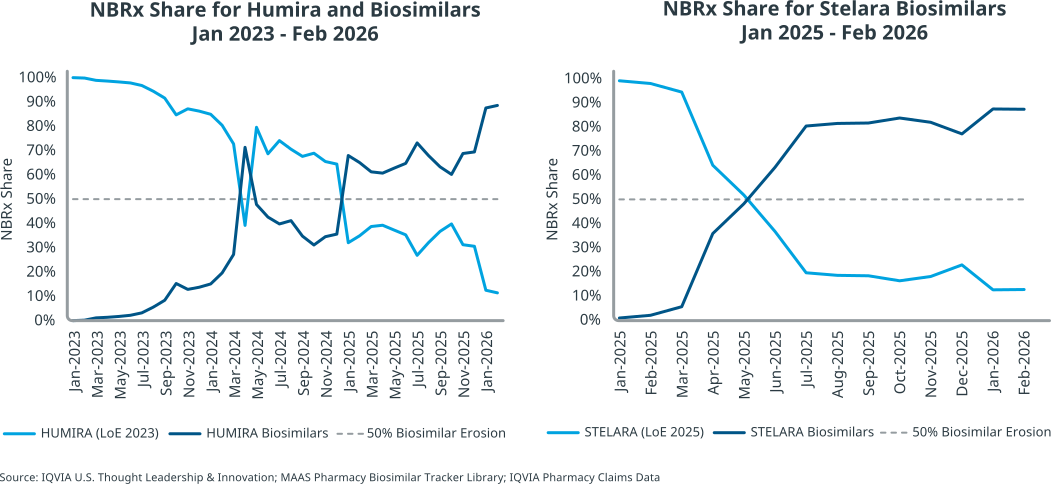
The Stelara biosimilar experience reflects how the market applied these learnings more efficiently. Compared with Humira, Stelara entered a post‑exclusivity environment with fewer formulation variants and less product‑level complexity, reducing friction for switching. Payer alignment occurred earlier, allowing demand to move decisively soon after biosimilar entry. As a result, erosion unfolded far more quickly, with the time to reach 50% patient acquisition share loss compressed from years to months.
Together, Humira and Stelara show that biosimilar erosion is neither slow nor automatic. It is conditional on payer control, vertical integration, product readiness, and access design. Where formulation complexity and patient economics reinforce inertia, erosion can lag well beyond LoE. Where those barriers are minimal and payer mechanisms activate early, value shifts rapidly and decisively, defining winners and losers in the earliest phases of post‑exclusivity transition.
Payer behavior is having an increasingly important impact on biosimilar adoption. Today, biosimilar adoption is driven less by prescriber-led substitution and more by formulary design, utilization management, specialty pharmacy, and access controls that determine which products scale. The experiences of Humira and Stelara illustrate how payer control translates into market movement. In both cases, adoption inflected only after access conditions shifted in favor of biosimilars. In each market, a major PBM implemented preferred positioning of white-labeled branded biosimilars while restricting alternatives, driving rapid reassignment of demand through payer-level rejection rather than patient-initiated abandonment. By embedding selected biosimilars directly within the payer’s ecosystem, these strategies simplified adoption within established access pathways and effectively dictated which products gained scale.
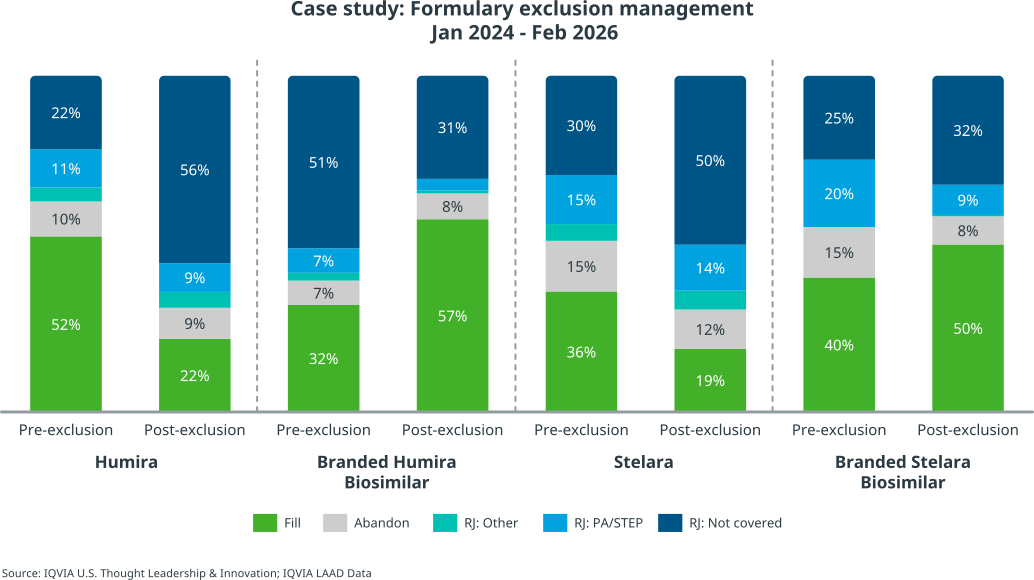
Importantly, this payer-driven model constrains how competition unfolds. While multiple biosimilars may be available at launch, formulary design and utilization management determine when demand shifts and how quickly scale is achieved. Early access decisions steer utilization toward preferred products and accelerate adoption after switching has been embedded into coverage pathways. This results in compressed timelines and limited opportunity for late repositioning entrants. In this environment, market outcomes are driven less by incremental price competition and more by alignment with payer priorities, operational readiness, and the ability to support coordinated switching at the moment access conditions change.
LoE no longer triggers predictable, linear erosion. Instead, erosion is defined by when market inertia on branded products breaks. As the Humira and Stelara experiences show, value does not decline steadily from the moment exclusivity expires. It can remain steady if access conditions preserve existing behavior. However, once payer mechanisms activate, patient behavior will follow abruptly. The decisive factor is not simply the presence of competition, but the timing at which switching becomes economically incented and operationally feasible.
This dynamic materially heightens LoE risk for manufacturers of today's largest branded products. As portfolio value becomes increasingly concentrated in a small number of mega-scale assets, erosion carries outsized consequences. Once payer-driven switching engages, erosion can compress, rapidly reallocating large volumes of value. Biosimilars play a central role in this process, not because they guarantee quicker erosion in every case, but because they provide examples of the mechanism payers use to redirect demand once conditions align.
This shift requires a reframing of how LoE is managed throughout a product’s lifecycle. Rather than reacting at the point exclusivity expires, outcomes are increasingly determined earlier through access strategy, payer alignment, and competitive readiness. Where inertia persists, value may be temporarily protected. Where payer control activates early, erosion accelerates sharply. LoE is no longer a gradual lifecycle phase. It is a high‑stakes inflection point defined by market learning, access design, and the speed at which control shifts.
The dynamics reshaping generics and biosimilars reflect a broader reconfiguration of how value is created, protected, and eroded across the pharmaceutical lifecycle. Rapid biosimilar uptake, concentrated winners, and payer-driven adoption have fundamentally altered expectations around competition and LoE, with clear consequences for both branded and biosimilar manufacturers.
Together, these shifts underscore the need to rethink traditional assumptions about competition and lifecycle management. In a market where adoption can be engineered and outcomes are decided early, success favors those that anticipate how value will be reshaped rather than reacting once it moves.

This blog is part of the Brave New World: State of the Industry series focused on understanding the U.S. life sciences industry. With timely insights, the series analyzes market trends, the impact of shifting policies, and the implications for stakeholders across the healthcare ecosystem. Want to dive deeper? Let’s talk. Contact your IQVIA representative for more information.
Related solutions
Our Real-World Evidence offerings turn diverse healthcare data into actionable insights, empowering confident decisions and better patient outcomes.