




Generics Manufacturers
Generics is about competition














Developing a new medicine requires substantial investment, often years before a medicine begins generating sales revenue. The sustainability of drug development depends on continued investment, funded by revenues from today’s medicines and by investors who expect a reasonable chance of a positive return.
But the economics of developing new medicines are changing.
A new analysis from the IQVIA Institute examines the lifetime economic returns of 825 novel medicines launched in the United States between 1991 and 2020. It considers lifetime revenues alongside operating costs, taxes, R&D investment and the time value of money.
About 44% of medicines generated less than $1 billion in lifetime NPV revenue. Together, these medicines accounted for only 4% of total industry lifetime revenue. At the other end of the distribution, only about 10% of medicines generated more than $10 billion. Yet these medicines accounted for 56% of lifetime revenue.
Roughly three-quarters of total lifetime revenue was generated by just 174 medicines and this level of concentration has become more pronounced over time.
Exhibit 11: NPV of lifetime by revenue band — share of drugs vs. share of revenue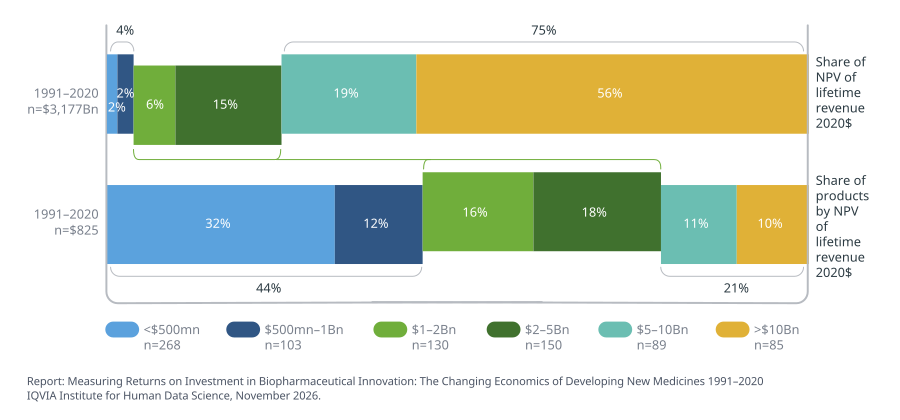
R&D costs have increased substantially. At the same time, the estimated cost of developing new medicines has increased. The report estimates that base-case capitalized R&D cost per new drug rose from about $366 million in 1991 to more than $3.2 billion in 2020.
These estimates include the cost of capital and the cost of failures. They reflect rising investigator costs, healthcare inflation, declining R&D success rates and growing clinical complexity, alongside the cost of capital adjustment.
Exhibit 7: Capitalized R&D cost by launch year, 2020$Mn
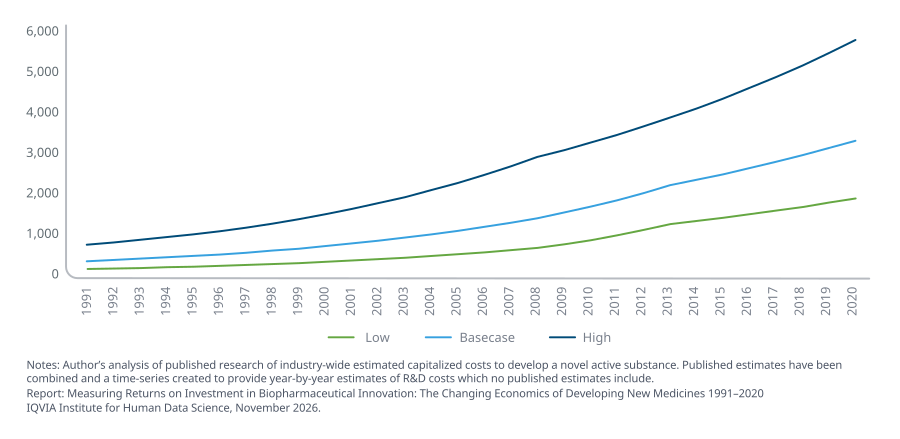
Rising R&D costs are the single most important driver of the decline in positive returns identified in the analysis. The challenge is compounded by R&D success rates. Fewer than 10% of compounds entering development successfully reach the market.
Positive lifetime returns have become less common. The changing relationship between revenue and costs is reflected in lifetime economic returns. Approximately half of medicines launched in the early 1990s generated positive lifetime returns. Among medicines launched between 2016 and 2020, fewer than one in ten did so. Across the entire 30-year period, only 28.2% generated a positive lifetime return.
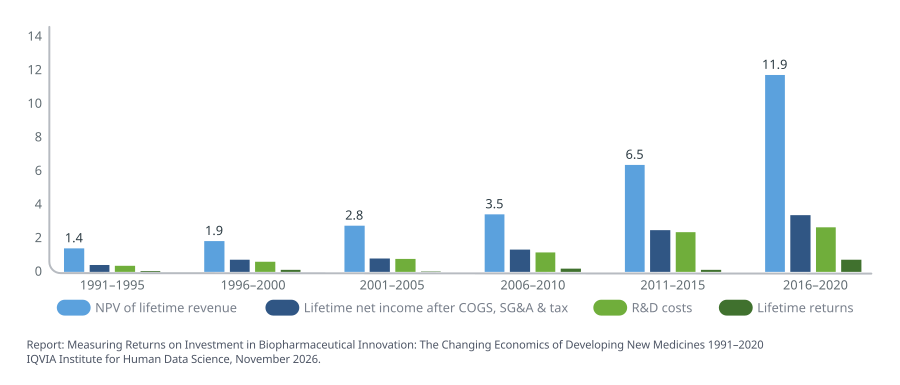
The average lifetime return for medicines launched between 1991 and 1995 was $555 million. Since the 2001–2005 cohort, average returns have fallen steadily.
For the 153 medicines launched between 2016 and 2020, average normalized and discounted lifetime revenue is estimated to be $1.7 billion below total operating and R&D investment costs.
Exhibit 21: Average NAS NPV of lifetime revenue, COGS, SG&A, tax and R&D costs 1991–2020
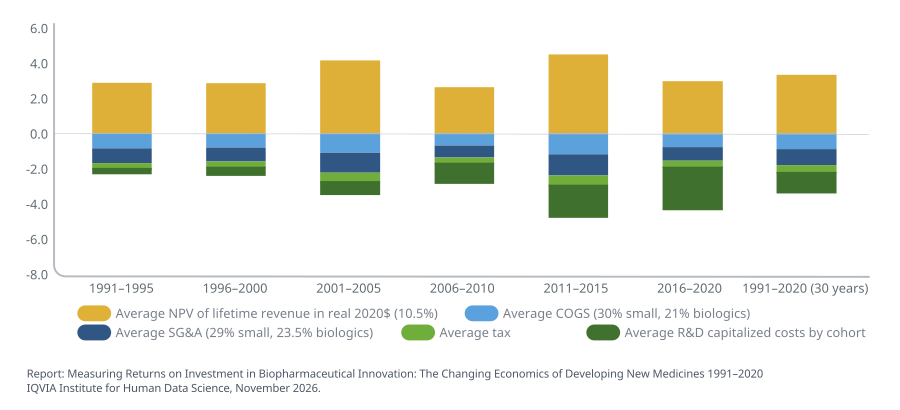
Exhibit 22: Average NPV of lifetime returns by launch cohort and decile, real 2020 US$ NPV Bn
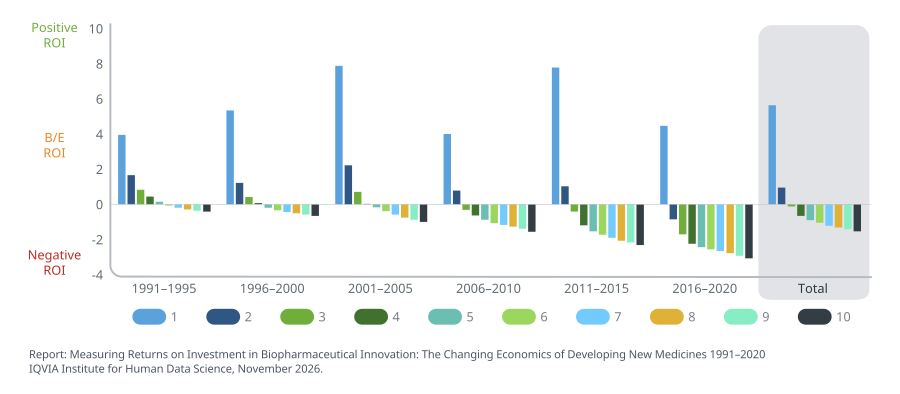
The revenue needed to achieve a positive lifetime return has risen as well. The smallest revenue product achieving a positive return had lifetime revenue of $1.4 billion in the 1991–1995 cohort. For the 2016–2020 cohort, that figure had risen to $11.9 billion.
Exhibit 26: Revenue and cost details for the medicine with a positive return and the lowest lifetime NPV revenue in the 5-year cohort, 2020$ Bn
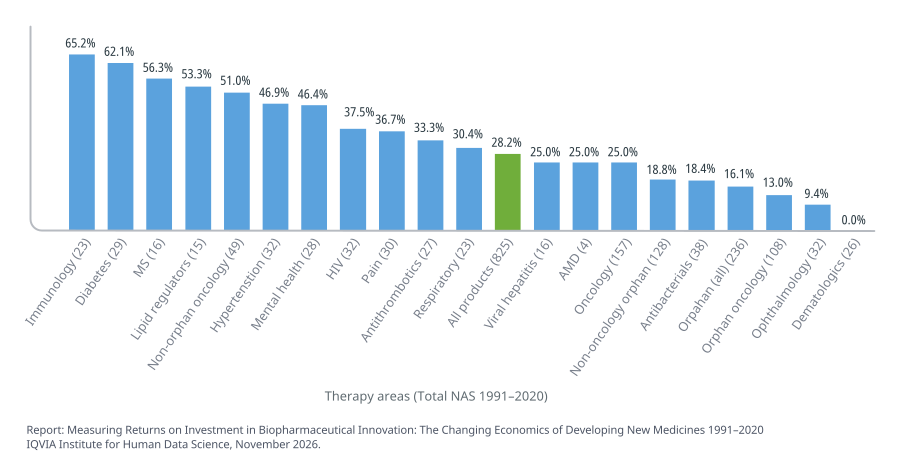
Economic returns are not the same across medicine types or therapy areas. The highest rates of positive returns were seen in immunology, diabetes, multiple sclerosis and lipid regulation.
65.2% of immunology medicines generated a positive lifetime return. This compared with 25% of oncology medicines, 18.4% of antibacterials and 16.1% of orphan drugs. Oncology accounted for 157 medicines in the analysis, making it the largest therapy area. Yet only one-quarter generated a positive return. Because the analysis applies the R&D cost assumption uniformly across therapy areas, these differences reflect variations in revenue and operating economics rather than differences in development costs.
Exhibit 23: %age of NAS with positive lifetime returns by therapy area, 1991–2020
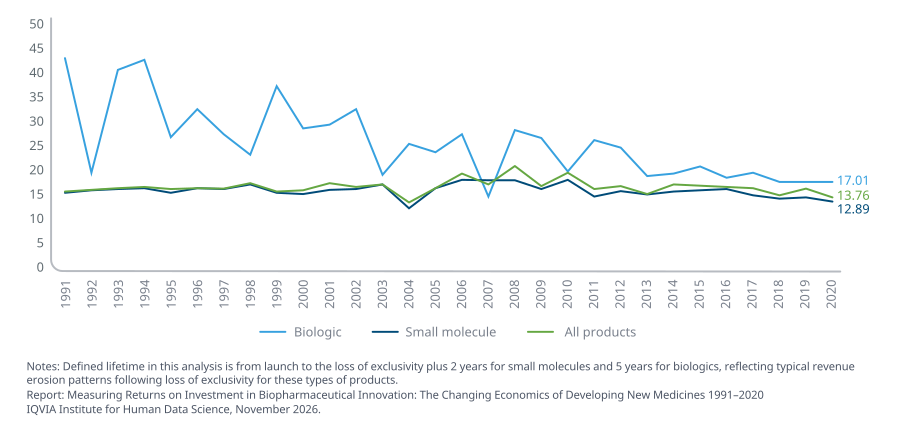
Product lifecycles continue to matter. The commercial lifetime of a medicine is another important part of its economic performance. Product lifecycles have changed substantially over the past three decades, particularly for biologics.
Median lifetime duration for biologics declined from approximately 40 years for the 1991–1995 cohort to 17.1 years for the 2016–2020 cohort. The report attributes much of this change to the introduction and maturation of biosimilar competition.
Despite shorter lifecycles, a meaningful share of economic value continues to be generated later in a medicine's commercial life. Across the 30 years studied, approximately 33% of lifetime NPV revenue was generated after nine years on the market for small molecules and after thirteen years for biologics.
Exhibit 17: Median defined lifetime by launch year
Medicines are also taking longer to reach peak sales. Across all medicines, the median time to peak global net sales was approximately 9.8 years after launch. It was 9.0 years for small molecules and 14.0 years for biologics.
These findings underline the role of long-duration commercial performance in lifetime economic returns.
Only about 10% of drugs entering human trials reach the market. In the most recent period, only about 10% of launched medicines achieve a positive return. Together, this means that only about 1% of compounds entering human trials achieve a positive financial return whose proceeds can help fund other innovations.
The result is an innovation system increasingly dependent on a relatively small number of successful medicines. Exceptional successes still occur. But they are increasingly the exception rather than the rule.
These findings have important implications for stakeholders considering the sustainability of biopharmaceutical innovation. Continued growth in industry R&D spending, combined with a slower increase in the number of novel medicines reaching the market, makes understanding the drivers of development costs increasingly important.
Long-term product lifecycles also remain important. The first nine years of a small molecule's life, or the first thirteen years for a biologic, are generally insufficient to recover development costs. These periods correspond to provisions of the Medicare Drug Price Negotiation Program established under the U.S. Inflation Reduction Act.
The competitive environment is changing too. The maturation of biosimilar markets in the United States and Europe has shortened the effective commercial lifetime of many biologics over the past 15 years.
The report also identifies the potential role of advancing technology. Artificial intelligence, personalized medicine, precision therapies, digital health tools and precision diagnostics may affect development costs, clinical success, clinical trials and patient interactions.
But the broader trend in the analysis is clear. Innovation is becoming more costly, more concentrated, and more dependent on a few medicines to sustain the wider research system. Understanding these long-term economics is increasingly important as stakeholders seek to balance patient access, affordability and the continued development of new therapies.
Dive deeper into the findings and analysis in the full report, Measuring Returns on Investment in Biopharmaceutical Innovation - The Changing Economics of Developing New Medicines, 1991-2020
Related solutions
Generics is about competition
Solutions for you to drive healthcare forward™