
.svg)




Patient Engagement Suite
Technology informed by unparalleled Decentralized Trials (DCT) operational experience and delivered at global scale.












A young person walked up to our table at the iCAN Summit, picked up the demo tablet, and went straight to the “What’s New” screen.
They weren’t browsing. They were checking whether something they’d said two days earlier had made it into the app. It had, and in their own words.
I’ve just spent a week at Barretstown in Ireland, at the International Children’s Advisory Network Summit (iCAN Summit), the annual gathering of young patient advisors who spend the year advising researchers, industry, and regulators on paediatric healthcare. The premise behind iCAN is simple: children’s voices belong at the start of research design, not bolted on at the end.
At the IQVIA table, we tried something different from the usual booth demo. We brought a question instead of a product: what would a patient app look like if YOU designed it?
The loop worked like this:
Four days. Four overnight builds. Fifty-three young voices.
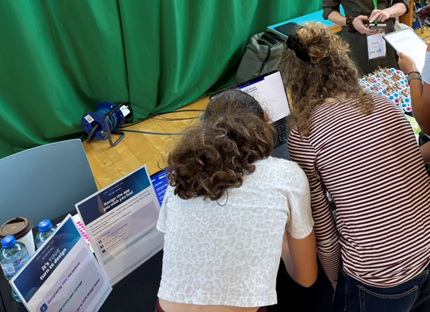
Young people at the booth laptop with the “Design the app you wish you had” table signs.
Here’s what stopped me: almost nothing they asked for was technical.
The most-voted idea of the entire week — 20 votes — was “Fits your schedule.” Reminders that know school exists. It shipped as a feature that stays silent from 8am to 3pm.
The rest of the leaderboard reads like a plea for kindness, not features:
“A calm reminder, that shouldn’t be stern.”
“Plain, human words.”
“Reminders like a friend.”
“Private mode.”
When we asked how the app should feel, “calm” and “honest” beat “fun” all week.
One submission simply said: “No check in.” A request for the app to stop prompting sometimes. In a week where a room full of adults might have brainstormed engagement mechanics, a young patient asked for the right to be left alone. It shipped as a take-a-break switch.
And on the final day, someone wrote: “A reminder that it’s not the end of the world.” That became the app’s encouragement screen: Missed a med or a check-in? That happens. Tomorrow is a fresh start — no guilt.
To be clear about scope: this was a preview, not a production app. What we proved is smaller and, I think, more important: that a young patient’s sentence can become a working screen by the next morning, with a visible line connecting the two. Every young person who contributed could answer the question that undermines most patient-engagement exercises: did anyone actually listen? In this app, the answer is on screen, in their own words.
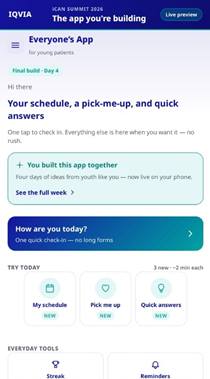
The Day 4 app build.
The signal I’ll remember isn’t the capture count. It’s that they came back. By mid-week, return visits were the pattern; young people bringing friends, adding ideas, checking whether their earlier ones had shipped. Nobody comes back to a feedback form. They come back to something they’re building.
The week ended Thursday evening with an awards ceremony celebrating the iCAN youth — recognition for advisory work they do all year, not just at Barretstown. Our booth work was already done by then. The final build was live on their phones, and it said what it needed to say: You built this app together.
The beautiful Barretstown castle may fade from memory. The teenager scrolling straight to “What’s New” will not.
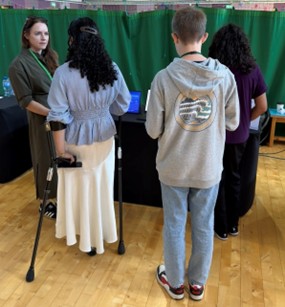
Young people at the booth, seen from behind, with our team.
Thank you to iCAN Summit and to Barretstown for an extraordinary week, and to the 53 young advisors whose words are all over this app. “Every Child. Everywhere.” isn’t a slogan when you watch it work.
If you design anything young patients touch: they already know what they need. The gap isn’t insight. It’s whether we build fast enough for them to see us listening.
You may also be interested in
Related solutions
Technology informed by unparalleled Decentralized Trials (DCT) operational experience and delivered at global scale.
Fast, flexible and proven, IQVIA’s industry-leading electronic clinical outcome assessment (eCOA) platform ramps up efficiencies, delivers real-time data, and sharpens insights through best-in-class technology and a better patient experience.
Power your decentralized trial with an agile randomization and trial supply management solution that supports supply flexibility and optimization as well as adaptable direct to patient options.