
.svg)




Patient Engagement Suite
Technology informed by unparalleled Decentralized Trials (DCT) operational experience and delivered at global scale.













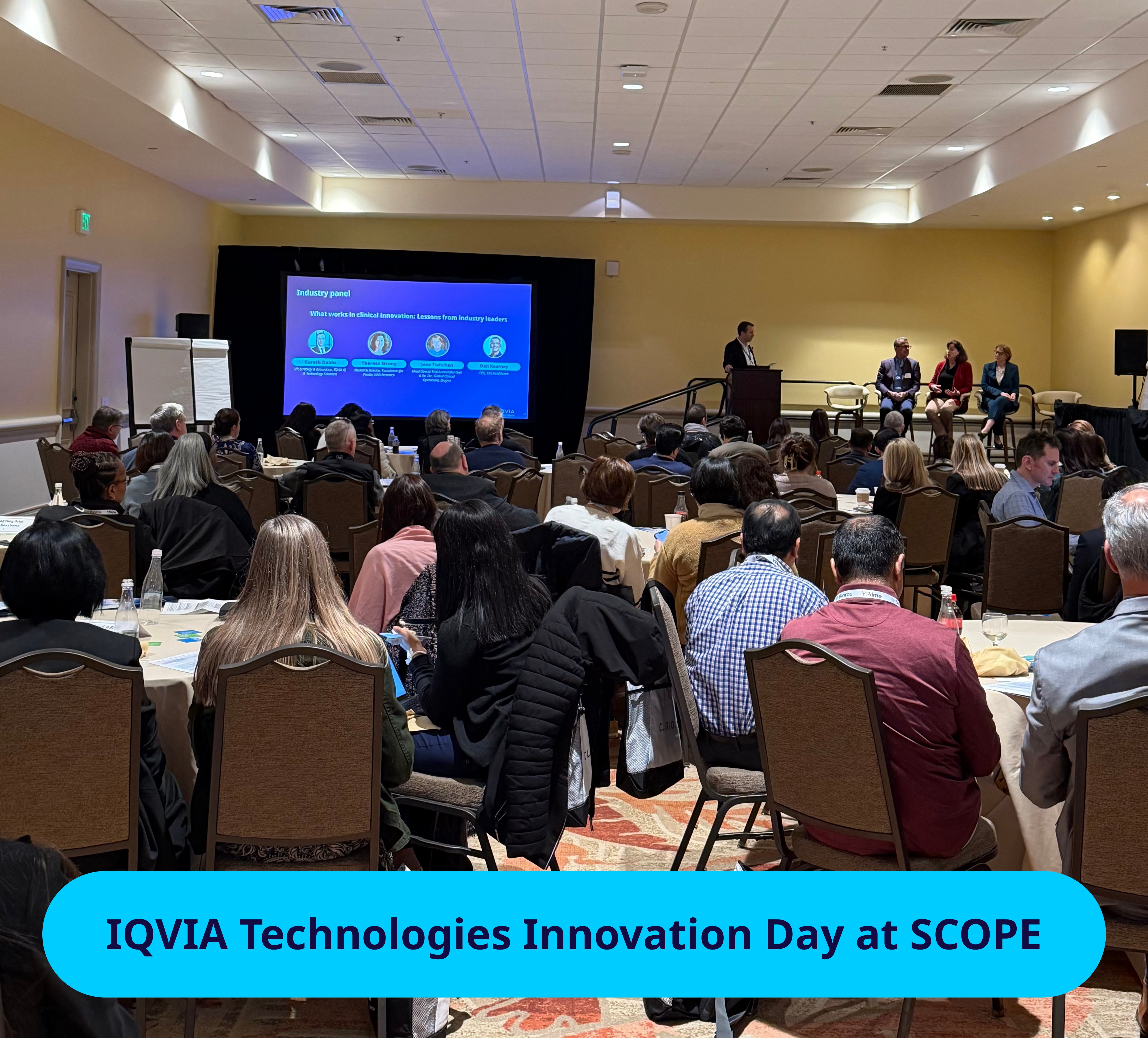 Innovation is a word we all use frequently—but it rarely means the same thing to everyone. In clinical research especially, innovation often shows up as incremental improvement: making an existing process a little faster, a little cheaper, a little more efficient. That matters. But if we’re honest with ourselves, incremental change alone will not solve the fundamental productivity challenges our industry faces.
One of the tensions I reflect on most is this: it’s easy to do things differently; it’s much harder to do different things.
At IQVIA, our challenge—and our opportunity—is balancing innovation for today with transformation for the future. We have to improve what already exists while also reimagining how clinical research could and should work. In this post, I want to share five concrete examples of how we’re doing exactly that, across the clinical development lifecycle, and offer a glimpse of where we’re heading next.
Clinical research has an extraordinary productivity problem. Roughly nine out of ten programs fail. That’s not something we can fix with marginal gains alone. It requires transformational change.
Across the industry, I consistently hear the same themes:
When I distill all of this down, clinical research can be viewed through three core lenses:
designing trials, selecting sites and participants, and delivering the best possible experience to all involved. Our focus is on improving all three, together—not in isolation.
One reality we all recognize is the explosion of technology vendors promising revolutionary capabilities. While much of that innovation is real, unchecked proliferation creates fragmentation - something no organization wants.
That’s why IQVIA’s technology strategy is built on interoperability. We believe the future belongs to best of breed ecosystems, not monolithic platforms. Whether you’re a site, a healthcare provider, or a life sciences organization, the winning model is one where systems connect seamlessly and securely.
Trust sits at the center of this strategy. Healthcare is inherently personal, which means privacy and data protection must be foundational. We’ve invested in a common privacy layer across use cases, partnering with organizations like the UK’s National Health Service and leading technology companies such as NVIDIA, Salesforce, and Veeva. Our role is to combine deep domain expertise with world class technology to build solutions you can rely on.
The Digital Protocol as an Orchestrator
Every clinical trial begins with a protocol. Historically, that protocol has been largely static – a document that gets handed off and interpreted manually downstream.
We’ve transformed protocols into digital constructs that can actively orchestrate trial execution. By combining protocol design with real world operational data—such as inclusion rates and diversity metrics—we can simulate how a study will perform over time. Sponsors can model changes and immediately see the downstream impact on site selection, timelines, and feasibility.
This approach helps eliminate points of failure before they occur, addressing productivity challenges at their source. Later this year, we’re bringing this capability to market as a standalone solution that sponsors can use across studies, regardless of CRO.
Automating Clinical Trial Payments
Site payments are one of the most painful friction points in clinical research. Imagine a world where clinical trial agreements are automatically ingested, budgets are generated directly from protocol driven plans, and fair market value data flows seamlessly between sponsors and sites.
That’s the world we’re building. AI agents now work behind the scenes to improve speed and quality across these workflows. In a recent hackathon at IQVIA Technologies, more than 80 agents were developed—some embedded directly into products, others optimizing how those products are used. This quiet automation is a powerful trend we expect to accelerate rapidly.
AI Enabled Drug Safety at Scale
Drug safety is another major cost driver—and current models are unsustainable. AI allows us to fundamentally rethink pharmacovigilance.
We are now continuously monitoring scientific literature globally for adverse events, automatically ingesting relevant data and generating structured safety cases using proprietary ontologies that achieve around 98% accuracy. That’s not perfect—but it’s transformative compared to manual processes. One customer recently reported freeing up 50% of their case processing workforce across a large portfolio, while improving both speed and quality.
This is AI applied pragmatically, solving real operational problems at scale.
Reimagining the Patient Experience with Agent Teams
For patients, the informed consent process is often the first—and most daunting—interaction with clinical research. We’re using teams of AI agents to change that experience.
Starting with a protocol, one agent generates a digital representation, another produces the informed consent form, a third creates a storyboard, and a fourth generates a video explanation. The result is a more human, understandable entry point into research—designed to reduce anxiety and improve comprehension.
Beyond consent, we’re embedding real time data quality monitoring into patient generated data streams. Patients and sites can see how data contributes to trial progress and identify issues immediately. This level of transparency is only possible when systems are truly connected.
Smarter Literature Intelligence and Medical Reasoning
Clinical research begins with understanding the scientific landscape. We’ve developed AI agents that summarize literature, generate targeted queries, and support systematic reviews across clinical and real world contexts.
Last year, we introduced a lightweight medical reasoning model designed specifically for healthcare data. Large language models are powerful, but they’re also expensive, especially at healthcare scale. Our approach delivers high accuracy at a fraction of the cost, enabling sustainable innovation without runaway token consumption.
Looking ahead, we’re expanding these capabilities into a Strategy Workbench that further optimizes site selection and engagement. We’re investing heavily in patient data quality, with real time agents already live in studies such as obesity trials using connected devices.
The bigger shift, however, is toward agent systems, not individual agents. Incremental gains come from point solutions; transformation comes from digital workforces operating across end to end workflows. By uniting clinical and real world data, improving quality, and accelerating speed, we can give regulators the line of sight they expect—and patients the experience they deserve.
That’s our innovation forecast: practical, interoperable, and relentlessly focused on making clinical research better.
You may also be interested in
Related solutions
Technology informed by unparalleled Decentralized Trials (DCT) operational experience and delivered at global scale.
Increase transparency, improve communications and reduce administrative burden for all clinical trial stakeholders.
Streamline every financial aspect of clinical trials by unifying budgeting, contracting, forecasting, and payments into a single, agentic AI-powered platform.
Combine data science, technology, and analytics driven by artificial intelligence to support new efficiencies and business insights -- without additional capital investment.