
.svg)




Patient Engagement Suite
Technology informed by unparalleled Decentralized Trials (DCT) operational experience and delivered at global scale.













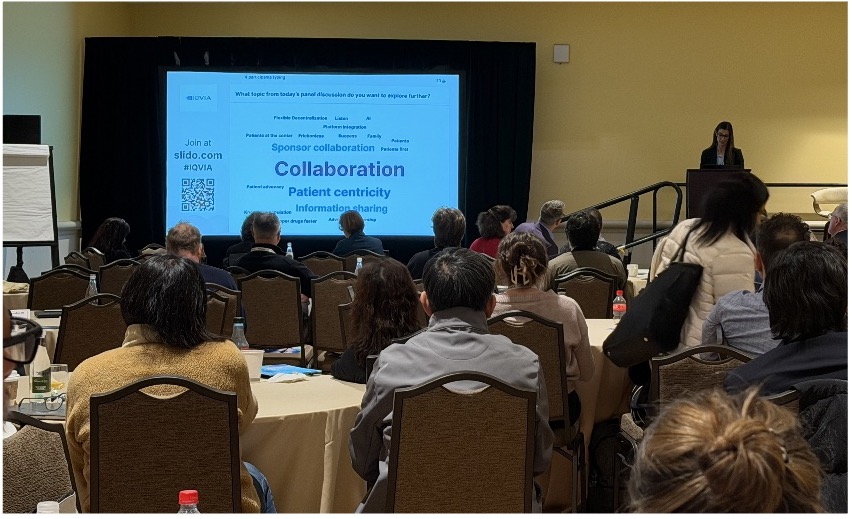 Serving as Master of Ceremonies for IQVIA Technologies Innovation Day at SCOPE was an experience I had been looking forward to for months, and the conversations exceeded my expectations. It was a half day event packed with sponsors and tech leaders who showed up ready to be candid about what’s working in clinical research today and where the friction still lives.
From the podium and through the days, I kept hearing the same themes from different angles: the future of clinical trials depends on partnership, integration, and keeping patients and sites at the center of everything we do. Innovation is not about a single breakthrough or a shiny, new tool, it’s about how we work together to simplify complexity, reduce burden, and deliver better outcomes. I’ll say it plainly, without sites and patients, there are no trials so we need to do more to support them.
Below are the key themes and takeaways I observed both while facilitating the conversation and as an active participant listening closely to the feedback shared in the room:
One of the strongest patterns I noticed was how quickly conversations returned to the same point: clinical research cannot succeed in silos. Whether someone represented a sponsor organization, a site, a patient advocacy group or a technology partner, the message was consistent, progress requires early and sustained collaboration across the ecosystem.
What stood out to me was the emphasis on moving partnerships beyond transactional interactions and toward shared problem solving. People spoke openly about the importance of transparency, ongoing feedback loops, and aligning around shared goals stating real innovation happens when stakeholders are building solutions together from the start, not handing problems off downstream.
Patient centricity came up repeatedly, not as a buzzword but as an operational imperative. What I heard most clearly is that patient centric decisions show up in measurable ways: enrollment, retention, and data quality. The conversation shifted away from what we wish patients could do and toward designing trials around real patient needs, real behaviors, and real constraints.
I also heard strong conviction that “one size does not fit all.” Different populations require different engagement models, and trial design needs to reflect that reality. The most consistent takeaway for me was that patient engagement must begin earlier, with patients helping shape meaningful endpoints and what an acceptable participation burden truly looks like.
If there was one theme that felt urgent, it was site burden. The examples varied, but the underlying challenges were familiar: disconnected systems, administrative complexity (especially around payments and contracting), and manual processes that create delays and errors.
What I found encouraging is that there was real alignment on what needs to happen next. The priority is not adding more tools, it’s enabling integration, automation, and fewer logins so sites can spend less time navigating systems and more time focused on patient care and trial execution. Put simply: simplifying the site experience may be one of the fastest ways to improve trial performance.
One of the most practical insights I heard was a pushback against “tool proliferation.” Rather than celebrating standalone innovations, the strongest support was for interoperable, end to end solutions that connect protocol design, site selection, financial management, patient engagement, and data capture into coherent workflows.
A concept that kept resurfacing was digitizing the protocol and using it as a downstream orchestration engine. To me, that reflects a broader shift the industry is ready for: moving from fragmented workstreams to coordinated execution that can scale without creating more complexity for the people doing the work.
AI was a major topic naturally, but I appreciated the pragmatic rather than listening to a lot of hype. The focus stayed on where AI is already delivering value today, from early patient identification and pre screening to automating document creation and data ingestion, reducing manual effort in safety case processing, and improving forecasting and operational planning.
Just as important were the guardrails. I heard consistent emphasis on human oversight, transparency, and trust and a clear warning against AI driven complexity that simply shifts burden back to sites or patients. The best framing I walked away with is that AI should enable better workflows, not replace clinical judgment, relationships, or accountability.
Flexibility came through as essential across visit modality (on site, remote, hybrid), cohort and enrollment management, and patient reimbursement and engagement strategies. More than once, rigid protocols were called out as a barrier to participation, especially in rare disease and vulnerable populations.
What I took from this is that the industry is ready to embrace adaptive approaches that meet patients and sites where they are, while still maintaining scientific rigor. The “how” will vary by study, but the direction is clear.
Financial management surfaced as both a persistent pain point and a significant opportunity. I heard a strong call for accurate, early budgeting driven by protocol metadata, faster and more predictable payments to sites and patients, and tighter integration of contracts, budgets, and payment systems.
What felt most important is how often timely reimbursement was linked to more than efficiency. People tied it directly to site sustainability, trust, and patient retention. When payments are delayed or opaque, it creates stress for sites and participants. When payments are predictable and transparent, it strengthens relationships and helps trials run better.
Across sessions, it was clear that adoption depends on enablement. Even the best technology can fail without training, clear communication, and proactive change management. I heard repeated reminders that technology teams should be involved earlier in protocol development and that sites need support throughout the lifecycle, not just at launch.
Finally, Innovation Day reinforced the value of shared learning and cross industry collaboration. Sponsors learning from one another, sites sharing operational best practices, and foundations collaborating across rare diseases were all highlighted as accelerators of progress.
What resonated with me most is that improving outcomes often requires pre competitive collaboration grounded in a patients first mindset.
Across all sessions, one message was unmistakable to me: the future of clinical research depends on integrated innovation grounded in partnership, empathy, and execution discipline. Technology plays a critical role but only when it simplifies workflows, strengthens trust, and improves the experience for patients and sites alike.
Thank you to our presenters and attendees who joined Innovation Day and engaged so thoughtfully in the discussions. These conversations don’t end with the event, they shape what we build next and how we show up as partners throughout 2026. I look forward to reconvening next year. Save the date: March 1, 2027. The future will be here before we know it. To continue the conversation or schedule a call with the IQVIA technology team, contact us.
Related solutions
Technology informed by unparalleled Decentralized Trials (DCT) operational experience and delivered at global scale.
Increase transparency, improve communications and reduce administrative burden for all clinical trial stakeholders.
Streamline every financial aspect of clinical trials by unifying budgeting, contracting, forecasting, and payments into a single, agentic AI-powered platform.
Combine data science, technology, and analytics driven by artificial intelligence to support new efficiencies and business insights -- without additional capital investment.