














Brand & Marketing
Grow your brand, now and through patent expiry
This blog is part of the series, A Brave New World: State of the Industry, on modern market dynamics influencing the life sciences industry.
Life sciences companies have historically designed commercial strategies around a physician-centric model of decision-making. For decades, this approach reflected how care was delivered, how prescribing authority was structured, and how influence flowed through the healthcare system. Today, that prevailing model is increasingly incomplete and, in many therapeutic areas, materially misaligned with clinical reality as nurse practitioners and physician associates (NP/PAs) have moved into the center of day-to-day treatment management.
For pharmaceutical brands and executives, the implication is straightforward: operating models that are slow to adapt will risk overlooking a meaningful and growing share of the healthcare workforce that directly shapes patient outcomes. Simply put: the relevance, reach, and impact of brand commercialization increasingly depend on designing go-to-market strategies around how care is actually delivered, rather than relying on legacy operating constructs.
Despite clear evidence of their expanding role, NP/PA influence is still frequently undervalued. Too often, they are viewed as secondary actors or downstream executors of physician decisions, a perception that runs counter to modern clinical practice. As these roles continue to expand, ignoring their influence widens the gap between commercial strategy and clinical reality, eroding promotional effectiveness, slowing adoption and growth, and ultimately constraining long term brand performance.
Myth: Growth in NP/PA roles is temporary and largely confined to primary care.
Reality: The evolution of the clinical care team reflects a structural, long-term shift that spans both primary and specialty care and continues to accelerate.
NP/PAs account for approximately one-third of all U.S. prescription claims, and that share only continues to grow. A common misconception is that this growth is limited to primary care settings. However, a closer examination of the data shows that the influence of NP/PAs extends across specialty therapeutic areas when their work is accurately attributed.
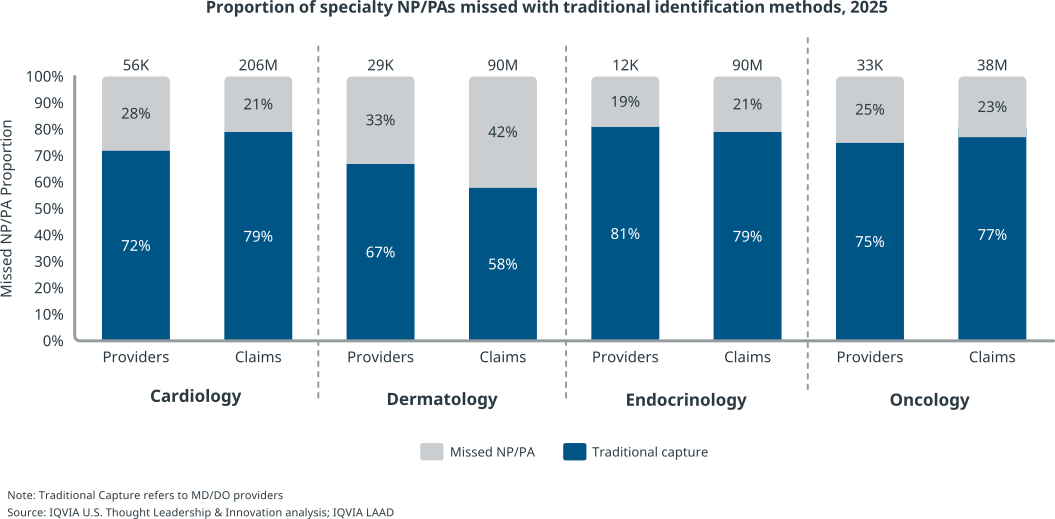
Because NP/PAs are often incorrectly assumed to function primarily as generalists, traditional identification approaches materially understate their role in specialty care. When digital twinning prescribing pattern-based reclassification methodologies are applied, approximately 20% more providers are identified across cardiology, dermatology, endocrinology, and oncology. Collectively, these clinicians drive 20% of total claims overall in their respective specialties, and up to 42% in dermatology alone.
Myth: NP/PAs primarily execute physician decisions rather than being empowered to make independent decisions for the patients in their care.
Reality: NP/PAs frequently manage prescribing decisions that are later attributed to physicians due to billing conventions, documentation workflows, or “incident to” practices.
Traditional attribution models tend to bias towards physicians while undercounting NP/PA decision making because they rely on legacy data systems and practices. Dependence on these models can lead to flawed audience development, inefficient investment, and misinterpretation of adoption signals particularly in team based care environments where NP/PAs are actively driving execution.
Another common misconception is that NP/PAs are less relevant to innovative therapies because they “prefer generics.“ However, POCNs 2024 survey of U.S.-practicing NP/PAs1 found that patient affordability and insurance coverage ranked among the top drivers of treatment decisions, highlighting the influence of access dynamics rather than clinical conservatism.
Because NP/PAs are deeply involved in therapy initiation and persistence, they experience payer controls, step therapy requirements, and affordability pressures firsthand. When properly supported with access tools, education, and practical guidance, NP/PAs can become powerful enablers of innovation, thereby translating clinical ambitions into real world execution and sustained success.
Myth: A physician-centric HCP strategy is sufficient in addressing the informational needs of the whole care team.
Reality: Sustained growth increasingly depends on engaging all clinicians who drive therapy initiation, adjustment, and persistence. In many therapeutic areas, those clinicians are NP/PAs.
In categories where longitudinal management determines outcomes such as chronic disease management, NP/PAs commonly function as the primary operators of care. They manage intake, diagnosis, treatment initiation, access navigation, titration, adherence, and side effect management. Physicians, by contrast, often focus on complex diagnostic decisions, procedural interventions, or escalated cases. In many practices, continuity of care rests squarely with the NP/PAs.
This reality exposes a fundamental limitation of traditional “HCP strategies” that assume physician delivered care. Even when campaigns perform well against physician focused metrics — such as reach or engagement -- they may fail to support sustained growth if they do not equip the clinicians managing the day to day realities of the patients in their care.
A more effective approach is to define NP/PA segments based on how they practice, rather than relying solely on professional title. Strategies that fail to adapt to these workflows risk persistent misalignment with clinical reality, resulting in diminished commercial impact as NP/ PA influence continues to expand across the lifecycle.
This is becoming more important as NP/PA growth accelerates. Over the next decade the projected NP/PA workforce growth is expected to grow 58%, reaching nearly 1 million clinicians, while physician growth is expected to remain comparatively modest.
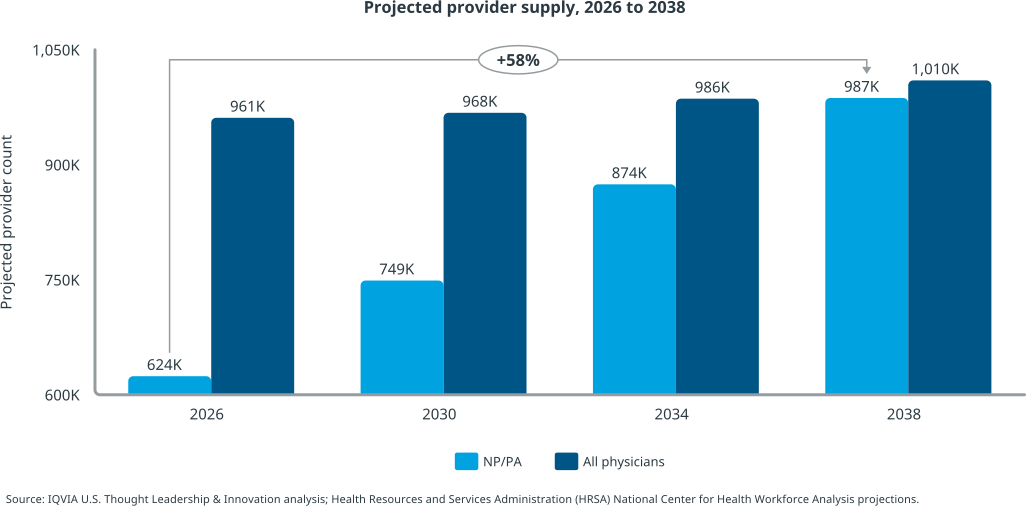
Beyond projected supply growth, utilization trends point in the same direction. A recent IQVIA analysis indicates that prescriptions written by NP/PAs are growing at faster rates than those delivered by physicians, with several physician specialties experiencing flat or negative growth.
These dynamics have direct consequences for long-term brand leadership. Commercial operating models that continue to treat NP/PAs as peripheral players will risk becoming progressively misaligned with how patient care is executed. As NP/PA roles deepen across diagnosis, prescribing, access navigation, and continuity of care, that misalignment compounds — limiting launch effectiveness, slowing uptake, and weakening lifecycle performance.
Durable leadership will depend on recognizing NP/PAs as central drivers of care delivery and designing engagement models that evolve alongside their growing clinical and operational influence.
Myth: NP/PAs play a limited role at launch, with primary influence emerging later in the product lifecycle.
Reality: NP/PAs exert significant — and often decisive — influence during the launch window, frequently determining whether a product gains early traction or stalls after initial exposure.
Recent analysis shows that 33% of prescriptions for newly launched products in their first year are written by NP/PAs, underscoring their influence at the most critical phase of the lifecycle. In several therapeutic areas, their impact is even more pronounced: 38% of new prescriptions for immunology launches, 47% in dermatology, and 53% in mental health.
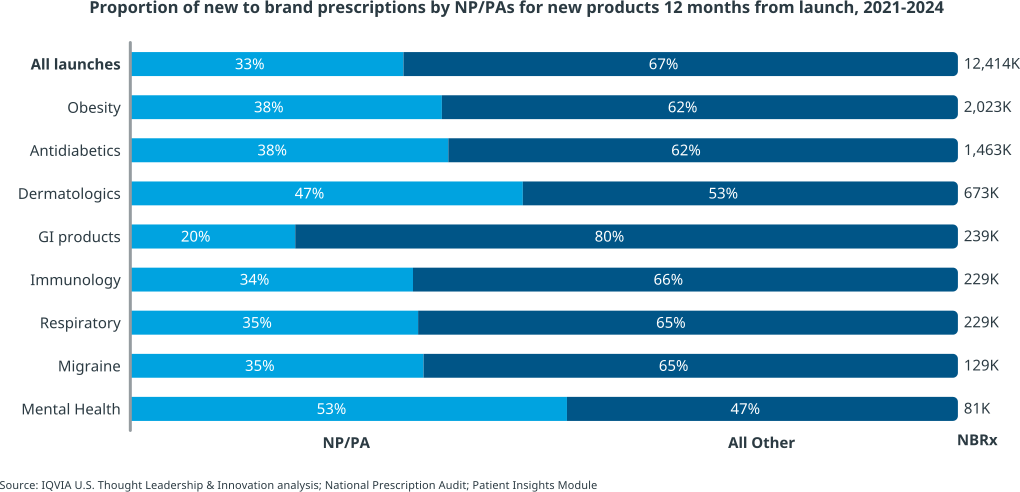
These figures reflect structural changes in care delivery. Across both primary and specialty care, NP/PAs increasingly manage diagnosis, treatment initiation, and ongoing therapy management. In many launch environments, they are the clinicians translating initial awareness into real world prescribing behavior- and their decisions often determine whether early momentum is sustained.
This influence carries even greater weight as payer control continues to intensify. NP/PAs are frequently the clinicians navigating prior authorizations, step therapy requirements, and affordability discussions at the point of care. For this audience, access strategy and clinical engagement are inseparable. Brands that align education, evidence, and access resources with NP/PA workflows are better positioned to compete in environments where payer restrictions shape real-world prescribing decisions.
Early engagement is therefore critical. When brands reach NP/PAs during the launch window — and pair clear clinical education with practical access support — these clinicians can become strong advocates for newer therapies. Effective engagement closes the gap between clinical confidence and real-world feasibility by addressing both what a therapy does and how it can be used in practice.
For marketers, this represents a tangible opportunity to recognize NP/PAs not as secondary audiences, but as critical contributors to early brand momentum.
Responding to this shift requires more than incremental adjustments. It demands a deliberate rethink of how brands identify, understand, and engage clinicians in real-world practice.
Effective NP/PA strategy goes beyond awareness and closing the gaps requires alignment across engagement, education, access, and channel design. Successful brands will:
Ultimately, accelerating future adoption in care environments may be less about increasing promotional pressure and more about designing to reduce friction where, when, and how care is delivered. Brands that align engagement, education, access, and measurement around real world workflows — and systematically remove friction across coverage, affordability, and administration — will earn confidence and sustain utilization.
When NP/PAs are supported end-to-end, from identifying the right patients to managing therapy over time, and that support aligns with their clinical priorities, workflow realities, and access challenges, adoption and adherence become outcomes of enablement rather than persuasion.
The provider landscape has already evolved, and the next decade will accelerate that shift. NP/PAs account for a substantial share of prescribing today, influence key inflection points in the patient journey, and will continue to expand their clinical and operational roles as workforce dynamics reshape care delivery.
For brands, this is not a tactical adjustment. It is a structural imperative. Commercial models that align engagement, education, and access strategy with the realities of NP/PA practice will be positioned to build durable share. Modern health systems are rapidly rotating to care team models to address capacity constraints. Those that continue optimizing for a physician-only view of influence risk misaligning with the clinicians who increasingly shape patient access, therapy persistence, and real-world outcomes.
References:

This blog is part of the Brave New World: State of the Industry series focused on understanding the U.S. life sciences industry. With timely insights, the series analyzes market trends, the impact of shifting policies, and the implications for stakeholders across the healthcare ecosystem. Want to dive deeper? Let’s talk. Contact your IQVIA representative for more information.
Grow your brand, now and through patent expiry
Gain high value access and increase the profitability of your brands