The proposed Biotech Act is a sweeping piece of legislation aiming to improve the environment for Biotech.
A central pillar of this Biotech Act is to improve the EU’s clinical trial environment through a wide-ranging reform of the Clinical Trials Regulation (EU) No 536/2014 (CTR), alongside targeted amendments to related legislation such as the ATMP Regulation (EC) No 1394/2007 and Directive 2001/83/EC. The objective is clear: simplify and accelerate clinical trials in the EU, particularly for biotech innovation, while maintaining high standards of patient safety, ethics and data robustness. The reforms are a proposed response to the EU’s declining share of global clinical trials over the past decade (Figure 1). This effect appears driven by several factors, including the rise in the number of trials conducted in China and the fragmentation and delays in the EU clinical trial system. The success of these proposals is therefore important to the EU’s strategic life sciences sector, clinical trial sponsors and, most importantly, patients’ access to better treatment.
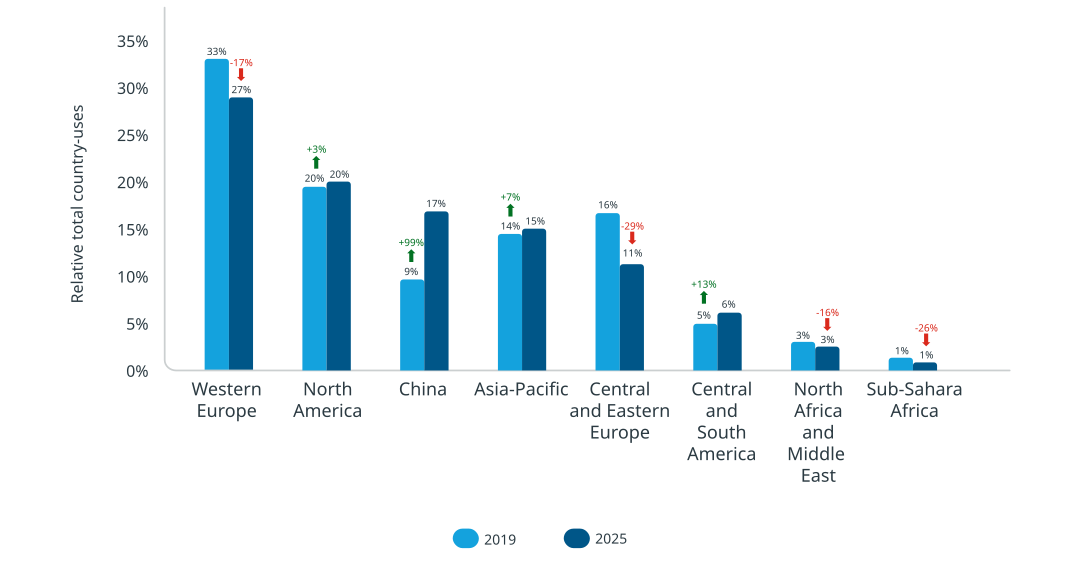
Figure 1 . Country utilization as percentage of global industry trial country uses, 2019 and 2025
Notes: Only industry sponsored interventional Phase I, II and III trials are included. Device only trials and those of biosimilars, generics (bioequivalence trials) and natural products – such as traditional Chinese medicines – were excluded. Trials with no country reported were excluded. Each trial country instance was counted, and the total was aggregated to region level to determine the share of newly initiated global trials which included a country in the region. Report: Global R&D Trends 2026: Advancing Innovation in a Changing Landscape. IQVIA Institute for Human Data Science, March 2026. Source: Citeline Trialtrove, Jan 2026; IQVIA Institute, Feb 2026.
From shortened clinical trial authorisation timelines to risk proportionate Genetically Modified Organism (GMO) therapies regulation and a proposed push towards Artificial Intelligence (AI) enabled trials, these proposals represent the most significant shift in the EU clinical research framework since the CTR entered into force.
Shorter authorisation timelines and an empowered Reporting Member State (RMS)
One of the most keenly awaited changes for sponsors is the proposed reduction in clinical trial authorisation timelines (Figure 2):
- For multinational trials, timelines would be shortened from 106 days to 75 days, inclusive of validation and ethical review.
- For Advance Therapy Medicinal Product (ATMP ) trials, the additional 50-day assessment step would be removed entirely.
- Assessment timelines for substantial modifications would be reduced from 96 days to 47 days.
- Parallel assessment of independent substantial modifications would be permitted.
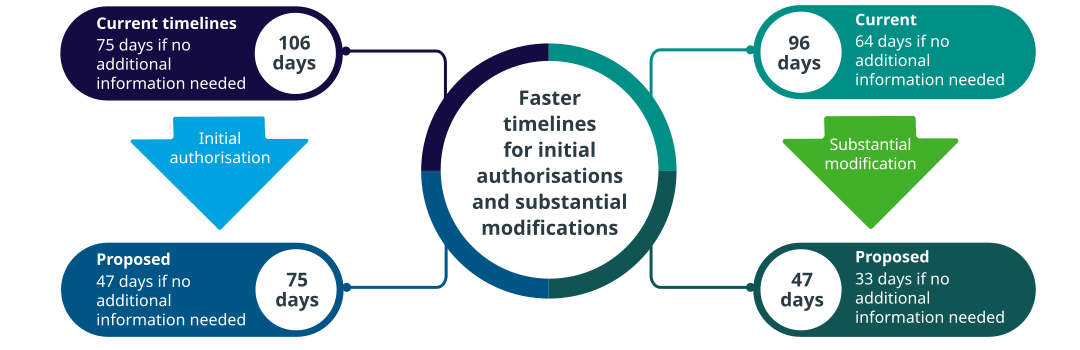
Figure 2: Proposed shorter assessment timelines
The RMS is proposed to take on a strengthened leadership role, coordinating the scientific, ethical and regulatory assessment. Member States participating in the same trial would rely on the RMS assessment, intervening only where within the scope of national law, ethical considerations or national standards of care. This is intended to reduce duplication, improve consistency, and reinforce mutual trust across the EU.
Ethical review would also be more tightly integrated: the ethics committee of the RMS would consolidate ethical input from participating Member States, to create a harmonised and transparent assessment process with fewer divergent national considerations. The Biotech Act also proposes increased use of harmonised templates to bring convergence in submission requirements across EU countries.
Clinical Trial Information System (CTIS)
Improvements to the EU portal (CTIS) are included in the proposals. The EMA would be tasked with improving CTIS to facilitate communication between Member States and sponsors during the assessment.
Regulatory streamlining
Minimal-Intervention Trials: This marks a significant effort to facilitate the work of non-commercial sponsors and encourage post-marketing trials in general, through the introduction of simplified procedures for a new category of Minimal-intervention trials. These would apply to trials using authorised products in line with their marketing authorisation. Such trials would benefit from risk-proportionate review requiring only Ethical approval before they can begin.
Combined trials involving medicines, medical devices and/or IVDs will have a dedicated pathway, affording more regulatory certainty. The proposals are to manage such studies through a single submission within CTIS significantly simplifying the multiple submissions per Member State needed currently for such studies.
A single core dossier concept for investigational medicinal products, with one Member State acting as a core dossier depository. In this process the first trial’s submission documents would become the “core dossier” which could be cross-referenced and/or updated for subsequent trials for greater efficiency in the submission of related trials. This approach would also potentially ease the management of updates to these documents at later stages through efficient updates of the “core dossier” affecting multiple trials for the same product.
Harmonised EU templates are proposed to become mandatory for certain Part II documentation, with potential reliance on RMS assessments for common elements.
Direct-to-patient IMP supply is supported through clearer rules including investigator oversight and controlled distribution frameworks to enable greater access to clinical trials and reducing travel burden for trial participants.
Risk-Proportionate GMO Regulation
There are several other areas for potential improvements suggested in the Biotech Act (Figure 3). One of the key proposals is the elimination of GMO environmental risk assessment (ERA) requirements for certain clinical trials conducted under the CTR. This represents a move away from a one-size -fits -all GMO framework (potentially covering a range of products from food crops to biological medicinal products) towards a risk proportionate approach for investigational medicinal products, particularly relevant for gene therapies and other ATMPs used in controlled clinical settings.
The Act proposes amendments to Regulation (EC) No 1394/2007 such that clinical trials involving GMOs that present no or negligible risk to human health or the environment would be exempt from submitting a full ERA. Instead, sponsors would submit a declaration within the clinical trial application, explaining why the exemption applies, and the Committee for Medicinal Products for Human Use (CHMP) would verify this declaration.
The simplification would also apply to manufacturing and import requirements for ATMPs, aligning GMP obligations with GMOs with a reduced risk profile.
In parallel, the revised Directive 2001/83/EC would empower the European Commission—via delegated acts—to amend or clarify the definitions of gene therapy medicinal products, somatic cell therapy products, and potentially tissue engineered products. While the practical impact of this remains to be seen and would be dependent on implementing acts and consistency applied by Member States to these requirements, it signals an intention to ensure regulatory definitions keep pace with scientific and technological developments.
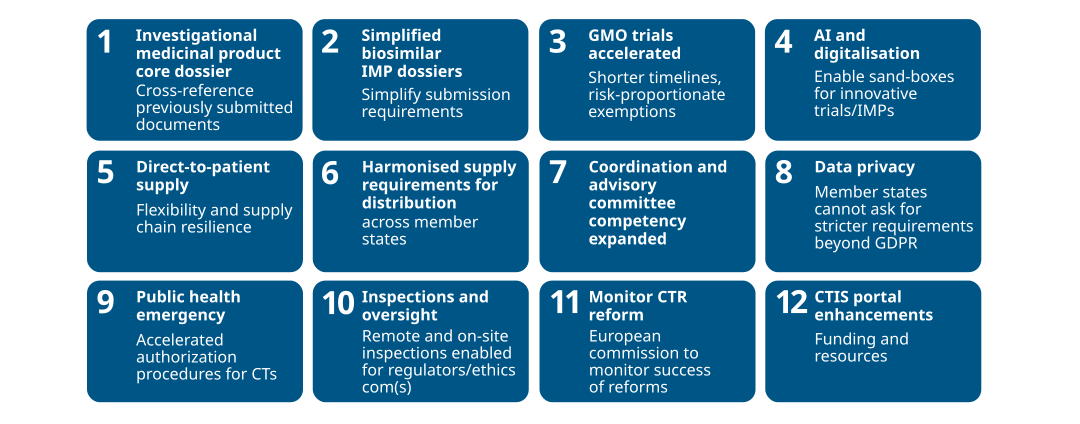
Figure 3: Other proposals for revision to clinical trial regulations
Personal Data, GDPR Alignment and Secondary Use
The amendments also aim to harmonise the legal basis for processing personal data under the CTR, aligning more closely with GDPR requirements. Protocols would need to clearly describe data collection and confidentiality safeguards, with sponsors and investigators acting as data controllers.
Importantly, personal data collected under an authorised trial could be reused by the same controller for other CTR authorised trials, thereby reducing unnecessary duplication and enabling more efficient research programmes.
Member States would be prohibited from introducing additional national data protection requirements beyond those set out in the amended CTR and GDPR.
AI, Digitalisation and Regulatory Sandboxes
The proposal supports AI’s use for medicines development and regulation. The EMA would be tasked with developing non binding guidance on the deployment of AI and advanced technologies across:
- Development and manufacturing
- Clinical trial design, conduct and analysis
- Marketing authorisation and post-authorisation activities
Sponsors would remain responsible for AI-related risks, supported by the EMA, the Clinical Trials Coordination and Advisory Group (CTAG), and external experts who are tasked with providing advice through guidance documents.
Regulatory sandboxes are envisaged to support innovation, allowing sponsors and regulators to test novel trial designs, AI tools and digital solutions in a controlled environment. Insights from these sandboxes would feed into future guidance and legislative updates.
Support for Innovation, Biosimilars and Biotech
Beyond clinical trial processes, the proposal includes measures to strengthen Europe’s competitiveness and attract or incentivize more clinical trials and product development:
- Pre submission advice will be expanded to provide non committal regulatory and scientific input earlier in development, effectively encouraging smaller biotech company filings in EU.
- Supplementary Protection Certificates (SPCs) could be extended for certain medicinal products which were developed on the basis of two or more clinical trials in the EU. We will be exploring this topic further in a separate blog.
- Reduced clinical data requirements for biosimilars will be codified in EMA guidance, where robust analytical and non clinical evidence is available, to generate more biosimilar development.
Would these reforms succeed in bringing more trials into the EU?
Undoubtedly, this is an ambitious and positive proposal which would see more trials run in the EU and therefore EU patients getting earlier access to promising innovative medicines. The key to this being the faster timelines and procedural efficiencies which would bring the EU in line with other regions with the largest share of clinical trials (Figure 4).
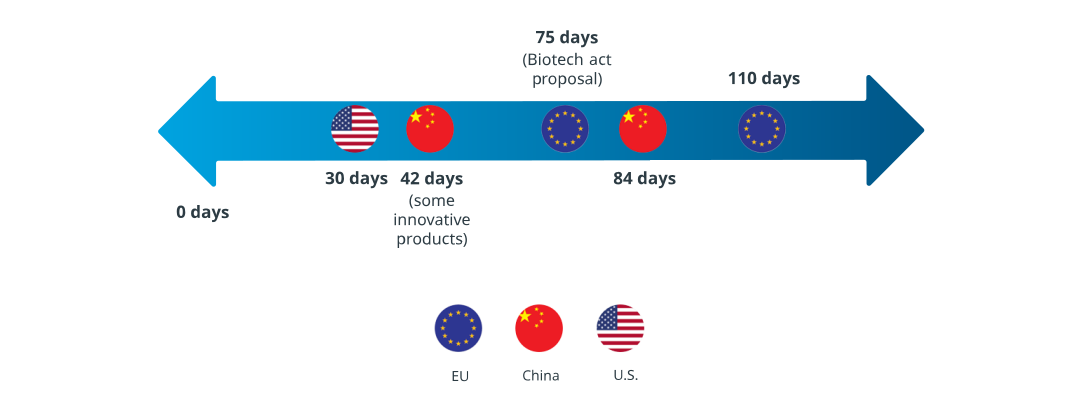
Figure 4. Comparison of clinical trial regulatory timelines between the EU, China and the US were the Biotech Act to be implemented as proposed. Source: IQVIA
Whether these proposals will be enough for the EU to attract clinical trials to the region, and how these measures will compare to efforts being made by countries outside the EU to draw trials into their own regions remains to be seen. Additionally, there are questions as to whether the proposals are broad enough in scope to address other aspects that affect where clinical trials are run, such as:
- site capacity,
- ease of patient recruitment,
- predictability of national implementation,
- commercial opportunity of medicines that do get authorised,
- and operational simplicity.








.svg)