In an earlier IQVIA blog1, we examined how sales representatives were engaging with healthcare professionals (HCPs) on the new generation of obesity medicines (OMs). While early conversations were dominated by class-level education, by mid-2025 there were already signs that the focus was shifting towards brand-specific differentiation. Since then, HCPs’ growing familiarity with injectable Wegovy and Mounjaro/Zepbound has intensified the need for differentiation. At the same time, the obesity market has continued to evolve at pace, most notably with the first two next-generation orals launching: Novo’s Wegovy pill in the US (January 2026) and the UK (June 2026), and Eli Lilly’s Foundayo in the US (April 2026). By broadening treatment choice and offering a unique set of benefits, these oral OMs add a new dimension to conversations with HCPs.
To understand how these developments are shaping customer engagement, we have used IQVIA's ChannelDynamics® data to analyse the most recent messages that HCPs recall from more than 20,000 real-world interactive engagements with sales representatives. These cover Wegovy (including Wegovy pill in the US and UK) and Mounjaro/Zepbound across the EU4, UK and US in the two years to July 2026. Foundayo is excluded because it launched shortly before the data cut-off. We expect these comments to reflect each product’s licensed indications in each country, as well as topics that the HCP may have spontaneously raised during the discussion.
In this blog, we examine how the key messages recalled by HCPs from these engagements have evolved since our last analysis. Specifically, we explore which messages were recalled most frequently within the last year, how the prominence of different messages has changed over time, and the variation by brand, formulation and specialty. While individual HCPs' comments reflect their own perceptions and may not capture all content covered during an interaction, large-scale analysis can provide detailed insight into the messages HCPs take away, and enable comparisons across HCP groups (see Methodology for more detail).
As the conversation matures for injectables, Wegovy pill brings a distinct set of priority messages
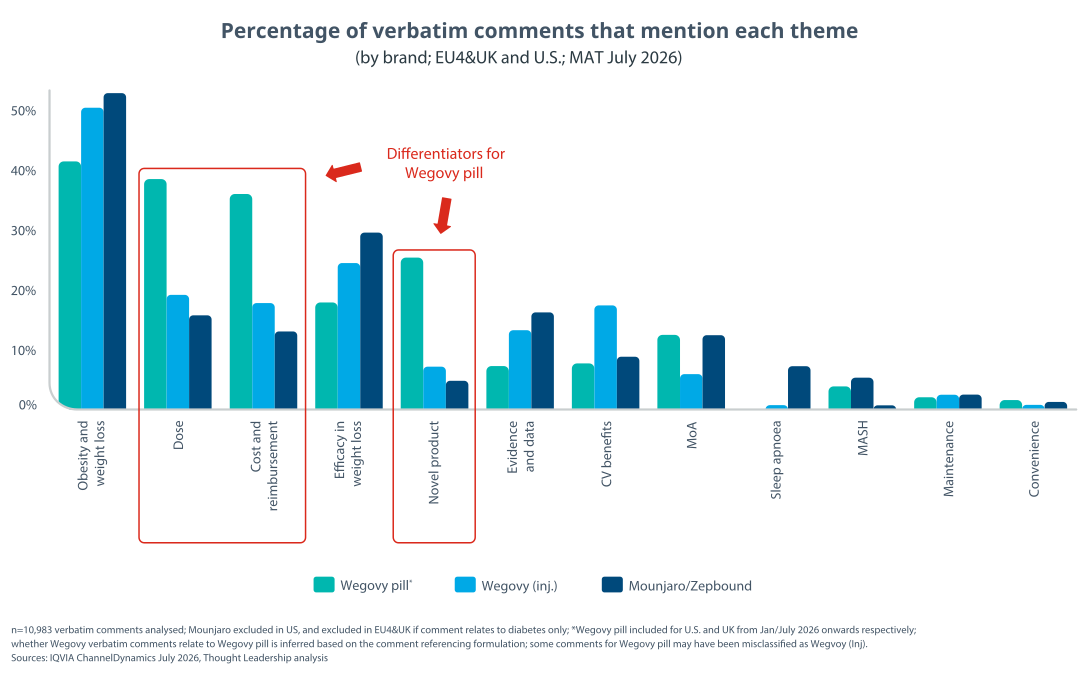
HCPs’ verbatim comments suggest that in the year to July 2026, Novo and Eli Lilly focused on a similar mix of educational and differentiating messages for injectable Wegovy and Mounjaro/Zepbound respectively. For example, themes such as obesity and weight loss, efficacy in weight loss, and dose were similarly prominent for both (Figure 1). Any differences between these injectables were largely linked to labels granted by the relevant regulatory body (FDA, EMA or MHRA): cardiovascular (CV) benefits and metabolic dysfunction-associated steatohepatitis (MASH) featured more frequently in comments relating to injectable Wegovy, while sleep apnoea was mentioned more often by HCPs for Mounjaro/Zepbound.
However, HCPs’ comments for Wegovy pill suggest that Novo has been prioritising a different combination of messages for this product. Key areas of focus include both product-specific practical considerations such as dosing, and differentiating attributes such as novelty, with cost and reimbursement being relevant to both categories. This combination of priorities reflects Wegovy pill being both a new launch and the first next-generation oral OM. It is important to note that while each Wegovy comment was assigned to a single formulation here, some conversations are likely to have covered both, and therefore messages about injectable Wegovy may sometimes appear under Wegovy pill. This may explain why MASH features among the comments for Wegovy pill, even though only injectable Wegovy is authorised for MASH (by the FDA and MHRA).
In contrast, compared to the injectables, both obesity and efficacy in weight loss are recalled relatively infrequently for Wegovy pill. This likely reflects a maturing market: HCPs are now broadly familiar with the high levels of weight loss achieved by the next-generation OMs, meaning that less class-level education is needed and Novo can focus on product-specific messages. These patterns offer an early indication of how oral OMs may be positioned to HCPs going forward.
Figure 1: The message themes most frequently recalled by HCPs
Differentiating messages are continuing to become more prominent
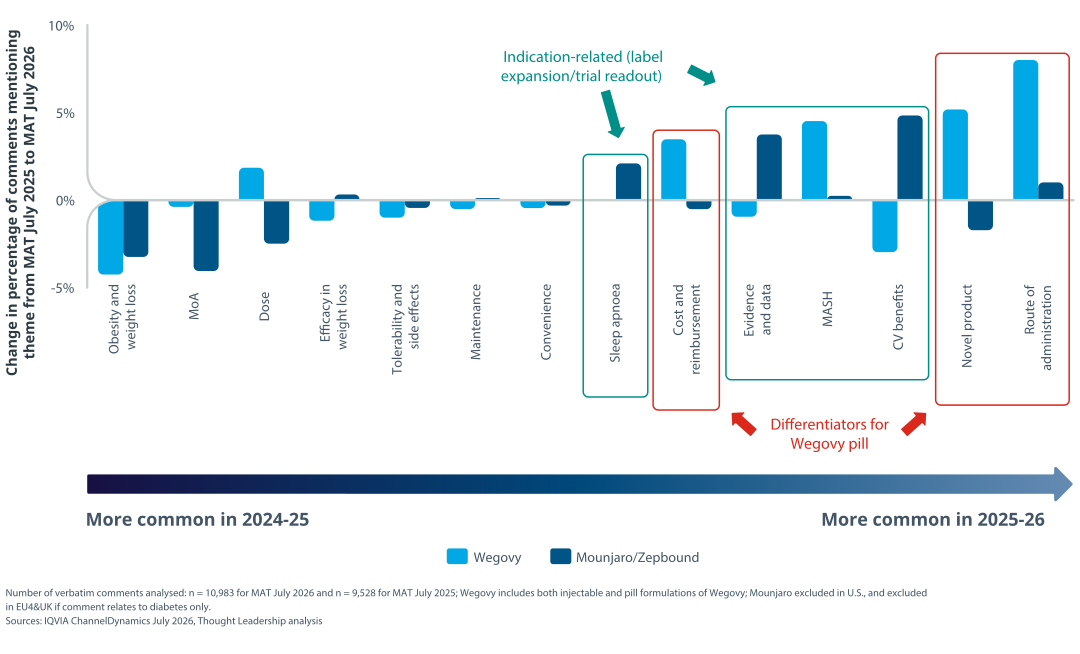
The conversations between sales representatives and HCPs also reflect the evolution of the obesity market, with some of the main year-on-year shifts illustrated in Figure 2 (where the two formulations of Wegovy are shown together). Many of the themes that dominated early discussions, such as obesity and weight loss, efficacy in weight loss, and mechanism of action (MoA), are now increasingly less of a focus, as they are familiar to HCPs. Instead, there is growing emphasis on unique indications for each brand, including label expansions and related trial readouts. For example, MASH is becoming increasingly prominent in Wegovy messaging, while sleep apnoea continues to emerge as an important differentiator for Mounjaro/Zepbound. While recall of Wegovy's CV benefits has fallen since the previous year, this is from a high base, and Figure 1 shows that this theme nevertheless remains highly prominent for injectable Wegovy.
There are further notable shifts for Wegovy, including increased emphasis on novelty, cost, and particularly route of administration (RoA), which an additional 8% of HCP comments referenced compared to the previous year. These three areas of change are likely a direct consequence of Wegovy pill launching in the US and UK. Where oral therapies are available, HCPs are choosing not only between brands, but also between formulations, with orals being the more convenient option for many patients. As next-generation orals continue to launch in new markets, formulation will be front-of-mind for increasing numbers of HCPs and patients.
Figure 2: The focus is shifting towards unique differentiators
How does messaging differ by specialty?
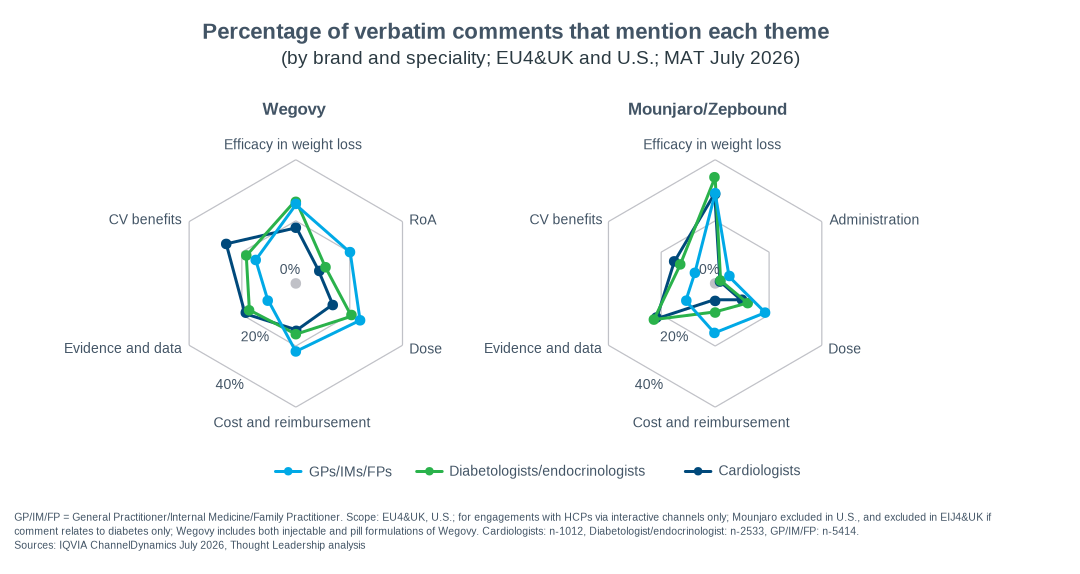
OMs can be prescribed by both primary care and specialist physicians, and the main messages that HCPs recall vary by specialty. Figure 3 indicates that GPs and other generalist physicians frequently recall practical considerations, such as dosing, cost and reimbursement, and RoA, compared to specialists. Diabetologists/endocrinologists and cardiologists, meanwhile, more often recall data and evidence, as well as CV benefits.
Overall, however, differences between brands are more pronounced than differences between specialties. For Mounjaro/Zepbound, verbatim comments are consistently centred around a small number of key themes such as efficacy, particularly among specialist HCPs. Conversely, Wegovy messages are spread across a broader range of themes, with notable emphasis on CV benefits, which all specialties mention but especially cardiologists. Some of the variation between specialties may simply reflect HCPs recalling the points that are most relevant to their own practice. However, the specialty patterns differ markedly between brands, suggesting that Novo and Eli Lilly have adopted different approaches to tailoring the messaging for each HCP group.
Figure 3: Differences between specialties for each brand
Conclusion
As in our previous blog, the key themes that emerge from HCPs’ verbatim comments reflect both what manufacturers choose to emphasise, and what HCPs remember and report afterwards. These provide valuable insight into the issues that are front-of-mind for HCPs following interactions with sales representatives about Wegovy and Mounjaro/Zepbound. For example, the focus appears to be shifting further towards unique differentiators for each brand, especially labels, such as MASH and CV risk reduction in obesity for Wegovy, and obstructive sleep apnoea for Zepbound.
Differentiation will become increasingly important as new treatments and competitors enter this rapidly evolving market. Since our last analysis, Wegovy pill has introduced a new combination of high-priority messages in the US and UK, balancing practical education and strategic differentiation. Supported by its ATTAIN-MAINTAIN data, Foundayo may shift more focus towards weight maintenance when a label is granted by the relevant regulators for each country for maintenance of weight loss. Other new launches such as CagriSema (expected in early 2027) may expand not only the treatment choice, but also the range of MoAs.
Supporting patients with weight management presents challenges for HCPs. Alongside the fast-changing treatment landscape, many patients with obesity have multiple comorbidities. Unusually for prescription medicines, patients also often have a preferred brand in mind and a significant role in the decision-making process, especially those who self-fund their treatment, but are not necessarily equipped to understand which option is most suitable. HCPs will therefore increasingly rely on clear, evidence-based information from manufacturers to understand the distinct value that each OM can offer to different patients. As this analysis has shown, the main points that HCPs take away from discussions with industry vary by specialty. Commercial success will depend on a tailored customer engagement strategy that focuses on what matters most to each HCP.
Methodology
The data used for this analysis is from IQVIA’s ChannelDynamics® database, which captures spontaneous HCP recall of messages communicated during interactions with customer engagement teams. HCPs responded to one of the following two prompts, depending on the type of interaction:
- “Please describe, in as much detail as possible, all of the points communicated by the representative during the product presentation. NB: please do not mention any adverse events or personal information.”
- “Regarding this product, what type of information was brought to your attention? NB: please do not mention any adverse events or personal information.”
The scope of this analysis is limited to verbatim comments about interactive engagements, specifically: traditional face-to-face detailing, traditional meetings, telephone-based detailing, remote digital detailing with a representative, and live digital meetings. The brands in scope are Wegovy, Mounjaro (outside the US), and Zepbound (US only). Verbatim comments were translated into English where applicable. For Mounjaro, we excluded any comments that focused only on diabetes, because Mounjaro has EMA and MHRA labels for both diabetes and weight management, and our intention was to focus on use in obesity.
For injectable Wegovy and Mounjaro/Zepbound, data was analysed for MAT July 2025 and MAT July 2026. As Wegovy pill had only launched in the US and UK during the study period, analysis of Wegovy pill was limited to these two markets, from their respective launch dates to July 2026. Here, we inferred whether each Wegovy verbatim comment related primarily to Wegovy pill or injectable Wegovy based on whether it referenced oral formulation. Some comments for Wegovy pill may therefore have been misclassified as injectable Wegovy, and it is also likely that some conversations covered both formulations. Foundayo is excluded because it launched shortly before the data cut-off.
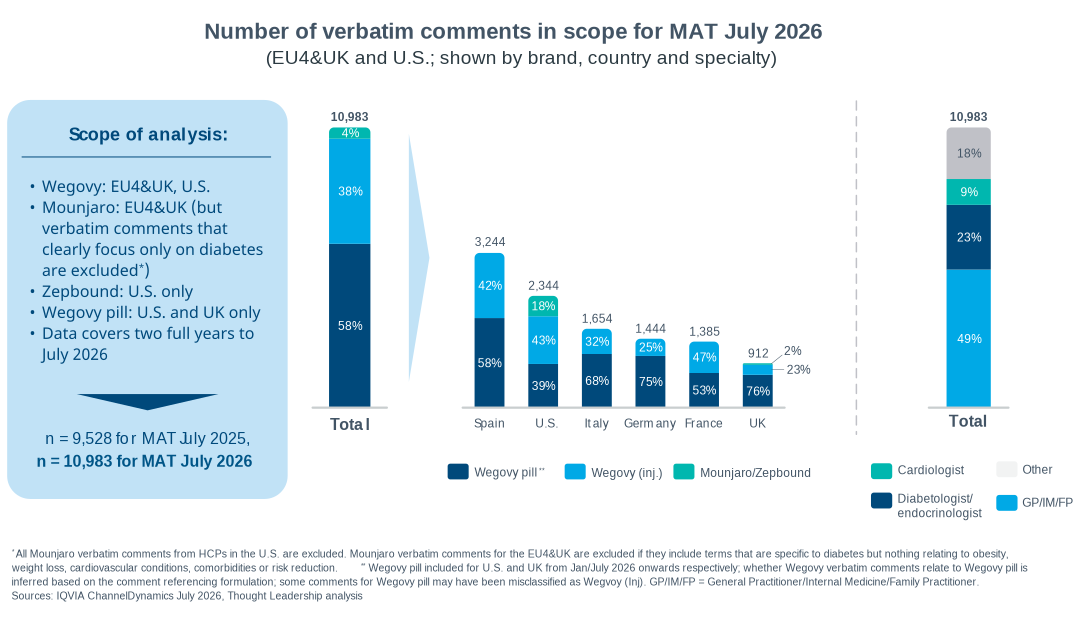
In total, 20,511 verbatim comments were in scope, with 10,983 of these being for MAT July 2026 and 9,528 being for MAT July 2025, illustrated in Figure 4.
Figure 4: Over 20,000 HCP verbatim comments were analysed for Wegovy and Mounjaro/Zepbound, across multiple countries and specialties
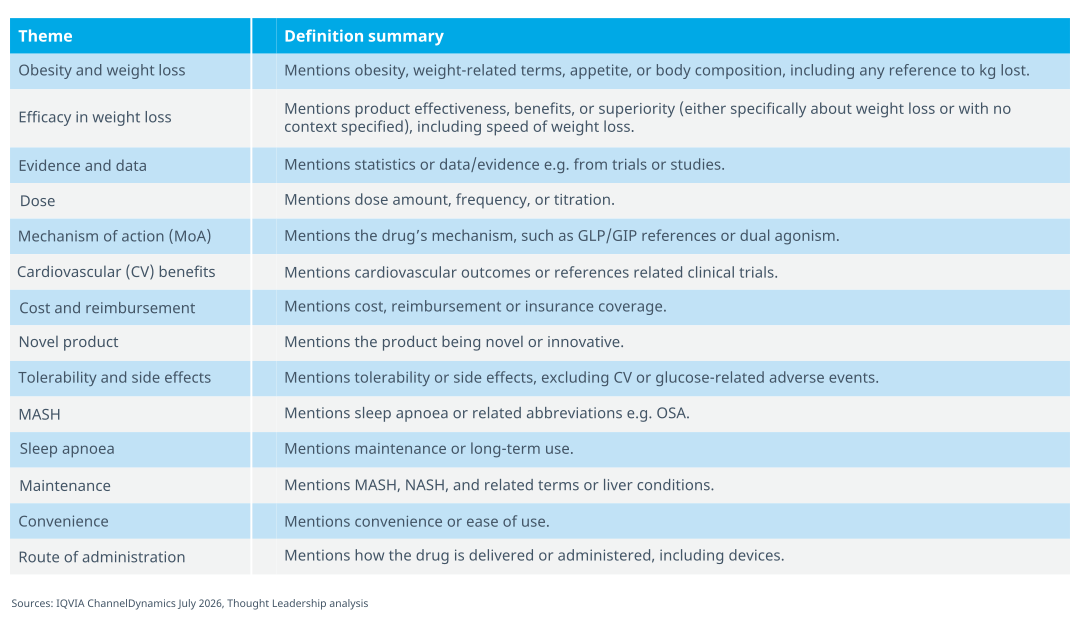
The themes in Figure 5 were identified as either present in or absent from each comment. These message themes were defined in detail using a combination of key words, context requirements, and exclusion criteria.
Figure 5: High-level definition of each theme
References
1. Mastering the Messaging: Engaging with HCPs on Obesity, IQVIA blog, February 2026: https://www.iqvia.com/locations/emea/blogs/2026/02/mastering-the-messaging