




.svg)











Identifying patients with rare diseases remains one of the greatest challenges in healthcare. Although each condition is individually uncommon, rare diseases collectively affect more than 350 million1,2 people worldwide across 6,000-7,000+1,3 conditions, making them a major public health issue rather than a niche concern (For more information on broader rare disease challenges, see our previous blog - Rare diseases, Bold strategies).
For pharmaceutical and biotech companies, this challenge has important strategic implications. Patient finding influences prevalence estimation, clinical trial recruitment, evidence generation, launch readiness and market sizing - and ultimately determines whether innovative therapies reach the patients who can benefit from them. Even the most transformative treatment cannot achieve its full clinical or commercial impact if eligible patients remain unidentified.
The challenge is that patient finding does not sit within any single part of the healthcare system. Patients and caregivers, healthcare professionals, diagnostic providers, health systems, patient advocacy groups and pharmaceutical companies all influence different points in the journey to diagnosis. As a result, patients are often missed not because of one isolated failure, but because barriers accumulate across the broader healthcare ecosystem.
Why Patient Finding Remains Difficult
Many patients with rare diseases interact with healthcare systems repeatedly before receiving an accurate diagnosis or referral to the appropriate specialist. This reflects a series of interconnected bottlenecks that exist throughout the patient journey:
- Patients and caregivers may not recognise early symptoms or know where to seek care, delaying initial HCP engagement
- General practitioners and frontline specialists often have limited exposure to rare conditions, reducing early clinical suspicion and delaying referral to specialist centres
- Clinical signals are fragmented across providers, care settings and datasets, while rare diseases are not always explicitly captured through diagnosis codes. As a result, no single dataset typically provides a complete view of the patient’s diagnostic journey
- Access to specialist centres, diagnostics and genetics testing remains inconsistent across geographies, limiting confirmatory testing and timely diagnosis
The consequence of the bottlenecks is often a prolonged diagnostic odyssey. Patients typically experience 4-5+5,6 year of delay before receiving a confirmed diagnosis, involving multiple misdiagnoses and specialist referrals. Notably, 25%6 of patients require eight or more specialist consultations before receiving a diagnosis, illustrating how bottlenecks across the system cumulatively delay identification of treatable populations.
The implications reach far beyond patients. Delayed identification has a profound impact on healthcare costs (e.g., health economic analyses estimate that delayed diagnosis can generate $86k–$517k7 in avoidable costs per patient) through unnecessary testing and inefficient care pathways, slows clinical trial recruitment and evidence generation, and creates uncertainty around prevalence estimates, market potential and commercialization planning. Ultimately, when patients remain unidentified, both patient outcomes and the value of innovation suffer.
The conclusion is clear: patient finding is a fundamental ecosystem challenge. Because barriers exist across multiple stakeholders and stages of the patient journey, no single intervention is sufficient. Success requires a coordinated approach that addresses awareness, identification, diagnosis and long-term learning simultaneously.
Turning Bottlenecks into Breakthroughs
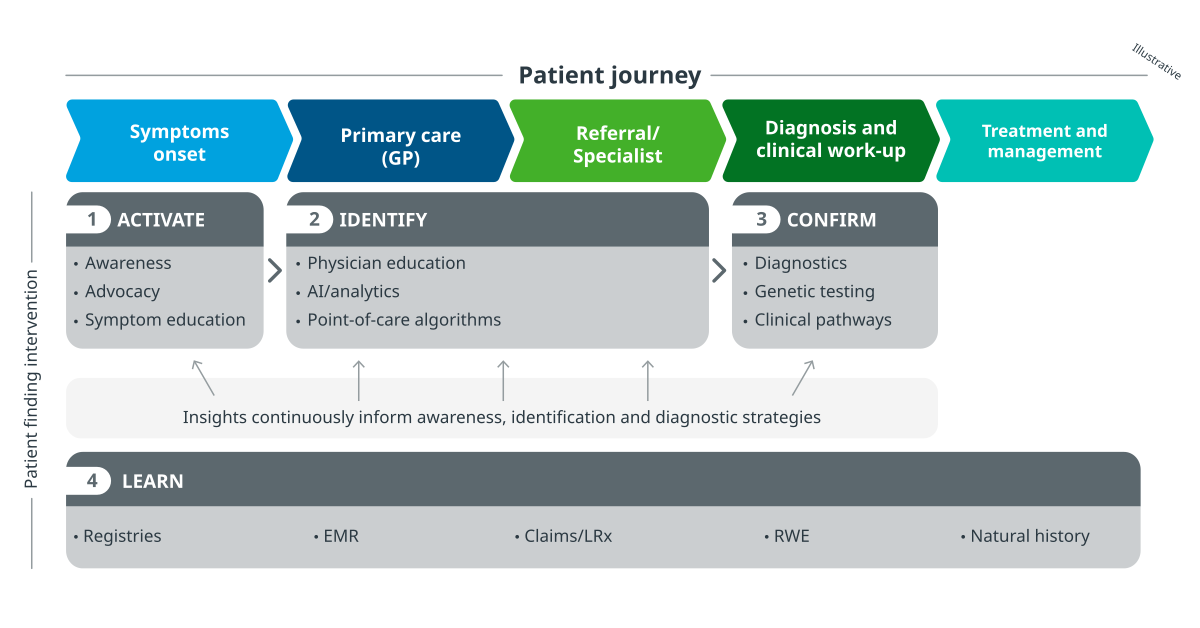
Organizations increasingly recognize that effective patient finding requires a combination of complementary interventions. These can be organized into a continuous cycle of ACTIVATE, IDENTIFY, CONFIRM and LEARN, with each pillar addressing a different barrier in the patient journey and contributing to overall ecosystem readiness (Figure 1).
Figure 1: Coordinated patient-finding interventions across the patient journey
1. ACTIVATE: Build Awareness and Engagement
|
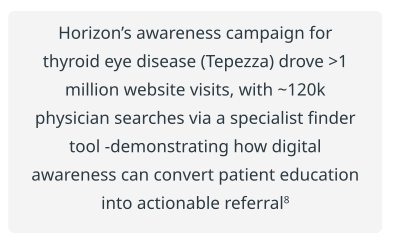
Patient finding often begins before clinical suspicion arises. Disease awareness initiatives, educational campaigns and partnerships with patient advocacy groups can help patients recognize symptoms earlier and seek appropriate medical care (Figure 2). Patient organizations also play a critical role in education, navigation and community engagement, particularly in diseases with limited awareness or poorly understood symptoms. While awareness initiatives can reach large populations, they typically provide broad reach rather than high precision, making them an important starting point rather than a complete solution. |
Figure 2 – Case study in Disease awareness
|
2. IDENTIFY: Recognize Patients Earlier
Once patients engage with healthcare systems, the focus shifts to identifying individuals who may have an underlying rare disease. The types of solutions deployed depend on local regulations and data availability.
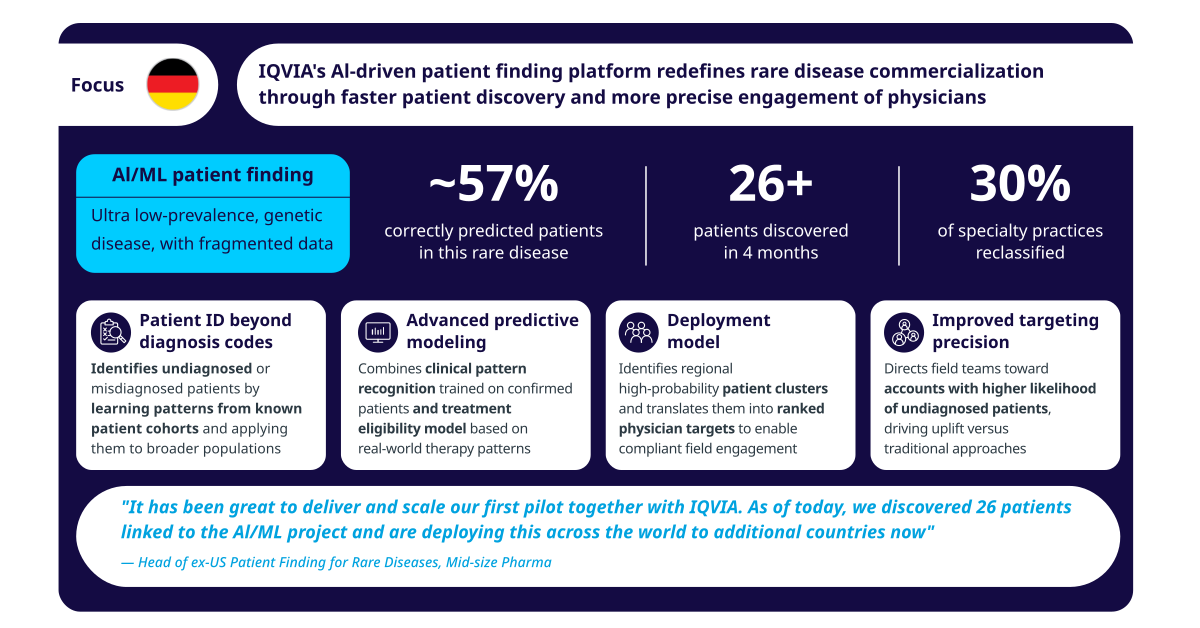
AI and advanced analytics can be applied to prescription data, claims data, historical patient records / electronic medical records and other real-world datasets to identify high-risk patients based on complex patterns that may be difficult to detect manually (Figure 3).
At the same time, physician education helps improve recognition of diagnostic red flags and referral pathways, particularly in primary care and frontline specialties where rare diseases are often first encountered.
Point-of-care algorithms can further support identification by flagging potential patients during routine healthcare interactions. However, such approaches often require local implementation and integration into clinical workflows, which can make large-scale deployment challenging.
While AI-enabled approaches have shown considerable promise, challenges remain around data quality, false positives, model transparency, privacy considerations and integration into clinical workflows. While the EHDS regulation in Europe promises a significant step forward in the data foundation on which AI models rely, AI remains most effective when used to augment clinical decision-making rather than replace it.
Together, these approaches strengthen identification both centrally through data-driven analyses and locally at the point of care, although trade-offs often exist between precision, scalability and implementation complexity.
3. CONFIRM: Accelerate Diagnosis
Even when a rare disease is suspected, delays often persist due to limited access to specialist testing, confirmatory diagnostics or genetic testing.
Sponsored diagnostic and genetic testing programs can play an important role in reducing these barriers, particularly in genetically driven diseases. Such programs can accelerate diagnosis, via improved access to testing, and demonstrate the clinical value of earlier patient identification.
However, long-term success depends on more than temporary access programs. Sustainable impact requires diagnostic pathways to become embedded within routine clinical practice and supported by providers, laboratories and payers. Compared with awareness initiatives, diagnostic programs deliver much greater certainty but rely on patients being proactively identified and referred into testing pathways.
4. LEARN: Create a Continuous Feedback Loop
Unlike the first three pillars, LEARN is a cross-cutting capability that continuously strengthens ACTIVATE, IDENTIFY and CONFIRM.
Patient registries, natural history studies and longitudinal real-world datasets are critical to improving patient finding over time. By capturing information on referral patterns, diagnostic journeys, treatment pathways and patient outcomes, these data sources help organizations understand where patients are being missed and which interventions are most effective. Insights generated through these efforts can then be fed back into awareness campaigns, targeted physician engagement, physician education programs, AI algorithms and diagnostic pathways, creating a continuous learning cycle.
Examples of data sources that support this process include:
- Electronic medical records (EMR/EHR)
- Longitudinal prescription claims (LRx)
- Genetic testing databases
- Hospital and laboratory datasets
- Disease registries and natural history studies
These assets not only improve patient identification but also strengthen evidence generation, disease understanding and overall ecosystem readiness.
No Single Lever Is Enough - Each pillar addresses a different bottleneck and involves different trade-offs. Awareness initiatives provide broad reach but lower precision. AI-enabled analytics enables precision finding at scale but depends on data availability and infrastructure. Diagnostic programs provide high diagnostic certainty but require effective referral pathways. Registries and longitudinal datasets generate valuable insights but typically require sustained investment before impact becomes visible.
For this reason, successful patient-finding strategies do not rely on a single intervention. Instead, they combine multiple interventions across the ecosystem and continuously refine them through data, evidence and stakeholder collaboration. The relative importance of each lever will vary depending on disease characteristics, healthcare system maturity and stage of market development.
Figure 3: Case study in AI/ML patient finding
Patient Finding – A Strategic Rare Disease Capability
Success in rare diseases is defined not only by scientific innovation, but also by the ability to identify patients and connect them to appropriate care. Patient finding should therefore be viewed as a strategic enterprise capability rather than a commercial, medical or launch activity. It requires coordinated investment across data, diagnostics, market access, medical affairs, commercial teams, and ecosystem partnerships.
A common pitfall is to treat patient finding as a late-stage launch initiative. In reality, leading rare disease organizations begin building these capabilities years before launch through investments in disease awareness, physician education, referral pathways, diagnostic access, registries and data infrastructure.
Organizations that invest early in patient-finding capabilities are better positioned to reduce diagnostic delays, improve patient access, and maximize the value of innovation across the product lifecycle.
Ultimately, patient finding is not simply about finding patients. It is about building the capabilities, partnerships and infrastructure needed to ensure that innovation reaches the patients who can benefit from it.
In future articles, we will explore additional capabilities that underpin success in rare diseases and examine how leading organizations build sustainable foundations for long-term patient impact.
Until then, you can access further rare disease insights in our previous thought leadership - Rare diseases, Bold strategies; From Orphan to Opportunity: Mastering Rare Disease Launch Excellence
Sources:
- Rare diseases: A global health priority for equity and inclusion (WHO). https://apps.who.int/gb/ebwha/pdf_files/WHA78/A78_R11-en.pdf
- Rich Colbaugh et al. (2018). Learning to Identify Rare Disease Patients from Electronic Health Records. https://pmc.ncbi.nlm.nih.gov/articles/PMC6371307/
- Stephanie Nguengang Wakap et. al. (2020). Estimating cumulative point prevalence of rare diseases: analysis of the Orphanet database. https://www.nature.com/articles/s41431-019-0508-0
- NHS UK (2026). https://www.genomicseducation.hee.nhs.uk/genotes/knowledge-hub/the-diagnostic-odyssey-in-rare-disease/
- Christine Phillips et. al (2024). Time to diagnosis for a rare disease: managing medical uncertainty. https://pmc.ncbi.nlm.nih.gov/articles/PMC11323401/
- EURORDIS Rare Disease Europe (2024). https://www.eurordis.org/survey-reveals-lengthy-diagnostic-delays/
- EveryLife Foundation for Rare Diseases. The cost of Delayed Diagnoses in Rare Disease (2023). https://everylifefoundation.org/wp-content/uploads/2023/09/EveryLife-Cost-of-Delayed-Diagnosis-in-Rare-Disease_Final-Full-Study-Report_0914223.pdf
- Horizon switched up strategy for Tepezza launch, moving quickly to DTC to reach eye disease patients. Fierce Pharma (2021). https://www.fiercepharma.com/marketing/horizon-uses-eye-catching-animation-for-ted-ads