





.svg)











Rare diseases are one of healthcare’s greatest paradoxes: individually uncommon yet collectively impacting millions. For patients and caregivers, the journey is often defined by uncertainty, delayed diagnosis, and few treatment options. For healthcare systems and pharma, the challenge is clear: meeting vast unmet needs with models built for mass medicine. Addressing rare diseases requires more than scaling down existing approaches; it demands a fundamental rethink that informs portfolio focus, operating model trade-offs, and investment decisions.
Situation: A Growing Global Burden
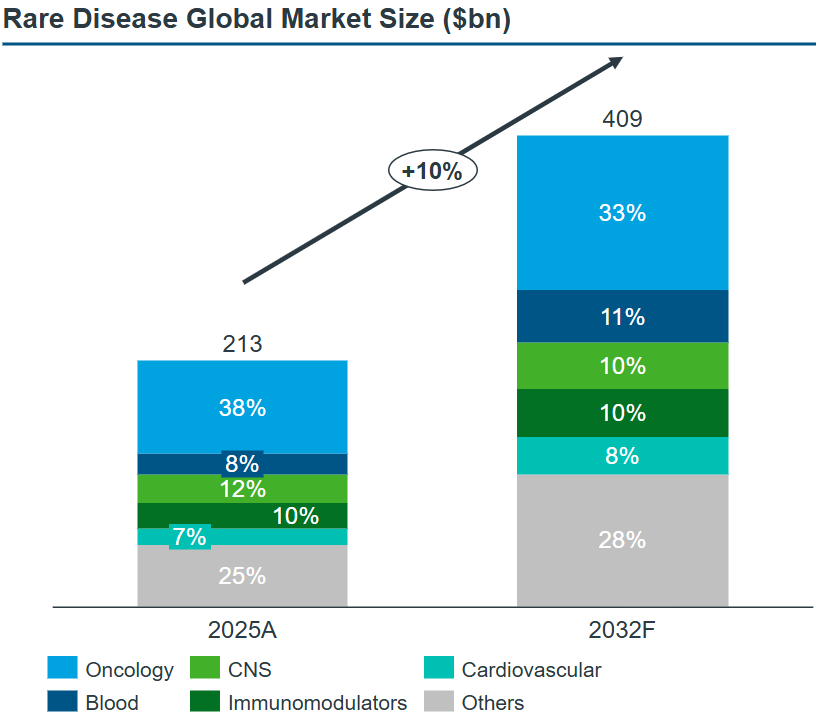
Around 350 million people worldwide are living with a rare disease.1 Despite the prevalence, 95% of rare diseases still have no approved treatment.2 The societal and economic burden is immense, estimated at $1.25 trillion annually across the US1 and Europe3 including both direct medical costs associated with hospitalisation and medication, and indirect costs such as lost productivity and caregiver strain. Driven by unmet need and advances in science, orphan drugs are projected to make up 21% of global prescription drug sales by 2032,4 reaching ~$409 billion at a 10% CAGR (Figure 1).4
Figure 1 – Rare disease global market size4
Complication: The Triple Dilemma
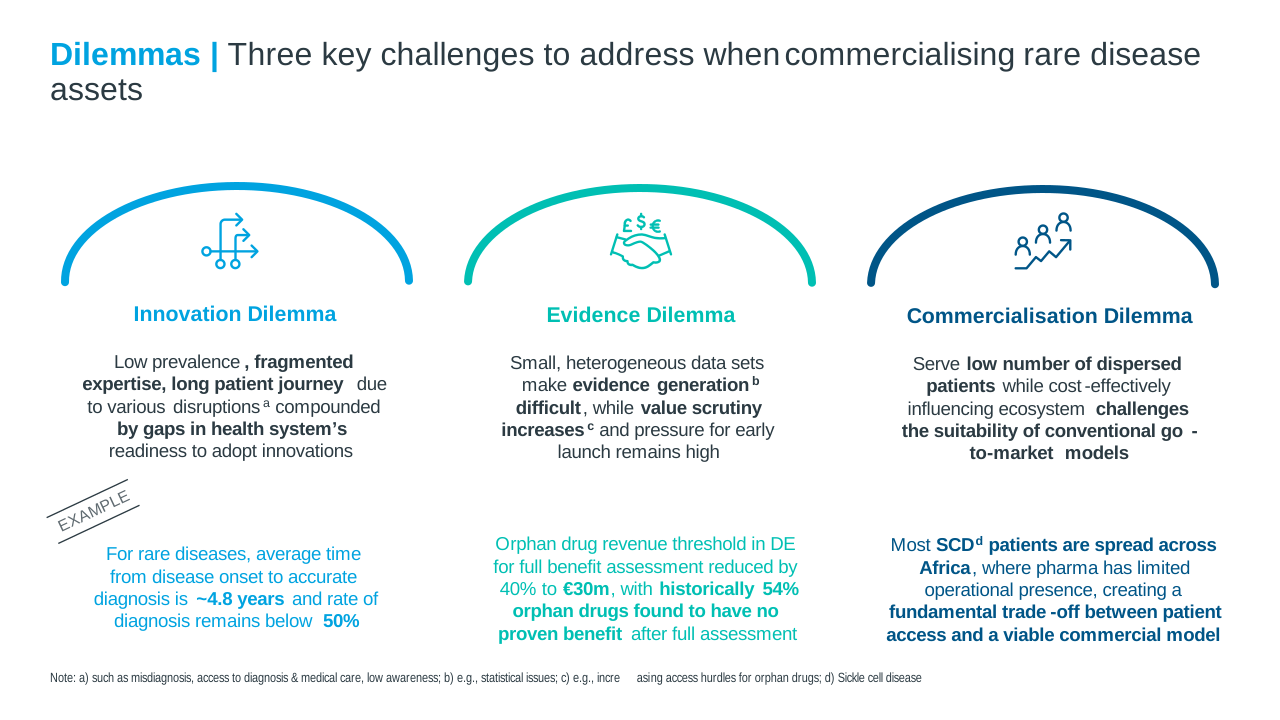
Succeeding with the commercialisation of rare disease focused therapies does not amount to a stripped-down version of traditional pharma commercialisation. It requires a radically different approach to tackle three interconnected dilemmas (Figure 2):
- Innovation dilemma: Rare and ultra rare diseases are characterised by very low prevalence, fragmented expertise, and long, non-linear patient journeys, which create clinical development obstacles and demand new models for diagnosis and care.
- The innovation dilemma reflects the challenge of advancing scientific innovation in areas of high unmet need, while underdeveloped diagnosis, referral pathways, and health system capabilities limit its translation into real-world patient impact.
- Evidence dilemma: Small, heterogeneous patient populations constrain trial size and data robustness, while payers expect more rigorous evidence characterisation and companies face pressure to launch early.
- The evidence dilemma reflects the difficulty of generating sufficiently robust and decision grade evidence under constrained data conditions, while enabling timely market entry.
- Commercialisation dilemma: Rare disease markets consist of small, geographically dispersed patients and highly specialised stakeholders. This challenges the effectiveness of traditional, scale-driven commercial models used by large and mid-sized pharma. For emerging biopharma, the dilemma is more fundamental: determining what new commercial model to build in the absence of legacy infrastructure.
- In both cases, the commercialisation dilemma reflects the misalignment between conventional go-to-market or commercial approaches and the realities of serving small, fragmented rare disease ecosystems.
Health systems often compound the challenge: capacity constraints, limitations to infrastructure, and uneven screening policies slow adoption of rare disease innovations. For companies looking to address the unmet need and capture the potential high-growth opportunity, this means that investment can all too easily result in low impact.
Figure 2 – Rare disease commercialisation dilemmas5,6
Solution: Addressing key dilemmas through strategic capability building
To address common rare disease dilemmas and build a sustainable competitive edge, it is critical to build dedicated rare disease capabilities across the value chain. The IQVIA Rare Disease Capability Framework provides a structured approach to assessing capability maturity, identifying gaps, and making deliberate choices about future capability priorities. The framework is organised around three capability themes, each directly linked to a corresponding rare disease dilemma (Figure 3):
- Patient and health system opportunity: Addresses the innovation dilemma by enabling patient identification, transforming care pathways, and improving treatment experience.
- Value and evidence: Tackles the evidence dilemma by embedding patient-centric endpoints, real-world data, and adaptive contracting early in development.
- Market shaping and stakeholder strategy: Responds to the commercialisation dilemma by building disease awareness, forging stakeholder partnerships, and designing fit for purpose organisational models.
Rare disease launches demand earlier and steeper investment than traditional assets,7 from patient identification and advocacy to real-world evidence and risk-sharing agreements, making capability building a decisive factor in commercialisation success.
Figure 3 – Rare disease capability themes
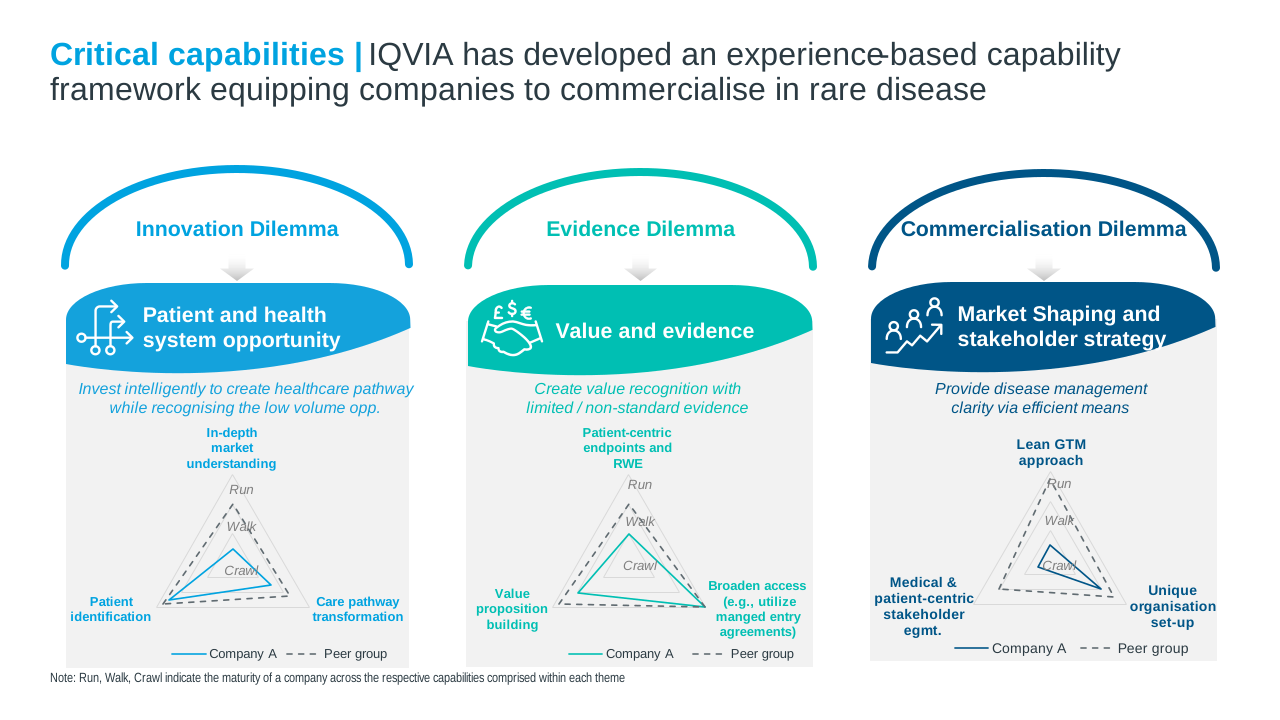
Our proven IQVIA Rare Disease Capability Framework enables companies to define and build the key capabilities required to succeed in rare diseases across the product lifecycle. Success depends not on being best in class across every capability, but on making deliberate trade offs, such as speed vs. certainty or focus vs. scale.
Conclusion: Rare diseases demand tailored strategies. Ignore this, and the cost is not only failure but lost trust and missed opportunities to change lives. In a series of upcoming blogs, we will explore selected key capabilities through case studies and lessons from industry leaders.
Until then, you can access further rare disease insights in IQVIA’s whitepaper From Orphan to Opportunity Mastering Rare Disease Launch Excellence.
Sources:
1) Yang G, Cintina I, Pariser A, et al. (2022). The national economic burden of rare disease in the United States in 2019. Orphanet J Rare Dis 17, 163.
2) Rare disease facts (2024). Global Genes. https://globalgenes.org/rare-disease-facts/
3) Wilsdon R, Axelsen K, Jayasuriya R, et al. (2024) The Economic Cost of Living with a Rare Disease Across Europe. Charles River Associates (CRA) Report.
4) Evaluate Orphan Drugs Report 2025 –2032 (2026). https://www.evaluate.com/thought-leadership/orphan-drugs-outlook-2032/
5) Lutzmayer S, Scott K, Rickwood S. (2024) Evaluate Pharma, IQVIA White Paper: From Orphan to Opportunity - Mastering Rare Disease Launch Excellence. https://www.iqvia.com/-/media/iqvia/pdfs/library/white-papers/from-orphan-to-opportunity-mastering-rare-disease-launch-excellence.pdf
6) Samantha N.Hartin et. al. 2020. Expediting rare disease diagnosis: a call to bridge the gap between clinical and functional genomics
7) IQVIA White Paper - Placing The Right Bets – Defining Tailored Investment Strategies for Pharma Launch. iqvia.com/-/media/iqvia/pdfs/library/white-papers/2026/placing-the-right-bets-defining-tailored-investment-strategies-for-pharma-launch.pdf