
.svg)




Be the first to know in patient support
Get the latest insights, best practices, and real-world strategies straight to your inbox.












A variety of novel therapeutic modalities are dramatically reshaping how cancer is treated. This evolution brings both promise and complexity. Now patients are required to navigate a variety of sophisticated treatment options while managing emotional, financial and logistical challenges that traditional support models were never designed to address.
The one-size-fits-all patient support program no longer works, as the demands of therapy vary greatly. For example, a patient receiving radioligand therapy (RLT) might undergo two weeks of daily treatment, while someone beginning cell and gene therapy (CGT) has an intense preparation phase that is followed by extended monitoring. As each type of therapy has its own demands and a unique mode of action, it's understandable that each patient has different needs when it comes to education and engagement.
Financial burdens in some markets remain a primary obstacle to successful treatment outcomes. High out-of-pocket costs and insurance delays force many patients to postpone or abandon care entirely.2
The challenges go beyond finances. Patients experience profound psychological challenges as they shift their identity to living with cancer. They often feel overwhelmed by complex treatment and administration protocols. The timeline can compound their stress.2-3, 6-7 A patient may have four weeks between biopsy and the start of treatment. During that window, they receive their diagnosis, learn about their treatment plan and must prepare emotionally and practically for what lies ahead. Then they may have to wait even longer to get the exact details of their regimen before rapidly transitioning into active treatment. This acute period demands fast and comprehensive support.
Patients and caregivers must quickly absorb complex concepts about how treatments work, potential side effects specific to their treatment and administration protocols that differ from what they may have heard about traditional chemotherapy. There is a delicate balance between educating patients without overwhelming them, particularly when they are already processing the emotional weight of a cancer diagnosis and facing treatment decisions within weeks of their initial diagnosis. Life sciences companies can play an important role here, complementing healthcare systems with support programs designed to meet patients where they are.2-3, 6-7
Effective oncology support programs should address five interconnected dimensions that span the full patient journey.
1. Patient education and engagement should set the foundation. Complex therapies need to be explained in plain-language materials that help build patient confidence and understanding. Pre-treatment orientation helps set realistic expectations, while peer programs and mental health resources can help address the unique anxieties associated with each therapy type.
2. Emotional and behavioral support can provide the psychological scaffolding patients often need. This dimension draws on behavioral science frameworks like COM-B (Capability, Opportunity, Motivation for Behavior change) and TDF (Theoretical Domains Framework), which examine the barriers patients face and techniques that can enhance their motivation. Unlike traditional education that simply provides information, these approaches target specific barriers and beliefs to drive lasting change.3
3. Treatment coordination and logistical support streamline the patient journey by establishing a single point of contact who manages the scheduling of visits and reminders, the logistics of transportation across care center locations and coordination of different HCPs. This person should help manage the specific nuances of local healthcare ecosystems. This can be especially critical for patients who undergo RLT, which requires coordinating travel to limited treatment sites, or for any patient who is navigating the complexity of combination regimens.2
4. Engaging caregivers often determine treatment success. Creating training programs to better equip caregivers can include how to administer treatment, recognizing side effects and managing home health care. For example, caregivers may need to monitor patients following CGT, which often requires extensive education. For patients receiving RLT, caregivers must understand the radiation safety protocols at home.2
5. Access and affordability solutions can help to address financial barriers through benefits verification, co-pay assistance and manufacturer support programs. This may prove particularly vital for newer therapies which may have reimbursement delays, where early financial navigation can prevent treatment abandonment before it begins.2
Success in patient support is measured not just by adherence rates, but by speed to treatment, patient-reported confidence and satisfaction and the ability to scale across markets. Planning a successful program should begin with companies mapping the patient journey regarding their specific therapy. They need to understand inherent barriers and analyze existing support in target markets before designing and committing to interventions. These concepts deliver measurable results when implemented thoughtfully.
Several real-world examples provide both evidence and inspiration:
To drive lasting change, integrating a behavioral science framework can help provide the scientific foundation for personalized interventions. Rather than applying the same approach to every patient, these frameworks examine individual barriers, whether the obstacle is capability, opportunity or motivation, and tailor support accordingly. This personalization distinguishes modern support programs from traditional approaches that usually educate patients without addressing their specific needs.
Personalization becomes more nuanced and effective over time when there’s robust data driving key decisions. Capturing real-world evidence throughout a patient support program allows teams to measure what's working and continually refine their approach.
A patient support program is an ideal setting for passive and active patience data collection, example biometric data from patient devices, surveys, and questionnaires just to mention a few.
These provide valuable real-world evidence to better understand patient journeys and outcomes as well as providing valuable insights to inform future program design.
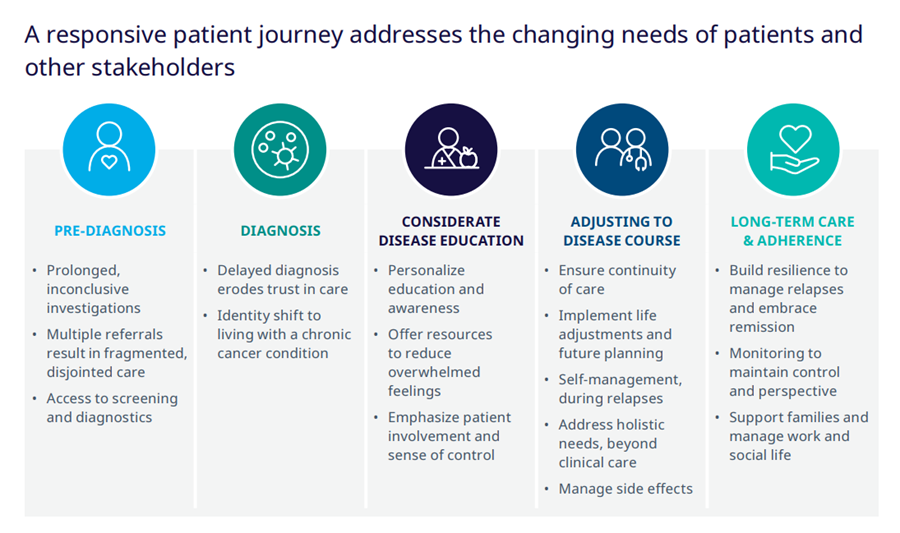
As oncology treatments evolve toward greater personalization and complexity, comprehensive patient support becomes essential for making a real and positive impact. More sophisticated frameworks, aligned to modern behavioral science, offer a roadmap for healthcare stakeholders interested in transforming patient experiences and outcomes. Through coordinated, compassionate, and scientifically grounded support, life sciences leaders can shape a brighter future in oncology for patients, caregivers, and the professionals they trust to guide them on their journey.
1. IQVIA. Removing Barriers, Restoring Hope: Transforming Access to Immunotherapy with IQVIA Patient Engagement and Support (Case Study). 2025.
2. IQVIA. Five Essential Aspects of Oncology Patient Support (Insight Brief). 2025.
3. IQVIA. Transforming Oncology Care: Patient Engagement and Support That Delivers (Fact Sheet). 2025.
4. Michie S, van Stralen MM, West R. The behavior change wheel: A new method for characterizing and designing behavior change interventions. Implementation Science. 2011;6:42.
5. Cane J, O'Connor D, Michie S. Validation of the theoretical domains framework for use in behavior change and implementation research. Implementation Science. 2012;7:37.
6. Cancer and Stress: Understanding the Connections and Interventions - PMC
7. Mental Health Challenges in Cancer Patients: A Cross-Sectional Analysis of Depression and Anxiety -…
Nagore Fernandez-Dominguez is qualified as a clinical pharmacist and Subject Matter Expert in global patient engagement, she has more than 18 years of experience gained from working across industry and providers of healthcare services. She is an experienced leader in patient engagement and support services and has worked with large and small pharmaceutical clients designing and implementing patient adherence solutions. Within IQVIA's Global Patient Engagement and Support team, Nagore is responsible for strategic client engagement and solution design, focused on building solutions that integrate the breadth of IQVIA's capabilities and partners in the patient space.
Effectively engage with patients to help improve adherence, drive better disease understanding, and deliver treatment value.