














Commercial Solutions
Data, AI, and expertise empower Commercial Solutions to optimize strategy, accelerate market access, and maximize brand performance.
This blog is part of an ongoing series, A Brave New World: State of the Industry, on modern market dynamics influencing the life sciences industry.
Patient affordability remains one of the most consequential forces influencing healthcare access and utilization. The underlying pattern is consistent: the more a patient is asked to pay, the less likely they are to start a therapy and stay on it. As healthcare costs continue to shift toward patients, affordability has become intertwined with access, adherence, and the realized value of treatment.
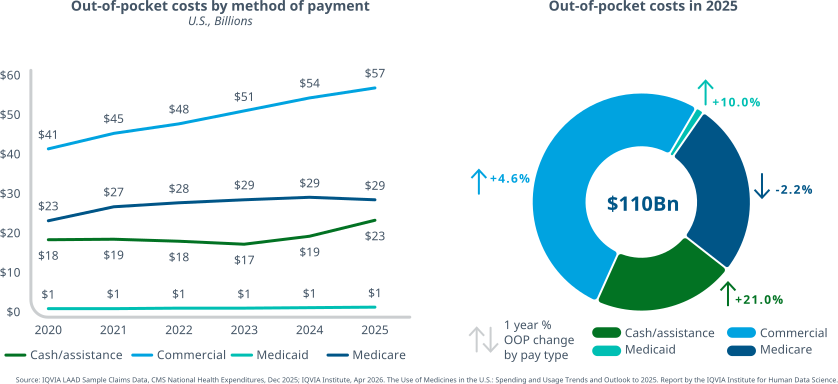
Rising patient cost has accelerated in recent years. Commercial patient out-of-pocket (OOP) costs increased to approximately 5% in 2025 alone and have risen approximately 37% since 2020, reflecting higher deductibles, coinsurance, and rising out-of-pocket cost within the coinsurance category and other forms of patient cost-sharing. As a result, patients are spending more time exposed to substantial financial responsibility, often at multiple points throughout the treatment journey rather than just a single moment of care.
The affordability landscape has also grown more complex. Copay assistance programs and other financial support mechanisms can materially alter patient cost exposure after a prescription is written, creating markedly different access experiences for patients receiving the same therapy. As these dynamics evolve, patient cost exposure has become a decisive factor in determining whether access and prescribing decisions ultimately translate into real-world treatment utilization.
Changes in benefit design are fundamentally altering how and when patients experience healthcare costs. Over the past several years, commercial OOP spending has risen substantially, driven by higher deductibles, copayments, and coinsurance. These trends are occurring alongside continued growth in the maximum financial exposure permitted under Affordable Care Act (ACA) plans. For 2027, the ACA annual OOP maximum is set to increase to $12,000 for self-only coverage and $24,000 for family coverage, approximately 13% higher than 2026 limits. Beyond premiums, deductibles, and out-of-pocket costs, indirect costs from burden of disease must also be considered.
As these components are continually layered, cost exposure is becoming more dynamic and less predictable. A patient's financial responsibility can vary considerably throughout the year depending on deductible status, benefit phase progression, and the structure of affordability support programs. Patients may face little or no cost at one point in treatment, only to encounter high expenses later as coverage phases shift or assistance is exhausted. As a result, patient burden is increasingly tied not only to therapy price, but also to when and how care is accessed.
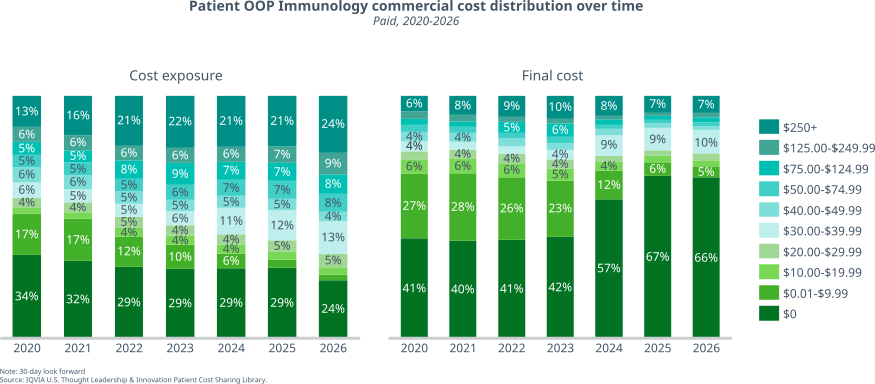
For commercial patients in particular, rising deductibles extend both the intensity and duration of cost exposure. As deductibles increase, patients spend a larger portion of the year in phases where they are responsible for the full or partial cost of therapy. Coinsurance further amplifies this effect, tying patient cost directly to drug price rather than a fixed dollar amount. Together, these dynamics have contributed to a decline in the share of commercial patients with no out-of-pocket cost exposure, from 34% in 2020 to 29% in 2025. As a result, affordability is becoming an ongoing consideration throughout the course of care, as patients make repeated decisions about whether to initiate, refill, or continue therapy while still exposed to meaningful cost sharing.
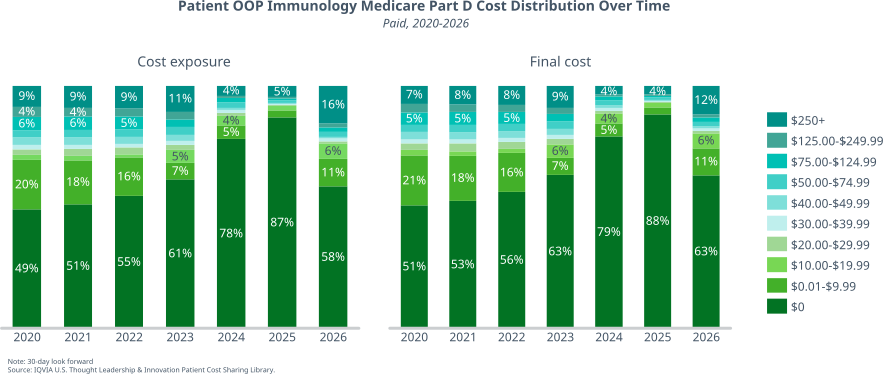
Medicare presents a different affordability dynamic. Beneficiaries have long experienced meaningful variation in OOP costs based on deductible status, benefit phase progression, and subsidy eligibility. Medicare OOP costs declined approximately 2% year over year, likely reflecting, in part, the introduction of the $2,000 annual OOP cap, which lowers maximum financial exposure for many beneficiaries. At the same time, IQVIA data shows that a significant share of Medicare volume continues to come from Low-Income Subsidy (LIS) beneficiaries who face minimal cost-sharing. Importantly, 2026 data captures only the first half of the benefit year, when costs are naturally more concentrated before patients progress through coverage phases or reach the cap. Together, these patterns reinforce that affordability is increasingly defined not only by how much patients pay, but also by when costs occur and which patients bear the greatest burden.
While these dynamics play out differently across both commercial and Medicare benefit structures, the implications are broadly consistent. Cost-sharing is becoming more variable, concentrated earlier in the benefit year, and closely tied to underlying therapy cost, increasing the likelihood that patients face barriers early in the treatment journey, often before a therapy has had time to demonstrate its benefit. This variability also creates diverging patient experiences, where access to the same therapy can follow very different financial pathways depending on benefit design. As cost exposure becomes more dynamic and prolonged, it introduces new friction points throughout the treatment journey, influencing initiation, persistence, and ultimately whether patients remain on treatment long enough to benefit. For manufacturers, this means moving beyond average OOP metrics to understand how affordability barriers vary and impact behavior across patient segments, benefit designs, and points in the treatment journey.
IQVIA analysis shows that branded therapies experience substantially higher abandonment rates than generic products. While multiple factors contribute to this difference, patient cost exposure plays an important role. For branded products with no patient OOP responsibility, abandonment falls to just 10%. However, as OOP costs increase, abandonment rises steadily, approaching 60% for branded therapies associated with costs greater than $250. Although abandonment rates also increase for generic products as costs rise, generic therapies are less frequently associated with these higher cost exposures.
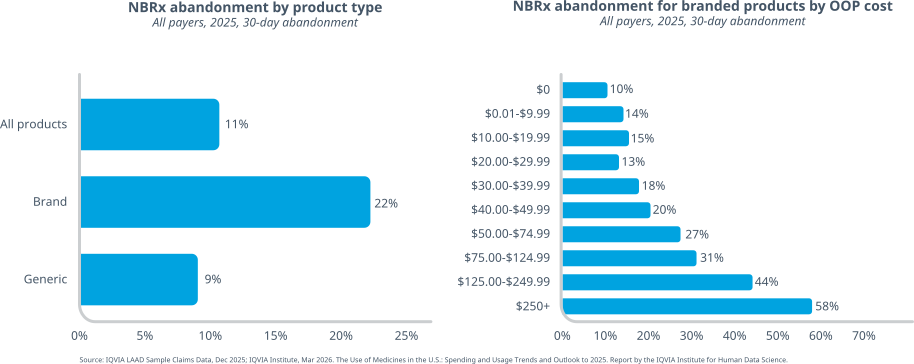
The relationship between cost and behavior appears to be multifactorial. Patients facing low or no OOP responsibility (OOP costs below $20) continue to abandon therapy at approximately 10-15%, indicating that affordability is only one of several factors influencing treatment initiation. However, abandonment increases substantially as patient financial burden rises, suggesting that the most significant opportunity for affordability interventions exists among patients facing higher levels of cost exposure. For these patients, reducing OOP burden may help preserve treatment initiation that would otherwise be lost, creating additional prescriptions and downstream days on therapy.
The impact of affordability extends well beyond treatment initiation. As patients encounter forms of cost-sharing throughout therapy, financial burden can continue to influence decisions about whether to refill, continue, or discontinue treatment. Copay card programs represent one of the most widely used affordability interventions in the commercial market and provide a practical example of how patient cost exposure can shape treatment behavior after a prescription has already been written.
IQVIA analysis comparing copay card users and non-users demonstrates a meaningful relationship between affordability support and sustained treatment engagement. Patients utilizing copay assistance exhibit lower abandonment, higher adherence, and greater persistence than those without support, resulting in substantially more effective days on therapy. These findings suggest that affordability interventions can influence treatment behavior well beyond the initial prescription fill.
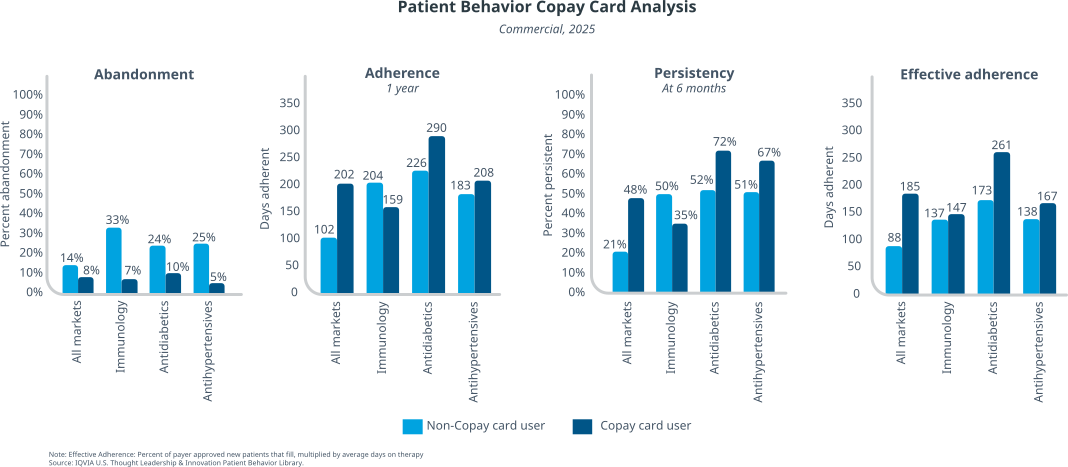
The impact of affordability interventions varies across therapeutic areas, reflecting differences in how patients perceive treatment value and the consequences of discontinuation. In some immunology conditions, such as eczema, symptom relief is immediate and readily felt by patients, making the benefits of staying on therapy tangible in the near term. Chronic conditions such as diabetes or hypertension present a different dynamic: therapy delivers meaningful clinical benefit, but patients experience little day-to-day improvement even as inadequate management carries serious long-term consequences. Where that benefit is less visible, the case for sustained persistence depends more heavily on removing financial friction, which helps explain why conditions with more serious long-term consequences often show stronger adherence once affordability barriers are reduced.
More broadly, copay assistance is increasingly used not just to secure access, but to protect continuity among patients who have already secured physician adoption and payer coverage.
As patient responsibility for healthcare costs continues to grow, affordability is becoming an increasingly important determinant of how therapies translate into sustained use and results once they reach patients. Taken together, these trends point to several broader implications for manufacturers navigating an environment where access alone does not guarantee treatment initiation, persistence, or the outcomes that follow from sustained treatment.
As the industry continues to shift more financial responsibility to patients, the ability to understand, anticipate, and influence affordability-driven behavior will become increasingly important. In this environment, affordability is no longer solely a patient support consideration, but a factor that can materially influence both patient outcomes and commercial performance.
Please contact your IQVIA representative for more information.
Cost is one of the strongest drivers of prescription abandonment. For branded therapies with no patient out-of-pocket (OOP) responsibility, only about 10% of prescriptions are abandoned; abandonment then rises steadily, approaching 60% once OOP costs exceed $250. The relationship is nonlinear—below $20, abandonment holds at around 10–15%, per IQVIA LAAD Sample Claims Data.
Commercial patient OOP costs rose approximately 5% in 2025 and roughly 37% since 2020, driven by higher deductibles, coinsurance, and other forms of cost-sharing. As a result, patients are increasingly exposed to substantial costs at multiple points across the treatment journey rather than at a single moment of care.
Benefit design now spreads cost unevenly across the year. Depending on deductible status, coverage phase, and the structure of affordability support, a patient may pay little or nothing one month, then owe thousands after hitting a deductible or exhausting copay assistance. Affordability increasingly depends on when and how care is accessed, not just a therapy's price.
IQVIA Patient Behavior Library analysis comparing copay card users and non-users shows that patients using copay assistance have lower abandonment, higher adherence, and greater persistence—translating into substantially more effective days on therapy. This indicates that affordability support can shape treatment behavior well beyond the initial prescription fill.
Because access alone no longer guarantees utilization. As cost-sharing becomes more variable and concentrated earlier in the benefit year, affordability directly influences whether patients initiate and remain on therapy, making it a factor that materially affects both patient outcomes and commercial performance.
Medicare OOP costs declined approximately 2% year over year, likely reflecting in part the new $2,000 annual cap, which lowers maximum exposure for many beneficiaries. The effect is uneven—a significant share of Medicare volume comes from Low-Income Subsidy (LIS) beneficiaries who already face minimal cost-sharing (IQVIA Institute, The Use of Medicines in the U.S. 2026).

Explore how digital engagement, direct-to-patient programs, and patient support services are reshaping commercial strategy and market access.
Related solutions
Data, AI, and expertise empower Commercial Solutions to optimize strategy, accelerate market access, and maximize brand performance.