














Across the life sciences industry, as rising out-of-pocket costs, shifting payer policies, and changing benefit designs continue to place greater strain on patients, organizations are navigating an increasingly complex patient support landscape shaped by evolving copay program design, reimbursement dynamics, and mounting pressures around affordability and access. At the same time, digital tools and emerging AI innovations are creating new opportunities to identify and support at-risk patients more quickly and effectively.
In this environment, copay analytics and data-driven insights serve as a stabilizing force, enabling organizations to anticipate challenges rather than react to them. By moving beyond basic transaction management and strategically leveraging copay insights, organizations can identify emerging affordability risks and payer controls, personalize support interventions, shorten time to therapy initiation, improve adherence and persistence, and demonstrate measurable impact to both internal and external stakeholders.
Seeing Beyond the Copay Transaction
Copay data is often viewed narrowly as a financial support mechanism, or simply an entry on a ledger, a cost offset, or a transactional necessity, but copay data is far more than a dollar amount -- it is a behavioral signal. Patterns in copay usage reveal important insights about a patient’s access journey:
- Delays in copay activation can indicate confusion or friction in starting therapy.
- Repeated declines or anomalies may be early indicators of affordability challenges.
- Redemptions followed by gaps can point to emerging adherence risk.
When teams learn to read these patterns, they unlock a deeper understanding of patient needs. Copay data becomes a window into where patients struggle, where support breaks down, and where targeted interventions can make the greatest difference.
The key takeaway: copay data is not just a financial tool; it is a strategic resource to improve access and adherence and optimize program performance.
Turning Insights into Meaningful Action
Collecting data is easy. Acting on it is transformative. Too often, patient support programs rely on delayed reporting or manual intervention, leaving teams reactive and unable to address access and affordability challenges in real time. By activating copay data within operational workflows, organizations can move faster, personalize interventions at scale, and respond to patient needs with greater precision.
Below are real-world examples of how some teams are integrating copay analytics into patient support workflows to trigger timely and personalized interventions:
- Automated alerts when copay burden spikes, prompting outreach before abandonment occurs
- Targeted support pathways for high-risk patients based on their copay behavior patterns
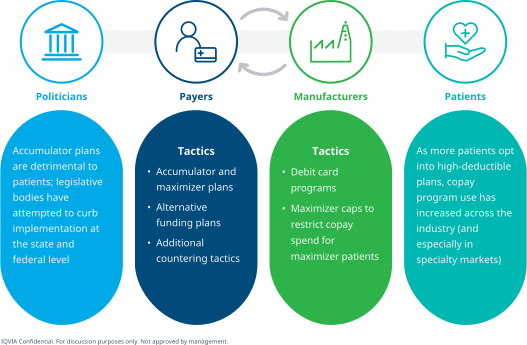
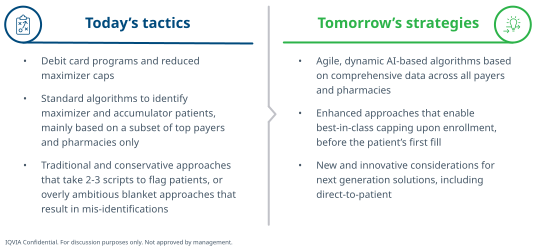
- Proactive identification and mitigation of accumulator and maximizer impacts through tailored affordability strategies
- Integrated messaging and digital engagement that meets patients with the right information at the right moment
These tactics reduce friction across the access journey and help patients start and stay on therapy. They also align cross-functional teams around a shared, data-driven strategy rather than reactive, inconsistent approaches.
The message is clear: Insights alone do not improve outcomes; integrated action does.
Measuring What Matters
While most patient support leaders agree on the need to measure impact, the question remains: What should be measured? Beyond tracking how many patients receive assistance, advanced teams are now evaluating:
- Time to therapy start before and after copay-related interventions
- Abandonment rate reductions tied directly to affordability support
- Long-term adherence patterns influenced by copay program design, accumulator/maximizer prevalence and budget impact
- Engagement rates following targeted outreach triggered by copay analytics
By connecting measurement to outcomes, rather than activities, organizations create a more accurate picture of program performance and patient benefit. They also build a stronger business case for ongoing investment in affordability and access solutions.
The seismic shift: copay programs move from being perceived as cost centers to becoming value centers, driving both patient results and organizational efficiency.
A More Strategic Path Forward
When copay data is treated as transactional, organizations miss opportunities to influence access, adherence, and revenue in real time. For leaders across patient support, needing to swiftly adapt to shifting market dynamics and patient needs there is a clear call to action: Treat copay data as a strategic asset, not just a transactional record of payment.
Strategic copay data unlocks real-time insights into patient behavior and access, highlighting opportunities to intervene where they are most needed. By embedding copay insights into workflows, linking analytics to frontline action, and measuring the outcomes that truly matter, organizations can create more proactive, resilient, and patient-centered support models. The result is better patient experiences, stronger adherence, and greater overall program effectiveness.
Organizations that optimize their affordability programs don’t just track copay data; they operationalize the insights to continuously improve patient outcomes.
Connect with us to learn more: IQVIA Patient Access & Support Services partners with life sciences organizations to transform copay insights into meaningful patient impact. Our advanced analytics, technology solutions, and patient support expertise help teams identify access barriers earlier, personalize interventions, and measure outcomes with confidence. If your organization is looking to strengthen its affordability strategy or leverage copay data more effectively, connect with IQVIA and explore how we can support your goals.


Four Forces Reshaping Patient Support in 2026
Patient support leaders face unprecedented pressure heading into 2026. To succeed in this environment, patient support leaders need practical insight into where patient support models are headed and how priorities must evolve in the year ahead. In this article, discover more about trends reshaping patient support in 2026.