














Brand & Marketing
Grow your brand, now and through patent expiry
This blog is part of an ongoing series, A Brave New World: Modern Analytics & Next-Gen Insights.
Pharmaceutical brand leaders face a critical challenge: proving which marketing investments truly move the needle on physician behavior and patient outcomes. Advanced measurement frameworks are in place at many organizations, yet too often they fail to deliver their full promise. Why? There are myriad factors at play that can inhibit a marketer’s ability to assess the opportunities in front of them and respond accordingly. IQVIA recently conducted a survey with pharmaceutical brand leaders to explore Modern Market challenges. The results were nearly uniform, suggesting that the industry broadly continues to struggle with delivering data-driven insights on marketing channel effectiveness. At the same time, leadership is elevating expectations — calling for bold, forward-thinking strategies that not only deliver measurable ROI but also shape long-term value and competitive advantage.
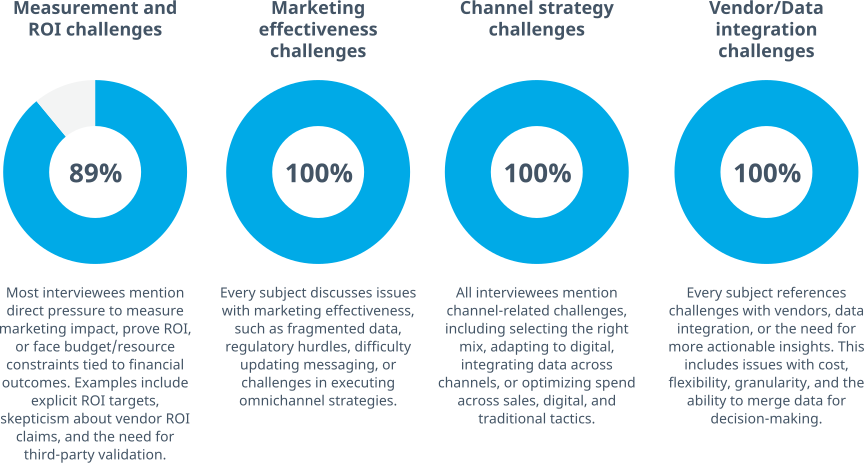
Addressing these challenges requires a multi-prong strategy. Fragmented touchpoints spanning digital channels, field teams, peer networks, and key opinion leaders make it challenging to transform data into actionable insights that drive meaningful improvements and maximize ROI. While traditional metrics like click-through rates and awareness scores offer only a partial view, most brands already collect prescribing, diagnostic, and treatment data; however, the real challenge lies in integrating these sources, breaking down silos, accelerating reporting, and connecting ROI signals quickly enough to inform timely decisions.
Without clarity, the consequences are steep: wasted budgets, diminished credibility with leadership, and missed opportunities to optimize resources. The challenge is not accessing data, it is unlocking its full potential. The sections ahead highlight best practices from high-performing brands and show why a framework that rapidly converts insight into action is essential. Continuous measurement and optimization aren’t optional; they are the keys to demonstrating value and ensuring every marketing dollar works harder.
The complexity of measuring channel effectiveness has grown exponentially over the past decade. Where once half of brand budgets went to television advertising and field force activities, today’s landscape is fragmented across dozens of channels. Digital engagement spans everything from targeted emails to the delivery of point-of-care messaging, while field teams compete for attention with virtual detailing and peer-to-peer platforms. Even opinion leader programs now operate alongside sophisticated digital targeting algorithms. With this, it is no surprise that eMarketer forecasts that almost 4 in 5 promotional dollars spent by brands in 2026 will be in digital channels (79%), with total digital spend up 14% compared to only a few years ago (2023 v. 2026)1. The market will see how this unfolds, but if even not to the projected levels, there is a fundamental shift happening to channel mix.
Adding to the accelerated pace of change are the recent FDA announcements around the renewed emphasis on regulation and guidance for direct-to-consumer (DTC) advertising. New attention adds yet another layer of complexity, raising the stakes for compliance, transparency, and accountability. These shifts mean that measurement is not just about tracking engagement; it is about ensuring that every tactic aligns with regulatory expectations while delivering meaningful outcomes for patients and prescribers.
This fragmentation increases the probability of measurement blind spots that lead to systematic misallocation of resources, and the consequences extend beyond wasted budget. Without clear visibility into channel performance, brand teams struggle to defend their strategies to senior leadership, justify budget requests, or pivot quickly when market dynamics shift. It is like trying to conduct a symphony without a score: every instrument plays in isolation, creating noise instead of music. A unified measurement framework is the sheet music that brings every channel into harmony, transforming complexity into a symphony of measurable outcomes. Beyond your music sheet is the entire industry also playing at the same time. Broadly, the competition for share of voice is filled with more noise than ever before.
The solution requires fundamentally rethinking what constitutes meaningful measurement. Surface metrics like impressions, clicks, and even awareness scores represent activities, not outcomes. What matters is whether marketing efforts change physician behavior and improve patient access to treatment.
Modern analytics enable pharmaceutical companies to connect disparate signals into a holistic view of channel impact. When a physician encounters a brand message through digital channels, attends a peer discussion, and receives a field visit, each touchpoint contributes to their prescribing decision. Advanced attribution modeling can now parse these interactions to understand not just which channels reached physicians, but which combinations influenced behavior. Measuring behavior is about understanding the overlapping Venn diagram that emerges from multiple channels exercised at the same time.
This transformation in measurement capabilities empowers brand leaders in tangible ways. When you can prove outcomes with data-backed insights, you gain the confidence to justify budgets to skeptical stakeholders. You can pivot strategies quickly based on real evidence rather than intuition. Most importantly, you can protect critical resources from funding cuts by demonstrating their direct impact on patient outcomes.
IQVIA's integrated approach to measurement examines billions of data points across channels using artificial intelligence and machine learning. This capability provides marketers with precise insights, transforming what once took months of costly analysis into actionable intelligence available in near-real time. Combining traditional campaign measurement with the prescription universe is the path to understanding campaign effectiveness across multiple dimensions. This starts with sophisticated patient flow models that understand demand generation, continues through access erosion, and then explores the impact of patient behavior on abandonment and adherence. The end result is a combined view of marketing effectiveness on demand capture throughout the patient journey.
Proving ROI requires more than just better measurement. It demands a systematic approach to understanding channel synergies and sequencing effects. Not all channels work independently. Some create awareness that other channels convert into action. Some reinforce messages while others introduce new information. Understanding these interdependencies transforms channel optimization from guesswork into science.
Predictive analytics now enable brand teams to model different investment scenarios before committing resources. Which channels should lead the engagement sequence? How much overlap optimizes impact without creating redundancy? At what point do healthcare providers tune out the noise? While it is difficult to get to predictive outcomes, these questions, once answered only through expensive and time-intensive trial and error, can now be addressed through sophisticated modeling with a fraction of the effort.
Leading brand teams don’t just react -- they anticipate. They harness insights to craft channel strategies that evolve in real time with market dynamics, while embedding a continuous optimization loop between brands, agencies, and media partners. This feedback-driven approach ensures every decision is informed and adaptive.
For example, when data reveals that certain physician segments respond more strongly to peer influence than direct promotion, resources pivot to amplify that effect. If analysis shows that digital engagement accelerates field force impact, teams recalibrate sequencing to unlock this synergy. Every insight becomes an opportunity to refine, optimize, and outperform. Research demonstrates that brands leveraging comprehensive measurement frameworks achieve significantly better returns on their marketing investments. IQVIA's BrandImpact™ score, for instance, distills decades of promotional effectiveness research into actionable metrics that directly correlate with prescription volume changes.
With common challenges experienced throughout the industry, brand leaders are not alone in their frustrations. The impact of promotional investment and channel ROI doesn’t have to be a mystery. With comprehensive data, advanced analytics, and strategic expertise, brand teams can prove what works, optimize resources, and act with confidence. The key is moving beyond fragmented measurement to integrated insights that connect investments to meaningful outcomes.
Success demands partners who understand both the complexity of pharmaceutical marketing and the analytics required to decode it. IQVIA's measurement capabilities and strategic guidance empower brand leaders to build evidence-based cases, secure budgets, and demonstrate clear value to leadership.
For brand leaders under pressure to do more with less, mastering channel ROI measurement is essential. Those who excel can justify budgets, defend strategies, and reach the right physicians with the right messages, ultimately improving patient outcomes. In today’s competitive landscape, that clarity makes all the difference.
Please contact your IQVIA representative for more information.
Reference:

Related solutions
Grow your brand, now and through patent expiry
Data, AI, and expertise empower Commercial Solutions to optimize strategy, accelerate market access, and maximize brand performance.
Gain high value access and increase the profitability of your brands
We empower life sciences with connected intelligence, transforming data into actionable insights for smarter decisions and better patient outcomes.