I started working in UK healthcare policy in the early 1990s. At the time, we were talking about three key developments with the potential to transform healthcare:
(1) Moving care from hospital into the community (first talked about in the 1950s), with GP Fundholding pushing commissioning decisions firmly into the hands of primary care. We were also talking about how the integration between health and social care would massively improve the experience of patients and staff involved in the system
(2) New approaches in public health, helping people to make positive choices about their own lives to prevent patients needing treatment in hospitals at all if possible
(3) Recent advances in computing – and in particular the internet – and whether they would change any of the ways we communicated and interacted with the healthcare system.
This is the same as today’s language, and essentially the same three shifts we talk about now – and certainly none of these very different from what we see in the NHS Ten Year Plan. Most commentators would agree that the pace in change in all of them has been painfully slow.
So, what confidence do we have that our current system can deliver on these priorities over the next ten years? Or even – as most would argue is necessary – over the next two or three?
In my view, what’s different this time is that significant progress is being made around technology, and how it enables us to better use the rich and amazing data our healthcare systems hold.
The building blocks are already in place
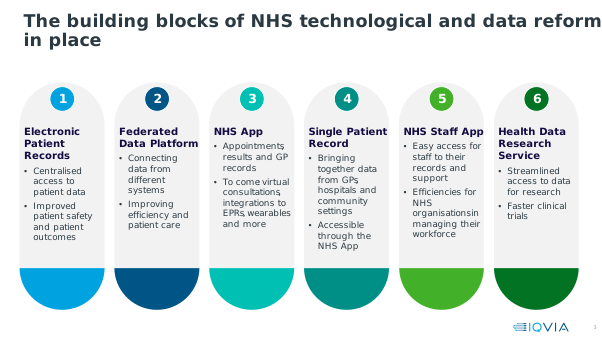
The NHS is making technological progress, and the fundamental building blocks across the NHS are being put into place:
- Most NHS Trusts are already seeing the benefits of Electronic Patient Records (EPRs)
- The Federated Data Platform (FDP) is rolling out at pace
- The NHS App is developing quickly
- A Single Patient Record is being developed
- The NHS Staff App will bring benefits to staff, and to their employers
- The £600m investment into the Health Data Research Service will enable faster clinical trials and medical research
We need to move from digitisation to productivity
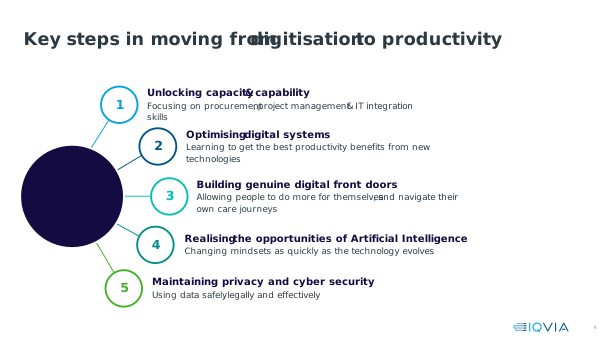
However, in order to get the benefits from these building blocks, we need to move from digitisation to productivity, and this is where organisations like IQVIA, that partner with the NHS, can add support. Here are five keys to unlocking that:
- The NHS needs the capacity and capability to implement digital systems, ranging from procurement to project management to IT integration skills. Where individual organisations don’t have these available internally, they need to have the freedom – and the budgets – to buy them externally. IQVIA regularly has teams of consultants in individual organisations supporting implementation of Electronic Patient Records, and other systems, usually working hand in hand with committed NHS teams
- Once the new technologies are implemented, the NHS needs to learn how to use them, and derive the best productivity benefits from them. This is what IQVIA refers to as “optimisation” of digital systems – supporting the staff (clinical, administrative, and managerial) who access these amazing pieces of technology to use them properly, and get the best out of them. Again, an individual NHS organisation might not have this expertise internally, but can learn and borrow from other organisations who have already been there, or bring in external support. And this applies just as much to new technologies like Ambient Voice Technology, as well as more established systems like EPRs, Imaging Systems and Electronic Document Management
- Creating effective digital front doors - helping people manage their care and move smoothly through NHS services - is essential. The NHS App is an important first step, and a Single Patient Record will be critical to making this seamless. IQVIA is already supporting local systems to design and deliver these solutions, turning digital ambition into practical improvements for patients and staff
- Most of us would agree that Artificial Intelligence brings the potential to radically change the way healthcare is understood, accessed and delivered. In order to benefit from it, our mindsets need to change and adapt as quickly as the technology evolves. At IQVIA, we’re considering across all of our NHS solutions what the potential of AI holds, as well as the barriers to adoption, the risks, and the likely future advances
- Critical to all of this is giving service users, patients and staff confidence that their data is being used safely, legally and effectively. It’s great to see the NHS focusing so acutely on this. IQVIA’s Privacy Enhancing Technology is a good example, registering and auditing every use of data across the FDP, and applying privacy technologies to de-identify personal data. And of course, we’re constantly working with all of our clients to understand and react to the ever-developing threats around cyber security.
Finally, underlying all of these, we need to continually ask ourselves with each new technological advancement whether it is really improving patient experience, and making the jobs of NHS staff easier and more rewarding: these should be our constant litmus tests.
Summary
So where does this leave us? The challenges and the language may be familiar, but this time with the right technology foundations, enhanced capability, and support in place (including from organisations like IQVIA), we have a genuine opportunity to deliver NHS change at pace and scale.