IQVIA Real World Solutions is the proven partner life science companies trust to take on their complex evidence challenges. We enable our customers to generate and disseminate real world evidence to answer crucial questions and meet the needs of their stakeholders.
The Innovative Licensing Access Pathway (ILAP) in the United Kingdom aims to improve patient access to innovative medicines. It was launched on 1 January 2021 and a total of 229 ILAP applications were received by 25 March 2024, of which 50% were awarded Innovation Passports. However, little is known about its benefits. In this review, we assess the market access benefits of ILAP process by examining time to access for Orbis-designated oncology products.
Approach
We conducted a search of an international database of extracted health technology assessments (HTAs) (HTA Accelerator) to identify National Institute for Health and Care Excellence (NICE) and Scottish Medicines Consortium (SMC) HTAs for Orbis-designated products. The objective was to assess whether oncology products eligible for ILAP benefited from prioritisation for HTA based on time to decision by means of a comparison with the average time to decision for all UK oncology products using the EFPIA Wait Indicator. Data extraction included evidence assessment, agency critique, outcome, and time to recommendation. The time to decision refers to the duration taken by HTA bodies to reach a decision on the re-imbursement whether positive or negative, while the mean time to availability indicates the period required for a product to become available following a positive recommendation.
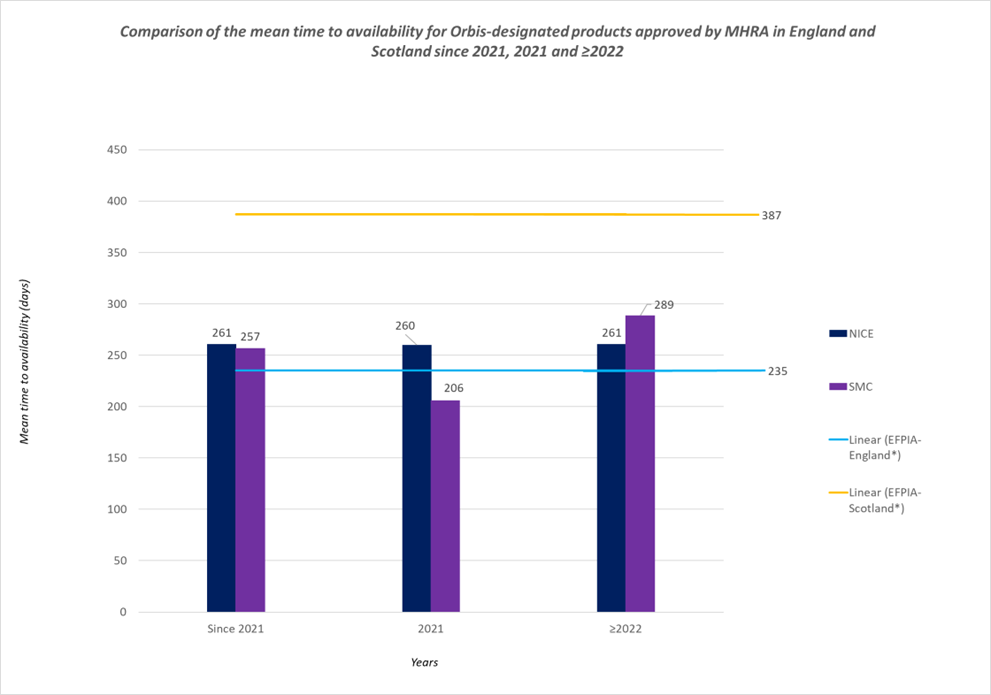
In Graph 1, we present a comparative analysis of the mean time to availability across three distinct time periods. Firstly, we examined the overall mean time to availability from 2021 to October 2024. Secondly, we focused specifically on the mean time to availability during 1st year 2021, when we considered that it was more likely that the application submitted were at a late stage of development. We also analysed the mean time to availability from the beginning of 2022 up until October 2024, as we expected these data to include products submitted earlier in development.
Table 1: Overview of MHRA grant dates, NICE, and SMC decisions, for 19 Orbis-designated products
|
Product |
MHRA |
|
|
||
|
Decision date |
Decision |
Decision date |
Decision |
||
|
Tagrisso® (osimertinib) |
06 May 2021 |
19 January 2022 |
Positive w. restrictions |
08 October 2021 |
Positive w. restrictions |
|
Trodelvy ® (sacituzumab govetican) |
08 September 2021 |
17 August 2022 |
Positive recommendation |
04 February 2022 |
Positive recommendation |
|
Lorviqua ® (lorlatinib) |
23 September 2021 |
26 April 2023 |
Negative recommendation |
04 February 2022 |
Positive recommendation |
|
Lumykras ® (sotorasib) |
08 September 2021 |
30 March 2022 |
Positive w. restrictions |
04 February 2022 |
Positive w. restrictions-Interim acceptance |
|
Rybrevant ® (amivantamab) |
15 November 2021 |
14 December 2022 |
Negative recommendation |
No application |
Not recommended in the absence of submission from the holder of marketing authorisation |
|
Tepmetko ® (tepotinib) |
24 September 2021 |
18 May 2022 |
Positive recommendation |
09 December 2022 |
Prior: Negative recommendation 06/05/22- |
|
Tecentriq ® (atezolizumab) |
27 January 2022 |
28 September 2022 |
Positive w. restrictions |
08 July 2022 |
Positive recommendation |
|
Jakavi ® (ruxolitinib) |
23 March 2022 |
No application |
Unable to make recommendation as MNF has confirmed it does not intend to make an evidence submission at this time |
No application |
Not recommended in the absence of submission from the holder of marketing authorisation |
|
Exkivity ® (mobocertinib) |
17 March 2022 |
MA Withdrawn on 8th March 2024 |
N/A |
MA Withdrawn on 8th March 2024 |
N/A |
|
Welireg ®(belzutifan) |
31 May 2022 |
Ongoing |
Expected publication date:16 October 2024 |
08 September 2023 |
Positive recommendation |
|
Kimmtrak ® (tebentafusp) |
07 June 2022 |
15 August 2023 |
Negative recommendation- appeal ongoing |
Ongoing |
N/A |
|
Rezurock ® (belumosudil) |
07 July 2022 |
07 February 2024 |
Prior: Negative recommendation 4 October 2023 |
09 June 2023 |
Positive recommendation |
|
Opdivo ® (nivolumab) |
16 August 2022 |
22 March 2023 |
Positive recommendation |
11 December 2023 |
Positive recommendation |
|
Nubeqa ® (darolutamide) |
22 November 2022 |
21 June 2023 |
Positive recommendation |
08 September 2023 |
Positive recommendation |
|
Imfinzi ® (durvalumab) |
25 January 2023 |
10 January 2024 |
Positive recommendation |
06 October 2023 |
Positive recommendation |
|
Tabrecta ® (capmatinib) |
27 March 2023 |
No application |
Unable to make recommendation as MNF has confirmed it does not intend to make an evidence submission at this time |
No application |
N/A |
|
Jemperli ® (dostarlimab) Line extension |
02 October 2023 |
03 April 2024 |
Positive recommendation |
08 March 2024 |
Positive recommendation |
|
Opdualag ® (nivolumab and relatlimab) |
27 December 2023 |
07 February 2024 |
Positive w. restrictions |
07 June 2024 |
Positive recommendation |
|
Truqap ® (capivasertib) |
17 July 2024 |
Ongoing |
Expected publication date:05 March 2025 |
No application |
NA |
Graph 1: Comparison of the mean time to availability for Orbis-designated products approved by MHRA in England and Scotland since 2021, 2021 and ≥2022 in relation to the EFPIA W.A.I.T survey
*IQVIA. EFPIA Patients W.A.I.T. Indicator 2023 Survey June 2024 Page 22
Key Findings
As of October 2024, 19 Orbis-designated products have been granted GB marketing authorization (MA) or had an existing authorisation extended. Interestingly, the majority (56%) were indicated for non-small cell lung cancer (NSCLC). This observed trend may reflect large pipeline in NSCLC products, the high unmet need in NSCLC characterised by consistently poor outcomes with existing NSCLC treatments and the high prevalence of the disease.
Of the 19 Orbis-designated products, NICE was less likely to provide a positive recommendation versus SMC, with 61% versus 72% of Orbis products receiving a positive recommendation, respectively. SMC was, however, more likely to not receive a company submission versus NICE, with 22% versus 11% of products not being submitted for review, respectively.
We also observed that regulator and HTA decisions were not always aligned, with more Orbis products achieving access in Scotland than in England. There were instances of two and four products that did not submit an evidence package to NICE and SMC, respectively, despite prioritisation for approval.
Another finding was that following HTA approvals from NICE and SMC, mobocertinib did not meet the approval conditions of the conditional marketing authorisation, with its MA having since been withdrawn. This case demonstrates the risks of conducting HTA for products with conditional approval, and not necessarily a risk with ILAP.
In terms of time to access, the overall mean time to decision since 2021 was longer for NICE (306 days) compared to SMC (257 days). The overall mean time to availability since 2021 were similar in England (261 days) and Scotland (257 days).
Our review observed that the timelines for HTA approval in Project Orbis (≥2022) were slightly longer in England (261 vs 235 days) and faster in Scotland (257 vs 387 days) compared to all oncology products reviewed in the 2023 EFPIA W.A.I.T. indicator survey.
Further, more recent Orbis approvals show quicker time to decision and availability by NICE compared to 2021 approvals, reflecting the first year of ILAP. However, time to decision and availability has significantly increased for SMC in recent years compared to 2021, suggesting divergent views on acceptability of evidence for Orbis products.
Takeaways
ILAP, launched in 2021, offers early engagement for manufacturers, but benefits remain unclear due to limited publicly available documentation. There is a decreasing trend in products going through ILAP, and instances of MA being withdrawn despite positive HTA indicating that ILAP participation may not guarantee commercial success . It is important to note that Orbis products may not fully represent ILAP, and transparency on non-Orbis products would aid assessment of participation benefits. Nonetheless, data available suggests it may not offer the benefits that were intended. This may explain why there is a proposal to alter the program, with recent communication from MHRA of its intention to revise the broad definition it applies to drugs entering ILAP so that the scheme resembles similar offerings by other regulators, such as the EMA’s PRIME and the US FDA’s Breakthrough Therapy Designation.
In the meantime, companies may want to consider alternative pathways to harmonise their regulatory and HTA timelines and requirements in the UK. Recent attention has also been given to the new international recognition procedure (IRP) allowing companies to request MHRA recognise the evidence submitted for products approved from one of the specified reference regulators. Note that this does not imply automatic MA and that MHRA retains the authority to reject applications if the evidence provided is considered insufficiently robust. NICE has recently posted communication on what this means for HTA. For companies seeking to benefit from the IRP, NICE encourages companies to engage early which can be done via NICE Advice, to ensure product information on UK PharmaScan is kept up to date, to regularly provide updates on regulatory plans to both NICE and the MHRA and to allow NICE and the MHRA to share operational and planning data.
Abbreviations: EFPIA: European Federation of Pharmaceutical Industries and Associations; HTA: Health technology assessment; ILAP: Innovative Licensing Access Pathway; NICE: National Institute for Health and Care Excellence; N/A Not applicable; NSCLC: Non-small cell lung cancer; SMC: Scottish Medicines Consortium; UK: United Kingdom.