














Stay ahead with the International Thought Leadership insights: your source for industry-leading expertise and analysis
Blog
Inflammation: The next frontier of therapeutic innovation in cardiovascular-renal diseases
Emerging approaches targeting underlying immune dysregulation
Oct 28, 2026
Introduction
Interest in exploring the role of inflammation across cardiovascular-renal (CVR) diseases has gained significant momentum. In particular, attention has turned to the involvement of chronic, low-grade inflammation in the pathogenesis of CVR diseases as an independent, modifiable driver of disease and risk.
This positions inflammation as an emerging therapeutic target offering innovators potential novel approaches for the management of CVR diseases, including primary and secondary prevention of major cardiovascular events1,2.
It is important to note that clarity and confidence about the role of inflammation vary considerably across the CVR disease spectrum. The strength of existing evidence supporting a relationship between inflammation and specific CVR diseases spans a wide range: from the most robust evidence for ASCVD establishing causality, closely followed by recurrent pericarditis, to associations and mere mechanistic plausibility in the case of heart failure, hypertension or CKD, with limited or no therapeutic validation to date.
Notwithstanding these uncertainties, the intersect of immunology and cardiometabolism holds tremendous therapeutic potential.
In this blog we will focus on targeted anti-inflammatory therapies that engage specific immune mediators or pathways driving inflammation in CVR diseases. Despite their anti-inflammatory properties, incretin-based pharmacotherapies were excluded as we categorise them as metabolic hormones and not targeted immuno-therapies. Moreover, in an earlier blog we already discussed their potential in the context of the metabolic-inflammation axis3.
Inflammation across the CVR disease spectrum
Compelling mechanistic plausibility supports the notion of inflammation playing an important role in the pathogenesis of many CVR diseases.
While numerous preclinical and clinical studies have shown associations between inflammation and specific CVR diseases, and advanced our understanding of the role of immune dysregulation, to date the higher evidence bar of demonstrating causality, and in turn therapeutic utility, has only been cleared for atherosclerotic cardiovascular disease (ASCVD) and recurrent pericarditis.
It resulted in two FDA approvals of targeted anti-inflammatory therapies: NLRP3- and neutrophil-targeting colchicine for risk reduction in adults with established ASCVD, and IL-1 inhibitor rilonacept for recurrent pericarditis.
Currently, there are no approved targeted anti-inflammatory drugs indicated for the treatment of atrial fibrillation, heart failure, hypertension, CKD-associated cardiovascular risk, or other CVR diseases (see Table 1).
Table 1: Selected CVR diseases vs. inflammation biology and supporting evidence
| Disease | Inflammation biology | Supporting evidence | Therapeutic implications |
|
ASCVD |
Lipoprotein-driven innate/adaptive immunity; NLRP3–IL-1β–IL-6 axis |
Causal; |
Colchicine (NLRP3, neutrophil targeting), canakinumab (IL-1 inhibitor) outcomes establish causality; |
|
Recurrent pericarditis |
Predominantly auto-inflammatory; pericardial injury activates NLRP3, IL‑1α/IL‑1β amplification, systemic CRP elevation |
Strong RCT validation (RHAPSODY, AIRTRIP) |
Rilonacept (IL-1 inhibitor) FDA-approved for recurrent pericarditis; |
|
Heart Failure |
Cardiac macrophages, endothelial inflammation, fibrosis, IL‑1/IL‑6/TNF, MPO; adipose, renal inflammation |
Strong association; no therapeutic validation |
HFrEF: anti-TNF inhibitors were neutral or harmful; HFpEF: HERMES termination weakens direct IL-6 validation; No approved targeted anti-inflammatory drugs |
|
Atrial fibrillation |
NLRP3 signalling, oxidative stress, macrophages, epicardial fat driving electrical and fibrotic remodelling |
Strong association; limited therapeutic validation |
Colchicine evidence remains context-dependent; |
|
Hypertension |
Renal, vascular dendritic cells, macrophages, |
Association, mechanistic plausibility, |
No approved targeted anti-inflammatory drugs |
|
CKD |
Inflammasome activation, cytokine release (IL-1β, IL-6, TNF-α, IL-18), endothelial dysfunction; fibrosis reinforces cycle of inflammation, hyper-tension, kidney injury |
Mechanistic plausibility; |
No approved targeted anti-inflammatory drugs |
This underscores the need to better understand the complex interplay between inflammation and the physiological systems involved in CVR diseases. To realise the promise of inflammation as a therapeutic target, we must identify causal drivers of cardiovascular risk, as opposed to prognostic markers of inflammation, such as hsCRP.
Deep dive: Inflammation and ASCVD
Atherosclerotic cardiovascular disease (ASCVD) is the poster child for causally linking inflammation to disease initiation and progression, from atherogenesis to plaque rupture and ischemic events.
Accumulation of atherogenic lipoproteins initiates inflammatory responses within the arterial wall, while inflammatory pathways contribute to endothelial dysfunction, leukocyte infiltration, foam cell formation and apoptosis to accelerate plaque growth, instability and thrombogenesis. The NLRP3/IL-1/IL-6 axis provides a key mechanistic link between lipoprotein accumulation and vascular inflammation.
Several high-quality, randomized controlled trials demonstrated that targeting inflammation reduces cardiovascular risk in ASCVD independent of lowering lipids (see Figure 1).
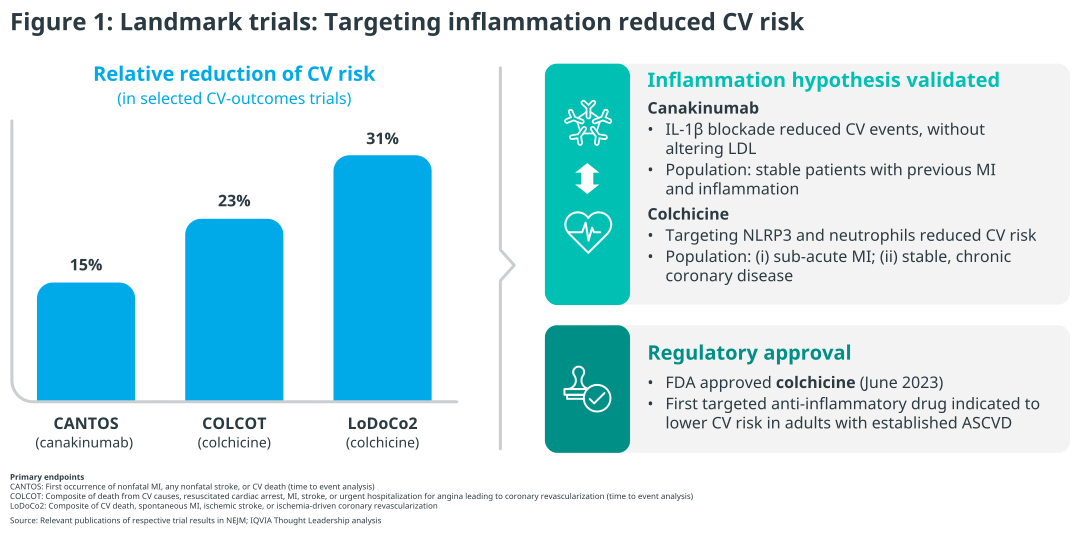
The strongest therapeutic validation comes from CANTOS, a randomized, double blind, placebo-controlled phase 3 trial involving 10,061 stable patients with previous myocardial infarction (MI) and hsCRP ≥2 mg/L receiving IL-1β inhibitor canakinumab every 3 months4.
The trial met its primary composite endpoint (nonfatal heart attack, nonfatal stroke, or cardiovascular death), showing a 15% relative risk reduction for patients receiving the 150 mg dose compared to the placebo group. Crucially, the IL-1β blockade reduced events without altering LDL-cholesterol levels, thus supporting the inflammatory hypothesis of atherosclerosis. It explains the presence of residual risk despite effective lipid lowering and established inflammation as a modifiable driver, via IL-1β inhibition, in ASCVD.
Despite this landmark result, the sponsor did not advance canakinumab, likely owing to a combination of the level of observed efficacy and increased risk of fatal infections.
Two randomised controlled phase 3 trials investigating NLRP3- and neutrophil-targeting oral colchicine provided additional evidence to validate the inflammatory hypothesis of cardiovascular disease.
- In COLCOT, low-dose colchicine (0.5 mg once daily) significantly reduced the risk of composite endpoint (CV death, resuscitated cardiac arrest, myocardial infarction, stroke, or urgent hospitalization for angina leading to coronary revascularization) by 23% compared to placebo when added to standard care in patients recruited within 30 days after a myocardial infarction5.
- In LoDoCo2, low-dose colchicine (0.5 mg once daily) significantly reduced the risk of major cardiovascular events (CV death, spontaneous MI, ischaemic stroke or revascularization) by 31% compared to placebo in patients with stable, chronic coronary disease6.
in June 2023, the FDA approved colchicine as the first targeted anti-inflammatory drug indicated for the secondary prevention of cardiovascular events in adults with established atherosclerotic cardiovascular disease7.
However, not all evidence has been universally positive for anti-inflammatory therapies in secondary prevention, e.g.,
- In contrast to COLCOT, CLEAR SYNERGY (OASIS 9) failed to show reduction in major adverse cardiovascular events (MACE) after a median follow-up of 3 years. CLEAR SYNERGY was a randomized, double-blind, placebo-controlled phase 3 trial involving 7,062 patients with acute MI, who were randomized within 72 hours after percutaneous coronary intervention to either receive colchicine or placebo8.
- ZEUS, a double-blind, placebo-controlled phase 3 trial, involved over 6,300 patients with ASCVD, CKD, and inflammation (hsCRP levels ≥2 mg/L) who were randomized to once-monthly IL-6 inhibitor ziltivekimab 15 mg or placebo. While the drug reduced cardiovascular inflammation, measured as IL-6 and hsCRP levels, this did not translate into MACE reduction9.
Unsurprisingly, such conflicting outcomes have raised questions about the general validity of the inflammation hypothesis. To understand the implications for ongoing cardiovascular inflammation-focussed innovation, it is important to consider the specifics of these trials before jumping to general conclusions.
The observed, mixed evidence does not invalidate the inflammation hypothesis. Instead, it prompts a rethink and the need for a more differentiated approach, for example:
- Causality: While hsCRP is a useful prognostic marker for cardiovascular risk, it is not a causal risk factor or a surrogate of cardiovascular benefit.
- Specificity: hsCRP is a non-specific marker of inflammation that can be elevated by many chronic diseases or acute immune responses, e.g., to transient infections.
- Systemic vs. vascular: Circulating blood markers do not necessarily reflect levels of vascular inflammation. For example, Fat Attenuation Index (FAI), a quantitative, imaging-derived measure of tissue-specific, coronary inflammation obtained via coronary computed tomography angiography (CCTA), poorly correlates with circulating hsCRP10.
- Timing of intervention: CLEAR SYNERGY focused on early administration of colchicine (72 hours post percutaneous coronary intervention), while in COLCOT colchicine was given within 30 days after ST-segment elevation MI (STEMI) or 14 days after non-STEMI. This suggests optimal outcomes depend on the disease stage, e.g., an acute vs sub-acute MI setting, with the former involving an initial cytokine surge that may blunt colchicine’s anti-inflammatory effects8.
The implications for innovators are clear: It is critical to distinguish between the general presence of cardiovascular inflammation vs. specific, causal and modifiable inflammatory pathways.
Therefore pathway selection is key, as is carefully defining the target patient population using meaningful biomarkers that correlate with outcomes, e.g., exploring direct measurements of tissue-specific vascular inflammation and plaque vulnerability instead of crude metrics such as hsCRP.
Increasing use of ‘backbone therapies’ such as SGLT2 inhibitors and especially incretin-based pharmacotherapies like semaglutide or tirzepatide pose additional challenges for innovators. These therapies have demonstrated broad benefits against multiple cardiometabolic risk factors, e.g., BMI, HbA1c, lipids or blood pressure, thereby re-setting a patient’s risk baseline. This reduces levels of residual risk and makes it harder for targeted anti-inflammatory interventions to demonstrate incremental benefits, e.g., requiring even larger outcomes trials with longer duration to accrue sufficient events and achieve statistical power.
Innovators will also need to carefully choose the optimal time window for a therapeutic intervention when a specific disease is most responsive to targeted anti-inflammatory treatment.
Innovation landscape: emerging targeted anti-inflammatory approaches to CV risk reduction
Ongoing innovation efforts explore a range of mechanisms of action across 21 active clinical trials to tackle inflammation as a driver of cardiovascular risk, with ASCVD/coronary inflammation, recurrent pericarditis, myocardial infarction and stroke as the leading indications (see Figure 2).
Intriguing translational research into potentially transformative approaches and numerous preclinical, proof-of-concept studies complement the still relatively small number of active clinical trials to create momentum behind inflammation-focused innovation in CVR diseases.
Of note, as explained earlier, incretin-based pharmacotherapies as metabolic hormones have been excluded from this analysis.
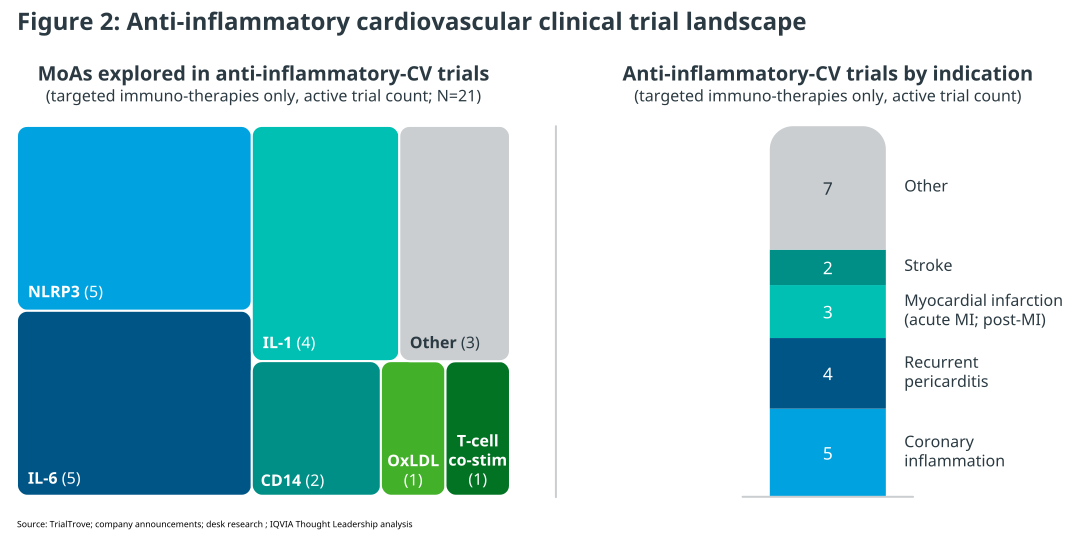
The NLRP3/IL-1/IL-6 axis continues to be the primary focus for innovators:
- NLRP3 represents an attractive inflammasome target for oral inhibitors11. As an upstream target closer to innate immune activation and cellular danger signalling, it may offer greater potential for effective inflammation control than targeting downstream inflammatory cytokines, possibly with a wider therapeutic window. However, NLRP3 inhibition still requires CV outcomes validation, since current trials only focus on biomarker-based endpoints, e.g., hsCRP, IL-1β, FDG-PET or imaging endpoints.
Notable oral NLRP3 inhibitors in development include ruvonoflast (Rezera, phase 2, moving into a registrational trial for PAD), selnoflast (Roche, phase 2, ASCVD), VTX2735 (Zomagen/Ventyx, phase 2, recurrent pericarditis) and BGE-102 (BioAge, phase 2, obesity with elevated hsCRP and cardiometabolic risk). - IL-1 as a meaningful target is supported by the strongest direct evidence, including data from the CANTOS outcomes trial in ASCVD and the approval of IL-1 inhibitor rilonacept for treating recurrent pericarditis. The most advanced candidates in development are IL-1 receptor antagonists KPL‑387 (Kiniksa, phase 2/3, recurrent pericarditis) and anakinra (investigator-initiated, phase 2, acute STEMI prevention).
- Confidence in targeting IL-6 has suffered from the recent failure of the ZEUS trial and the discontinuation of the HERMES and ATHENA trials, all investigating IL-6 inhibitor ziltivekimab. Nevertheless, several ongoing trials continue to explore IL-6 inhibition, including ziltivekimab (Novo, ARTEMIS/phase 3, acute MI), clazakizumab (CSL, phase 3, dialysis patients with systemic inflammation plus ASCVD or diabetes) and tocilizumab (investigator-initiated, phase 3, acute ischaemic stroke).
Oxidative and neutrophil pathways are also being explored as potential targets for anti-inflammatory therapies:
- Oxidised low-density lipoprotein (oxLDL) modulates innate and adaptive immune responses driving chronic vascular inflammation. Orticumab (Abcentra, phase 2, prior MI with high coronary inflammation) targets oxLDL to reduce coronary artery and atherosclerotic plaque inflammation, while avoiding broader immune suppression12.
- Neutrophils play a key role in atherosclerotic plaque development and progression. Several early-stage, preclinical efforts are exploring a number of neutrophil-related targets, e.g., neutrophil extracellular trap formation (NETosis), peptidyl arginine deiminase 4 (PAD4) or gasdermin-D13.
Other noteworthy innovative approaches include:
- Innate immune interruption upstream of multiple inflammatory pathways could dampen several inflammatory signals simultaneously, e.g., TNF-α and IL-6 release, vs. suppressing individual downstream mediators. Atibuclimab (Implicit Bioscience, phase 2, prior MI with high coronary inflammation) blocks CD14, a key pattern recognition receptor for the innate immune response, upstream in the inflammatory cascade with the aim to reduce the inflammatory response after acute myocardial injury to prevent secondary myocardial damage and adverse ventricular remodelling.
- Selectively expanding regulatory T cells (Tregs) via low-dose IL‑2 to restore immune control without broad immunosuppression. In the IVORY phase 2 trial, 60 ACS (acute coronary syndrome) patients with inflammation (hsCRP >2 mg/L) received low-dose aldesleukin (IL‑2) or placebo. Patients in the active arm saw selective and significant increases in Tregs cells alongside reduced arterial inflammation, measured by PET scan14. The ongoing IVORY-FINALE extension study tracks participants for up to 5 years to evaluate long-term major adverse cardiovascular events (MACE).
- Selectively modulating T-cell costimulation via CD80- and CD86-targeting abatacept. The currently recruiting ATRIUM phase 3 trial will investigate reduction of cardiac immune activation via abatacept in hospitalized patients with immune checkpoint inhibitor (ICI)-associated myocarditis, using a composite endpoint of first occurrence of cardiovascular death, non-fatal sudden cardiac arrest, cardiogenic shock, significant ventricular arrhythmias, significant bradyarrhythmias, or incident heart failure15.
- Pro-resolution biology: This very early-stage approach has transformative potential by focusing on resolving inflammation in cardiovascular disease as opposed to suppressing it. Atherosclerosis is characterized by defective efferocytosis, the clearance of apoptotic cells by macrophages to control inflammation, leading to necrotic debris accumulation, plaque instability and thrombosis. Therefore, restoring continual efferocytosis offers a promising approach to stabilize vulnerable plaques and reduce residual cardiovascular risk16.
In a proof of concept study, an engineered macrophage exosome combining SIRPα-mediated CD47 checkpoint blockade with metabolic reprogramming restored defective efferocytosis and improved plaque stability in ApoE-deficient mice models17.
These examples not only illustrate a rich innovation landscape but also an important shift in focus: From broad systemic immunosuppression towards pathway-, phenotype- and time-specific immuno-modulation, or even resolution, to overcome the limitations of first-generation interventions and broaden the therapeutic utility of targeted anti-inflammatory approaches to CV risk reduction.
Capturing the inflammation opportunity in CVR diseases: Key considerations for innovators
The fundamental challenge facing innovators is converting the treatment of inflammation from a biologically compelling concept for CV risk reduction into a viable commercial opportunity.
Unlike other, established cardiometabolic risk factors such as elevated LDL, blood pressure or HbA1c, inflammation lacks a universally accepted paradigm firmly linking a therapeutic target to a biomarker that upon treatment directly translates into CV outcomes.
Consequently, tackling inflammation in CVR diseases does not present itself as a single, uniform opportunity. Instead, it needs to be understood as a collection of distinct, disease- and pathway-specific opportunities governed by different success factors.
This has important implications for innovators exploring inflammation in CVR diseases:
- Need for precision-inflammation approaches that target specific inflammatory pathways driving a given patient's CV risk, at the most tractable disease stage, vs. broad suppression of inflammation. This elevates the importance of pathway-specific biomarkers for patient identification, endo-/phenotyping and risk-based stratification to guide clinical development and therapeutic interventions.
- Disease-specific context matters: The same MoA can translate into very different opportunity profiles across indications. For example, in recurrent pericarditis, severe myocarditis or inflammatory cardiomyopathy, inflammation is a key feature of the disease itself vs being one component of long-term risk, e.g., in ASCVD or HF.
Therefore, the former resemble specialty care opportunities in typical immunology indications, whereas targeting inflammation in ASCVD requires scalable, population-level risk management, with clear implications for respective viable price points and acceptable product features, such as safety, including selectivity of immune suppression, tolerability, route of administration and required setting of care. - CV outcomes data are king: In the absence of a universal, causal link between inflammation and clinical outcomes, evidence from cardiovascular outcomes trials (CVOTs) is paramount to convince HCPs and payers of the value of targeting inflammation in a given CVR disease. Furthermore, showing relative risk reduction alone may not be sufficient, with stakeholders increasingly focussing on absolute risk, avoidance of downstream complications requiring hospitalisations and healthcare resource utilisation, and resulting cost offsets.
However, given the significant cost and practical challenges of running ever-larger and longer CVOTs, innovators must carefully de-risk their investments.
This means pursuing a stage-gated approach along an evidence ladder, progressing from causal biology to safe target inhibition, pathway-specific effects, disease modification, responder identification and ultimately clinical outcomes, with clear go or no-go criteria at each stage.
Novel biomarkers and genetics data combined with AI will play a key role in streamlining CVOTs, e.g., measuring coronary inflammation using CT angiography and AI could help follow patients longitudinally for 1-2 years to understand who is progressing; or embedding broad proteomic profiling into phase 2 trials to compare responders to non-responders. In turn, this insight can be used to enrich subsequent outcomes trials for patients with both high inflammatory activity and high absolute event risk who are also likely responders to reduce the size, duration, and thus cost, of CVOTs. - Fit within therapeutic landscape: Targeted anti-inflammatory therapies for CV risk reduction will enter a crowded cardiometabolic treatment landscape, including many low-cost, off-patent drugs, e.g., statins, antihypertensives or antithrombotics. Furthermore, as we discussed earlier, increasing use of ‘backbone therapies’, especially incretin mimetics, re-sets a patient’s CV risk baseline, thereby moving the goal posts of what constitutes residual risk.
Innovators will therefore need to develop a clear strategy for optimally positioning their anti-inflammatory therapies within the disease-specific competitive landscape, including defining target patient profiles who are responders and benefit the most, treatment timing and sequencing, and possibly use in combination with backbone therapies. - Diagnostics partnerships: Diagnostics play a critical role as precision enablers along the entire value chain for capturing the inflammation opportunity in CVR diseases. Innovators therefore need to develop an integrated therapeutic and diagnostic strategy, starting as early as phase 1.
This must also include exploring strategic partnerships with diagnostics companies focussed on addressing specific challenges, e.g., identifying active inflammation pathways and responder phenotypes, optimally matching anti-inflammatory therapies to patient profiles, clinical validation of scalable patient segmentation, and ultimately helping health systems achieve diagnostic readiness in routine practice.
Addressing the underlying immune dysregulation is the next frontier of therapeutic innovation to tackle residual risk in cardiovascular-renal diseases.
Unlike cardiometabolic innovation that targets broad patient populations, the inflammation opportunity manifests itself as precision immuno-modulation: selecting the right inflammatory pathway, in the right disease and the right patient, at the right point along the disease trajectory.
References
- Mensah GA, Arnold N, Prabhu SD, Ridker PM, Welty FK. Inflammation and Cardiovascular Disease: 2025 ACC Scientific Statement: A Report of the American College of Cardiology. J Am Coll Cardiol. 2026 Mar 24;87(11):1381-1404. https://doi.org/10.1016/j.jacc.2025.08.047
- Inflammation in coronary syndromes in clinical practice: a clinical consensus statement. Eur Heart J Acute Cardiovasc Care. 2026 Jul 31:zuag086. https://doi.org/10.1093/ehjacc/zuag086
- The obesity-inflammation axis: An emerging target for therapeutic innovation | IQVIA, IQVIA blog, June 2026
- CANTOS Trial Group. Antiinflammatory Therapy with Canakinumab for Atherosclerotic Disease. N Engl J Med. 2017 Sep 21;377(12):1119-1131. https://doi.org/10.1056/nejmoa1707914
- Tardif JC et al, Efficacy and Safety of Low-Dose Colchicine after Myocardial Infarction. N Engl J Med. 2019 Dec 26;381(26):2497-2505. https://doi.org/10.1056/nejmoa1912388
- LoDoCo2 Trial Investigators. Colchicine in Patients with Chronic Coronary Disease. N Engl J Med. 2020 Nov 5;383(19):1838-1847. https://doi.org/10.1056/nejmoa2021372
- FDA Approves Colchicine for Decreasing CV Events, 20 June 2023: FDA Approves Colchicine for Decreasing CV Events | tctmd.com
- Laudani C, Abbate A, Angiolillo DJ, Galli M. CLEAR results, cloudy impact: colchicine's neutral role in ST-segment elevation myocardial infarction. Eur Heart J Cardiovasc Pharmacother. 2025 May 2;11(3):215-217. https://doi.org/10.1093/ehjcvp/pvaf011
- Novo Nordisk press release, 31 July 2026: News Details
- Caristo Diagnostics press release, 11 September 2025: https://www.prnewswire.com/news-releases/european-society-of-cardiology-esc-congress-2025-late-breaking-results-confirm-caristo-fai-score-technologys-superior-and-complementary-predictive-value-for-cardiac-death-beyond-hscrp
- Chen P and Li X (2024) NLRP3 inflammasome in atherosclerosis: Mechanisms and targeted therapies. Front. Pharmacol. 15:1430236. https://doi.org/10.1161/atvbaha.124.320150
- Rhoads JP, Major AS. How Oxidized Low-Density Lipoprotein Activates Inflammatory Responses. Crit Rev Immunol. 2018;38(4):333-342. https://doi.org/10.1615/CritRevImmunol.2018026483
- Baaten CCFMJ, Nagy M, Spronk HMH, Ten Cate H, Kietselaer BLJH. NETosis in Cardiovascular Disease: An Opportunity for Personalized Antithrombotic Treatments? Arterioscler Thromb Vasc Biol. 2024 Dec;44(12):2366-2370. https://doi.org/10.1161/atvbaha.124.320150
- Sriranjan-Rothwell, R.S., Zhao, T.X., Hoole, S.P. et al. Anti-inflammatory therapy with low-dose IL-2 in acute coronary syndromes: a randomized phase 2 trial. Nat Med 32, 624–632 (2026). https://doi.org/10.1038/s41591-025-04090-y
- Kerry Lynn Reynolds et al., Abatacept for immune checkpoint inhibitor associated myocarditis (ATRIUM): Phase 3, investigator-initiated, randomized, placebo-controlled study to evaluate the efficacy and safety of abatacept compared to placebo in hospitalized patients with immune checkpoint inhibitor associated myocarditis.. J Clin Oncol 41, TPS2680-TPS2680(2023). doi:10.1200/JCO.2023.41.16_suppl.TPS2680
- Zhang B et al, Efferocytosis: the resolution of inflammation in cardiovascular and cerebrovascular disease. Front Immunol. 2024 Nov 26;15:1485222. https://doi.org/10.3389/fimmu.2024.1485222
- Zheng D et al, A Dual-Phase Exosomal Nanotherapy Enhances Continual Efferocytosis by Coordinating Checkpoint Inhibition and Metabolic Reprogramming in Atherosclerosis. Adv Sci (Weinh). 2026 Aug;13(48):e75941. https://doi.org/10.1002/advs.75941