







.svg)











Stay ahead with the International Thought Leadership insights: your source for industry-leading expertise and analysis
Blog
Tracking MFN’s impact on innovative medicine launches: separating the signal from the noise
Jul 17, 2026
Where pharmaceutical companies decide to launch their products first is determined partly by commercial opportunity. Launches often start in the US, followed by key European markets. Together, the US and the top five European markets — Germany, France, Italy, Spain and the UK — account for 84% of cumulative revenue in the first five years for innovative prescription medicines, defined here as Novel Active Substances1 (NAS), measured at list price. The US alone accounts for 68%, while the EU4+UK contribute 16%.
The US Administration’s Most Favoured Nation (MFN2) policy could add a commercial cost to launching in countries in scope of this policy and therefore alter launch decisions.
To analyse the impact MFN is having on launches of innovative medicines, it is useful to look at launch volumes in countries in scope for MFN relative to the US. This analysis focuses on the five largest European markets, given their commercial significance and inclusion in the GLOBE, GUARD, and GENEROUS MFN pilots. Importantly, MFN could affect countries whose prices are referenced by those directly included in the policy, creating a cascading effect through established international reference pricing networks.
Novel Active Substance launches in the US and EU4+UK fluctuate over time, with the EU4+UK typically lagging US launch.
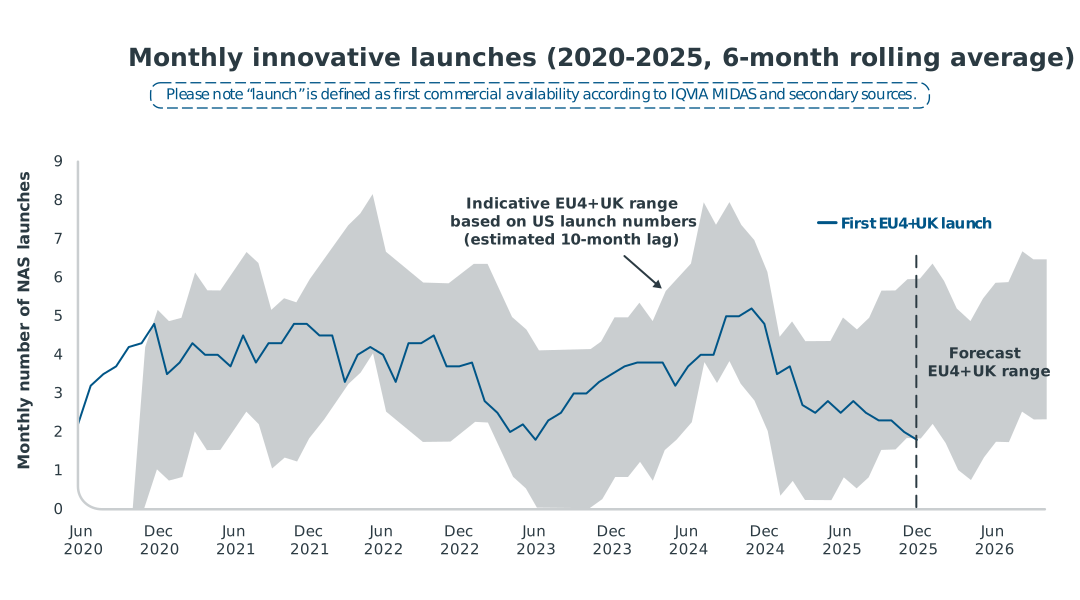
Notes: IQVIA has defined NAS (novel active substance) as any pharmaceutical product (including both small molecules and biologics) which has not already been used in another medicinal product and has been granted marketing authorisation; Analysis uses launch dates by country; First EU4+UK launch refers to the earliest launch date in any EU4+UK country for each molecule; Shaded area shows the expected range of EU4+UK launches based on the US launch volume 10 months earlier (±2 standard deviations around the expected EU4+UK level, i.e. capturing typical variation around the mean); This 10 month lag excludes medicines launched in the EU4+UK before the US, as these are likely to be less affected by MFN.
Source: IQVIA Institute NAS Dashboard 2026; IQVIA Thought Leadership
The above graph shows the number of innovative medicines (defined as Novel Active Substances) launched in the EU4+UK over time. Launch is defined as first commercial availability, encompassing both public and private market access. A grey range of how this relates to US launches, based on the historical relationship, is included.
Launch volumes fluctuate year-on-year, driven primarily by the productivity of the pharmaceutical pipeline. Historical data bear out this volatility, including a notable dip during and immediately after the pandemic, when launches slowed on both sides of the Atlantic.
There is typically a lag between the first commercial launch of innovative medicines in the US and subsequent launches in the EU4+UK. While the timing varies across European markets, the earliest launch within the EU4+UK — most commonly in Germany — occurs, on average, approximately 10 months after first US commercial availability. As a result, trends in US launch activity have historically tended to be reflected in the EU4+UK with a corresponding delay. This relationship is not perfectly correlated. Not all medicines launched in the US ultimately launch in Europe, and the duration of the transatlantic launch gap has evolved over time. This gap is growing in part due to regulatory and pricing barriers, and in part due to more products in the US originating from smaller companies who lack the capability to swiftly launch in Europe. Nevertheless, it remains a useful indicator of expected launch volumes through 2026.
While recent data show a decline in EU4+UK launches, it is too early to attribute this to MFN policy.
EU4+UK NAS launches have declined since May 2025, when the MFN policy was announced. However, this downturn appears to have begun around November 2024, following an earlier drop in US launches.
Given the potential for MFN policies to influence launch decisions and patient access, distinguishing signal from noise is critical. Our analysis suggests this is far from straightforward. It requires an understanding of the historical relationship between US and European launch timing, as well as the revenue dynamics that underpin sequencing decisions and how MFN may disrupt them.
Central to this is the relative contribution of revenue from the US and Europe, including the evolution over the course of a product’s lifecycle.
Over time, ex-US markets become increasingly important, accounting for around one-third of cumulative revenue in the first five years after launch, and more thereafter. At least half of this ex-US revenue has historically come from the five largest European markets.
A similar pattern is evident in net revenue data. Among novel drugs approved by the FDA between 2018 and 2023, an average of 35% of revenue was generated outside the US, compared with 65% from the US.
Looking ahead, based on historical US launch volumes (setting aside MFN impacts), EU4+UK launches would be expected to remain within the grey shaded area and recover during the first half of 2026. A sustained deviation from this pattern would indicate a potential MFN impact. Therefore, the next few months of NAS launch data will be a critical indicator of early impacts of the MFN policies beyond the US.
How IQVIA is tracking MFN impacts
More launch data will be available in August and will update the tracker with this data.
Beyond launch data, IQVIA is using a combination of public and proprietary data to track the impact of MFN across multiple dimensions. Analyses are being conducted at both global and country level to capture heterogeneity in effects.
If you would like to learn more about how we are tracking these impacts—or explore our tailored insights on MFN—please contact us.
1 “NAS” (Novel Active Substance) is defined here as any pharmaceutical product (including both small molecules and biologics) which has not already been used in another medicinal product and has been granted marketing authorisation.
2 “MFN” is referring to “Most Favoured Nation” pricing policies, or international reference pricing, including GLOBE, GUARD, GENEROUS, TrumpRx, etc. It aims to rebalance US drug prices to peer nations.