














Commercial Solutions
Data, AI, and expertise empower Commercial Solutions to optimize strategy, accelerate market access, and maximize brand performance.
For years, commercial organizations have responded to complexity by adding more tools and resources. Market sizing may sit with one team, forecasting with another, access planning with another, and HCP targeting with yet another. Each function may produce high-quality analysis, but the output often relies on different assumptions, data cuts, patient definitions, time horizons, and business logic. The result is a familiar problem: plenty of answers without one aligned version of the truth or consistent reporting.
The real challenge facing organizations now is whether AI can fundamentally change how decisions are made and flow through commercial activities from an interconnected view of the market, a coordinated plan of action, and an adaptive system that learns as conditions change. Can AI become a shared intelligence layer across the brand lifecycle instead of a set of disconnected tools?1
For the commercial enterprise, this shift in strategy can be understood through four interdependent imperatives: understand, plan, engage, and optimize.
In life sciences, commercial strategy begins with a question: Where is the real opportunity?
Leaders must understand patient populations, care pathways, diagnosis and treatment patterns, healthcare provider (HCP) and account relationships, payer dynamics, geographic variation, and points of leakage or friction across the patient journey. Historically, this work required multiple teams to build separate views of the market, often using different methodologies and assumptions.
Now, AI is enhancing scenario planning and modeling. Instead of relying on static assessments, leading organizations can create a dynamic, shared understanding of the market. AI can help define relevant patient cohorts, quantify market opportunity, identify where patients move through the care pathway, and reveal where friction may prevent appropriate treatment. It can also connect patient opportunity to HCPs, accounts, geographies, and payer contexts, creating a more complete picture of where commercial effort matters most.
This is especially important in launch and growth-stage environments, where early strategic choices shape investment decisions, field deployment, board narratives, market access strategy, and launch readiness. If the organization begins with misaligned definitions of the patient population or market opportunity, downstream decisions can quickly diverge. A shared intelligence layer helps ensure that the patient cohort informing market sizing also informs forecasting, access planning, targeting, and measurement.
The value of the “understand” imperative is confidence. It means the organization is no longer debating whose market view is correct. Instead, teams are working from a governed, transparent, and continuously refreshed view of opportunity.
Once the opportunity is understood, the next question is how to capture it.
Planning is where many organizations experience the greatest disconnect. Forecasts may not fully reflect payer friction. Access strategies may not connect back to patient opportunity. Investment decisions may be based on assumptions that are difficult to trace or update. In volatile markets, with changing reimbursement dynamics, competitive pressures, evolving guidelines, and shorter launch windows, static planning models are no longer sufficient.
AI enables a more adaptive planning model. Forecasting can become scenario-driven rather than episodic. Commercial teams can evaluate how changes in diagnosis, conversion, persistence, pricing, access, competitive dynamics, or adoption assumptions affect the outlook. Access planning can pressure-test the strategy against payer, affordability, formulary, reimbursement, and contracting realities. When planning inputs are connected, changes in one area can cascade intelligently across related decisions.
For example, if a payer restriction changes the addressable opportunity in a key region, that signal should not remain isolated within market access. It should inform the forecast, influence investment priorities, shape HCP targeting, and guide engagement strategy. Similarly, if a forecast scenario suggests that incremental uptake in a specific segment will disproportionately affect performance, that insight should flow directly into customer prioritization and measurement.
The next stage of AI commercial intelligence will increasingly include agentic capabilities. AI agents will help orchestrate workflows, identify assumption changes, suggest scenarios, flag downstream implications, and support decision-making across functions. The planning process becomes less manual and more responsive to market signals.2
The realized value is agility, moving from fixed annual planning cycles toward more dynamic commercial decision-making.
Impact will be limited if commercial strategy doesn’t translate into precise customer engagement.
A thoughtful market assessment, solid forecast, and clear access strategy with fragmented execution, static segments and disconnected channel plans means field, marketing, medical, market access, and patient services teams may each act on partial information.
Dynamic commercial insights can close the gap between strategy and action by connecting planning assumptions directly to customer prioritization. HCP segmentation and targeting can be informed by patient opportunity, access context, geographic dynamics, adoption signals, account characteristics, and forecast implications. Instead of asking only which HCPs are high value, commercial teams can understand why they matter, what opportunity is associated with them, what barriers may affect their ability to act, and what engagement objective should be prioritized.
Explainability helps home office and field leaders to trust the recommendations. Prioritization is transparent by showing the data, assumptions, and business logic behind customer recommendations. It should help teams understand whether an HCP is prioritized because of patient opportunity, influence, access conditions, adoption potential, unmet need, or a combination of factors.
Over time, this intelligence layer can support deeper orchestration across CRM, field planning, media, medical, and other engagement workflows. The near-term opportunity is to ensure that targeting logic, segmentation, and engagement priorities are grounded in the same commercial strategy. The longer-term opportunity is to enable more autonomous, adaptive engagement models that respond as market conditions and customer behaviors evolve.
Aligning engagement ensures that customer-facing teams are not just active, but focused on the customers, accounts, and actions most likely to advance the strategy.
The final shift is from retrospective measurement to continuous optimization.
Traditional performance management often happens after the fact. Teams review dashboards, campaign reports, field activity, access updates, and prescription trends, then try to determine what happened and why. By the time insights emerge, the market may already have moved.
AI creates the opportunity for a continuous learning loop. Performance signals can be evaluated against the assumptions established during planning. Are target HCPs being reached? Are priority segments responding? Is uptake tracking against forecast? Are access barriers emerging where expected? Are engagement investments influencing behavior or simply creating activity?
The most powerful models will go beyond measurement and will recommend what needs to change. If a segment underperforms, AI can help identify whether the issue is access, message resonance, channel mix, field reach, affordability, competitive pressure, or an incorrect planning assumption. If uptake lags forecast, the system can help determine whether the driver is patient availability, diagnosis, persistence, conversion, coverage, or customer behavior.
Now commercial intelligence is adaptive and impact measurement feeds back into market understanding, forecasting, access planning, targeting, and engagement. HCP behavioral signals improve future targeting logic. Real-world uptake and access signals refresh forecast assumptions. Unexpected leakage or unmet need can prompt refinement of market definitions and patient cohorts.
Optimization delivers new levels of sustained performance improvement. The organization learns faster, adjusts earlier, and becomes more intelligent with every cycle.
The next era of AI in commercial intelligence will not be defined by isolated use cases but by the ability to connect decisions across the brand lifecycle.
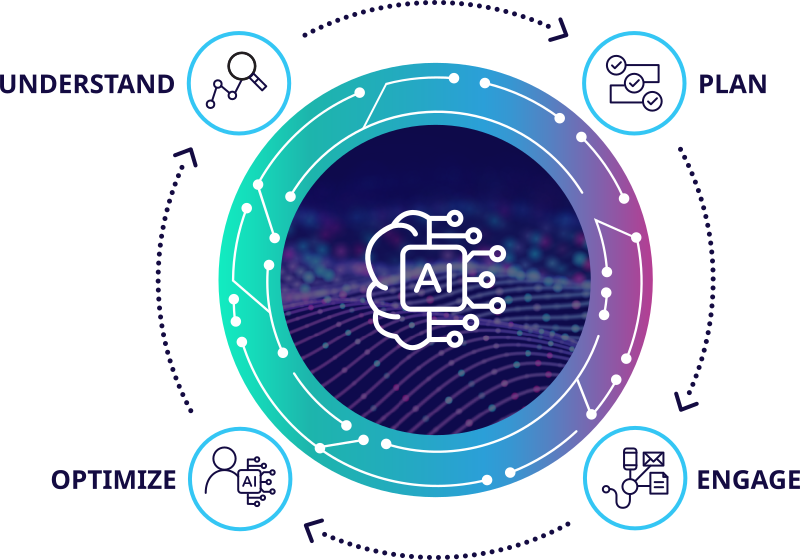
This represents a fundamental evolution to an adaptive commercial operating system. The winners will be organizations that use AI to make more interconnected, explainable, and actionable decisions. In a market defined by increasing complexity, volatility, and margin compression, this intelligence layer may become one of the most important sources of competitive advantage.
The future of AI and commercial insights is already taking shape; it’s interconnected and scalable across functions. For organizations ready to improve brand performance through decisions that impact cost and productivity, the time to prepare is now. Something new is coming soon to help field teams understand, plan, engage, and optimize with greater speed, confidence, and precision than ever before.
References:
About the authors:

|
Rohit Vashisht leads products and platforms for Pharma Commercial Solutions at IQVIA, driving innovation at the intersection of AI, data and life sciences. A seasoned tech entrepreneur, he is the co founder of WhizAI, a generative AI analytics platform for life sciences and healthcare that was recognized by Inc. as one of America’s 500 fastest growing private companies and acquired by IQVIA in 202With over 20 years of experience across product management, engineering, sales and strategy, Rohit combines deep enterprise software expertise with a visionary mindset. He holds an MBA from NYU Stern and an engineering degree from IIT Delhi. |

|
Nicola Partridge is a product and commercial strategy leader at IQVIA, where she leads the development and commercialization of AI-enabled offerings for life sciences. A scientist by training and strategist by career, Nicola’s work sits at the intersection of artificial intelligence, advanced analytics, and life sciences. She leads product, technology, data science, and commercial teams to develop and commercialize technology driven solutions that drive better decisions, more relevant customer engagement, and ultimately improved health outcomes. In her spare time, Nicola volunteers as President of Corporate Relations for HBA Tri-State Region. Nicola holds postgraduate degrees from the University of Cambridge and Imperial College London. She has been recognized by MM+M's Women of Distinction program and is a three-time recipient of the IQVIA CEO Award. |

Key shifts are shaping the future of AI and analytics in commercial life sciences. Discover how AI enables a seamless, governed system that operates at the speed of business by turning data into intelligence and action for faster decisions, more responsive execution, and measurable impact at scale.
Data, AI, and expertise empower Commercial Solutions to optimize strategy, accelerate market access, and maximize brand performance.