














Provider Solutions
Power your growth by reaching the right physicians and their patients.
As healthcare marketers work to stretch shrinking budgets and do more with less, many are turning to AI to support their campaigns. AI helps marketers move through a range of campaign-related tasks more quickly, from the most strategic to the most tactical. It’s a comprehensive tool, and speed-to-launch is a top reason marketers use it.
AI can help marketers identify high-quality, receptive consumer audiences faster and move campaigns to market with less manual effort. But focusing on speed often means marketers stop short of reaching AI’s true potential to shape and refine campaigns, ultimately making them much more effective.
This is a missed opportunity, given the bigger pressures marketers face, including fragmented data across channels and service lines combined with a patient journey increasingly shaped by AI.
Using AI to connect data to the decisions marketers make across planning is the first step in moving away from using AI simply for speed. Connectivity across data and systems helps marketing teams act with more confidence.
At IQVIA we call this Connected Intelligence™. It’s a way of thinking about AI’s value that goes beyond speed. When AI moves from a tool that simply speeds up processes to one that helps marketers prioritize what matters most, it creates true value and lets marketing leaders act with confidence.
Three specific use cases are already helping marketing teams make better decisions. They span the campaign lifecycle and include:
Media plans are built around audiences, so getting audience size right is integral to everything that comes next. Ad platforms like Meta generate their own audience size estimates, though these numbers are often inaccurate. Meta explicitly warns advertisers not to use their audience data to plan budgets, with guidelines stating that “estimates may vary over time and should not be interpreted as the number of Account Center accounts who will actually view your ads.”
Generative AI can help make the audience estimation process more accurate by improving the quality of the underlying data set. We can use tools like ChatGPT to clean and prepare data for analysis, then engage with that data conversationally to explore patterns, ask questions and uncover insights more efficiently. For example, we build a more precise audience size estimate by:
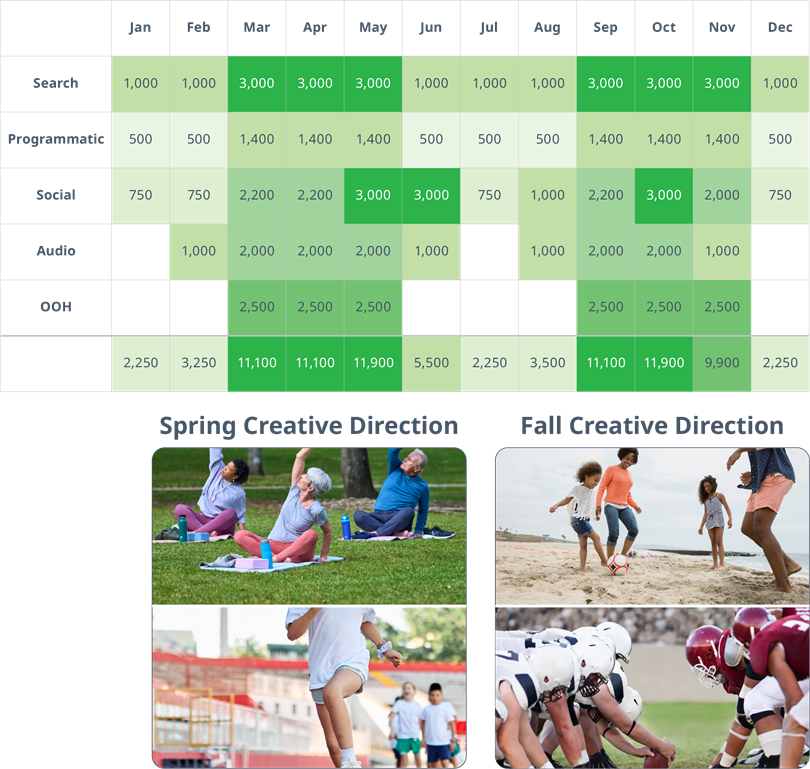
This combination of U.S. Census and Pew Research data provides a much more reliable estimate of audience size. It adds confidence to the planning process, particularly around budget and flighting.
Marketers can create a more accurate budget for each channel across the life of a campaign. When paired with seasonal demand, this allows for more accurate budget tuning that matches rising and falling demand based on audience behavior.
Healthcare marketers have countless levers available to improve campaign performance but limited time to manage them. For marketers who may be managing dozens of campaigns across multiple service lines, the task of optimization becomes impossible to scale without AI.
A clear example of this is search ads. Responsive search ads on Google require 15 headlines and four descriptions per ad. This means that an advertiser running 80 paid search campaigns can face more than 4,800 opportunities for ad copy optimization at once.
That volume of work makes it easy to lean on the same messaging campaign after campaign, even when a fresher, more informed message could perform better. IQVIA leverages generative AI tools like ChatGPT to bring more data into the copywriting process before a single word is written. This allows us to:
In one example, this process pointed to a specific opportunity in an anonymized proton therapy campaign. We found the most engaging ads led with “treatment” rather than “cancer” or “therapy,” while competitors’ messaging skipped that framing and focused more on location and program advantages.
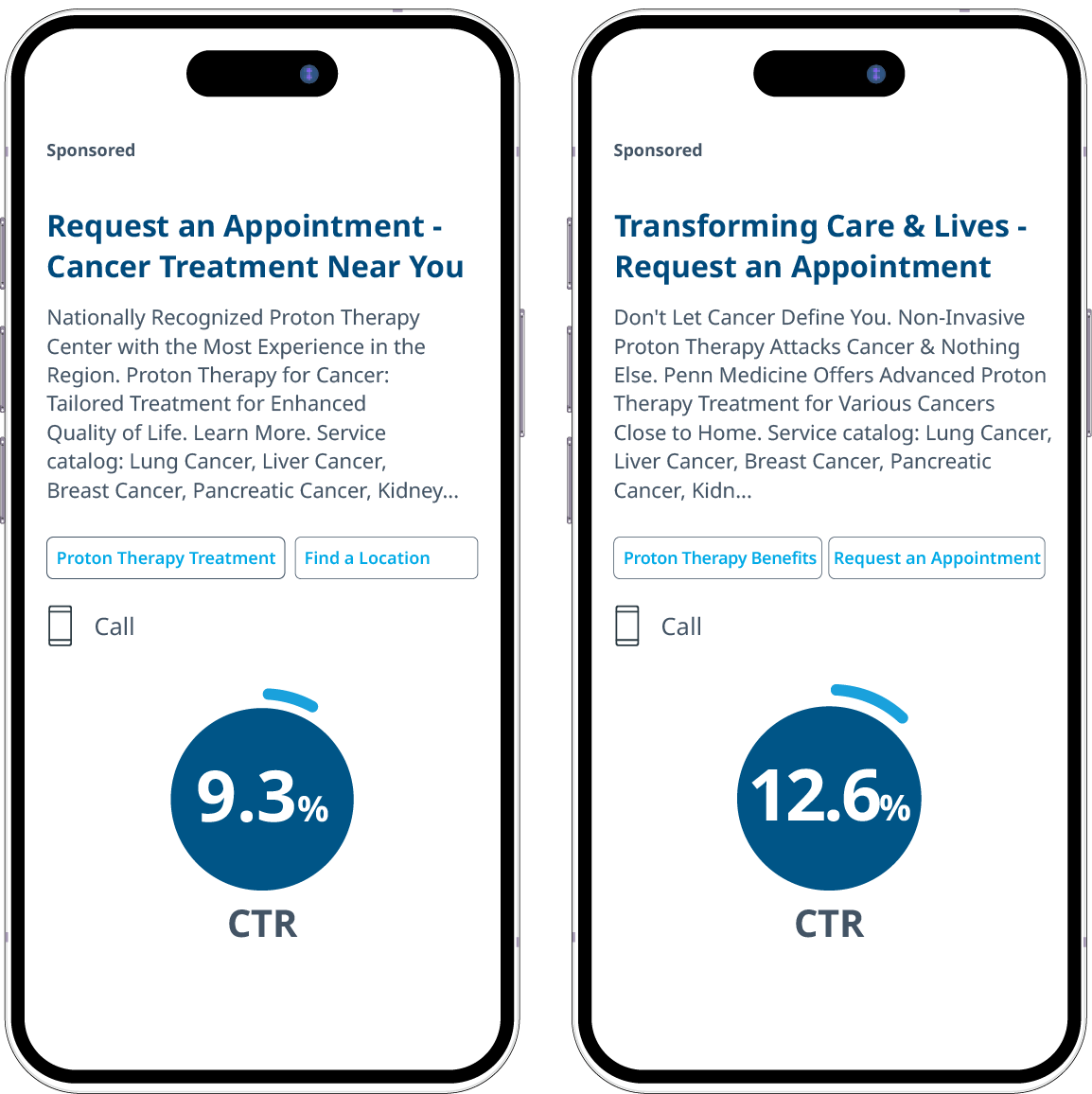
We applied that finding to new ad copy, which lifted click-through rate from 9.3% to 12.6%, a gain that held steady for six months. That same process can be applied to any service line, giving marketers a way to keep ad copy sharp without adding hours of manual research to every refresh.
Healthcare marketers running campaigns across multiple service lines often struggle to get a clear month-over-month read on performance. Oncology and orthopedics might live in one ad platform’s dashboard, primary care in another. Pulling this information into one comparable view usually means manually stitching data together before analysis can start.
IQVIA uses generative AI as a reporting partner instead, chatting directly with campaign data to get answers in the time it would otherwise take to build a report from scratch. A typical question looks something like this:
“Which service lines had more clicks in December compared to November?”
AI-powered reporting tools can also flag significant shifts in spend against performance, so we can tell whether a budget increase was worth it or see signs of seasonal demand across service lines. That same visibility applies to ad copy, showing exactly how click-through rate improved once new messaging went live. Getting to these answers faster leaves more time for human analysis.
AI allows us to easily create and share reports and visualizations that used to take hours, which shifts the team’s energy away from reconciling whose numbers are right and toward deciding what to do next.
AI applied across the full marketing cycle strengthens performance and deepens patient engagement. Speed alone doesn’t get you there. Marketers don’t have to build every capability at once to see that value either. A single use case, like sizing an audience or refreshing ad copy, is enough to build momentum. Reporting works equally well as a starting point. Pinpointing one specific use case allows marketers to get started with AI immediately.
Using AI only to find efficiencies is a race to the bottom. It’s quick. It’s easy. But it isn’t the whole value of AI. The real opportunity is using AI to decide what matters most, not simply to move faster.
Power your growth by reaching the right physicians and their patients.