














Your company’s novel therapy may be on track for FDA approval, but approval isn’t the same as patient access, and patient access doesn’t guarantee outcomes. In the gap between the proverbial prescription pad and a patient’s first dose lies an often-complex journey that even manufacturers of the best products must navigate strategically and with precision. For emerging biopharma companies (EBPs), this can be especially challenging because of complex diagnostic and treatment pathways, limited brand recognition, and constrained budgets. The patient journey reveals where patients need support most and where missteps can occur, which is particularly important with rare and specialty therapies.
The stakes are measurable, with rare disease diagnostic odysseys averaging more than six years1, oncology treatment delays of four weeks linked to 6% to 8% higher mortality2, and 78% of patients abandoning therapy when facing prior authorization (PA) friction3.
This is where patient support services can become a competitive advantage and patient support strategies, grounded in a clear understanding of the treatment journey, help patients start therapy sooner and stay on treatment longer, enabling stronger commercial outcomes. What’s more, emerging brands have a chance to build patient support strategies precisely calibrated to their specific population and treatment pathway, without the legacy systems and one-size-fits-all approaches.
Map the journey. Remove friction. Prove value.
EBP companies that map the treatment journey through the lenses of patients, caregivers, and healthcare providers (HCPs) surface the moments that matter most and the points where delays, handoff failures, or suboptimal engagement cause patients to leak out of the funnel. The most actionable journey maps are informed by real signals – Hub/CRM notes, SP activity, PA outcomes, and engagement touchpoints (and where available, claims/EHR/lab events) – so decisions are grounded in evidence, not anecdotes.
Additionally, patient support programs represent an opportunity to establish credibility with clinicians. Prescribing an unfamiliar product requires trust that patients will get timely access, clear guidance, and reliable support. A transparent, well-designed path from diagnosis to treatment initiation facilitated by a thoughtful patient support program strategy builds prescribers’ confidence.
By pairing deep journey insights with right-sized patient support interventions, you can drive faster treatment starts, stronger adherence, and better patient and provider experiences.
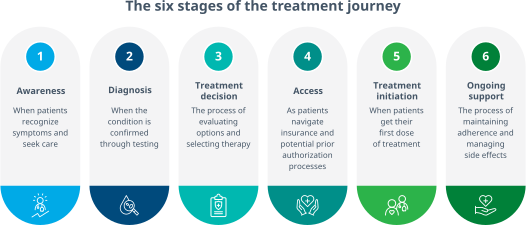
Of the six stages of the treatment journey, three present the highest risk for patient drop-off and require the most attention.
- Access & Affordability - where insurance rules create delays
- Treatment initiation - where credibility is won or lost
- Ongoing support - where persistence proves product value and increases adherence
Implementing patient support services to overcome obstacles
Once the journey is mapped, most drop-offs cluster in a few predictable places. By anticipating common barriers, organizations can pair the highest-friction moments with practical, scalable interventions that reduce delays and prevent leakage.
- Insurance rules slow patient care
Growing payer control increases Prior Authorization (PA) rejections and abandonment at launch. In fact, 94% of physicians report care delays due to PA processes.4 Payer-specific PA templates, clear medical criteria checklists, and reimbursement best-practice guides raise first-pass approval rates and shorten cycle times.
There may be therapy-specific considerations, as well. For instance, for infused or office-administered products, payer PA, site-of-care, and sometimes step-therapy rules can further shape where treatment can start. Reduce delays by offering early benefits checks to confirm coverage and site eligibility and giving HCPs payer-specific PA/step guidance.
- Starts can stall even after approval
After approval, getting therapy into the patient’s hands may require navigating additional steps that patients may not be expecting. This gap from approval to first dose can last for weeks, especially for newer therapies where this could include pre-administration testing and the availability of the pharmacy to dispense therapy. A fragmented journey with inefficiencies can lead to dissatisfaction, loss of trust and failure to meet the needs of patients. EBPs can respond with patient support in the form of centralized scheduling, rapid delivery of starter kits/bridge fills, and/or day-one patient education. These solutions guide patients through the steps more efficiently with a clearer understanding of expectations and the path ahead. - Drop-offs during treatment
Adherence and persistence often erode quietly during the first three to six months. typically before clinical teams notice. For emerging brands, this silent attrition is especially damaging because higher persistence rates are your primary tool for proving product value and supporting future contracting negotiations.
Proactive interventions like text reminders, symptom check-ins, and nurse callbacks are strategic investments in building the real-world evidence that unlocks payer access. Supporting caregivers with concise guides and appointment-prep tools can also pay dividends in keeping home plans stable.
Strategic focus translates into commercial success
Without strategic support at the moments that matter most, even breakthrough therapies struggle to reach patients.
Consider the implications: Higher persistence rates during the critical first three to six months don’t just prove product value. They also create the real-world evidence needed for favorable payer contracting and formulary placement. Improvements in persistence can translate to stronger outcomes data, better prescriber confidence, and ultimately, improved access for future patients. For EBPs building their commercial foundation, early patient support investments compound over time, especially when resources are limited and tradeoffs are unavoidable.
Importantly, achieving impact doesn’t require spending at scale before understanding what works. IQVIA recommends starting with the two or three highest-leverage interventions. Generate clear metrics that prove return on investment, and then scale based on evidence.
Map your treatment journey
Identify the two or three stages where patients currently experience the most friction, which typically surfaces in PA cycle times, time from approval to first dose, or early discontinuation rates.
Select interventions strategically. Rather than implementing a full-service patient support program, deploy targeted fixes where your data shows the greatest patient leakage.
Establish your scorecard. Track four to six metrics monthly (for example, PA first-pass rate, approval-to-start days, and/or 90-day persistence). That way, you can demonstrate impact to internal stakeholders and adjust quickly based on what’s working.
These actions create a foundation for measurable impact with a clear view of your treatment pathway, and a focused set of high-leverage interventions can deliver measurable results. IQVIA offers a breadth of integrated data assets, therapeutic area expertise, and operational scale to help you understand patient journeys and deliver support services focused on impact and outcomes. Learn more at Emerging Biopharma - IQVIA.
References:
- EveryLife Foundation for Rare Diseases. Cost of Delayed Diagnosis in Rare Disease. EveryLife Foundation, 14 Sept. 2023.
- Hanna, Timothy P., et al. Mortality Due to Cancer Treatment Delay: Systematic Review and Meta-analysis. BMJ, vol. 371, 2020, m4087.
- American Medical Association. 2024 AMA Prior Authorization Physician Survey. American Medical Association, 18 July 2024.
- American Medical Association. AMA Survey Indicates Prior Authorization Wreaks Havoc on Patient Care. American Medical Association, 18 June 2024.

Patient Treatment Journey Strategies
Related solutions
Flexible solutions. Responsive teams. Data-driven insights.