


Market Access and Patient Activation
Delivering end-to-end services to ensure patients in the UK get efficient access to pharmaceutical therapeutics and diagnostics.
Previously unchanged since its inception over 25 years ago, April 2026 saw the National Institute for Health and Care Excellence (NICE) shift the line that determines whether new medicines are deemed cost-effective.1 Initially announced on the 1st December 2025, the decision to increase the cost-effectiveness threshold from £20,000-£30,000 to £25,000-£35,000 per quality-adjusted life year (QALY) gained marks a decisive moment for UK health technology assessment (HTA), one with significant implications for pharmaceutical investment, innovation incentives, and the future competitiveness of the UK life-sciences sector.
Alongside the cost-effectiveness threshold update, NICE also announced a new value set for its preferred Quality of Life (QoL) measure, allowing for a formal shift from the EQ 5D 3L to the more sensitive EQ 5D 5L instrument.1 This update enables more accurate and up-to-date QALY estimates reflecting modern values, and brings NICE’s methods closer to international practice.2,3,4
On the whole, NICE’s recent changes have been welcomed by stakeholders, reflecting their potential to improve access to innovative treatments.5,6 Official estimates state the threshold increase could lead to an additional three to five medicines each year being recommended for routine use in NHS England.1 This headline figure, however, may not capture the full extent of the reform due to one important and potentially over-looked factor, the rate at which NICE appraisals are terminated before a final decision is reached.
NICE plays a central role in English, Welsh and Northern Irish healthcare by assessing novel technologies through the HTA process. Although the vast majority of HTAs result in a definitive decision on reimbursement and routine NHS practice, a notable proportion are discontinued before reaching a conclusion; these cases are described as terminations.7
Terminations arise when health technology developers (HTDs) decide against following through with an initiated appraisal. These are typically ‘non-submissions’, when the HTD does not submit any evidence, but a small number initially submit evidence and terminate further in the process, being labelled as ‘withdrawals’.
At face value, terminations prevent NICE from properly evaluating innovative medicine to determine whether their benefits are worth the associated costs (in line with principles of social fiscal responsibility in healthcare spending). Critically, the inability of NICE to assess a healthcare intervention has downstream implications for patient access within the NHS, preventing UK patients from gaining access to life saving medicines.
Terminations may also offer valuable learning opportunities by highlighting the common pitfalls in market access appraisals and indicating whether early scientific advice and collaboration could help prevent similar outcomes in future evaluations.
Research at IQVIA has focused on identifying the incidence of termination within NICE, delving into termination causes and characteristics to further our understanding of how often, and why, they happen.
As part of this research, IQVIA has built a database on all terminated appraisals from 2008 to 30th June 2025, collating data on various aspects behind these appraisals. Comparing the database to the overall number of appraisals undertaken by NICE, IQVIA were able to quantify total and annual termination rates (Figure 1). In doing so, results showed that 123 appraisals had been terminated within the relevant timeframe, making up 15% of all initiated appraisals. The vast majority of NICE-terminated appraisals are considered non-submissions (108/123, 87.8%) because the health technology developer did not provide NICE with evidence to support the appraisal. The remaining 15 appraisals terminated after evidence submission, with 6 of these having draft guidance on the technology published.
Figure 1. Annual NICE Termination Rates (01/01/2008 - 30/06/2025)
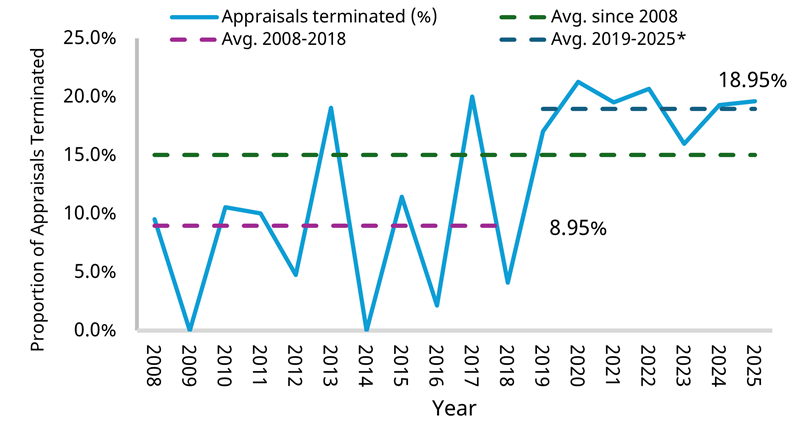
Analysing terminations by annual rate revealed two distinct periods: 2008-2018, with an average termination rate of 8.95% and 2019-2025, averaging 18.95%. This increase coincides with a period of modernisation of NICE’s methods beginning in 2019, alongside broader system reforms, including the introduction of 2019’s Voluntary Scheme for Branded Medicines Pricing and Access (VPAS).8,9
Analysing captured characteristics across the distinct time periods showed the proportion of multi-indicator products and orphan drugs to be increasing in representation, from 21.4% to 39.4%, and 3.5% to 28.7%, respectively. Conversely, the proportion of terminations categorised as combination therapies remained largely consistent (24.1% vs 25.5%).
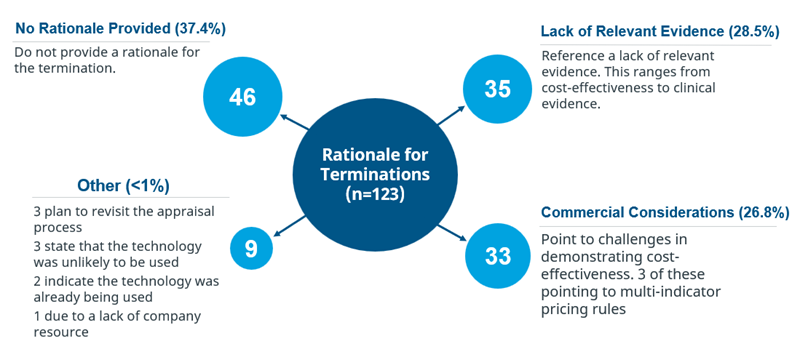
Our research also captured the variety of reasons for termination which were offered by developers (Figure 2). Many HTDs (46/123, 37.4%) did not provide an explanation, or stated that they were not launching the technology in the UK for that indication. Of the remaining appraisals, the primary reason (28.5% of all terminations) for termination was due to a lack of evidence to support the appraisal. It is unclear if these appraisals would have been opportunities for the Cancer Drug Fund (CDF) consideration, avoiding a termination; we highlight this as an option to be considered when evidence is limited at the time of assessment and additional evidence is feasible to generate during a data collection agreement. Assessing feasibility of real-world evidence (RWE) to fill evidence gaps is another opportunity that should be considered, especially for combination therapies where the evidence is particularly lacking and feature prominently in this cohort of terminations – IQVIA insights show that combination appraisals presenting RWE were quicker to decision versus combinations appraisals without RWE.10 Challenges in demonstrating cost-effectiveness and commercial considerations were narrowly behind, responsible for a quarter of all terminations. The remaining 9 appraisals cited intention to revisit the appraisal, lack of company resource, and a low likelihood of the technology being used in NHS practice.
Figure 2. HTD Provided Reasons for Termination
As research has demonstrated, terminations are often driven by a low-perceived probability of proving cost-effectiveness under NICE’s thresholds. As a result, sponsors may choose to prematurely end the appraisal before official evaluation in a bid to avoid the additional costs and reputation implications that are associated with a negative recommendation. Given the recent increase in NICE’s cost-effectiveness threshold, we anticipate assets which would previously have sat above the £30,000 per QALY gained ceiling, and potentially disengage with the process, to now consider success as more likely. For these assets, this is expected to reduce premature termination and leading to a greater number of appraisals proceeding to completion. However, no such change is anticipated for the large number of terminated assets that are classified as orphan drugs, since these are instead evaluated under the highly specialised technology (HST) threshold which, at present, is remaining unchanged.
Decisions to terminate are inherently made under significant uncertainty, often made prior to receiving complete information on key drivers of the final appraisal outcome (such as committee-preferred modelling assumptions and acceptance of extrapolation methods). This prevents developers from determining final cost effectiveness estimates and understanding the potential scope of patient access schemes. In turn, this uncertainty substantially limits NICE’s ability to quantify how many appraisals that previously would have been discontinued might now proceed under the revised thresholds.
Considering both aspects of terminations raises the question of how terminated appraisals factored into NICE’s headline estimate of an additional three to five medicines being approved each year.1 Assuming not, a reduction in terminations could mean that the true impact of the threshold change is larger than anticipated, translating into a greater number of approved medicines and, ultimately, greater patient access to innovative health technologies.
Terminations represent a quiet but important feature of the NICE appraisal landscape, limiting the organisation’s ability to fully assess value for money and therefore ensure patients’ access to potentially beneficial technologies. As our research shows, termination rates have increased markedly in recent years, particularly among complex and high uncertainty assets such as orphan and multi indication products.
Against this backdrop, NICE’s recent increase in the cost effectiveness threshold, alongside methodological updates to quality of life measurement, has the potential to alter HTD expectations and reduce early disengagement from the appraisal process. If fewer technologies are withdrawn before evaluation, the impact of these changes may extend beyond estimated additional approval figures, enabling a greater proportion of innovative medicines to reach a final decision and routine NHS use.
Research at IQVIA is ongoing to monitor how the termination rate changes across the next several months under the new cost-effectiveness thresholds to assess whether these changes translate into a sustained reduction in terminations over time.
This analysis is based on research presented at the HTAi Annual Meeting on Monday 8th June 2026 (poster 263; Health Technology Assessment Terminations In England: A Descriptive Review To Uncover Recent Trends And Causes For Termination).
References
1. Changes to NICE’s cost-effectiveness thresholds confirmed | NICE
2. Better data for better decisions | NICE
3. New EQ-5D-5L value set for the United Kingdom published - EuroQol
5. NICE hikes cost-effectiveness threshold for new NHS drugs
7. Technology appraisal data: appraisal recommendations | NICE
8. Capturing what matters: updating NICE methods guidance on measuring and valuing health | Quality of Life Research | Springer Nature Link
9. ISPOR - Increasing Termination Rates of NICE Technology and Highly Specialised Technology Appraisals
10. Overcoming barriers to oncology combination therapies in the UK and EU | Article | Drug Target Review
Delivering end-to-end services to ensure patients in the UK get efficient access to pharmaceutical therapeutics and diagnostics.