

















Real World Evidence
Generate and disseminate strategic and impactful Real World Evidence to meet regulators, payers, providers and patients' needs
As innovative therapies for rare diseases continue to enter the Chinese market, treatment options for patients are expanding rapidly. This progress, however, has brought a growing challenge to healthcare systems and policymakers:
China has gradually established a multi-layered healthcare financing framework for rare diseases, centered on basic medical insurance and supplemented by commercial health insurance, regional supplementary insurance programs, medical assistance, patient assistance programs, and other support mechanisms. Despite these efforts, substantial access gaps remain for certain high-cost innovative therapies, leaving many patients exposed to significant out-of-pocket expenditures.
Against this backdrop, dedicated rare disease funding mechanisms have emerged as a potential solution to bridge remaining access gaps while balancing affordability and funding sustainability. As discussions around such mechanisms continue to evolve, important questions remain: which rare disease therapies should be prioritized for dedicated funding, what principles should guide prioritization, and what level of funding would be needed?
Drawing on policy developments and practical experience from China and international markets, this blog explores the potential role of dedicated rare disease funding mechanisms, proposes principles for medicine prioritization, and assesses the potential budget impact.
This blog highlights selected insights from the report.
China’s rare disease support system has undergone significant transformation over the past decade, driven by continuous policy support, regulatory innovation, and expanding reimbursement coverage. A series of national initiatives, including the publication of two National Rare Disease Lists, the development of clinical guidelines, and the introduction of priority review and conditional approval pathways, have substantially improved the availability of treatments for patients living with rare diseases.
As a result, access to innovative therapies has expanded considerably. Among the 207 rare diseases included in China’s two national rare disease lists, 47% now have approved therapies available domestically, providing patients with access to a broader range of innovative therapies than ever before.
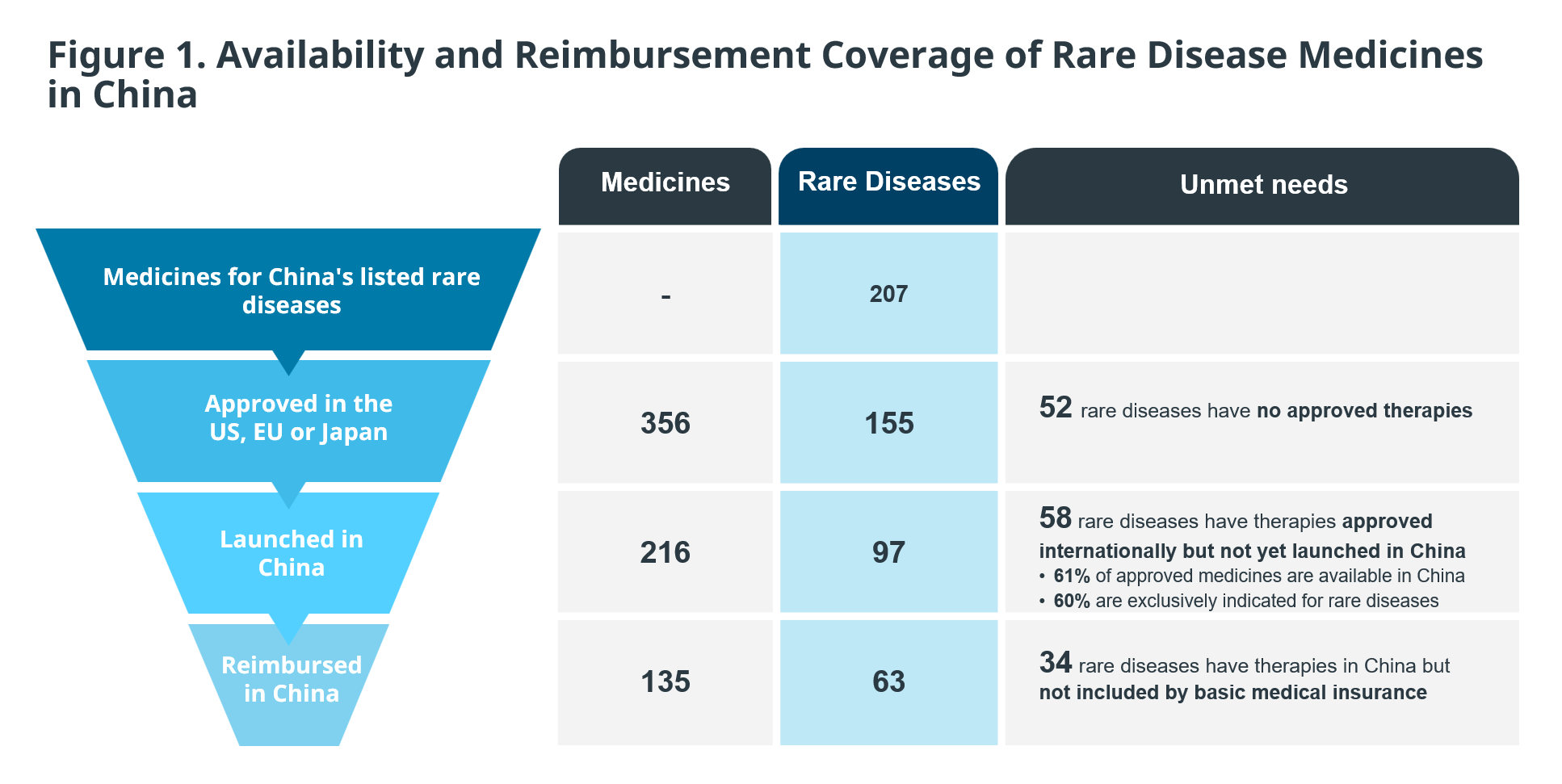
At the same time, reimbursement access has improved significantly. Between 2019 and 2025, 66 rare disease medicines were added to China’s National Reimbursement Drug List (NRDL), reflecting a growing commitment to addressing unmet medical needs. Today, approximately 65% of rare diseases with approved therapies have at least one therapy covered by basic medical insurance, substantially reducing out-of-pocket costs and improving affordability.
Consequently, China's rare disease policy agenda is gradually evolving from a primary focus on improving treatment availability toward a broader objective of adequacy, quality, and long-term sustainability of patient access.
Despite expanding reimbursement coverage, access gaps remain for some high-value rare disease therapies. Several factors contribute to these challenges:
Commercial health insurance, Huiminbao, charitable assistance, and patient support programs have helped expand access. However, more stable and sustainable financing arrangements are needed to address long-term funding needs.
Against this backdrop, dedicated rare disease funding mechanisms are gaining attention as a way to bridge remaining access gaps and strengthen sustainable access to innovative therapies.
A dedicated rare disease fund should not simply serve as an extension of basic medical insurance. Instead, it should focus on high-value therapies that address the most significant unmet needs.
Priority should be given to medicines that:
The goal of a dedicated fund should not be broad coverage, but targeted support for patients with the greatest unmet needs.
To achieve this, coverage decisions should consider a range of factors, including disease severity, clinical value, level of innovation, availability of alternatives, patient affordability, and overall budget impact.
For any new financing mechanism, affordability remains a key consideration.
To estimate the potential funding required, we assessed two categories of rare disease medicines:
The analysis focused on rare disease medicines with limited treatment alternatives and characteristics that make them difficult to fully accommodate within the basic medical insurance system. In practice, factors such as disease severity, clinical value, patient burden, and budget impact should also inform funding decisions.
Our findings suggest that a dedicated rare disease fund could remain affordable if coverage is carefully targeted toward patients and therapies with the greatest unmet need.
Under the scenarios evaluated:
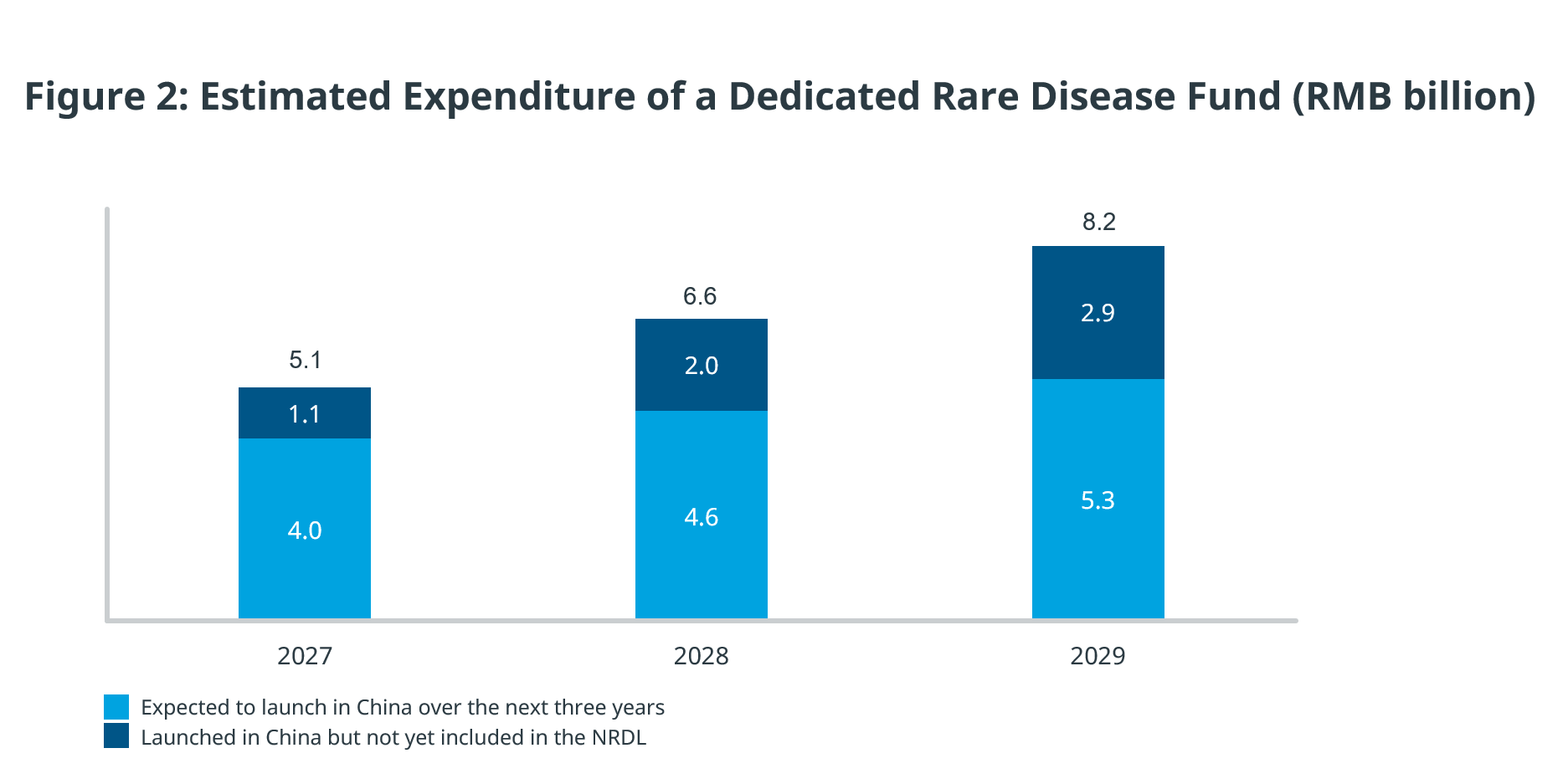
Note: The estimates reflect only the approximate budget required under the predefined scope of medicines and parameter assumptions. They do not represent the final size of the fund or actual expenditure.
Overall, a dedicated rare disease fund could provide a targeted and financially manageable complement to China's existing coverage system.
Yet affordability is only the starting point. The long-term success of the fund will depend on sustainable financing, transparent governance, regular reassessment, and effective coordination with other coverage mechanisms.
By strengthening these foundations, a dedicated fund could become an important component of China's evolving rare disease coverage system, helping to bridge remaining access gaps while balancing patient needs, innovation, and financial sustainability.
From Exploration to Institutionalization:
A Critical Window for Dedicated Rare Disease Funding
All original content is copyrighted by IQVIA China, which reserves the right of final interpretation. For permission to reproduce or republish this article, please contact IQVIA.
Related solutions
Generate and disseminate strategic and impactful Real World Evidence to meet regulators, payers, providers and patients' needs