

















Emerging biopharma companies continue to play a leading role in global clinical development, including sponsoring an increasing share of later-phase development. At the same time, protocols are increasingly complex, competition for patients is intense, and enrolment delays now carry outsized financial and strategic consequences. JAPAC felt like an underexplored part of the answer.
Against this backdrop, IQVIA recently conducted a survey of emerging biopharma leaders across North America and Europe, to better understand how leveraging Japan and Asia-Pacific (JAPAC) could mitigate some of these concerns. While the overall sentiment in further utilizing the region was overwhelmingly positive, with an expected 13% year-on-year increase in R&D spend into JAPAC over the next 3 years, the feedback provided some insightful commentary on how well understood the opportunity is and what, if anything continues to stand in the way.
The structural enrollment problem sponsors can no longer ignore
The scale of the problem is real: nearly 80% of clinical trials miss their original enrolment timelines, often by months, contributing to higher costs, delayed decision-making, and lost commercial windows. Traditional geographies in North America and Europe are struggling under site saturation, tighter eligibility criteria, and rising operational complexity.
Tapping into the large patient populations and experienced investigators within JAPAC could well be part of the solution. But for many biotech sponsors, it remains a question of balancing the opportunity for acceleration against logistical concerns, perceived communication hurdles, and limited experience navigating the regulatory and trial landscapes within the region. That is exactly the tension the survey was designed to explore.
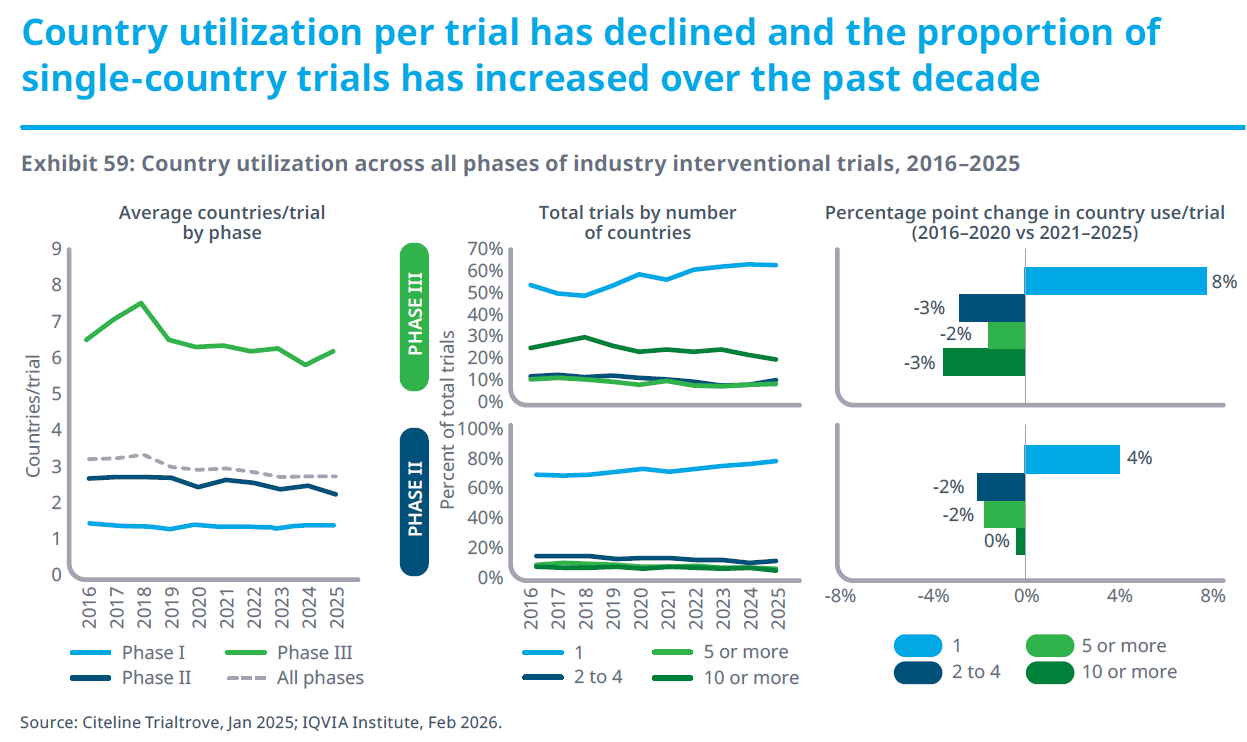
The research notes a rise in later-phase studies conducted in single regions. Does that put more pressure on the regional selection process? It raises the stakes significantly.
The proportion of later-phase studies conducted in single regions or even single countries has continued to rise. When you are focusing your efforts on one geography, the choice of that region must be resilient. JAPAC-generated data is increasingly being used for submissions to US and EU regulatory authorities, which de-risks that single-region strategy by providing high-quality, relevant data while maintaining the speed needed to hit critical market access windows.
What should sponsors - and the research industry - be doing differently to unlock JAPAC's potential
The survey is very clear on what sponsors need most: 75% of respondents said that greater clarity on timelines, requirements, and regulatory best practices in key countries is their number one ask in order to further consider JAPAC's potential. That is an actionable brief for the research industry - move from regional narratives to country-level specificity.
Early engagement with site and therapeutic leaders within potential countries is equally critical - for understanding fit with development plans and identifying any adjustments required to study designs before they become costly.
On timing, the when matters as much as the what. 60% of respondents felt that earlier discussions on potential JAPAC destinations would directly influence their clinical development programs, with one third indicating a high level of interest in engaging global research partners in those conversations. The potential to consider JAPAC earlier - as a core component of de-risking timelines and strengthening trial resilience - is real and growing.
There is also a broader context that makes this urgent. Changing regulatory landscapes in the US and Europe - including discussions about the sources of patient data accepted for submissions - make it critical that biotech companies keep an open mind to development opportunities across the globe. And investors are already ahead of this: more than 55% of respondents said their investors have specifically encouraged the exploration of JAPAC as a development destination.
JAPAC's role as a research destination continues to evolve - with real benefits to patient availability, overall timelines, and increasing access to leading therapeutic voices. The combination of expanding evidence and growing curiosity in the market means the opportunity is there. What the research shows is that with the right support and earlier conversations, sponsors are ready to move.
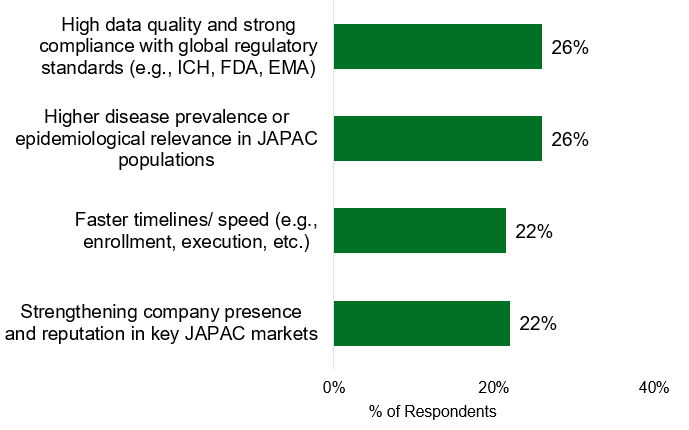
Top Drivers Ranked*
What are the most important perceived drivers Emerging BioPharma Customers face when running or considering trials in JAPAC?
The real barrier is knowledge, not willingness
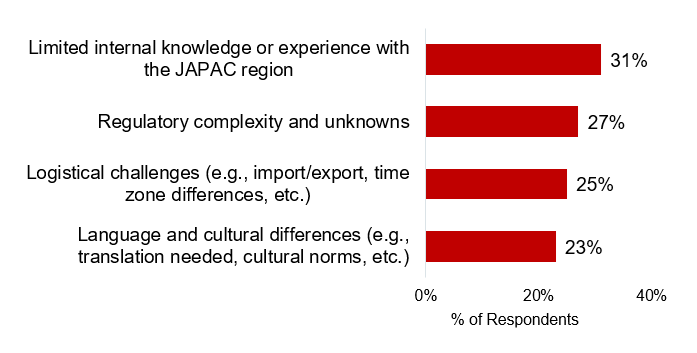
The biggest barrier highlighted was not regulation, logistics, or cost – it was simply having less knowledge and experience working within the region.
The clinical research landscape in JAPAC is extremely diverse - ranging from well-established global hubs to regions with limited global trial experience but great patient and site potential. Each country offers different regulatory timelines, pathways, and cultural nuances that can be challenging even for large pharmaceutical companies, let alone emerging biotechs.
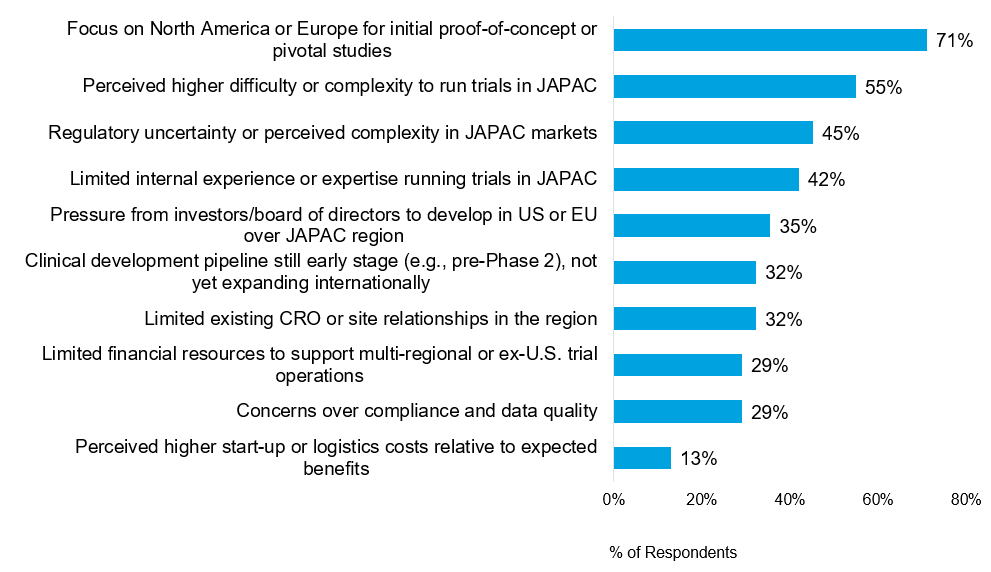
Understandably, many sponsors admit they default to North America or Europe simply given the familiarity, even if JAPAC has the potential to deliver faster timelines, if done right. This runs the risk of creating a self-reinforcing cycle: with a preference for past experience, leading to greater experience with well-known destinations - and the cycle repeats.
In other words, confidence - not capability - is the often-limiting factor.
Top Challenges Ranked*
What are the most important perceived drivers Emerging BioPharma Customers face when running or considering trials in JAPAC?
Reasons Sponsors are Not Conducting/Planning to Conduct JAPAC Trials
Japan and Asia Pacific is not one market - and shouldn’t be treated as one
Another critical finding from the survey coupled with the commentary on experience above, is the acknowledgement that the opportunities available in JAPAC can vary based on the nature and ambition of a clinical program. Treating JAPAC as a single market doesn't work. Each location can play a distinct role in successful global site strategies. The survey respondents recognized this clearly, with distinct rationales for when and why they would look to each country:
Australia is consistently positioned as an early phase accelerator, valued for its fast start up timelines, regulatory efficiency, and highly experienced sites. Japan and South Korea serve as depth markets, offering disciplined execution, strong investigators, and long term commercial relevance, while China and India provide scale and access to large patient populations—though sponsors tend to be more selective in these markets due to perceived regulatory, geopolitical, or operational complexity.
Sponsors who succeed are those who match each country to the specific job it needs to do in the trial - not defaulting based on comfort.
The value of leveraging partnerships
Perhaps unsurprisingly - given the diversity of the region and the varying levels of experience sponsors bring to it - the majority of respondents indicated prior engagement with global and local-based research partners and CXOs when pursuing JAPAC.
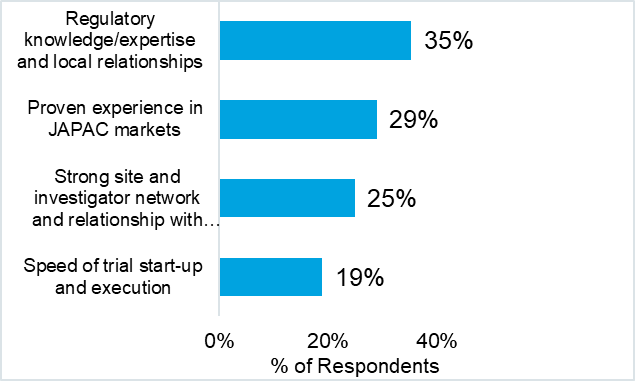
The number one driver for engaging a partner was accessing knowledge and expertise to navigate individual regulatory landscapes. That was also the leading factor in the eventual decision to select a specific vendor. Closely aligned with that was leveraging a partner's existing site and investigator relationships - which is critical both for identifying the right study locations and for building long-term relationships with JAPAC therapeutic experts and opinion leaders.
The Bottom Line
Feedback from the survey provided some valuable insights into perceptions around the JAPAC market and reflected an interesting moment in the opportunity the region can provide in tackling some of the long-standing challenges around development speed and productivity.
It is clear that the alignment of regulatory standards and growing JAPAC patient representation in global trials has led to confidence in the ability to generate high-quality data to support global development.
With changing regulatory landscapes in the US and Europe, including discussions about the sources of patient data for submissions, it is critical that biotech companies keep an open mind to development opportunities across the globe. What is clear is that JAPAC’s role as a research destination continues to evolve, with real benefits to patient availability, overall timelines and increasing access to leading therapeutic voices. Through a combination of curiosity and expanded evidence, expanding utilization of the JAPAC region could be a valuable tool in tackling the ongoing impact of enrollment and program delays on research and development as a whole.
By David Horsburgh, Head Strategy, Site and Patient Solutions, IQVIA R&D Solutions Japan and Asia-Pacific (JAPAC)

David Horsburgh is Senior Director and Head of Strategic Planning, Site and Patient Solutions for IQVIA Research and Development Solutions in Asia-Pacific. David and his team oversee various responsibilities across the region including corporate strategy, growth and operational planning, strategic site partnerships, patient recruitment services, as well as corporate communications.
David is key member of the JAPAC R&D Solutions leadership team, acting as chief of staff to the Head of IQVIA’s R&D Solutions business in JAPAC and leveraging 14 years of experience with IQVIA Asia-Pacific across roles in clinical strategy, site identification, sales enablement, as well as real-world data and evidence network development.
David is based in Singapore and holds a Bachelor of Science (Hons), Biomedical Sciences from the University of Manchester (UK) as well as an Executive MBA from Rutgers University (USA).