

















As global biopharma companies look to China not only as a late‑stage enrollment engine, but also as a strategic early‑development geography, a recurring question arises: Should we start with an Investigator‑Initiated Trial (IIT), or proceed directly via a formal China IND?
While the IND pathway remains essential for registrational intent, China IITs offer distinct advantages in speed, flexibility, and data generation, especially during early clinical exploration.1,2,3 Understanding when and how to deploy an IIT can materially impact overall development timelines and decision‑making.
China operates a dual‑track regulatory system for various therapeutic areas, including Cell and Gene Therapies (CAGT), that allows for both Investigator‑Initiated Trials (IITs) and Industry‑Sponsored IND trials.3,4 This system offers unique strategic opportunities for early development.
This blog addresses common questions sponsors raise when evaluating China IITs, and how they compare with a typical China IND‑enabled trial.
Question: What is a China IIT and how does it differ from a China IND Trial?1-6
A China Investigator‑Initiated Trial (IIT) is a clinical study initiated and sponsored by a qualified Chinese investigator and medical institution. IITs are governed under the oversight of the National Health Commission (NHC) and implemented within accredited medical institutions. Approval by the local ethics committee and compliance with China Good Clinical Practice (GCP) are mandatory requirements for IIT conduct.
In contrast, a China IND trial is regulated through the National Medical Products Administration (NMPA) and requires formal submission and approval by the Center for Drug Evaluation (CDE), along with full compliance with IND dossier and regulatory review requirements.
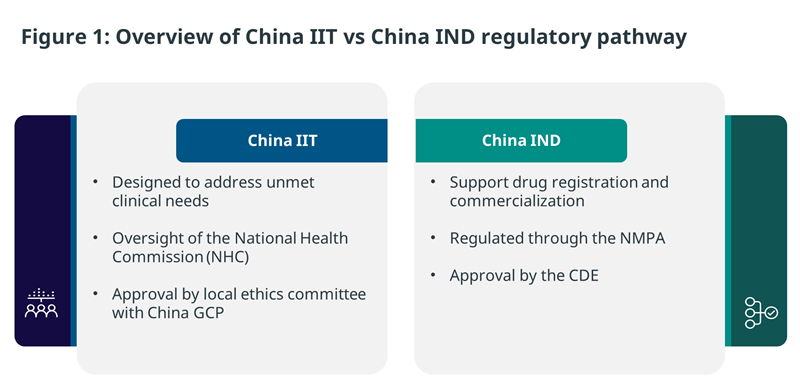
While both IITs and IND trials operate under China GCP and ethics oversight, they represent two distinct regulatory tracks. IITs are primarily designed to address unmet clinical needs and generate early scientific insights, offering greater flexibility and speed, whereas IND trials are structured to support drug registration and commercialization. As a result, the two pathways differ meaningfully in regulatory burden, timelines, and the degree of sponsor control, and are often used sequentially rather than interchangeably.
Key Advantages of China IITs1-3,6
1. Faster Study Initiation Compared with IND Pathways
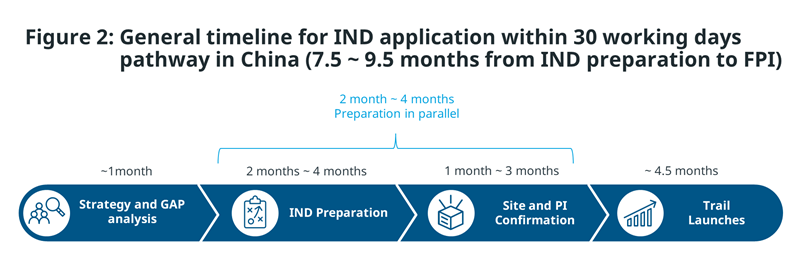
One of the most cited advantages of China IITs is speed to first patient. China IND timelines are influenced by:
- CDE technical review cycles
- Potential pre‑IND interactions
- Document translation and format review
- Downstream site GCP, ethics, and contract sequencing
On the other hand, IITs:
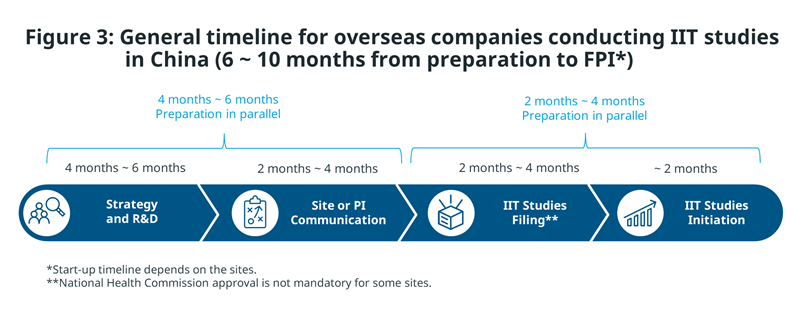
- Do not require CDE IND approval
- Are initiated at the hospital and ethics committee level
- Can often progress to site activation more rapidly once protocol alignment is achieved
For sponsors seeking early signal generation or rapid clinical learning, this difference can be decisive.
2. Flexibility in Early Clinical Exploration1,2,4
China IITs are particularly well suited for:
- Dose exploration
- Proof‑of‑concept studies
- Indication expansion exploration
Compared with IND trials, IITs offer:
- Greater flexibility in protocol amendments
- Faster iteration based on emerging data
- Investigator‑driven scientific insights aligned with local clinical practice
This flexibility is especially valuable when global development plans are still evolving.
3. Strategic Bridge to a Future China IND2,5
Importantly, IITs are not an alternative to INDs, but rather a complementary step.
Data generated from a well‑designed IIT can:
- Inform China‑specific dose selection
- Support rationale for ethnic sensitivity considerations
- De-risk programs before investing in full IND development
- Strengthen sponsor positioning for future regulatory interactions, by providing supportive, exploratory data generated from IIT alongside the IND submission package.
- Potential enhancement to product valuation and increase partnering prospects for sponsors
For some programs, especially in oncology and Cell and Gene Therapies, IITs can potentially shorten the learning curve before committing to a full IND program.
Question: Which products and modalities are suitable for China IITs?1,2,4,5
Sponsors often ask whether IITs are limited to specific modalities. While China IITs are commonly used in oncology and innovative products, including Cell and Gene Therapies, eligibility is broader and depends on:
- Investigator capability and institutional infrastructure
- Scientific rationale and unmet medical need
- Risk profile of the investigational product
Beyond Cell and Gene Therapy oncology programs, IITs have been conducted for novel biomedical technologies that are used in non-oncology indications where strong investigator interest exists and unmet needs. However, suitability must be assessed case by case, particularly where long‑term registration intent is clear.
Question: IIT vs. IND: When does an IND make more sense?2-4,6
Despite the advantage of an IIT, they may not always be the optimal first step. A China IND pathway may be more appropriate when:
- The study is directly registrational
- Global protocol consistency is mandatory
- Formal alignment with US / EU regulatory expectations is required
- Large multicenter execution is planned from the outset
In these cases, sponsors often accept longer startup timelines in exchange for regulatory continuity and data acceptability. The decision is therefore less about IIT vs. IND, and more about how each pathway fits within the overall development strategy.
Why work with a CRO for your IIT?
Some sponsors consider working directly with individual investigators for IIT execution. However, this approach can introduce variability in:
- Study quality
- Data consistency
- Oversight and compliance
Managing an IIT through an experienced China CRO can help:
- Standardize study execution
- Maintain global‑level quality expectations
- Ensure data usability for downstream decision‑making
This becomes increasingly important when IIT data are expected to influence global development strategy.
Final Thoughts
China IITs are not simply a faster IND substitute. Used thoughtfully, they are a strategic tool that allows sponsors to:
- Generate early clinical insights
- Leverage China’s investigator expertise and broad patient access with high unmet needs.
- De‑risk larger regulatory investments
Some of the most successful programs are those that deliberately sequence IITs and INDs, aligning speed, flexibility, and regulatory rigor with the program’s stage and objectives.
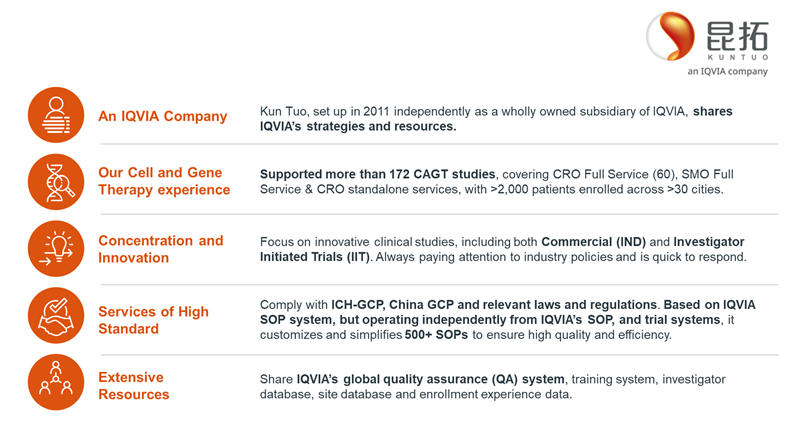
IQVIA's Local China CRO for your China IIT
Overview of Kun Tuo
Disclaimer
This blog is intended for informational purposes only and does not constitute regulatory advice. While the content reflects current understanding of China’s clinical research environment, including Investigator-Initiated Trials (IITs) and IND pathways, sponsors should consult with qualified regulatory professionals and relevant authorities (e.g., NMPA, CDE, NHC) to determine the appropriate development strategy for their specific product and program. Regulatory requirements and interpretations may evolve over time and vary by product type, indication, and institutional context.
References
1 Hong, M., Yan, Z. The development and challenges of Investigator-Initiated Trials (IITs) in China. Holist Integ Oncol 3, 57 (2024). https://doi.org/10.1007/s44178-024-00123-7
2 Yang Y, Bian L, Cheng Y, Xu Y, Shao H, Rao J, Ge S, Gong J, Jiang M, Zheng X, Liu L, Ma S, Liu X, Cheng T, Gao C. The Role and Challenges of Investigator-Initiated Trials in the Cell and Gene Therapy Products Boom in Mainland China. Clin Transl Sci. 2025 Feb;18(2):e70148. doi: 10.1111/cts.70148. PMID: 39936621; PMCID: PMC11815567.
3 Liu Y, Ge C, Chen X, Lu S, Wang T. Trends in the development of cellular and gene therapy in China. Nat Rev Drug Discov. 2025; published online 31 July 2025. https://doi.org/10.1038/d41573-025-00126-7
4 Yin, et al. Gene and cell therapies in China: booming landscape under dual‑track regulation. Journal of Hematology & Oncology (2022) 15:139. https://doi.org/10.1186/s13045-022-01354-9
5 Du, et al. Mapping the cell therapy landscape: insights into clinical trials and regulatory advances in China. Journal of Hematology & Oncology (2024) 17:96. https://doi.org/10.1186/s13045-024-01616-8
6 Clinical Research Regulation For China | ClinRegs. https://clinregs.niaid.nih.gov/country/china#regulatory_authority