Global R&D Trends 2026
Advancing Innovation in a Changing Landscape
Mar 25, 2026

IQVIA customers will be able to access these reports at no cost via discount codes. If you are an existing customer, please contact your account representative or send a request for the code to Info@IQVIAInstitute.org.

This report is licensed for individual use only.  It may not be shared, reproduced, distributed, or transferred in any form to any other person or entity without prior written consent.  This report is subject to the terms and conditions of the IQVIA Licensing and Services Agreement General Terms and Conditions (April 2022) available at (https://ogc.iqvia.com/Contracts/LSA-0422).  By purchasing this report, you agree that your use of the report is bound by these General Terms.

Report Summary:

Biopharmaceutical R&D remained resilient in 2025, with investment and dealmaking increasingly concentrated in high value science, emerging biopharma, and China linked activity. At the same time, growing scientific complexity, longer development timelines, and persistent regional disparities in drug availability and trial country utilization have put pressure on productivity, elevating the importance of internal efficiency levers and regulatory reform in sustaining and enhancing innovation and competitiveness.

Although end-to-end clinical development timelines have increased, reversing the improvements of recent years, emerging developments in artificial intelligence-enabled discovery and development offer a tantalizing glimpse of a future in which reduced pipeline attrition dramatically improves R&D productivity.

This report assesses trends in R&D funding, clinical trial activity, new drug launches and clinical productivity, while examining key efficiency enablers at sponsor and ecosystem level. Operationally addressable cycle time components are investigated, demonstrating ongoing and increasingly important opportunities to accelerate development. Continuing shifts in the clinical development ecosystem and the increasing importance of emerging biopharma companies are discussed throughout the report.

Key Findings:

  • R&D funding levels were high in 2025 but lower than in 2024:
    • Biopharma funding and large pharma R&D expenditure slowed, but remained well-above pre-pandemic levels
    • R&D deals between biopharma companies rose, while deals between China-headquartered and international companies reached an all-time high
  • Clinical trial starts were increasingly concentrated among U.S. sponsors:
    • Trial starts increased for U.S.-headquartered sponsors and for those in Japan
    • Trial starts from China-headquartered and Europe-headquartered sponsors declined
  • The number of novel active substance (NAS) launches increased on a global basis:
    • Thirty launches were global first-in-class
    • Thirty were launched only in China
  • Improved clinical program productivity was not sustained:
    • Trial durations increased overall, with faster enrolment in oncology countered by its higher representation among trials completing enrolment
    • Inter-trial intervals increased by 3 months
  • Sponsors and regulators are taking steps to enable efficient development
    • Acceleration activities have been prominent among regulatory agencies
    • Artificial intelligence increasingly enabled R&D, manifesting in increased success rates among AI-driven programs

Other findings:

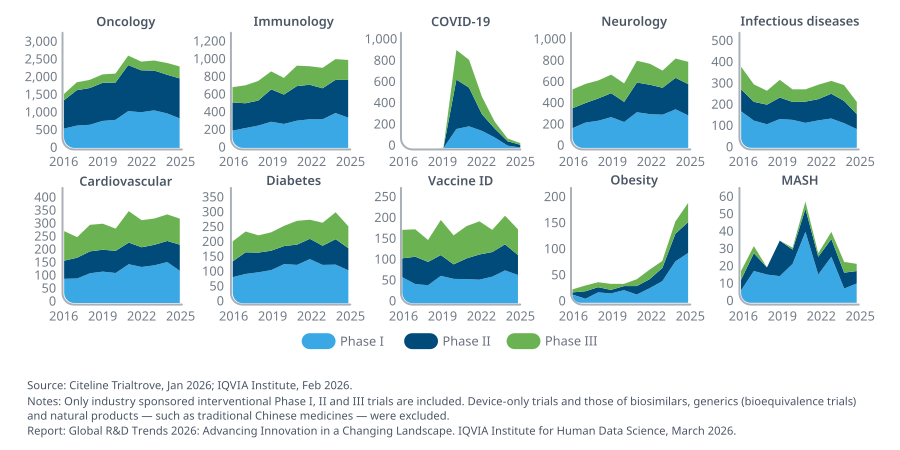
Exhibit 18: Clinical trial starts by year and phase, 2016–2025
  • In absolute terms, most therapeutic areas experienced small declines in trial starts between 2024 and 2025, reflecting global Phase I trends.
  • Oncology trial starts declined overall by 4% between 2024 and 2025, although oncology trial starts increased in Phase II and in Phase III, respectively, by 3% and 4%.
  • Immunology trial starts reduced slightly in Phase III, by 4% from 2024 to 2025, but a 14% increase in Phase II starts was attenuated by a 13% decrease in Phase I; however, immunology has been a high-growth area over the longer term.

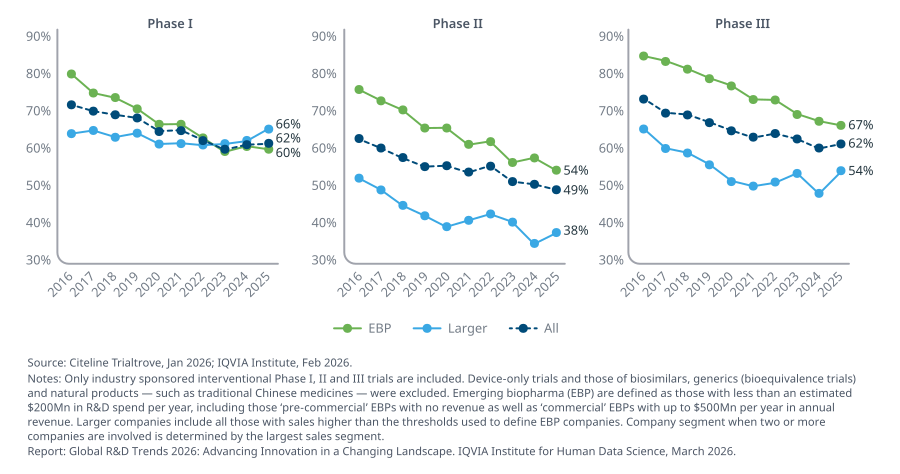
Exhibit 21: Small molecule share of trial starts by phase and company segment, 2016–2025
  • The small molecule share of trial starts has experienced a long-term decline in all development phases.
  • Between 2016 and 2023, trials examining small molecule drugs in Phase I declined from 72% to 60% of trials before increasing to reach 62% in 2025.
  • The recent increase in the proportion of small molecule trials in Phase I has been driven by a combination of stabilization of small molecule share among EBPs and an increasing share of small molecule trials among larger companies, where the small molecule share increased from 61% in 2022 to 66% in 2025.

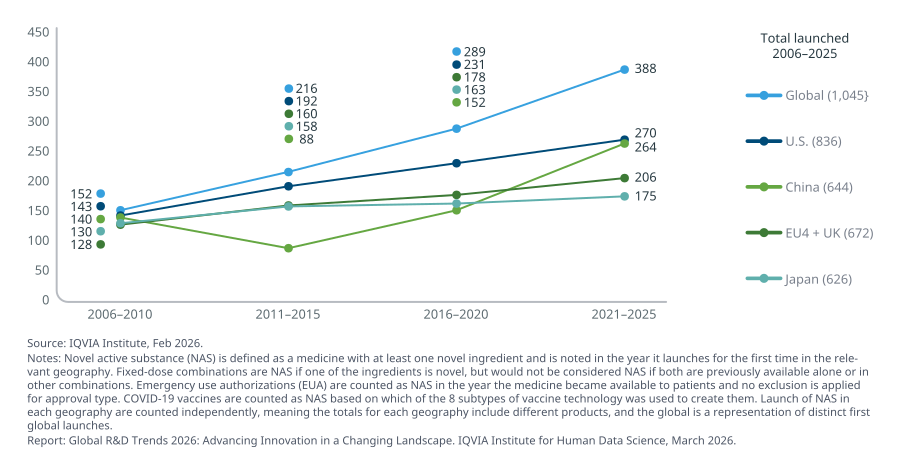
Exhibit 33: Novel active substances (NAS) launched globally and in selected countries, 2006–2025
  • The 79 novel active substances launched globally in 2025 bring the five-year total to 388, or 369 excluding COVID-19 vaccines and therapeutics.
  • Based on molecules in the late-stage pipeline and historic success rates, over the next five years an average of 70–80 NAS are expected to launch annually, expanding the number of NAS launched globally by 350–400.
  • A total of 53 NAS launched in the U.S. in 2025, bringing the five-year total to 270. This represents a 17% increase in the number of launches between 2021

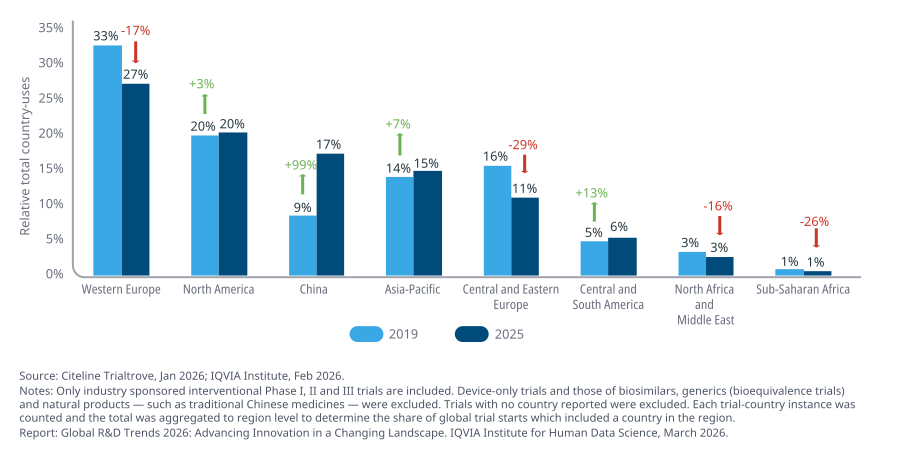
Exhibit 55: Country utilization as percentage of global trial country uses, 2019 and 2025
  • Analysis of trial country uses — the count of instances in which at least one site in a country is used in a clinical trial — can be helpful in examining global utilization trends, especially when compared with the total count of all trial country uses globally and presented as a percentage of this.
  • Large global shifts in the share of trial country uses by region have occurred in recent years.
  • Although Western Europe remained the most-utilized region in 2025, with a 27% share of global country uses, its utilization fell by 17% in comparison to 2019.

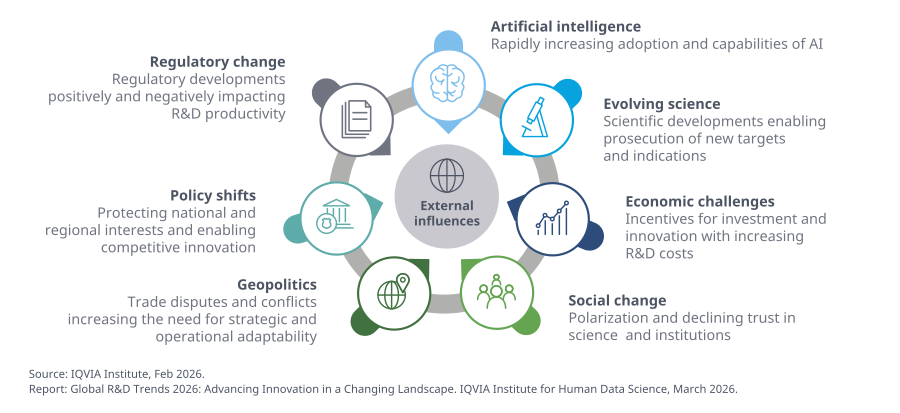
Exhibit 67: Dynamics impacting trial sponsors
  • Multiple evolving dynamics continue to reshape global business and innovation ecosystems, with important implications for clinical trial sponsors.
  • Capabilities and utilization of artificial intelligence are accelerating, with growing impact on fundamental R&D processes across discovery research, clinical planning and operations, portfolio decision-making, and regulatory approvals, in addition to mainstream shifts in general utilization; competition for talent is fierce, with skills that combine technical capabilities and R&D domain expertise in high demand.

Related solutions

Contact Us