
.svg)




Defensible Data & AI
Secure your platforms and products to drive insights from AI and accelerate healthcare transformation.













As digital health platforms evolve, aligning with global regulations and best practices is more complex than ever. AI can help teams map requirements, score compliance, and proactively address risks, turning regulatory complexity into actionable platform guardrails. We will provide a real‑world example where regulatory mapping and risk‑based analysis enabled a team to align design decisions, clarify regulatory expectations, and move forward with a defensible, scalable development path.
From predictive analytics to personalized care, organizations are keen to embed AI into digital health platforms to unlock evidence-based insights faster than traditional approaches. With the growing opportunity that AI presents, however, come an equally sharp focus on expectations for these systems by regulators, policymakers, and the public. The range of shifting AI policies and frameworks call for AI systems to be defensible, scalable and resilient to emerging threats.
What’s needed is a proactive, structured approach. An approach that turns regulatory complexity into actionable guidance and controls for platform design and development. By translating complex regulatory signals into practical controls, organisations can anticipate requirements, address risks, and lay the groundwork for innovation that stands up to regulatory and ethical expectations.
In an earlier blog on platform operations [1], we explored a three-pronged approach to managing AI in practice: mapping controls and requirements, designing technical features, and establishing operating guidelines. Building on that foundation, this article examines how AI-powered regulatory controls can guide every stage of digital health platform development. We focus on controls because they form the operational backbone that carries regulatory intelligence into action.
AI-enabled digital health platforms are increasingly designed to serve global patient populations, integrate with multinational clinical networks, and align with enterprise strategies that span multiple jurisdictions. Organisations pushing for enterprise-scale digital health solutions face the dual challenge of meeting country-specific laws while maintaining a unified AI governance model that supports scalability and defensibility.
With 70+ countries actively developing data and AI-related laws, frameworks, and oversight mechanisms, the regulatory landscape for data and AI in healthcare is evolving rapidly. Governments and agencies are taking diverse approaches: the European Union’s AI Act is rolling out requirements for risk management and transparency for high-risk use cases, while the United States sees sectorial regulation from bodies like the FDA and FTC, alongside relevant state-level statutes beginning to take shape. All regions are trying to prioritise innovation and flexible governance while maintaining patient safety.
AI in healthcare is regulated through several layers:
Each layer introduces unique obligations and expectations, and the interplay between them can result in inconsistency and fragmentation. Without a structured approach to harmonize these requirements, organizations risk costly delays, compliance failures, and reputational harm.
Organisations often struggle to find a systematic way to translate diverse regulatory requirements and expectations into actionable safeguards for AI-enabled platforms. Controls mapping provides a structured process to identify, organise, and align regulatory, legal, and best practice requirements into a unified set of operational controls that can be embedded within AI systems.
To make this process practical and scalable, controls mapping can be anchored to recognised frameworks such as the NIST frameworks (privacy, cybersecurity, AI) or ISO/IEC 42001 (standard for AI Management System). These frameworks provide a normative structure (a common language and reference points) that enables teams to map requirements from multiple sources into a unified view. AI technologies can accelerate this process by automating extraction of regulatory content, mapping requirements to frameworks, and optimising prompts for expert validation (Figure 1). We have operationalised this approach, deploying AI agents to streamline mapping workflows while maintaining expert-in-the-loop oversight for accuracy and defensibility.[5]
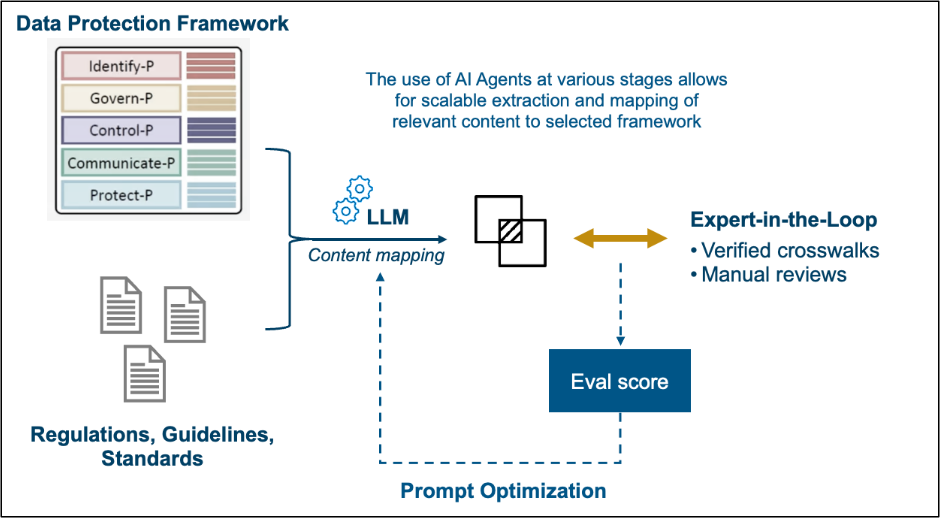
Figure 1: AI-powered regulatory controls mapping
By leveraging these and other frameworks, organisations can more effectively:
Ultimately, this approach moves health technology teams beyond reactive compliance, establishing a proactive and resilient foundation for AI platform and systems development. Controls mapping, grounded in robust frameworks, is critical to designing platform and system guardrails that are adaptable, transparent, and ready for regulatory scrutiny.
Consider a recent global health innovation initiative aimed at developing a personalised nutrition and wellness platform within a broader digital health ecosystem. The ambition was bold: integrate clinical and consumer health data, design AI-driven features for personalised recommendations, and operate across multiple jurisdictions with diverse regulatory expectations.
To align client teams, we mapped regulatory requirements across privacy, cybersecurity, and AI governance domains. We applied a risk-based methodology to align data flows and feature engineering with compliance obligations, ensuring that protections were commensurate with the level of risk. Risk tiering of personal data considers how sensitive or potentially harmful the data is, how it was approved for collection, and how easily it can be linked, identified, addressed, or used to draw inferences (Figure 2). The result was a comprehensive roadmap containing 600+ recommendations, each tied to specific use cases and regulatory signals.
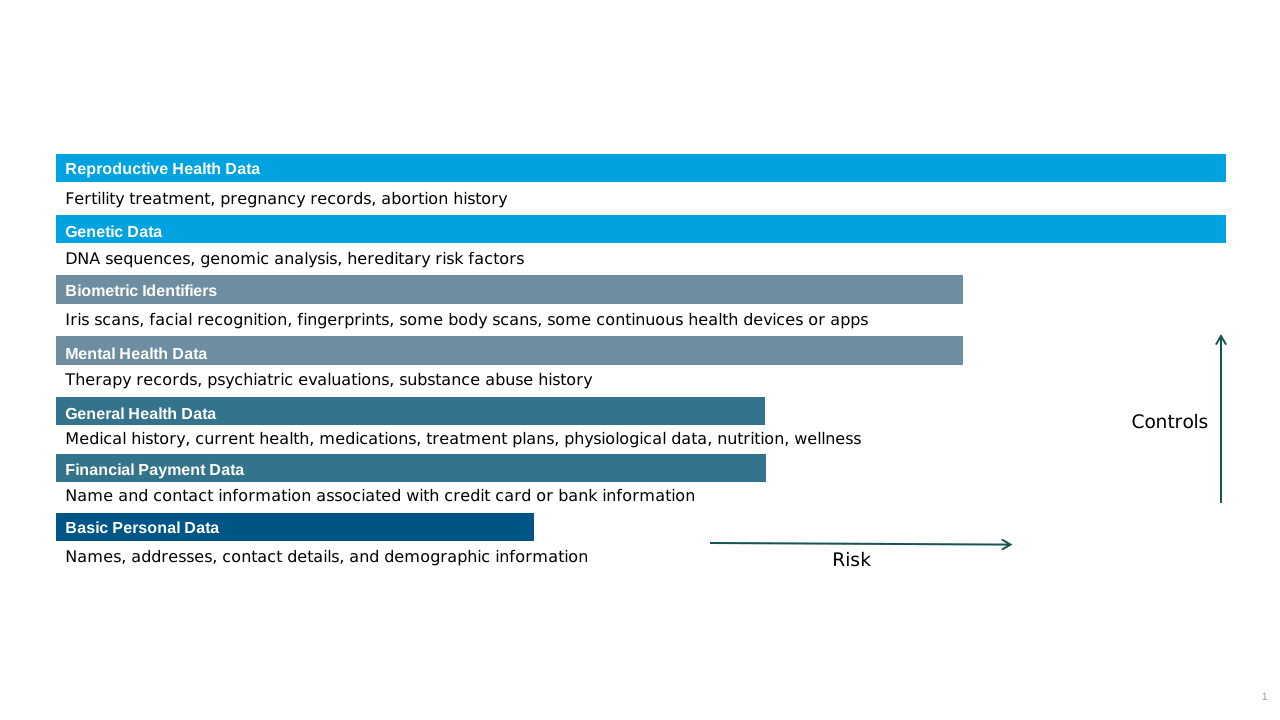
Figure 2: Risk tiering applied to personal data types based on potential invasion of privacy and dimension of interconnectedness
With the comprehensive roadmap in hand, the client was able to properly scope and evaluate options for building their AI platform and system and match this to their go-to-market plans. Given the number of regulatory considerations for a multi-jurisdictional initiative, this effort resulted in clarity and supported decision making.
Regulatory intelligence delivers value when it moves beyond awareness and becomes a guiding principle for design and delivery. The development plan is where this transformation happens, be it for a new build or an existing system that needs to adapt to regulatory changes. It is the blueprint for what gets built, when, and why so that teams can make decisions that carry through to the final platform. A well‑structured development plan doesn’t just outline activities; it shapes the architecture, data flows, and safeguards that ultimately determine how the platform operates in production. This is true whether an organisation is building something new or adapting an existing system to meet evolving requirements.
Embedding governance into core platform or system features ensures that high-impact safeguards, such as auditability, AI-secure architecture, and explainability, are prioritised early. Technical specifications align with operational expectations, reducing late-stage rework. Collaboration between technical and compliance teams becomes integrated, and every decision is grounded in defensibility and transparency.
Embedding governance into core platform or systems features also creates resilience, turning regulatory insight into a strategic driver. As regulations evolve, platforms built on mapped controls can adapt more easily, avoiding disruptive overhauls. This adaptability is critical in a world where regulatory expectations are dynamic, shaped by technological advances, societal concerns, and global policy shifts.
For leaders in digital health technology, the message is clear: governance should be integrated into the DNA of platform development. Organisations that succeed will treat regulatory controls as a living capability, rather than a static checklist. They will invest in frameworks that harmonise global requirements, build evidence packs that demonstrate compliance, and create feedback loops that catch emerging risks before they escalate. In doing so, organizations can create compliant systems that inspire confidence, accelerate innovation, and deliver lasting value to patients, providers, and partners alike.
Related solutions
Secure your platforms and products to drive insights from AI and accelerate healthcare transformation.