














Stay ahead with the International Thought Leadership insights: your source for industry-leading expertise and analysis
Blog
Aligning for impact: Exploring healthcare professionals’ channel preferences in 2026
Nov 26, 2026
Introduction
Pharmaceutical engagement with healthcare professionals (HCPs) continues to evolve, shaped by changing ways of working, pressures on HCP time and availability, and the growing adoption of AI. While AI is rapidly changing how HCPs access information, a clear signal of its impact on channel preferences and engagement with pharma has yet to emerge.1 Against this backdrop, understanding how HCPs prefer to engage, and how closely pharmaceutical activity aligns with those preferences, will be increasingly important.
Channel preference is just one component of effective engagement, alongside understanding which channels HCPs actually use, which have the greatest impact, and what messages are delivered through them. It provides an important baseline for identifying where preference and practice align, and where gaps remain.
Through the ChannelDynamics™ Channel Preference Survey, IQVIA has tracked HCP preferences over the past decade. This 2026 analysis examines changes in the preferred channel mix, alignment across countries and specialties, and variation between individual HCPs, with a particular focus on face-to-face (F2F) engagement.
Bridging the Gap: Examining Country-level Channel Alignment
The 2026 survey reveals considerable variation in how closely pharmaceutical engagement aligns with HCP preferences (Figure 1). An HCP is considered aligned when their most preferred channel is also the one through which they receive the most engagement. Across the eight largest markets globally, alignment exceeds 60% in four countries but remains below 50% in the other four. Italy and the US show the highest alignment, at 68% and 66% respectively, while China and Japan are lowest, both at 41%.
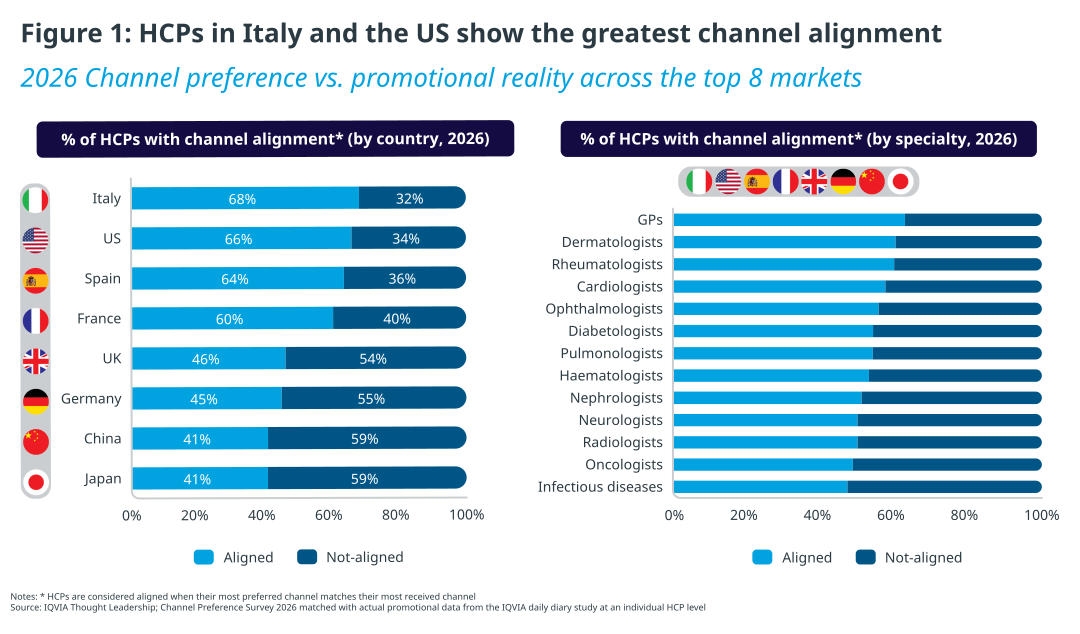
These differences highlight the importance of considering channel strategy at an individual country level. Notably, alignment can also change over time: in the UK, the proportion of aligned HCPs has increased steadily from 38% in 2024 to 43% in 2025 and 46% in 2026, suggesting a gradual narrowing of the gap between HCP preferences and pharmaceutical engagements.2
However, country is not the only source of variation. Alignment reaches 63% among GPs and 60% among dermatologists but remains below 50% among oncologists and infectious disease specialists. Factors such as the nature of clinical work, schedule predictability, and work in outpatient settings may all contribute to these disparities by influencing HCPs’ flexibility in choosing and responding to engagements.
Evolving Channel Preferences: Email On The Rise
Across the EU4+UK and US, HCP channel preferences remain broadly consistent with previous years across the ten channels surveyed. F2F meetings continue to account for 40% of the preferred channel mix in 2026, while in-person conferences remain at around 15%. However, alongside this stability, email preference has risen consistently over the past five years, reaching a new high of 18% in 2026 and overtaking in-person conferences for the first time.
Continued pressure on HCP access and time provides important context for the growing role of email, which allows engagement to take place outside the constraints of a scheduled interaction. This is supported by recent IQVIA research which found that 20% of service providers reported a significant increase in pharma clients’ focus on email over the previous two years, reflecting growing industry attention to the channel.3
Looking across the broader set of countries in the 2026 survey reveals substantial differences in the role of each channel (Figure 2). F2F accounts for 56% of the preferred mix in South Korea and 53% in Türkiye, compared with 18% in Sweden and 17% in Denmark. While F2F remains the leading channel overall, its role therefore varies considerably across markets.
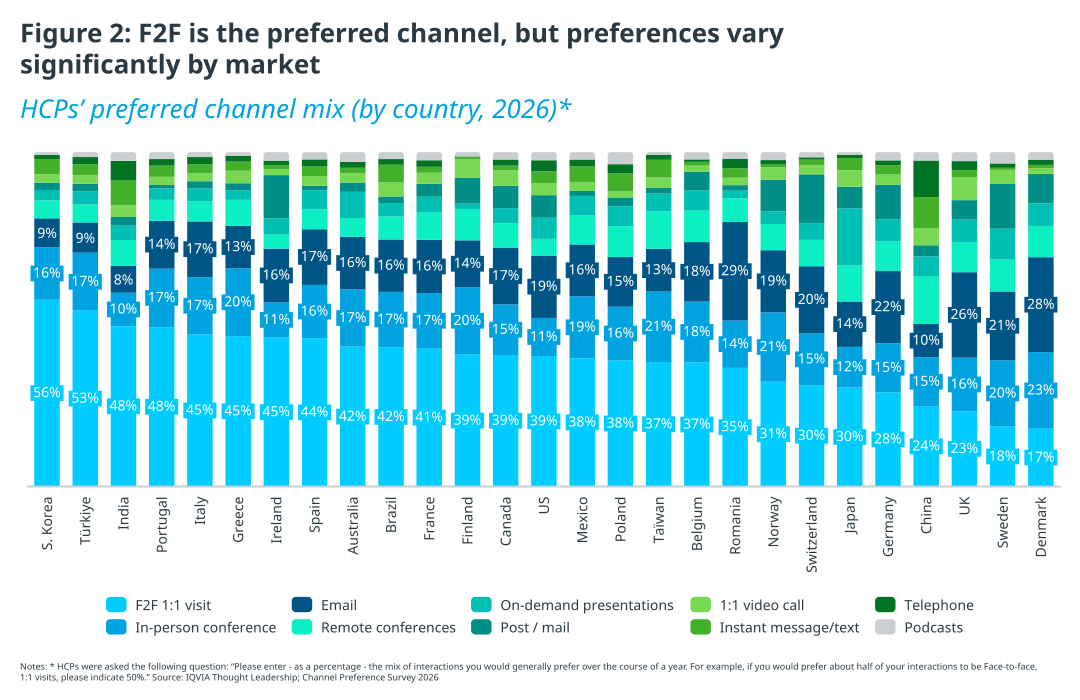
In the UK, F2F has lost its position as the most preferred channel in an environment of continued workforce and capacity pressures. During the survey period, demand for GP services in England reached a record high, despite little growth in the number of GPs. At the same time, workload pressures have continued to mount, with the average full-time GP now accountable for 2,143 patients, 205 more than in 2015, alongside substantial hidden administrative pressures.4,5 While these factors do not explain channel preference dynamics directly, they provide relevant context for the value of flexible engagements.
China also stands out for its distinct channel mix, with instant messaging accounting for 9% of preference and telephone for 11%, consistent with patterns seen in previous years. This sits within a unique digital ecosystem, where platforms such as WeChat play an established role, alongside an evolving regulatory environment. New measures introduced by China’s National Medical Products Administration (NMPA), effective August 2026, tightened oversight of pharmaceutical representatives, emphasising their responsibility for academic promotion of drugs rather than sales activities.6 These developments add further market-specific considerations for HCP engagement, the full effects of which will be seen in 2027.
Beyond Country Averages: The Spectrum of F2F Preference
Country-level channel mixes provide a useful indication of the overall role of F2F but can mask substantial variation between HCPs. Looking at how much of their preferred channel mix each HCP allocates to F2F meetings reveals whether preferences within a country cluster around a similar level or vary widely across the spectrum (Figure 3). As above, this reflects stated preference distribution rather than actual engagements.
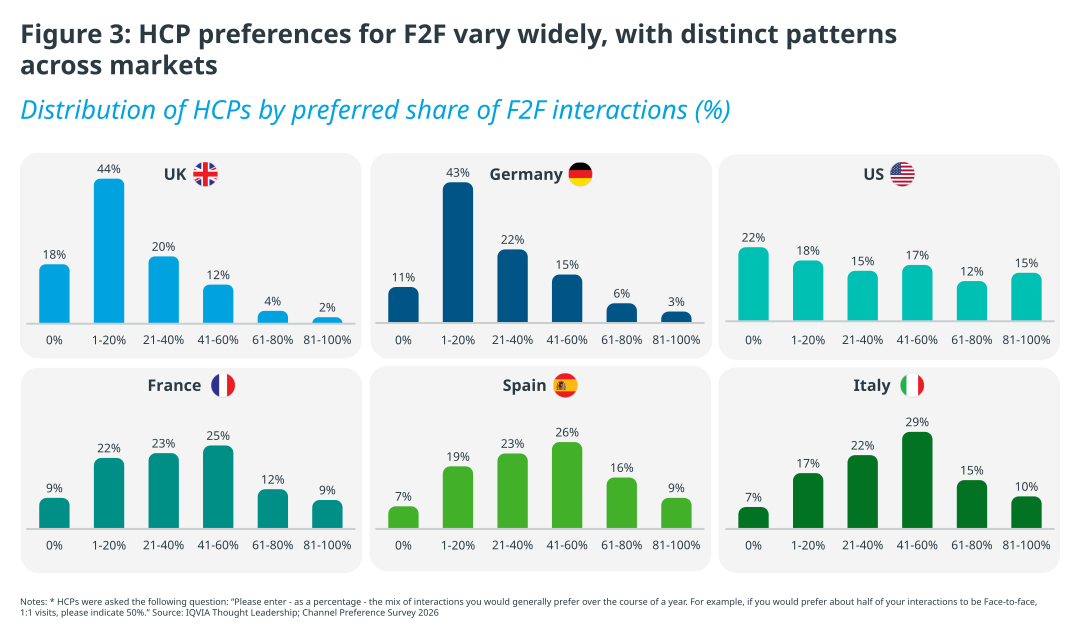
Three distinct patterns emerge across the EU4+UK and US:
- Germany and the UK are similar, with preferences concentrated towards the lower end of the spectrum. In both markets, the largest group of HCPs allocates just 1–20% of their preferred channel mix to F2F, at 43% of HCPs in Germany and 44% in the UK.
- France, Spain and Italy show a different pattern, with HCP preferences more concentrated towards the middle of the spectrum, particularly in the 41–60% F2F preference band.
- The US stands apart, with F2F preferences distributed much more evenly across the spectrum. While 22% of HCPs allocate none of their preferred mix to F2F, sizeable groups are represented across the remaining preference bands, highlighting particularly diverse preferences within the market.
These distributions demonstrate why country averages alone cannot capture the full picture. HCPs within the same market can have substantially different preferences for F2F engagement, meaning that an effective channel strategy requires both an understanding of broader market trends and the flexibility to respond to individual HCP preferences.
Conclusion
The 2026 Channel Preference Survey reveals gradual evolution rather than fundamental change, based on comparison with similar analyses from previous years. F2F meetings remain the largest component of the preferred channel mix overall, while email continues to gain ground. Yet beneath this stable aggregate picture lies considerable variation: alignment differs significantly across countries and specialties, the role of individual channels varies by market, and HCPs within the same country can have very different preferences for F2F engagement.
As HCPs increasingly turn to AI for medical information, more of the information journey may take place outside channels directly controlled by pharma.7 Tracking these changes will therefore be increasingly critical to understanding whether growing use of AI will fundamentally reshape how HCPs want to engage with pharma.
1 IQVIA Use of AI Tools ChannelDynamics Survey, May-July 2026; survey base: n = 23,769 HCPs across 34 markets; each HCP classified by highest usage frequency of any AI tool
2 IQVIA blog, November 2025: https://www.iqvia.com/locations/emea/blogs/2025/11/from-preference-to-practice
3 IQVIA white paper, October 2025: https://www.iqvia.com/library/white-papers/advancing-scientific-exchange
4 British Medical Association, October 2026: https://www.bma.org.uk/advice-and-support/nhs-delivery-and-workforce/pressures/pressures-in-general-practice
5 Royal College of General Practioners, April 2026: https://www.rcgp.org.uk/representing-you/policy-areas/workload
6 National Medical Products Administration (NMPA) et al., April 2026: https://www.gov.cn/gongbao/2026/issue_12826/202606/content_7073631.html
7 IQVIA blog, November 2026: https://www.iqvia.com/blogs/2026/11/evolving-implications-of-ai-as-a-gateway-to-medical-information
Related solutions