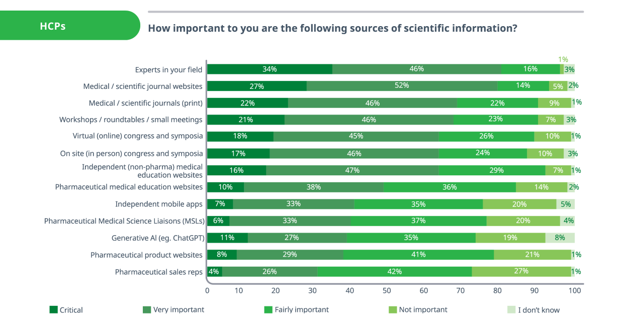
Figure 1. How HCPs rate the importance of sources of scientific information. Source: IQVIA, Advancing Scientific Exchange: Trends and Tactics for Healthcare Professional Engagement, 2025.
A company is therefore one voice among many, and seldom the loudest. What matters more than any single touchpoint is knowing which sources a clinician has already been exposed to, across which channels, and which gaps remain to be filled. Most engagement plans still answer a different question, namely how many interactions each channel delivered.
Integrated engagement works as a continuous cycle
None of this devalues what the industry has spent years building. Digital content still needs to be excellent, to answer a need the audience has voiced, and to arrive while the question still matters. Clinicians expect a smooth, connected experience across medical, commercial, education, and digital channels, and when it falls short the cost is greater than it was, because the alternative is one search away.
Meeting that expectation is less a channel plan than a cycle that keeps turning. It starts with listening. Medical information requests, congress questions, field notes, and search behavior on owned sites all carry signal about what clinicians are trying to resolve. AI can read across those sources at a scale no team could manage by hand, surfacing a need in one specialty before it appears everywhere. Engagement follows, with content shaped by what was heard, in the channel and at the moment the clinician prefers. Then comes measurement, and here the metrics need to change. Opens, clicks, and attendance describe delivery. The harder questions are whether understanding improved, whether practice changed, and whether patients benefited, each with a stated proxy a team can realistically collect. What is learned there feeds the next round of listening, so insight from one interaction reaches the next.
Underneath the cycle sits a further shift. When an AI system puts an answer together, influence depends on the credibility of the underlying evidence, so being included in guidelines matters more than it did, as does publishing in respected journals and keeping both up to date.1 Credible evidence is the foundation, though on its own it is not the differentiator. The company that pulls ahead translates its data into something a clinician can use, communicates it through the sources the clinician already trusts, and can show that understanding, practice, and patient outcomes moved as a result.
Every touchpoint now starts further into the conversation
Consider the MSL visit that would have counted as excellent five or six years ago. It would have included well-made slides on method, population, efficacy, and safety, plus one on a patient the clinician was likely to see. Today, that clinician can enter a 63-year-old’s performance status and prior therapy and obtain a summary before anyone from the company arrives. Every other touchpoint faces the same test. An education module built around the pivotal trial, a symposium that presents the data, an owned page that explains the mechanism, each now competes with an answer the clinician assembled in seconds.
So what is left for each touchpoint to do? Not much that counts as information. The gap tends to be practical, running to access and reimbursement for a specific patient, a health system not designed with the therapy in mind, and real-world cases that do not match the trial population. Education can start from those cases, a congress session from the questions clinicians are already putting to AI tools without a satisfying answer, and a field conversation from where the summary ends. Data shortens the groundwork, and an assistant working from reference data on clinicians and institutions has been associated with a 27% reduction in time spent preparing for and following up on calls.3 Knowing what a clinician has probably worked out already is a training question, in every channel, and it is where most of the effort belongs.
Peer exchange is where the gaps get filled
When information grows faster than people can read it, clinicians stop looking for more sources and rely on a few they trust, and the survey above shows where that trust lands. Experts in their own field outrank every journal, congress, and company channel, and they are the one influence no tool can replace, because a peer brings judgment that has been tested on patients like the one in front of them. Ask a clinician who they call when a case is uncertain and the answer is generally someone they trained alongside, published with, or practice near.
Those relationships can be mapped from primary research and from records of who has co-authored, studied, treated, or investigated together.4 A map of who influences whom shows two things at once: where trusted conversations already happen, and where they do not. A specialty in which the people leading on long-term safety never meet the people leading on access is a gap, and so is a region with no one near the center of the network. Those are the places where a company can add most. The role is to strengthen peer exchange rather than substitute for it, by bringing the right people together at a congress session, an advisory board, an educational program, or a field introduction. Data and AI show where that effort will carry furthest. The exchange itself is still human work, and it calls for a facilitator’s instincts that medical teams have not traditionally been hired for.
A valuable interaction, in any channel, builds trust, while a poor one uses it up, and trust is easier to lose now because a clinician who finds an interaction unhelpful has somewhere else to go. Clinicians are not going to hand back the tools that put evidence at their fingertips, nor should anyone want them to. What a company can offer is what those tools cannot, context for a specific patient, judgment about which of a dozen sources to trust, and a peer relationship in which the harder questions get asked. None of that is visible without data. Connected evidence and AI show which sources a clinician has already seen, which conversations are already happening around them, and whether the last interaction changed anything. There is no other way to find a gap before someone else fills it. The premium on human engagement is real. What earns it is the data behind it, connected well enough to show where that engagement will matter most.
References
1. Scott K, Alzaga-Chaudhry C. The evolution of pharma engagement as AI becomes a front door to medical information. IQVIA EMEA Blog. 2026 Mar 31.
2. IQVIA. Advancing scientific exchange: trends and tactics for healthcare professional engagement. IQVIA White Paper. 2025 Oct 8.
3. IQVIA. HCP engagement. IQVIA solutions page. Accessed 2026 Sep 24.
4. IQVIA. Expert ecosystem. IQVIA solutions page. Accessed 2026 Sep 24.