Institute Report
A New Look at Biopharmaceutical Blockbusters
An analysis of blockbuster prevalence, eras, lifecycle dynamics, and outlook for the future
Oct 22, 2026

Report Summary

Since Tagamet became the first medicine to surpass $1Bn in annual global sales nearly four decades ago, biopharmaceutical blockbusters have become increasingly central to the global medicines market. Between 2000 and 2024, the number of medicines surpassing the global sales threshold, adjusted for inflation, has increased nearly five-fold, representing approximately $700Bn in global sales and accounting for nearly 50% of prescription medicine spending worldwide. The characteristics of blockbuster medicines have also changed dramatically over this time, shifting towards specialty medicines and towards “mega” blockbusters with more than five times the annual blockbuster threshold in sales. These changes raise important questions regarding the future of innovation for the industry and affordability for patients and payers.

This report examines how the blockbuster medicine landscape has evolved between 2000 and 2024, including changes in blockbuster prevalence, global sales, therapeutic composition, and lifecycle dynamics. Using historical global sales data and product-level analysis, this study defines distinct blockbuster eras, documents the shift towards specialty blockbuster concentration and “mega” blockbuster global sales, the durability of blockbuster commercial performance over time, and other factors associated with blockbuster medicines. The findings presented in this report characterize how blockbuster medicines have evolved over the past 25 years and provide context for discussions about the next generation of blockbuster therapies and their implications for innovation, competition, and access.

Key Findings

  • Using an inflation-adjusted global sales threshold anchored to the $1Bn benchmark set by Tagamet in 1986 (about $2.4Bn in 2024), the number of blockbuster medicines grew nearly five-fold, from 19 in 2000 to 91 in 2024.
  • Despite accounting for only 2% to 4% of the number of global branded medicines each year, blockbusters made up 63% of global branded medicine sales at list prices in 2024, up from 25% in 2000.
  • The analysis identifies four eras of blockbuster evolution over 25 years, during which the market moved from high-volume, primary-care medicines to a dominance of specialty medicines (63% of blockbusters by 2024), and oncology, immunology and diabetes treatments grew from 5% of all blockbusters in 2000 to 60% in 2024.
  • Blockbuster sales are increasingly concentrated among "mega" blockbusters, those with sales of at least five times the annual blockbuster sales threshold, which made up only 15% of the number of blockbusters in 2024 but accounted for 46% of all blockbuster sales.
  • Blockbusters typically reach blockbuster status an average of 4.8 years after launch, with 67% doing so within five years, and then sustain blockbuster-level sales for an average of 12.1 years before U.S. loss of exclusivity (LOE), nearly 80% of their average protected commercial lifecycle.
  • Nine of today's "mega" blockbusters are expected to face U.S. LOE between 2028 and 2036; this will put pressure on manufacturers to replenish their portfolios and creates potential savings for payers and health systems as generic and biosimilar competition enters.

Other Findings


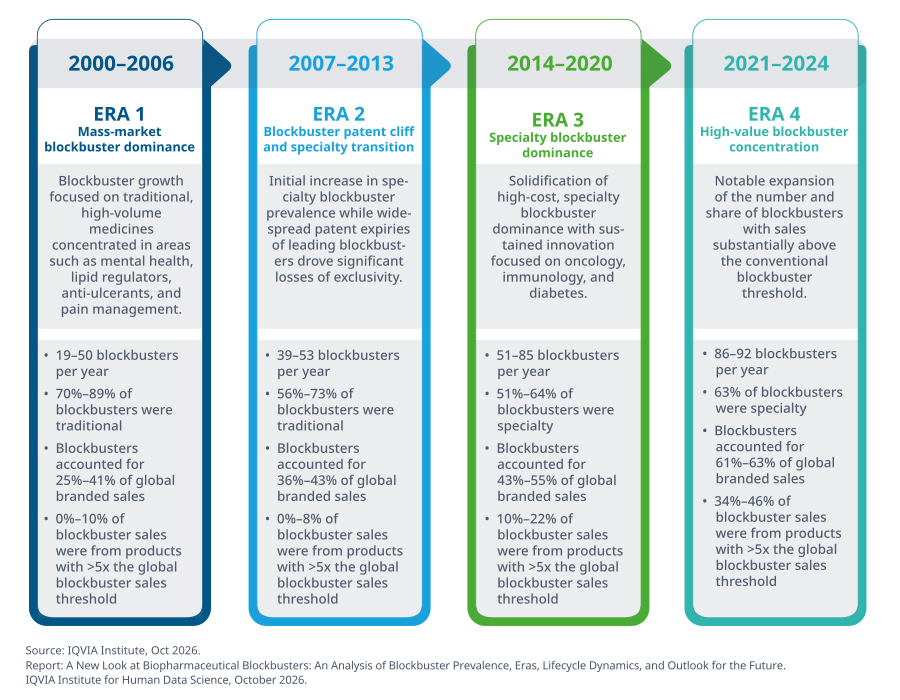
Exhibit 6: Blockbuster eras, 2000-2024

  • The early 2000s are characterized by a mature traditional blockbuster model centered on high-volume medicines treating prevalent diseases, primarily within primary-care settings; specialty medicines and biologics remained relatively uncommon.
  • The second era is characterized by the coexistence of widespread loss of exclusivity (LOE) among established traditional primary-care blockbusters alongside a growing presence of specialty medicines; the combination of patent-driven erosion among established franchises and a more diversified mix of specialty blockbusters distinguished this period from the predominantly traditional blockbuster model of the preceding era.
  • The third era is characterized by specialty medicines representing the majority of blockbuster products, with blockbuster activity concentrated increasingly in oncology, immunology and diabetes; compared with the preceding transition era, specialty medicines are an established feature of the blockbuster landscape rather than an emerging one.
  • The most recent era is characterized by specialty medicines maintaining their dominant share of blockbuster products alongside an unprecedented concentration of commercial value among exceptionally high-selling medicines.


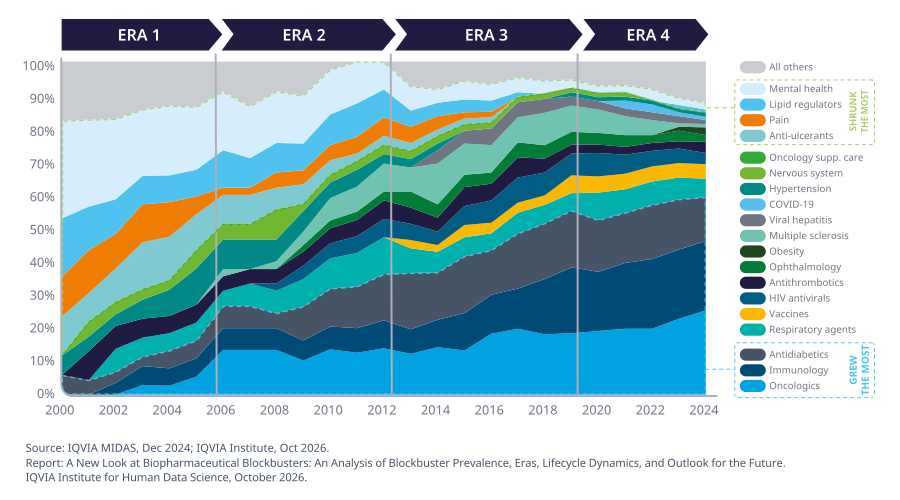
Exhibit 8: Share of blockbuster drugs by therapy area, year, and era, 2000-2024

  • In the early 2000s, blockbuster portfolios were dominated by large-population primary-care areas such as mental health, lipid regulators, anti-ulcerants, and pain medicines; these therapeutic areas formed much of the foundation of the earlier mass-market blockbuster era.
  • From 2007 to 2020, over the course of the second and third eras, the share of blockbusters represented by immunology therapies increased by a net 12 percentage points from 6% to 18%, antidiabetics increased nine percentage points from 6% to 15%, and oncology increased seven percentage points from 12% to 19%.
  • By 2024, these three therapy areas represented 60% of all blockbusters after representing only 5% in 2000, having become major drivers of blockbuster growth during the specialty blockbuster era (from 2014-2020), supported by rapid innovation, multiple indication expansions, and increasing use of combination regimens.


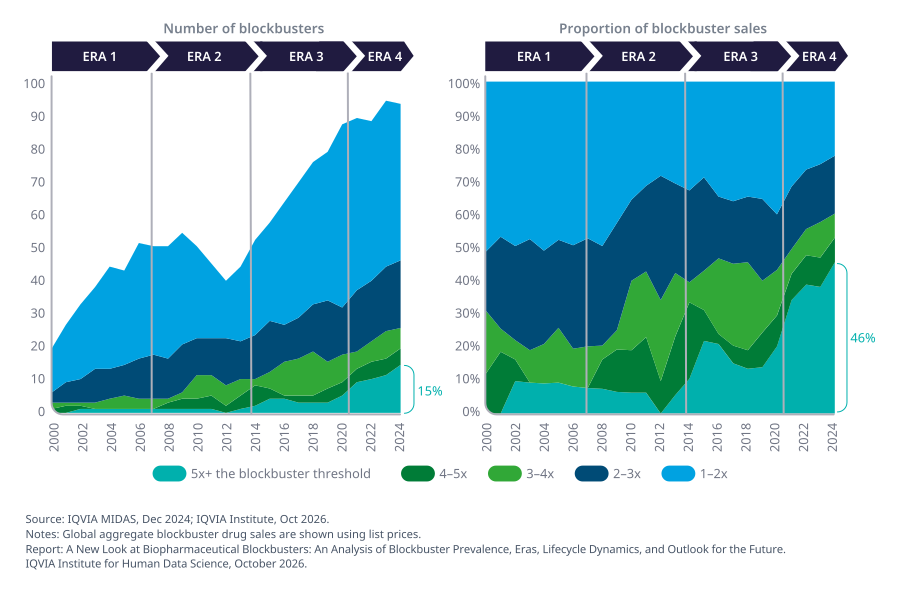
Exhibit 9: Number of blockbusters and proportion of global sales for blockbusters with sales increments of the blockbuster sales threshold by year and era, 2000-2024

  • In the early 2000s, about 70% of blockbusters had sales between one and two times the threshold, and almost none were “mega” blockbusters exceeding five times the threshold ($5Bn in real 1986 dollars).
  • Products with sales of at least three times the threshold became more common in the late 2010s, and their growth accelerated after 2020.
  • By 2024, "mega" blockbusters accounted for 15% of the number of blockbuster medicines but generated 46% of blockbuster sales, with annual sales ranging from about 6.4 to 18.9 times the threshold.
  • Recent growth in blockbuster sales reflects both a larger number of blockbusters and the outsized performance of a small group of medicines.

Related solutions