














340B Drug Discount Program
Explore the state-by-state impact of 340B costs
This is the second article in a three-part series calculating the size of 340B/Medicare Maximum Fair Price (MFP) duplicate discounts. It presents the underlying data, methodology, and findings that support the study’s conclusion that those duplicates will involve billions in 2027 alone, substantially outweighing the costs of the Pilot.
After years of concerns about duplicate discounts and diversion in the 340B program from multiple government analysts, HRSA has adopted a rebate model because it is concerned that MFP/340B duplicate discounts pose a substantial risk. The Inflation Reduction Act does not permit manufacturers to be required to pay MFP/340B duplicate discounts.
The calculation of MFP/340B duplicate discounts depends, in turn, on several factors. Those factors include the negotiation cycles in question, whether drugs subject to MFP in a year remain subject to MFP in a subsequent year, and the point in time at which drug prices are determined.
The current study uses three related analytical frames to estimate potential MFP/340B duplicate discounts:
The calculations were performed using three different sets of drug prices: (1) 2025 average prices, which predate list price decreases that some manufacturers took as MFP was approaching and being implemented, (2) Q2 2026 prices, which reflect changes to list prices but not associated changes in 340B prices, and (3) July 2026 prices, which reflect changes to both list prices and associated changes in 340B prices.
Implementation costs for the Pilot were determined based on inputs identified by HRSA and a discussion of those inputs by the agency. This permits us to compare the size of the duplicate discounts to the Pilot’s implementation costs.
This study utilized a combination of IQVIA proprietary data sources, including Longitudinal Access and Adjudication Dataset (LAAD) for pharmacy claims, subnational sales database (subsequently referred to as “DDD”), and 340B eligibility scores.
LAAD is a national sample of pharmacy claims that includes details about patient cost-sharing as well as plan and payer information. Specifically, the payer element is used to identify commercial, Medicare Part D, Medicaid fee-for-service (FFS), and Medicaid managed care utilization. While physician-administered drugs are subject to 340B prices and will be subject to MFP beginning on January 1, 2028, those Part B drugs were not included in this study.
DDD captures wholesaler sell-in data to pharmacies, hospitals, and clinics. It also captures both Wholesale Acquisition Cost (WAC), or list price, and 340B pricing for drugs in scope. 340B eligibility scores estimate the likelihood of a prescription being 340B-eligible by integrating 340B covered entity and contract pharmacy participation data with physician affiliation data. A detailed methodological walkthrough of the analysis is provided in Methods.
To quantify the magnitude of MFP/340B duplicate discounts, the LAAD sample was used to identify Medicare Part D pharmacy claims, while DDD was used to source unit-level WAC, or list price, and 340B prices for branded drugs. For each branded claim, we calculated the 340B discount for the quantity dispensed as the starting point for estimating the duplicate discount.
A central methodological challenge is that 340B status is not typically reported at the claim level. To address this, IQVIA 340B eligibility scores, which are a proprietary probabilistic model that estimates the likelihood that any given claim was dispensed under 340B, were used. A full description of the model can be found elsewhere,2 but in brief, the mechanism is based on the prescribing provider's affiliation with a covered entity, the dispensing pharmacy's contract pharmacy relationships, and other features. The data accessed does not contain protected health information. The expected 340B duplicate discount is the product of the eligibility score and the per-claim 340B discount, aggregated across Medicare Part D claims.
Our findings may underestimate the true magnitude of MFP/340B duplicate discounts for several reasons. First, the national prescription and sales samples used in the analysis do not capture all transactions. Second, no attempt was made to account for increases in the Medicare population or associated utilization increases that may occur over time. Third, for the analysis of potential MFP/340B duplicate discounts beyond 2026 and 2027, no attempt was made to account for Medicare Part B drugs. As noted above, Medicare Part B drugs will be subject to price negotiation beginning January 1, 2028. Fourth, while the data collected in the Pilot has the potential to support estimates of Medicaid FFS duplicate discounts, Medicaid managed care duplicate discounts, and diversion of 340B drugs, no such estimates have been attempted here. Fifth, no attempt was made to estimate the extent to which Medicare Part D or Medicare Part B inflation rebates may be excessive. The government can require the payment of rebates by manufacturers of Medicare Part D and Part B drugs where drug prices grow faster than the rate of inflation. Inflation rebates are not permitted, however, on 340B drugs.
Conversely, several factors could cause actual future MFP/340B duplicate discounts to be lower than our estimates. First, list price decreases tend to raise the 340B price after a six-month lag under the applicable price-reporting and price-setting rules. Given the timing of this study, potential 340B price increases resulting from list price decreases may not yet have been fully realized. Second, additional list price reductions may occur in the future. Third, some additional drugs may not be subject to MFP because they become subject to generic or biosimilar competition, which has occurred with respect to several of the drugs subject to MFP in 2026. Fourth, with respect to the analysis of all Part D drugs, some orphan products are separately excluded from MFP. Finally, regarding that same part of this analysis, 340B discounts may exceed the MFP in some cases, meaning that a portion of a 340B discount is correctly owed on some MFP drugs.
MFP/340B duplicate discounts across Medicare Part D
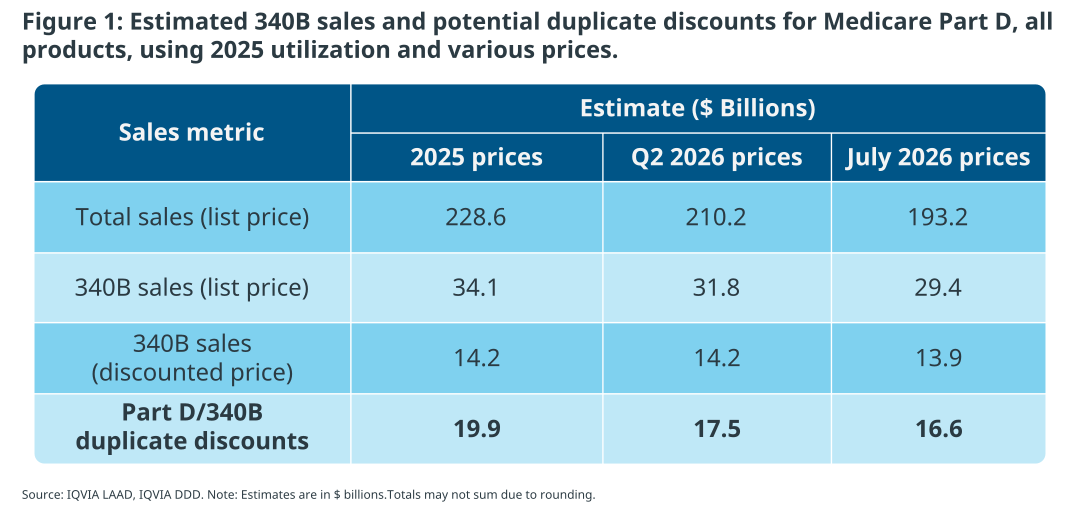
Using 2025 utilization and pricing, the total value of 340B sales for Part D reimbursed drugs at the discounted 340B price was $14.2 billion, while the list price of those Part D reimbursed 340B drugs, a measure of their reimbursement value, was $34.1 billion. The difference between these two values yielded 340B discounts of $19.9 billion. This is a measure of the total potential MFP/340B duplicate discounts that may occur as negotiated prices extend to an increasing share of Medicare Part D spending. By 2036, as many as 180 drugs will be subject to MFP, reflecting the vast majority of Medicare Part D and Part B drug expenditures.
To provide a refined analysis of the Part D portion of potential MFP/340B duplicate discounts over time, the Part D estimate provided above was recalculated using the reduced Q2 2026 list prices and July 2026 list prices. That analysis yielded potential MFP/340B Part D duplicate discounts of $17.5 billion and $16.6 billion, respectively.
Results are summarized in Figure 1.
Duplicate discounts for the first 25 MFP drugs
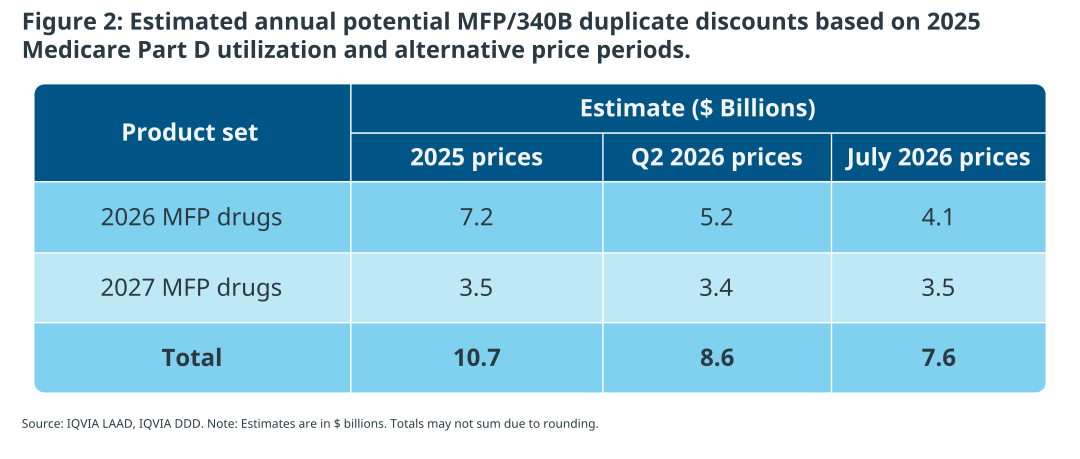
When potential duplicate discounts for each 2026 and 2027 MFP drug were examined during their first year subject to MFP, using 2025 list prices, estimated MFP/340B duplicate discounts were $7.2 billion for the first 10 drugs in 2026 and $3.5 billion for the next 15 drugs in 2027. The combined potential MFP/340B duplicate discounts for those 25 drugs in the first year that each drug was subject to MFP was $10.7 billion.
Given the list price reductions, however, we adjusted our model to reflect Q2 2026 and then July 2026 list prices. Applying Q2 2026 list prices, MFP/340B duplicate discounts for the first 10 drugs in 2026 were estimated to be $5.2 billion, the next 15 drugs in 2027 were $3.4 billion, and the combined impact was $8.6 billion. Applying July 2026 prices, MFP/340B duplicate discounts for the first 10 drugs were estimated to be $4.1 billion for 2026, the next 15 drugs were $3.5 billion for 2027, and the combined impact was $7.6 billion.
These findings are summarized in Figure 2.
Estimated duplicate discounts for drugs subject to MFP in 2027
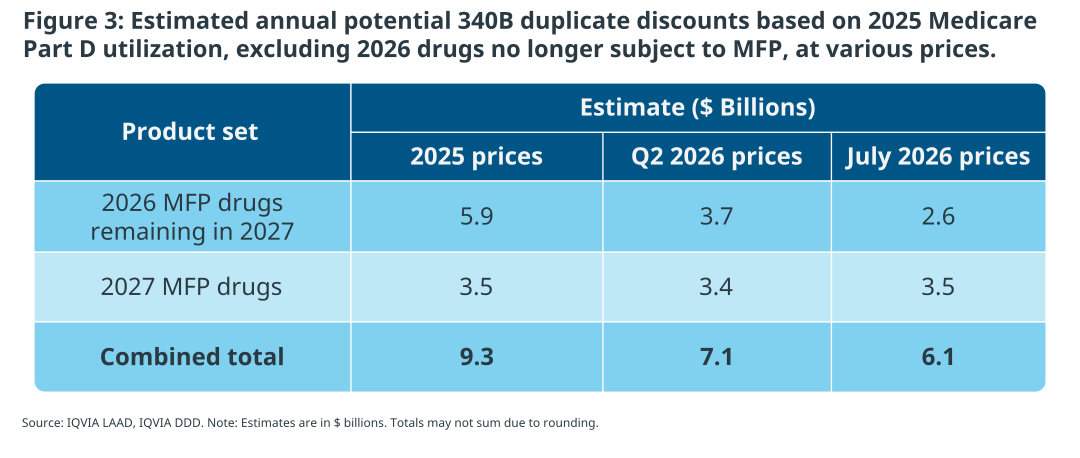
The analysis was further refined by considering the impact, in 2027, of the exclusion of some of the 2026 MFP drugs that became subject to generic or biosimilar competition. Those drugs are Stelara, Entresto, Xarelto, and NovoLog/Fiasp. Because those drugs will no longer be reimbursed at MFP beginning January 1, 2027, we analyzed the MFP/340B duplicate discounts for the remaining 2026 drugs and the 2027 drugs to determine the combined MFP/340B duplicate discounts for 2027.
The analysis showed that MFP/340B duplicate discounts for the remaining 2026 MFP drugs in 2027 were estimated to be $5.9 billion at 2025 list prices, $3.7 billion at Q2 2026 list prices, and $2.6 billion at July 2026 list prices. When those calculations were combined with the 2027 MFP/340B duplicate discounts shown in Figure 2 for the 2027 MFP drugs, the combined MFP/340B duplicate discounts for 2027 were $9.3 billion at 2025 list prices, $7.1 billion at Q2 2026 list prices, and $6.1 billion at July 2026 list prices.
The combined results for 2027 are reflected in Figure 3.
Estimated Pilot implementation costs
HRSA found the implementation costs for the Pilot to be “low” and “negligible”.1(pp48,894, 49,001) HRSA cited multiple reasons for this finding. As the agency found, 340B covered entities already collect even more extensive data than is required under the Pilot. Further, they already transmit that data to multiple parties. In addition, technology will limit Pilot-related costs. We sought to quantify the implementation costs based on HRSA’s identified inputs. For example, HRSA found that the incremental administrative and operational costs for more than 15,000 covered entities were $523 million.1(pp48,893) This equates to approximately $34,320 per covered entity.
HRSA also discussed the incremental interest costs that would be associated with buying initially at a list price under the Pilot. In discussing those costs, HRSA spoke approvingly of a prior analysis of rebate interest costs that our group completed.3 HRSA stated that, even under “unfavorable assumptions”, interest costs in that model would be less than 1.2% of list price.1(pp48,901)
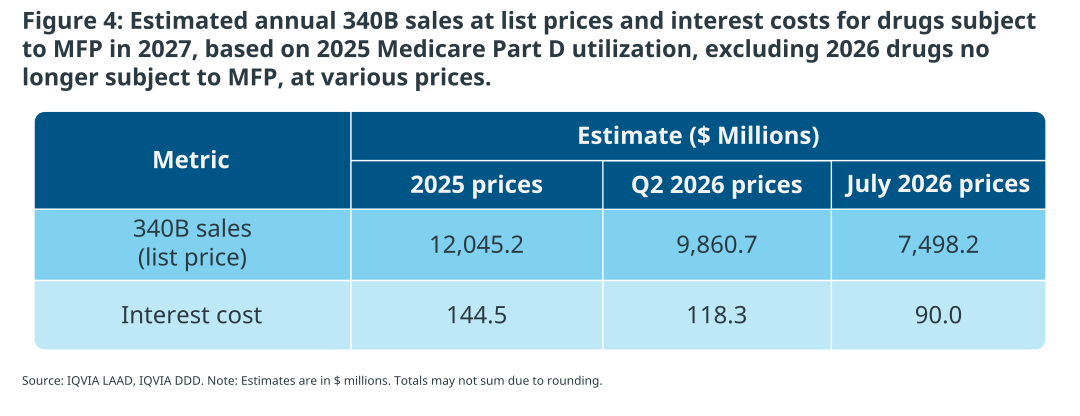
To calculate a conservative interest cost associated with the list price value of the drugs in the Pilot, we examined those list price values. The list price value of the 2026 drugs included in the Pilot in 2027, combined with the list price value of the 2027 drugs, is $12.0 billion at 2025 list prices, $9.9 billion at Q2 2026 prices, and $7.5 billion at July 2026 prices. Applying the conservative 1.2% that reflects “unfavorable assumptions” to those list prices, the resulting interest costs are $144.5 million at 2025 list prices, $118.3 million at Q2 2026 prices, and $90.0 million at July 2026 prices.
Taking HRSA’s calculation of $523 million in administrative and operational costs and adding the highest value of the three calculated interest cost figures we analyzed, the combined implementation costs for the Pilot in 2027 are $667 million. This produces a conservative estimate of the costs to implement the Pilot. This estimate is conservative, in part, because the reduction in list prices means that covered entities will pay substantially lower prices for MFP drugs as an initial matter.
Our results are summarized in Figure 4.
Across each analytical frame, the reduced 2026 list prices lower the estimated value of potential MFP/340B duplicate discounts. Even after those reductions, the estimates identify substantial potential exposure across the broader Part D market, the first 25 drugs subject to MFP, and the adjusted set of drugs remaining under MFP in calendar year 2027. Across all analyses, estimated potential MFP/340B duplicate discounts were at least nine times the estimated Pilot implementation costs.
The third and final installment in this series examines the implications of these findings, including the effect of list price reductions, comparisons with prior estimates, and the use of Pilot data to address other types of duplicate discounts and diversion.
Health Resources and Services Administration. Notice Regarding 340B Rebate Model Pilot Program. Federal Register, 91 Fed. Reg. 48,883. August 3, 2026.
Martin R and Illich K. Are discounts in the 340B program being shared with patients at contract pharmacies? IQVIA. 2022.
Sun C, Zeng S, Sarraille W, and Martin R. How will a rebate model impact cash flow in the 340B drug pricing program? IQVIA. 2025.
We thank Kenneth Finegold, Kimberly Westrich, Yevgeniy Feyman, Jeanna Haw, and Luke Greenwalt for suggestions on an earlier draft.
This study was supported by the National Pharmaceutical Council, which reviewed the manuscript and provided feedback, but had no role in data collection, analysis, or the decision to publish. Full editorial control was retained by IQVIA.
Learn More
Part 1 of 3: Understanding the scale of duplicate discounts and the role of the 340B rebate model Pilot
Part 3 of 3: What the findings reveal about the Pilot and the broader challenge of duplicate discounts
Related solutions
Explore the state-by-state impact of 340B costs
Leapfrog the competition by proving the value of your products