
.svg)




IQVIA OneKey
Enable precise HCP targeting across dimensions like channels, timing, and messaging with industry-leading data and marketing services.












Agentic AI is moving quickly into life sciences workflows, but speed is not the same as trust. An agent can reason, plan and execute faster than a human team, yet its value depends on whether the answer holds up when the decision matters. In commercial life sciences, where a recommendation can shape launch strategy or a multimillion-dollar licensing decision, agentic AI can scale only as safely as the data on which it’s built.
Most organizations exploring agentic AI are focused on workflows: automating tasks, reducing manual effort and accelerating reporting. Those gains are real, and they often provide the first proof points for adoption.1 But as organizations grow more comfortable with agentic AI, they begin asking agents to support decisions that carry real consequence. At that point, the conversation shifts from capability to trust.
For commercial teams, trust matters as much as speed. When a brand team asks where to focus investment or whether to pursue a licensing opportunity, it is relying on the quality of the information behind the recommendation. An agent’s value rests not only on its reasoning but on the accuracy and relevance of the data it uses.
Foundation models have made remarkable progress in reasoning and language understanding, yet even the most advanced systems struggle when reliable, domain-specific data is limited or fragmented. OpenAI’s HealthBench, developed with input from 262 physicians across 60 countries, found that even the strongest models achieved only partial alignment with physician-defined evaluation criteria.2 The advances are real, but they do not remove the need for a trusted data foundation.
The implication is clear: Agentic AI creates the greatest value when advanced reasoning is paired with continuously validated, domain-specific data. Without that foundation, confidence in the answer breaks down no matter how capable the model.
Most commercial decisions come down to customers. Which healthcare professionals should be prioritized? Which experts shape the conversation in a therapeutic area? As organizations look to agentic AI to answer these questions and support personalized engagement, the need for trust grows sharper.
Unlike broad commercial insights, personalized engagement requires AI to understand individuals. An agent must distinguish one healthcare professional from another, connect signals across multiple sources and maintain an accurate view as careers, affiliations and interests evolve. Recommendation quality depends not only on the model’s reasoning but on whether the underlying identity is correct.
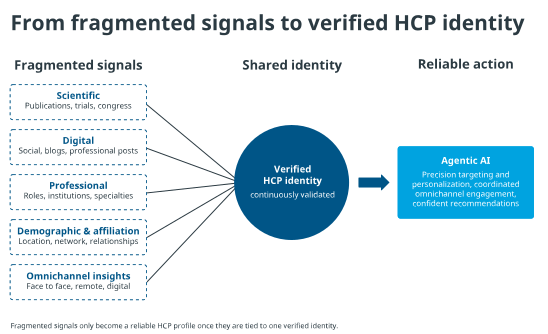
A healthcare professional’s digital footprint rarely aligns on its own. A PubMed record may list an institutional affiliation from years ago. A conference biography may use a nickname rather than a full legal name. A social post may reference a specialty that was never formally verified. Each source is a valuable signal; none is a reliable representation on its own.
General-purpose AI models tend to struggle here. Ask a generalist model to build a profile from a name and a publication, and it will do exactly what it was designed to do: search, synthesize and summarize. The result may look convincing, but it can easily merge information from several individuals who share a name or a professional background. Resolving that ambiguity takes identity resolution: the continuous reconciliation of scientific, professional and digital data into a single profile that stays accurate over time.
Achieving that at scale requires a persistent identity framework that can continuously connect and validate signals across sources as they evolve.
That reconciliation cannot be a one-time exercise. An HCP’s scientific footprint, including publications, clinical trials and conference activity, evolves gradually, while digital activity surfaces new signals about interests and affiliations far more quickly. Bringing both together produces a profile that reflects not only who an HCP is but how their focus is changing.
To support personalized engagement, an agent needs more than access to data. It needs confidence that every signal and attribute belongs to the right healthcare professional. Without that, even accurate information produces inaccurate recommendations.
This is where a persistent identity becomes essential. When every piece of information traces back to a verified individual, fragmented data becomes a connected profile, and an agent no longer has to guess whether two records refer to one person or two.
A persistent identity such as a OneKey ID serves as that foundation. It creates a consistent link between scientific, professional and digital signals, allowing agents to combine information confidently and stay accurate over time. Rather than being misled by fragmented data, agents can use those signals to support more relevant, more personalized engagement (Figure 1).
Many organizations are working toward a long-term vision in which AI platforms, agents and enterprise data are seamlessly connected. That vision takes significant investment and a multiyear roadmap, yet business needs do not pause while the architecture is built. Launches must be planned and engagement strategies refined using the information available today.
Organizations do not need to wait for a fully integrated AI ecosystem to realize value from agentic AI. Solutions built on trusted, already connected HCP and HCO data let teams answer complex commercial questions immediately while fitting into broader transformation plans over time.
IQVIA OneKey Agent is built on that principle. It works directly against OneKey HCP and HCO reference data, so identity resolution and validation are already in place rather than assembled after the fact. When trusted identity and validated data are already embedded in the solution, teams spend less time assembling and reconciling sources and more time interpreting the insight and acting on it.
The impact can be substantial. In one customer engagement, a biopharma team ran an extended research effort to prioritize specialties for a disease launch, only to find later that an important specialty had been missed. An agent working from connected, validated data surfaces those signals faster and more completely.
Organizations should not have to choose between generating value today and building for tomorrow. The stronger approach is to start on a trusted data foundation that meets immediate needs and leaves room to expand.
Agentic AI will keep improving, and stronger reasoning will reach every workflow it touches. But the launch strategy and the licensing decision still turn on whether the agent knew exactly whose record it was reading. In life sciences, verified identity is what separates an answer a commercial team can act on from one that only looks right.
1 Shankar R. From AI pilots to real impact: transforming life sciences workflows with agentic AI. IQVIA Blog. 2026 May 18.
2 Arora RK, Wei J, Hicks RS, Bowman P, Quiñonero-Candela J, Tsimpourlas F, Sharman M, Shah M, Vallone A, Buetel A, Heidecke J, Singhal K. HealthBench: evaluating large language models towards improved human health. OpenAI research paper. 2025 May 13.
Enable precise HCP targeting across dimensions like channels, timing, and messaging with industry-leading data and marketing services.